
How will nuclear fusion companies actually make money?
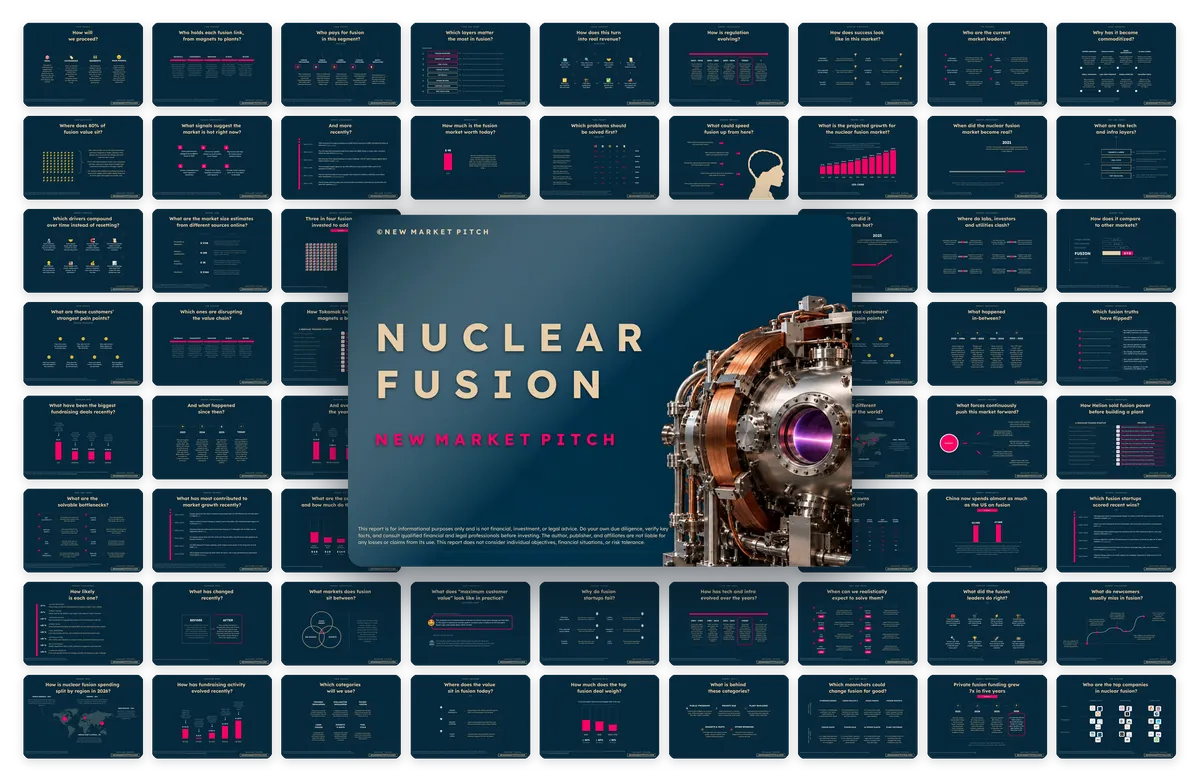
Whether you're building or investing in the nuclear fusion market, our report covers everything you need to know: the players, the money, and what's coming next.
Summary
Nuclear fusion companies will probably make the most money by selling scarce reactor technology and recurring services while utilities and infrastructure investors finance most of the power plants themselves.
Electricity is still the biggest prize. A few hundred megawatts of reliable fusion power could support hundreds of millions of dollars of annual revenue per plant, but owning the asset also means carrying the construction and financing burden.
The industry is already splitting into distinct commercial models. CFS and Helion lean toward power production, General Fusion and Type One toward reactor supply, and TAE toward licensing.
The more capital-light models look easier to scale. An OEM or licensor can potentially deploy the same reactor design across many owners without raising billions of dollars for every new site.
Recurring revenue may become one of the most valuable parts of the business. Maintenance, replacement components, diagnostics, engineering support and software can keep generating income long after the original reactor is installed.
Fusion companies do not necessarily have to wait for commercial power to make money. Tokamak Energy is commercializing superconducting magnets, Marvel Fusion has spun out laser technology, and TAE already operates adjacent power and medical businesses.
AI data centers are unusually important early customers because they value dependable electricity and are facing rapidly rising power demand. That can give first-generation fusion plants room to charge more than mature commodity generation technologies.
The biggest commercial risk may not be fuel cost. Construction overruns, expensive financing, maintenance cycles and poor plant availability can destroy the economics even if the underlying fusion physics works.
The first successful reactor will not by itself create a huge company. The real industrial breakthrough is repetition: reactor number twenty needs to be cheaper, faster and easier to finance than reactor number two.
The strongest current model therefore looks hybrid: keep control of the difficult fusion-specific technology, avoid owning every plant, add recurring service revenue, and monetize useful spin-off technologies while the commercial fleet is still small.

Written by the New Market Pitch teamWe track new markets so founders and investors can move faster. About us

A good product starts with a real problem. In our report covering the nuclear fusion market, we show you the ones customers still live with.
Why are fusion companies looking for customers before they can sell fusion power?
Fusion companies are already signing customers because the industry is moving from proving the science to figuring out who will actually pay for the first commercial plants.
That shift has become much easier to see lately. According to the Fusion Industry Association's latest global industry survey, 56 private fusion companies raised $4.48 billion over the latest twelve-month reporting period, 69% more than the previous year. Total funding reported through the survey has now reached $14.24 billion, and the sector employs more than 16,000 people.
The type of money entering fusion is changing too. Commonwealth Fusion Systems recently raised another $1 billion, taking its total capital raised to about $4 billion. Its investor base now includes pension funds, sovereign wealth funds and industrial groups such as Hyundai, which is already discussing possible collaboration around future ARC plants. General Fusion and TAE Technologies, meanwhile, have filed detailed public-market documents that explain how they expect to make money if their reactors reach commercialization.
The industry is therefore being forced to answer questions that research projects can postpone. Who owns the reactor? Who finances the plant? Who sells the electricity? Does the fusion developer manufacture the entire machine or license the design? Who replaces expensive components twenty years later?
Those decisions are starting to separate fusion companies that once looked broadly similar.
What will fusion companies actually sell?
Fusion companies currently have four serious ways to make money: electricity, complete fusion machines, reactor licenses and technologies developed while building the reactor.
These models can produce very different companies.
Commonwealth Fusion Systems currently intends to finance, build, own and operate its first ARC power plant. Helion also looks closer to a power producer because its commercial agreements revolve around delivering electricity from Helion plants.
Type One Energy is taking another route. The company describes itself as a technology provider and original equipment manufacturer, leaving utilities and infrastructure partners much closer to the eventual ownership of the plant.
General Fusion has now laid out an especially clear OEM model in its public filings. It plans to sell, engineer, install and commission its Fusion Island while an engineering, procurement and construction partner handles the wider plant. Utilities, energy companies or infrastructure investors would finance and operate the asset.
TAE Technologies goes even lighter. Its latest SEC filing says its primary commercial fusion product is expected to be intellectual-property licenses for reactor construction and operation, followed by engineering support, maintenance and software-related revenue.
Then there are companies making money from the technologies surrounding fusion. Tokamak Energy sells high-temperature superconducting expertise. Marvel Fusion has created a separate laser company. TAE already operates non-fusion businesses in power electronics and cancer treatment.
The label "fusion company" therefore hides several completely different business models.
| Fusion business model | What the company sells | Who finances the power plant | Main attraction |
|---|---|---|---|
| Power producer | Electricity | Fusion company/project investors | Keeps long-term power revenue |
| Reactor OEM | Fusion machine and installation | Utility or infrastructure owner | Less capital than owning plants |
| Technology licensor | Reactor design and IP | Licensee | Very scalable if the design wins |
| Services company | Maintenance and replacement equipment | Plant owner | Recurring revenue |
| Component supplier | Magnets, lasers, electronics | Industrial customers | Revenue can start before fusion |
| Hybrid model | Several of these products | Shared | More ways to monetize the technology |

If you build or invest in the nuclear fusion market, you need to know which business models pay off now and which ones are fading. That's why our report covering it has a whole section on it.
Will fusion companies mainly make money by selling electricity?
Electricity should become the biggest fusion revenue pool if the technology works, although many reactor developers will probably choose not to own the power plants themselves.
The clearest current examples are Commonwealth Fusion Systems and Helion.
CFS plans a roughly 400 MW ARC plant in Virginia and says it intends to own and operate the first facility. Google has agreed to purchase 200 MW from that plant, while Eni has signed a separate power agreement that CFS values at more than $1 billion.
Helion has an agreement with Microsoft built around supplying at least 50 MW from its Orion project. It is also working with Nucor toward a much larger 500 MW fusion facility for steelmaking operations.
These contracts show why electricity is so attractive. A successful plant can keep earning money every hour it operates instead of creating one large payment when the reactor is delivered.
The revenue becomes substantial surprisingly quickly. A 400 MW plant running at a 90% capacity factor would produce about 3.15 million MWh each year. At an average realized electricity price of $100 per MWh, annual revenue would be roughly $315 million. At $150 per MWh, it would approach $473 million.
Those prices are illustrations rather than forecasts because the commercial terms of most fusion power agreements remain private. The calculation simply shows the scale: a few hundred megawatts can support a business worth several hundred million dollars a year per plant.
The harder problem is keeping enough of that revenue after construction costs, financing and maintenance.
If you want more recent data on this point, please see our latest nuclear fusion market report.
Why are AI data centers becoming such important customers for fusion power?
AI data centers are becoming natural early fusion customers because they need huge amounts of reliable electricity and are increasingly struggling to find enough of it.
EPRI's latest U.S. analysis estimates that data centers could consume 9% to 17% of American electricity by 2030, up from roughly 4% to 5% today. Its updated projection is about 60% higher than its previous range because announced data-center capacity has grown so quickly.
The same pressure exists globally. The International Energy Agency expects electricity used by data centers to rise from around 460 TWh in 2024 to more than 1,000 TWh in 2030.
That creates a buyer that looks very different from a normal household electricity customer. A hyperscaler building a multibillion-dollar AI campus cares about price, but it also cares deeply about whether hundreds of megawatts are actually available at the right location and whether that power can run continuously.
That helps explain Google's 200 MW commitment to CFS and Microsoft's Helion agreement. The same technology companies are also signing deals with advanced fission developers, which tells us something useful: their interest in fusion comes from a wider search for new sources of dependable electricity rather than enthusiasm for one particular reactor design.
The first fusion plants could therefore sell into a market where simply having enough firm power is unusually valuable. They do not necessarily need to beat solar or natural gas on pure generation cost from day one.

Learning from others' mistakes is the cheapest lesson there is. In our market report about nuclear fusion, we look at what broke startups before you, so you don't repeat it.
Will fusion startups really want to own billion-dollar power plants?
Most fusion companies probably will not want to finance and own every reactor they deploy because doing so would make capital, rather than technology, the main limit on growth.
CFS is currently willing to take that risk with its first ARC plant. The company wants direct exposure to the electricity revenue and believes it can assemble the capital needed to build and operate the asset.
General Fusion is deliberately avoiding that model. Its recent SEC filing describes what it calls an asset-light OEM strategy. The company expects each Fusion Island to produce about 150 MW net, with two units forming a reference 300 MW power plant. General Fusion would concentrate on the fusion machine while another company manages the wider plant construction and the plant owner provides the capital.
Type One Energy is moving in a similar direction with TVA and AECOM. Type One supplies the stellarator technology, TVA brings utility experience and AECOM contributes engineering and construction expertise.
TAE's licensing strategy pushes the idea even further. TAE expects customers to finance reactor construction while it earns a large licensing payment around the start of each project and then recurring revenue from operations, maintenance and potentially software upgrades.
This division of labor looks increasingly logical. Fusion startups are unusually good at plasma physics, magnets, lasers and reactor engineering. Utilities and infrastructure investors are much better at financing and operating power stations.
If you want more recent data on this point, please see our latest nuclear fusion market report.
Could selling fusion reactors be better than selling fusion electricity?
Selling fusion reactors could become the cleaner business because the developer gets paid for scarce technology without having to finance decades of electricity production.
General Fusion gives us the clearest current blueprint.
Its proposed 300 MW plant would contain two 150 MW Fusion Islands supplied by General Fusion. The company expects to earn money from engineering, equipment sales, installation and commissioning while an EPC partner builds the rest of the facility.
Type One Energy is also positioning Infinity Two as a product that utilities could eventually deploy rather than as the beginning of a giant Type One-owned power fleet.
That structure makes expansion much easier. A company owning ten multibillion-dollar plants needs to finance ten multibillion-dollar assets. An OEM supplying the reactor core for ten projects needs factories, engineers and working capital, but most of the project debt can sit elsewhere.
Power equipment companies have worked this way for decades. Gas-turbine manufacturers do not normally need to own every power plant using their machines.
Fusion could eventually follow the same pattern, especially if reactor designs become standardized enough to manufacture repeatedly.

When you build or invest in the nuclear fusion market, you need clarity, not confusion. In our document detailing everything you need to know about nuclear fusion, we always try to put numbers on and quantify whatever is usually vague and confusing.
Could fusion companies simply license their reactor designs?
Fusion licensing could become one of the highest-margin business models in the sector, but today TAE is the clearest major developer betting heavily on it.
TAE's recent SEC filing is unusually specific. The company says it currently does not intend to sell utility-scale electricity directly to end users. Its primary fusion product is expected to be intellectual-property licenses that allow other companies to construct and operate TAE-designed reactors.
The license would create a large upfront revenue event when construction begins. TAE then expects additional income from engineering, manufacturing support, operations, maintenance and software upgrades.
The attraction is easy to understand. If a utility wants another plant, TAE would not need to raise the full construction budget itself. That could allow one successful reactor design to spread much faster across multiple owners and countries.
There is a big condition attached to this model: customers need to trust the design enough to spend billions building it.
That makes licensing extremely scalable after commercial validation and extremely difficult before it. Nobody wants to license a reactor design that has not yet proven it can produce economical electricity.
If you want more recent data on this point, please see our latest nuclear fusion market report.
Can fusion companies make money before commercial reactors exist?
Some fusion companies are already creating revenue streams that do not depend on waiting for the first commercial fusion plant.
Tokamak Energy is probably the strongest example right now. The company created TE Magnetics to commercialize the high-temperature superconducting magnet technology originally developed for its tokamak program.
Those magnets have applications outside fusion, including data centers, life sciences, propulsion, motors and power systems. The business has become concrete enough that UK Fusion Energy awarded Tokamak Energy a £70 million contract to work on magnet systems for the STEP fusion program through 2029.
Tokamak Energy has also acquired Ridgway Machines, an industrial manufacturer whose equipment has been supplied to more than 2,000 customers across more than 100 countries. That gives the company something most fusion startups lack: an existing manufacturing business with customers outside the fusion sector.
Marvel Fusion has taken a similar step lately. It launched Caelora as a wholly owned subsidiary to commercialize high-energy laser systems. Those lasers are being developed for fusion, scientific research, medical applications, industrial uses and security.
TAE has been doing this for longer. TAE Power Solutions works on power-management systems, while TAE Life Sciences applies accelerator technology to cancer treatment.
These businesses will not necessarily become larger than fusion itself. They do make the companies less dependent on one distant commercial milestone.

In our report covering the nuclear fusion market, we look at what the winners do differently, so you can learn from the best instead of guessing.
Is government money part of the fusion business model?
Government funding is currently a major source of fusion capital, but a company relying permanently on grants has not built a commercial fusion business.
Public money is most useful for paying part of the cost of getting from laboratory hardware to something private customers are willing to finance.
The U.S. Department of Energy's Milestone-Based Fusion Development Program is designed around that idea. Companies receive support after hitting independently reviewed milestones, while private capital still funds a large share of the work.
Europe is moving in a similar direction through national programs, research institutions and public-private projects. Proxima Fusion, for example, is developing its commercial stellarator plans alongside RWE, the Max Planck Institute for Plasma Physics and the state of Bavaria.
Government participation can lower technology risk, help create supply chains and make the first plant easier to finance. Regulation is also starting to adapt to commercial deployment. In the United States, the Nuclear Regulatory Commission recently published a proposed fusion-specific regulatory framework and is separately studying how rules could support mass-produced fusion machines.
That is commercially valuable because years of regulatory delay translate directly into financing costs.
The real transition comes when customer payments grow faster than government development funding. That is when fusion starts behaving like an energy industry.
Will the first commercial fusion plants actually make money?
The first fusion plants could sell plenty of electricity and still struggle to earn attractive profits because the cost of building and maintaining them remains the biggest unknown.
A recent techno-economic analysis of a 350 MW magnetic-confinement plant estimated electricity costs anywhere from roughly $140 to $550 per MWh depending on assumptions about plant design, manufacturing and regulation.
That is an enormous range. Its width is more informative today than the midpoint.
At the low end, fusion could eventually compete for premium clean power markets and perhaps broader wholesale electricity. At the high end, the economics become extremely difficult outside specialized customers willing to pay unusually high prices.
The first plants will also carry costs that later reactors should avoid. Engineers will still be learning construction sequences. Suppliers will be producing specialized parts in small volumes. Lenders will demand large risk premiums. Maintenance schedules will be uncertain.
Proving fusion in a machine and building a profitable fusion company are two separate challenges.
Investors will eventually care about much less glamorous numbers than plasma temperature: plant cost per kilowatt, construction time, capacity factor, replacement intervals and financing rates.
If you want more recent data on this point, please see our latest nuclear fusion market report.

Your time is limited. In our research about nuclear fusion, we put numbers on each part of the market, so you can see where it makes sense to focus.
What could make fusion power too expensive?
Construction costs, financing and reactor downtime currently look more dangerous to fusion economics than the price of fusion fuel itself.
A commercial fusion plant needs far more than a plasma chamber. Depending on the design, it can require superconducting magnets, lasers, vacuum systems, power electronics, shielding, specialized materials, heat exchangers, turbines, tritium systems and industrial-scale cooling infrastructure.
The supply chain is already becoming expensive before commercial plants exist. According to the Fusion Industry Association's latest supplier survey, the participating fusion companies spent $538 million with suppliers in 2025, up 24% in a year. They expect that figure to reach about $681 million in 2026. Three-quarters of surveyed suppliers said they had invested in extra fusion capacity.
Manufacturing scale could eventually push those costs down. The opposite happens if every reactor becomes a custom megaproject.
Maintenance could be just as important. Components facing extreme heat and neutron bombardment may need regular replacement, and every long outage cuts the number of megawatt-hours available to pay back the plant.
For a capital-heavy reactor, going from a 90% capacity factor to 60% changes the economics dramatically even if the fusion physics performs exactly as expected.
| Fusion cost problem | Why it affects profits |
|---|---|
| Construction cost | Determines how much capital must be raised |
| Long build times | Increase interest and financing costs |
| Specialized magnets or lasers | Require expensive supply chains |
| Component replacement | Creates recurring maintenance expense |
| Low plant availability | Reduces electricity sold |
| Slow licensing | Keeps capital tied up before revenue starts |
| Small production volumes | Prevent manufacturers from reaching scale |
| Custom plant designs | Make every new project expensive again |
Is tritium going to become a big fusion business?
Tritium will probably create specialized businesses, but for most deuterium-tritium fusion developers it is currently a fuel problem that has to be solved rather than an attractive commodity to sell.
Commercial D-T reactors cannot rely indefinitely on today's external tritium supply. The global inventory is simply too small for a large fleet.
That is why reactor concepts such as CFS's ARC include breeding blankets designed to produce new tritium from lithium using the neutrons created by fusion.
The commercial goal is fuel self-sufficiency. A reactor that needs large quantities of scarce externally produced tritium every year becomes much harder to scale.
That will still create opportunities around tritium extraction, processing, storage, monitoring and fuel-cycle equipment. Suppliers with reliable technology could build valuable businesses around those systems.
But the reactor developer would prefer tritium to behave like an internally replenished input rather than a scarce commodity whose price rises every time another fusion plant opens.

In our market report about nuclear fusion, we always try to gather several sources and make estimates that make sense, so you can work with solid numbers.
Could fusion companies make more money from maintenance than from the original reactor?
Maintenance could become an excellent recurring fusion business because every reactor sold potentially creates decades of service and replacement work.
General Fusion has already written this directly into its commercial model.
After selling and commissioning its Fusion Islands, the company expects ongoing revenue from technical support and the replacement or refurbishment of equipment such as plasma injectors. The plant owner remains responsible for owning and operating the wider facility.
TAE is planning recurring operations and maintenance agreements around its licensed reactor designs as well as possible software upgrades.
The exact economics are impossible to know before commercial reactors operate for years. Different fusion technologies expose components to very different stresses, and nobody currently has enough fleet data to know real-world replacement cycles.
Still, the basic business model is compelling. A reactor vendor that sells hundreds of machines could eventually have hundreds of customers paying for proprietary parts, engineering expertise, diagnostics and software.
That installed base may become more valuable than the margin on the first equipment sale.
Is fusion already creating a real component industry?
Fusion is already creating a meaningful component market, even though commercial fusion electricity still does not exist.
The strongest evidence comes from spending rather than press releases. The Fusion Industry Association's latest supply-chain research found $538 million of reported supplier spending from only around half of private fusion companies, with spending projected to rise another 27% to $681 million this year.
High-temperature superconductors are becoming one important market. CFS has signed large supply agreements for the specialized tape used in its magnets, while Tokamak Energy is selling magnet expertise through TE Magnetics.
High-energy lasers are creating another. As discussed earlier, Marvel Fusion's new Caelora subsidiary was created specifically to turn its laser systems into products for several industries rather than keeping them exclusively inside the fusion program.
The rest of the emerging supply chain includes specialized materials, heat-management systems, vacuum equipment, fuel-cycle technology, diagnostics, robotics and power electronics.
Two fusion economies are now developing at different speeds. Commercial fusion electricity remains a future product, while companies supplying the effort to build fusion reactors can already have paying customers.

In our document detailing everything you need to know about nuclear fusion, we turn what is vague and complex into simple, useful visuals. Market maps like this one show you at a glance where every startup stands.
What do today's fusion power deals actually prove?
Current fusion agreements prove that serious buyers want future fusion power, but they still tell us very little about whether those plants will arrive on time or produce electricity cheaply.
The distinction matters because the market now contains everything from strategic partnerships to development agreements and actual power-purchase commitments.
As seen above, Microsoft has committed to buying at least 50 MW from Helion, while Google has reserved 200 MW from CFS's planned first ARC plant. Those are stronger commercial signals than a company announcing that it has started talking to a utility.
Other relationships are earlier in the process. Type One Energy and TVA have moved into commercial contracts around the Infinity project, but Infinity Two still has to pass several technical and regulatory steps before it becomes a power station. Proxima Fusion's relationship with RWE similarly gives Stellaris a serious industrial partner without yet creating an operating plant.
We should give these agreements credit for what they show: customers are willing to spend money and time positioning themselves for fusion power.
They cannot yet answer the harder questions about construction cost, reliability or plant margins. Only operating reactors can do that.
What will separate a huge fusion company from an impressive science project?
The fusion companies that become huge businesses will need to build the same reactor repeatedly rather than spending another decade engineering each new plant.
Manufacturing is therefore moving closer to the center of the commercial race.
CFS's recent fundraising tells us something about this transition. The company has now raised about $4 billion and says its latest capital is meant to support the path from SPARC toward ARC and eventually a broader fleet of commercial plants. Industrial investors are starting to appear alongside traditional venture investors because the problem increasingly involves factories, supply chains and large-scale construction.
Type One Energy's strategy also depends on turning a stellarator into a product that utilities can deploy repeatedly. General Fusion has designed its commercial structure around standardized Fusion Islands. TAE's licensing model only becomes powerful if multiple customers can build versions of the same underlying reactor.
U.S. regulators are thinking about the same issue. The Nuclear Regulatory Commission has been studying regulatory frameworks that could support mass-produced fusion machines rather than treating every future machine as a completely unrelated project.
Fusion reaches real scale when reactor number twenty becomes easier and cheaper to build than reactor number two.

Our report covering the nuclear fusion market gets updated several times a month, so you always get the latest view of where things stand.
Which fusion business model looks strongest right now?
The strongest fusion business model today looks like a hybrid: sell the scarce reactor technology, let infrastructure investors finance most plants, then collect recurring service revenue while monetizing useful spin-off technology before the fleet reaches scale.
Owning plants can still be extremely valuable. If CFS successfully builds ARC and keeps a large share of its electricity economics, decades of power sales could produce far more revenue per plant than a one-time equipment sale.
The drawback is the capital bill. Every additional company-owned power station requires another large financing package.
Pure licensing solves much of that problem but sits further from proof today. TAE still has to show that customers will commit billions to reactors built around licensed technology.
The OEM approach currently sits in an attractive middle ground. General Fusion and Type One can keep control over the difficult fusion-specific hardware while letting utilities and infrastructure partners handle much of the balance sheet.
Adding maintenance makes that model considerably better because revenue continues after construction.
The companies with commercially useful side technologies have another advantage. Tokamak Energy's magnets, Marvel Fusion's lasers and TAE's power and medical businesses can create revenue even if commercial fusion takes longer than expected.
| Model | Revenue potential | Capital needed | Evidence today | Our current view |
|---|---|---|---|---|
| Own fusion plants | Extremely high | Extremely high | Real PPAs emerging | Powerful but hard to scale |
| Sell reactors | Very high | High | Commercial strategies defined | One of the strongest models |
| License reactor IP | Very high at scale | Relatively low | Clear strategy, little validation | Excellent if technology is proven |
| Maintenance and services | High recurring revenue | Moderate | Already built into several plans | Likely very attractive |
| Sell fusion components | Smaller overall market | Moderate | Revenue opportunities exist now | Strong pre-fusion business |
| Spin out other technologies | Variable | Moderate | Already happening | Useful diversification |
| Depend on government grants | Limited | Low private capital requirement | Common today | Bridge to commercialization, not an end model |
If you want more recent data on this point, please see our latest nuclear fusion market report.
How will nuclear fusion companies actually make money?
Nuclear fusion companies will make money in several different ways, but the most scalable winners will probably sell reactor technology and recurring services while letting utilities and infrastructure investors finance most of the actual power plants.
Electricity remains the largest prize. A successful commercial fusion plant could generate hundreds of millions of dollars of revenue each year, and customers are currently showing real interest in buying that power.
Yet the industry is already moving away from the assumption that every fusion developer must become a giant electricity company.
General Fusion wants to operate as an OEM. Type One Energy wants to become a technology provider. TAE plans to license reactor designs. Tokamak Energy has built a commercial magnet business. Marvel Fusion has just created a separate laser company. CFS is taking a more vertically integrated route and wants to own its first ARC plant.
Those choices will create very different economics.
A company owning reactors can capture more revenue from each plant but needs enormous amounts of capital. A reactor vendor gives up some of that upside in exchange for faster expansion. Licensing can scale even faster if the design becomes trusted. Maintenance adds recurring revenue to both models.
This is where the fusion business story looks much clearer than it did a few years ago. The question is no longer simply whether fusion companies can eventually charge someone for electricity. Several credible ways of making money are already taking shape.
The tougher question now is which company can turn its reactor into something customers can finance, build repeatedly and operate reliably.
Whoever manages that will have more than a fusion breakthrough. It will have a real industrial business.
Our methodology
The commercial future of fusion is still unusually easy to discuss in abstractions. We approached the question by breaking it into the dimensions that will actually determine how money moves through the industry: what companies expect to sell, who finances the plant, who owns the generating asset, where recurring revenue can emerge, which customers are making concrete commitments, how much capital different models require, and which businesses can generate revenue before commercial fusion power exists.
For each dimension, we looked for recent evidence that moved the discussion beyond positioning. We prioritized signed power and offtake agreements, regulatory filings, disclosed commercial structures, customer and industrial partnerships, government programs, supply-chain spending, project specifications and capital commitments.
We also separated different levels of commercial evidence. A signed commitment to buy future electricity carries more weight than a general partnership; a business model described in an SEC filing carries more weight than a broad commercialization statement; and reported supplier spending tells us more about an emerging component market than the number of companies saying they are interested in it.
The comparisons are deliberately commercial rather than technological. Reactor concepts matter, but the central question here is how each company could turn its technology into revenue and how much capital it would have to carry itself to do so. That is why plant ownership, OEM sales, licensing, maintenance and component businesses are compared even when the underlying fusion technologies are very different.
Where economics remain uncertain, we used ranges and simple scenarios rather than pretending first-generation fusion costs can already be forecast precisely. The electricity-revenue examples are scale illustrations, while current techno-economic work is used mainly to identify the variables with the biggest commercial consequences: construction cost, financing, manufacturing assumptions, availability and maintenance.
Our assessment of the strongest business models is not a ranking of which fusion technology will work first. It is a synthesis of the commercial evidence available today, with particular attention to revenue potential, capital intensity, repeatability, recurring revenue opportunities, customer validation and how much of the model can already be observed rather than merely projected.
Key sources include the Fusion Industry Association's global funding data, Commonwealth Fusion Systems on its latest financing, CFS on the Google power agreement, CFS on its Eni power agreement, Helion on its Microsoft power agreement, General Fusion's SEC registration filing, TAE Technologies' SEC filing, Type One Energy on Infinity Two, EPRI's Powering Intelligence 2026 analysis, the IEA's Energy and AI work, the Fusion Industry Association's 2026 supply-chain report, Tokamak Energy on TE Magnetics, Marvel Fusion on Caelora, the U.S. Nuclear Regulatory Commission's fusion rulemaking, and the Applied Energy techno-economic analysis of magnetic-confinement fusion.

In our research about nuclear fusion, we don't want to repeat what boring consulting reports say. Instead, we show you the real and latest market signals that matter.
Written by the New Market Pitch teamWe track new markets so founders and investors can move faster. About us