
How big is the nuclear fusion market before commercial power?
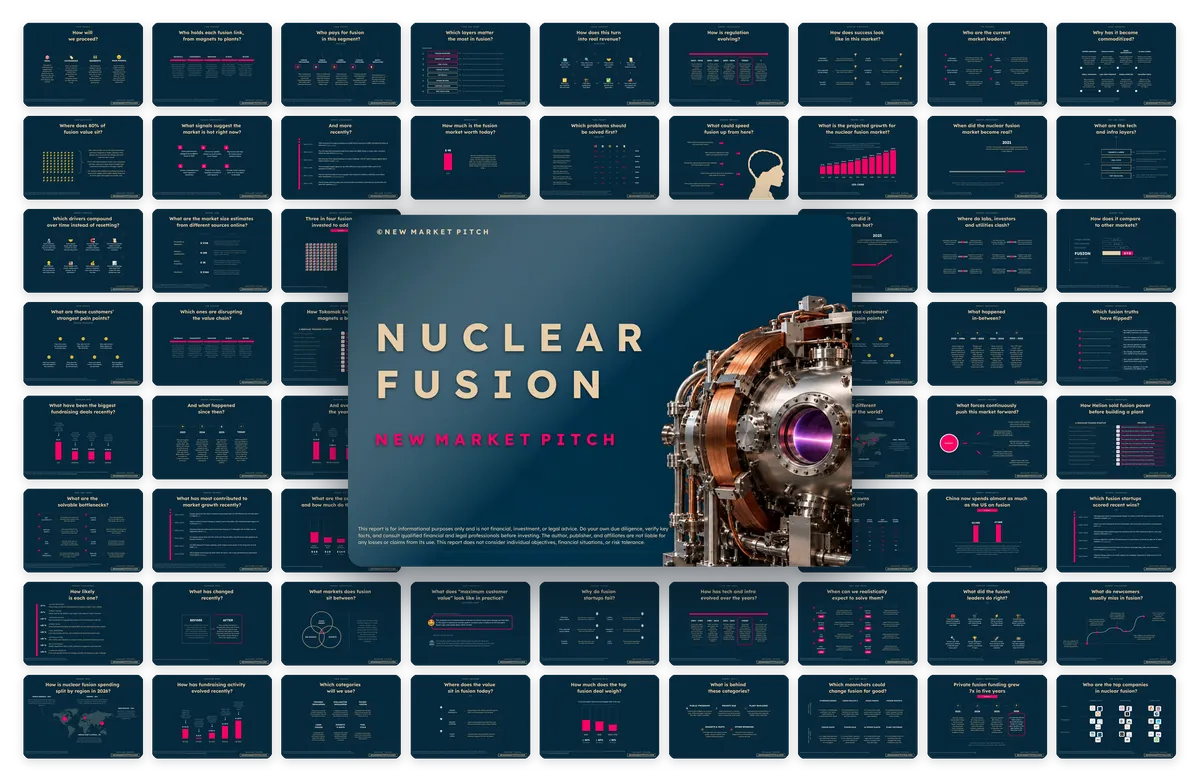
Whether you're building or investing in the nuclear fusion market, our report covers everything you need to know: the players, the money, and what's coming next.
Summary
Nuclear fusion is already roughly an $8 billion to $10 billion annual global economy before commercial power, with about $3 billion to $5 billion behaving like a conventional procurement market for equipment, engineering, construction and services.
The important distinction is between fusion electricity and the fusion industry. Electricity revenue is still essentially zero, but governments and developers are already paying for magnets, vacuum systems, cryogenics, power electronics, materials, buildings, software and engineering.
Private fundraising is large enough to shape the industrial market, but it should not be confused with revenue. Fusion companies raised $4.48 billion in the latest FIA reporting period, giving developers the capital to order hardware and build facilities over the following years.
The cleaner evidence comes from money already reaching suppliers. Twenty-five private developers reported $538 million of supply-chain spending in 2025 and expect $681 million in 2026, despite the survey covering only part of the private fusion industry.
Governments still carry a huge share of the market. The US, China, EU, UK and Japan accounted for more than €20 billion of identified fusion funding between 2022 and 2025, with China especially dependent on direct public spending and the US unusually strong in private capital.
ITER shows why reactor-company revenue alone is a bad way to measure the sector. An experimental machine that will never sell commercial electricity has nevertheless generated roughly €10.7 billion of contracts across thousands of companies.
The supply chain is also changing character. Fusion spending is moving beyond one-off laboratory equipment toward complete industrial systems: high-temperature superconducting magnets, high-power electrical equipment, cooling, vacuum infrastructure, digital engineering, construction and eventually fuel-cycle equipment.
A small number of projects matter far more than the number of fusion startups suggests. CFS, Helion, STEP, ITER and major Chinese facilities can each generate more supplier demand than a long tail of lightly funded developers combined.
Future electricity agreements with Microsoft, Google and Eni do not count as current market revenue, but they can bring current investment forward. A developer with a site, grid application and committed future buyer can raise and spend money earlier than one still trying to prove customer demand.
The market can become much larger before the first serious electricity sales arrive. If even a handful of leading developers move into multi-billion-dollar pilot-plant construction at roughly the same time, annual pre-commercial activity could climb comfortably above $10 billion.
The weak point is still financing. Fusion has enough projects that one failure would not collapse the industry, but several flagship machines missing milestones could weaken investor confidence, delay construction and make suppliers much more cautious about adding dedicated capacity.

Written by the New Market Pitch teamWe track new markets so founders and investors can move faster. About us

Your time is limited. In our report covering the nuclear fusion market, we put numbers on each part of the market, so you can see where it makes sense to focus.
How can nuclear fusion already have a market if nobody is selling fusion electricity?
Nuclear fusion already has a real market today because governments, investors and developers are spending billions to build the machines, components and infrastructure needed before commercial electricity can exist.
The confusion comes from using “fusion market” to describe two very different things. Commercial fusion electricity is still essentially a future market. The industrial economy being built around fusion already exists.
Money currently flows through several channels. Governments finance laboratories, experimental machines and demonstration programs. Investors fund private developers such as Commonwealth Fusion Systems, Helion, TAE Technologies and Proxima Fusion. Those organizations then buy superconducting magnets, vacuum systems, power electronics, cryogenic equipment, lasers, diagnostics, engineering work and construction services.
Large public programs create another layer. ITER has awarded about €10.7 billion of contracts since 2007 through the ITER Organization, Fusion for Energy and Agence Iter France. The UK is putting more than £2.5 billion into fusion over five years. The US enacted $806 million for Fusion Energy Sciences for FY2026. China runs an even larger state-directed fusion program.
How big is the nuclear fusion market today before commercial power?
Our best estimate is that the nuclear fusion economy currently runs at roughly $8 billion to $10 billion a year, while the narrower market for equipment, engineering, construction and other paid procurement is probably closer to $3 billion to $5 billion.
There is no official global market-size figure we can simply quote. We arrived at that range by comparing the largest public programs with the latest private funding and supply-chain data, while avoiding the most obvious double counting.
Fusion for Energy's new Global Fusion Energy Trends study gives us the strongest international baseline. The US, China, EU, UK and Japan together directed more than €20 billion of identifiable public and private funding into fusion between 2022 and 2025. That already works out to more than €5 billion a year across five ecosystems.
The pace has since increased. The Fusion Industry Association's latest survey found $4.48 billion of new funding for private fusion companies over twelve months, the highest annual figure since the survey started. Public spending remains large at the same time. The US enacted $806 million for Fusion Energy Sciences, Fusion for Energy has a 2026 budget slightly above €1 billion, the UK has committed more than £2.5 billion over five years, Germany has earmarked more than €2 billion through 2029, and China's public fusion spending alone was estimated at €5.45 billion over 2022-2025 by Fusion for Energy.
Some government money eventually reaches private companies, and fiscal-year definitions differ. We therefore discount the simple sum rather than pretending every dollar represents separate economic activity. Even after doing that, an annual pre-commercial fusion economy in the high single-digit billions is the most defensible range.
The narrower procurement market is harder to measure. Private developers reported $538 million of supply-chain spending in 2025 from only 25 companies, while public projects such as ITER, STEP and China's fusion facilities add several billion dollars of procurement and engineering activity. That puts the supplier market roughly in the $3 billion to $5 billion range, although our confidence in that number is lower than for the broader funding estimate.
| What we are measuring | Current order of magnitude | What the number includes |
|---|---|---|
| Commercial fusion electricity revenue | Almost zero | Electricity sold by operating commercial fusion plants |
| Private fusion-company funding | $4.48B in latest 12-month FIA period | Capital raised by fusion developers |
| Five major fusion ecosystems | >€20B over 2022-2025 | Public funding, ITER contributions and private capital |
| US Fusion Energy Sciences | $806M FY2026 enacted | Federal fusion research and development |
| Fusion for Energy budget | ~€1.02B in 2026 | ITER and European fusion activities |
| UK fusion commitment | >£2.5B over five years | STEP, R&D facilities, tritium, skills and commercialization |
| Private supply-chain spending reported | $538M in 2025 | Spending reported by 25 developers |
| Private supply-chain spending projected | $681M in 2026 | Projection from the same respondent group |
| Our broad pre-commercial estimate | ~$8B-$10B/year | Current capital formation and fusion-program activity |
| Our narrower procurement estimate | ~$3B-$5B/year | Equipment, engineering, facilities and industrial services |
If you want more recent data on this point, please see our latest nuclear fusion market report.

In our research about nuclear fusion, we always try to gather several sources and make estimates that make sense, so you can work with solid numbers.
Does the $4.48 billion raised by fusion companies count as market size?
We treat the $4.48 billion raised by private fusion companies as capital flowing into the industry, rather than $4.48 billion of fusion revenue.
The difference is important. When Commonwealth Fusion Systems raises money, the financing eventually pays for SPARC, staff, superconducting magnets, facilities and ARC development. Suppliers may turn part of that capital into revenue over several years. The fundraising itself is not a sale.
The latest FIA figure is still useful because its trajectory tells us how much capital the industry can currently attract. Annual new funding was around $900 million in the 2024 survey, climbed to $2.64 billion in 2025 and reached $4.48 billion in the latest twelve-month period.
Even that latest survey became dated quickly. Shortly after the FIA reporting window, Commonwealth Fusion Systems announced another $1 billion equity round, taking its cumulative capital to $4 billion. Hyundai Motor Group has since joined that investor base as CFS starts looking beyond SPARC toward industrial partnerships for future ARC plants.
Annual surveys can therefore lag the industry by several months. The capital pool is moving faster than the yearly datasets.
Funding cannot be counted as revenue, but an industry raising several billion dollars annually has enough capital to create a sizeable procurement market long before its final product reaches customers.
How much are private fusion companies spending with suppliers right now?
Private fusion developers reported $538 million of supply-chain spending in 2025, and the same group expects that figure to reach $681 million in 2026.
Those numbers come from the Fusion Industry Association's latest supply-chain study, based on 25 fusion companies and 67 suppliers. The 2025 figure was up 24% in one year, while the 2026 projection implies another 27% increase.
Coverage is incomplete because only around half of the private fusion companies tracked by FIA provided spending figures. We cannot simply double $681 million: CFS, Helion and other heavily funded developers probably spend far more than many early-stage companies. Still, the survey gives us a clean minimum rather than a hypothetical TAM.
Supplier behavior makes the trend more convincing. Seventy-five percent of the surveyed suppliers said they had invested specifically to increase fusion capacity over the previous year. Individual investments ranged from $30,000 to $65 million. Seventy percent of developers also said they had seen more established suppliers move into fusion.
There is still hesitation. Sixty-nine percent of suppliers say they lack enough visibility into long-term demand to plan confidently. That is pretty much what we would expect in a market sitting between bespoke research equipment and repeatable industrial production.

In our market report about nuclear fusion, we don't want to repeat what boring consulting reports say. Instead, we show you the real and latest market signals that matter.
How much of today's fusion market still depends on governments?
Governments still finance several billion dollars of the fusion economy every year, making public spending one of the largest parts of the market today.
The US provides one of the clearest examples. Congress enacted $806 million for Fusion Energy Sciences for FY2026, up from $790 million the previous year. That covers national facilities, fusion materials, private-sector programs, ITER contributions and other research.
Europe has a similarly large industrial footprint. Fusion for Energy's 2026 budget is about €1.02 billion. Since 2007, F4E says it has invested more than €7 billion through over 1,400 contracts, involving at least 2,700 companies and 75 R&D organizations.
The UK has moved even more explicitly toward industrial policy. Its current five-year fusion package exceeds £2.5 billion. About £1.3 billion goes toward the next STEP phase, including roughly £700 million expected to flow into private construction, engineering and other contracts. Another £740 million supports R&D infrastructure and facilities.
Germany is heading in the same direction. Its federal fusion action plan provides more than €2 billion through 2029 as the country tries to build a domestic ecosystem around both magnetic and laser fusion.
China sits at the other end of the scale. Fusion for Energy calculated €5.45 billion of Chinese public fusion expenditure during 2022-2025, substantially more than any other country in its comparison.
The current fusion market would be dramatically smaller without governments. Private capital is becoming more important, particularly in the US, but public budgets still pay for much of the infrastructure, science and early industrial capacity that private companies use.
If you want more recent data on this point, please see our latest nuclear fusion market report.
Which countries have the biggest nuclear fusion markets right now?
The United States and China currently have the largest fusion ecosystems, although the US leans heavily on private capital while China spends much more directly through the state.
Fusion for Energy compared the US, China, EU, UK and Japan over 2022-2025. The US ranked first with €7.38 billion of identified funding. China followed closely at €6.94 billion. The EU reached €3.34 billion, the UK €1.49 billion and Japan €1.21 billion.
The similarity between the US and Chinese totals hides a major difference. US private investment accounted for €2.41 billion during the period, more than any other ecosystem. China recorded €5.45 billion of public spending, making it by far the strongest state-funded market.
That Chinese spending is increasingly visible in procurement. Recent Chinese government purchasing notices cover power-system expansion for fusion test platforms, superconducting-magnet test equipment and new laser-fusion systems. Hefei alone now hosts EAST, the CRAFT engineering platform and the BEST burning-plasma project.
America currently has the deepest private-company market. All five companies that had raised more than $1 billion in the FIA's latest global survey were US-based. CFS has since reached $4 billion of cumulative capital on its own.
Europe remains heavily linked to ITER and public research infrastructure. Britain is trying to push further into private procurement through STEP. Japan combines government programs with an unusually strong advanced-manufacturing base.
There is already a global fusion market, but the customer changes depending on the country. In China and much of Europe, the state is still the dominant buyer. In the US, private developers increasingly decide where the next dollar gets spent.
| Fusion ecosystem | Identified funding, 2022-2025 | What currently drives the market |
|---|---|---|
| United States | €7.38B | Large private developers plus federal fusion programs |
| China | €6.94B | State-funded facilities and an expanding startup base |
| European Union | €3.34B | ITER, public research and industrial contracts |
| United Kingdom | €1.49B | UKAEA, STEP and private fusion companies |
| Japan | €1.21B | National research programs and advanced manufacturing |
| US private investment | €2.41B | Largest private pool in the comparison |
| China public funding | €5.45B | Largest government-funded fusion program |
| Five ecosystems combined | >€20B | The clearest broad measure of current global activity |

In our document detailing everything you need to know about nuclear fusion, we like to show you the big picture. We know your time is precious, so we make every page quick to read and packed with as much learning as possible per minute.
Does ITER belong in the fusion market even though it will never sell electricity?
ITER clearly belongs in the pre-commercial fusion market because it has already generated billions of euros of real engineering and manufacturing contracts.
The machine itself is experimental. ITER is designed to demonstrate large-scale burning-plasma physics rather than operate as a commercial power station.
Its economic footprint looks very industrial, though. By late 2025, the ITER Organization, Fusion for Energy and Agence Iter France had awarded roughly €10.7 billion in contracts. About 5,000 companies have participated in ITER construction since work began, and approximately 6,500 people currently work on the project site.
Those contracts cover superconducting magnets, cryogenics, vacuum vessels, buildings, electrical systems, heating equipment, robotics, diagnostics and precision manufacturing. Suppliers receive actual revenue regardless of whether ITER ever sends electricity onto a grid.
Europe has also measured the spillover. An independent assessment published by Fusion for Energy this year estimated that F4E activities generated close to €6 billion of added economic value between 2018 and 2024 and supported around 5,600 jobs per year over the period.
ITER exposes a weakness in market reports that define fusion only through reactor-company revenue. A huge part of the existing market sits one or two layers deeper in the supply chain.
If you want more recent data on this point, please see our latest nuclear fusion market report.
What are fusion companies actually buying before power plants exist?
Fusion companies are currently spending heavily on magnets, power systems, cooling, vacuum equipment and specialized manufacturing because those are already bottlenecks in experimental and pilot machines.
The latest FIA supplier survey shows where demand is becoming tight. Forty-eight percent of developers reported current constraints in power systems and components. Forty-four percent cited heat-management technology, while 32% reported constraints around vacuum vessels and pumps.
Longer-term problems are already influencing current investment. Forty-eight percent of companies identified fusion fuel-cycle systems as a future concern, and 40% highlighted first-wall materials capable of surviving extreme reactor conditions.
Fusion procurement is moving beyond laboratory diagnostics toward hardware needed in complete machines.
Recent contracts show the shift. The UK's STEP program awarded Tokamak Energy a £70 million magnet-systems contract running through 2029. Dassault Systèmes separately received a £30 million agreement to expand STEP's engineering and product-lifecycle platform. Tokamak Energy is also working on a joint $52 million UK-US upgrade of its ST40 device.
China's public procurement database shows the same industrial mix: power-infrastructure contracts for fusion facilities, large superconducting magnet test equipment, optical components and control systems for laser-fusion research.
Companies are increasingly buying the infrastructure around the plasma. That is where a pre-commercial research market starts looking like a proper industrial supply chain.

In our report covering the nuclear fusion market, we turn what is vague and complex into simple, useful visuals. Market maps like this one show you at a glance where every startup stands.
Which fusion suppliers can actually make money today?
The best fusion businesses today often sit one layer below the reactor developers, selling expensive hardware and engineering that customers already need.
High-temperature superconducting magnets are an obvious example. Tokamak Energy now combines its own fusion program with TE Magnetics, a dedicated commercial magnet business. Its £70 million STEP contract already creates revenue without waiting for a commercial reactor.
The company has also acquired Ridgway Machines, an established manufacturer of winding and insulation equipment with more than 2,000 customers across 100 countries. That gives Tokamak Energy a route from fusion magnet development into broader industrial manufacturing.
Digital engineering is another current market. STEP's £30 million Dassault Systèmes contract covers the 3DEXPERIENCE platform that will support its plant-information and digital-engineering environment. Construction, systems integration and remote-maintenance work will grow as STEP moves further into delivery.
Superconducting tape could become particularly large. Tokamak Energy says STEP may require around 30,000 kilometers of HTS tape. Even if the eventual design changes, that order of magnitude explains why companies such as Furukawa Electric are already studying manufacturing capacity.
Several other categories can earn revenue well before electricity appears because every serious demonstration machine needs them.
| Fusion supplier market | Demand already visible? | Why customers pay now |
|---|---|---|
| HTS magnets | Yes | Tokamaks and stellarators need high-field confinement systems |
| Superconducting tape | Yes | Large magnet systems require huge lengths of conductor |
| Power electronics | Yes | 48% of surveyed developers report current constraints |
| Heat-management systems | Yes | High-power machines need aggressive cooling |
| Vacuum systems | Yes | Plasma devices require large specialized vacuum environments |
| Cryogenics | Yes | Superconducting magnets need extremely low temperatures |
| Digital engineering | Yes | STEP already awarded a £30M platform contract |
| Construction and systems integration | Yes | Pilot facilities require conventional industrial contractors |
| Fuel-cycle equipment | Emerging | D-T machines require tritium handling and recycling |
| Advanced reactor materials | Emerging | First walls must tolerate heat and neutron damage |
Are nuclear fusion companies making real revenue yet?
Most pure fusion-power developers still generate very little operating revenue, although engineering contracts and fusion-derived products are starting to create businesses around the core technology.
TAE Technologies gives us unusually good visibility because a recent SEC filing opened its finances to public scrutiny. TAE says its businesses have not generated material operating revenue to date. The company recorded a $184.3 million net loss attributable to TAE Technologies for the year ended March 2026 and had accumulated deficits of about $1.8 billion.
That financial profile is much closer to a late-stage technology developer than an energy producer. Commonwealth Fusion Systems is assembling SPARC, Helion is building Orion, and other leading companies are still spending capital to prove and industrialize their systems.
Some companies already have different revenue paths. Tokamak Energy can sell magnet engineering through TE Magnetics and work on STEP. Its HTS technology is also being developed for data centers, life sciences, propulsion, motors and power systems.
TAE has created Power Solutions and Life Sciences businesses around technologies developed through fusion research. SHINE uses fusion-derived neutron technology for testing, imaging and medical-isotope applications.
Europe is actively pushing this model as well. Fusion for Energy recently launched another technology-transfer program around robotics, specialized software, advanced materials and other technologies created through fusion projects. The UK government's latest fusion investment prospectus highlights HTS magnets, gyrotrons, neutral beams, cryogenics, lasers, robotics and plasma technologies that can sell into other industries.
We would keep those adjacent sales separate when estimating the core fusion market. They still tell us something useful about the economics: several companies can monetize fusion-developed technology while reactor commercialization remains years away.

Our research about nuclear fusion gets updated several times a month, so you always get the latest view of where things stand.
Do the Microsoft, Google and Eni fusion deals count as today's market?
Microsoft, Google and Eni's fusion agreements show real customer demand, but we leave their future electricity purchases out of today's market-size calculation.
Helion's agreement with Microsoft targets at least 50 MW from its first commercial facility. Commonwealth Fusion Systems has a 200 MW agreement with Google for its planned ARC plant in Virginia, while Eni signed an offtake agreement with CFS worth more than $1 billion.
The latest FIA survey found five private fusion companies with a PPA, offtake agreement or similar commercial commitment. Another two were already in discussions. Six had secured sites, with four more evaluating locations.
CFS has gone further by submitting an interconnection application to PJM for its Virginia project. Google and Eni together are expected to buy more than half of that first ARC plant's output.
None of this creates fusion-electricity revenue today. But it changes the financing story. A developer approaching investors with a site, grid application and committed customer is in a stronger position than one that only has a reactor concept.
That can pull investment and construction spending forward years before power sales begin, which is why the PPAs affect today's fusion economy even though we exclude their face value from current market revenue.
If you want more recent data on this point, please see our latest nuclear fusion market report.
Is nuclear fusion funding spread across dozens of startups?
Fusion funding is extremely concentrated, with a small group of US companies controlling a huge share of the private capital raised so far.
Commonwealth Fusion Systems is the clearest example. After its latest $1 billion round, CFS says it has raised $4 billion in total. The company estimates that this represents roughly 30% of all private fusion capital raised globally.
Helion has raised around $1.5 billion. TAE Technologies has attracted more than $1.6 billion over its lifetime. SHINE has also crossed the billion-dollar mark. The latest FIA survey found that all five companies above $1 billion were based in the United States.
This concentration explains why counting startup logos tells us very little about market size. FIA currently tracks 56 private fusion companies, but their spending power varies enormously.
A developer with $30 million can fund staff, simulations and an experimental system. A developer with several billion dollars can build large facilities, secure sites, order industrial hardware and start developing a power station before its demonstration machine is finished.
The concentration also affects suppliers. Winning CFS, Helion, STEP or a major Chinese government facility can be worth more than serving many small startups combined.

In our market report about nuclear fusion, you will always find fresh funding data, taken straight from our own verified funding database.
Is the nuclear fusion market really growing, or did fundraising simply spike again?
The nuclear fusion market is genuinely growing now, although annual fundraising remains volatile enough that one record year should never be extrapolated mechanically.
The stronger evidence comes from looking beyond investment rounds. Private fusion fundraising has recovered sharply, but supplier activity is moving in the same direction.
FIA recorded about $900 million of new company funding in its 2024 reporting period, followed by $2.64 billion in 2025 and $4.48 billion in the latest survey. A few giant transactions clearly affect those totals.
Supply-chain spending is smoother. The latest survey found a 24% increase during 2025, reaching $538 million, with the same respondents expecting $681 million in 2026. At the same time, three quarters of surveyed suppliers said they had invested to increase fusion capacity.
Public programs are also shifting into more industrial phases. STEP has started awarding systems contracts. BEST is under construction in China. CFS is finishing SPARC while developing its first ARC site. Tokamak Energy has recently completed another full-system HTS magnet testing campaign and is feeding that work into STEP.
So we are seeing more capital, more supplier spending and more machine construction at the same time. That combination is much harder to dismiss as another fundraising cycle.
| Indicator | Earlier level | Latest level | What changed |
|---|---|---|---|
| FIA companies tracked | 23 in 2021 | 56 in 2026 | Private developer base more than doubled |
| Annual private funding | ~$0.9B in 2024 survey | $4.48B latest survey | Capital availability rebounded sharply |
| CFS cumulative funding | $1.8B after 2021 round | $4B now | One developer alone reached infrastructure-scale capital |
| Reported supplier spend | Lower base in prior surveys | $538M in 2025 | Spending rose 24% in one year |
| Projected supplier spend | $538M | $681M in 2026 | Respondents expect another 27% increase |
| Suppliers investing in fusion capacity | - | 75% | Companies are committing their own capital |
| Developers seeing more established suppliers enter | - | 70% | Existing industry is moving into fusion |
| Private companies with commercial commitments | Very rare historically | 5 in latest FIA survey | Future demand is starting to be contracted |
How much bigger can the fusion market get before the first commercial power sales?
The pre-commercial fusion market could move well above $10 billion a year before meaningful electricity revenue appears if several leading projects enter full pilot-plant construction at the same time.
The capital requirements explain why. In the latest FIA survey, developers estimated that making a fusion power plant commercially viable would require anywhere from $100 million to $10.9 billion of additional funding. The average response was $2.7 billion.
Multiplying $2.7 billion by every fusion startup would be nonsense because many concepts will never reach that stage. A handful of survivors can still create a huge construction wave.
Imagine five developers each deploying another $2 billion into pilot plants, factories and supporting infrastructure. That alone represents $10 billion of additional investment spread over a few years, before counting ITER, STEP, Chinese government facilities or existing research programs.
Several projects are already approaching the point where that spending can begin. CFS is developing ARC in parallel with SPARC. Helion is constructing Orion and has a future customer in Microsoft. STEP is moving from design work into industrial partnerships. China continues building BEST and the broader Hefei fusion infrastructure.
Commercial electricity is therefore a poor marker for when the fusion market becomes large. The largest pre-revenue expansion may happen during the construction race immediately before the first plants operate.

In our document detailing everything you need to know about nuclear fusion, we look at what the winners do differently, so you can learn from the best instead of guessing.
What could make the nuclear fusion market shrink again?
The nuclear fusion market could contract quickly if major machines miss technical milestones and investors decide that pilot plants are still much further away than developers claim.
Funding remains the most immediate vulnerability. In the FIA's latest survey, 67% of fusion companies still named access to funding as a major short-term challenge. The percentage has improved from 84% a year earlier, but two thirds of the industry continuing to worry about capital tells us how dependent the current build-out remains on external financing.
The technical list is equally demanding. Sixty-four percent of companies cited power efficiency as a major short-term challenge, and the same share cited neutron-resistant materials. Longer-term concerns include materials, power efficiency and tritium self-sufficiency.
Suppliers have their own warning sign. Sixty-nine percent say they still lack enough long-term visibility into fusion demand. A specialist manufacturer can justify a few million dollars of incremental capacity relatively easily. A dedicated factory becomes much harder to finance when customers cannot guarantee repeat orders.
The biggest risk is a break in the current chain: machine delays weaken investor confidence, weaker financing postpones plant construction, and postponed plants make suppliers reluctant to expand.
Fusion has enough active programs now that one failed company would not collapse the whole market. Several flagship projects missing their targets within a short period would be a much more serious test.
If you want more recent data on this point, please see our latest nuclear fusion market report.
How big is the nuclear fusion market before commercial power?
The nuclear fusion market before commercial power is already roughly an $8 billion to $10 billion annual global economy, with around $3 billion to $5 billion of that behaving like a conventional procurement market for equipment, facilities, engineering and services.
That is the clearest answer we can defend from the current evidence.
The electricity market remains essentially at zero because commercial fusion plants have yet to start routine power sales. Looking only at electricity revenue would therefore make the industry appear almost nonexistent.
The opposite mistake is to quote the future value of the global electricity market and call that fusion's current TAM. Forecasts running into trillions of dollars describe what fusion might eventually compete for, rather than what customers are paying for today.
Our estimate sits between those extremes. More than €20 billion flowed through the five largest fusion ecosystems during 2022-2025. Since then, private fundraising has accelerated, large government budgets have continued, and programs such as STEP, SPARC, BEST and ITER are creating increasingly industrial procurement.
The composition of the market is also changing. Investors once funded mostly experiments and scientific teams. These days, more money is reaching magnets, factories, power systems, construction, digital engineering, materials and future plant sites.
Commercial power will eventually determine whether fusion becomes one of the world's major energy industries. It no longer determines whether fusion has a market. That market is already here, and today its realistic scale is measured in high single-digit billions of dollars per year.
Our methodology
This analysis estimates how large the nuclear fusion market is before commercial fusion electricity becomes a meaningful source of revenue. Because no official dataset measures that exact market, we built the estimate from public funding, private capital, procurement, supplier spending, major project activity, company disclosures and early commercial commitments.
We keep different kinds of economic activity separate. Capital raised by a fusion company tells us how much money it can deploy, but it is not company revenue. A future power-purchase agreement demonstrates customer demand, but it is not a current electricity sale. Supplier spending, engineering contracts and construction work are much closer to conventional market revenue because money is already being paid for products and services.
For the broad market estimate, we used the most comparable international funding data as the starting point and tested it against newer private financing and current government budgets. We did not simply add every figure together because public support, private financing, ITER contributions and company spending can describe overlapping parts of the same economic chain.
The narrower $3 billion to $5 billion procurement estimate focuses more heavily on spending already reaching equipment manufacturers, engineering companies, construction providers, software vendors and other suppliers. The FIA supply-chain survey gives us a useful minimum for private-company spending, while ITER, Fusion for Energy, STEP and major Chinese programs show how much additional procurement sits outside that private-company sample.
We also avoid using fundraising alone as proof that the market is growing. Investment rounds can move sharply from one year to another, so we compare them with supplier expenditure, capacity investment, contract awards, machine construction and commercial commitments. Growth is much more convincing when several of those measures move together.
Geographic comparisons come primarily from Fusion for Energy's Global Fusion Energy Trends work, which gives a common basis for comparing the US, China, EU, UK and Japan. Individual national programs are then checked against their own published budgets, industrial programs and procurement activity where available.
ITER is included because the purpose of this analysis is to measure the economic system around fusion today, not only electricity sales by reactor companies. An experimental fusion machine can still create real demand for magnets, vacuum vessels, cryogenics, construction, electrical systems, robotics, diagnostics and precision manufacturing.
Adjacent businesses created from fusion technology, including commercial magnet systems, life-sciences applications and neutron products, are useful evidence that fusion-developed technology can already make money. We keep those sales separate from the core fusion-market estimate where possible so they do not inflate the headline number.
Key sources used for this analysis include Fusion for Energy's Global Fusion Energy Trends report, the Fusion Industry Association's 2026 global industry survey, the FIA's 2026 supply-chain study, ITER's project and economic-impact data, ITER's description of the machine's experimental purpose, Fusion for Energy's economic-impact assessment, Fusion for Energy's 2026 budget, the UK government's fusion funding breakdown, and the German government's fusion funding plans.
Company and contract evidence includes Commonwealth Fusion Systems' latest financing announcement, Google's CFS offtake announcement, Eni's CFS power agreement, Helion's Orion project disclosure, Tokamak Energy's £70 million STEP magnet contract, Tokamak Energy and Furukawa Electric's HTS manufacturing work, Dassault Systèmes' STEP digital-engineering contract, TAE Technologies' SEC filing, Tokamak Energy's company and TE Magnetics disclosures, and Fusion for Energy's fusion-technology mapping work.

If you build or invest in the nuclear fusion market, you need to know which business models pay off now and which ones are fading. That's why our report covering it has a whole section on it.
Written by the New Market Pitch teamWe track new markets so founders and investors can move faster. About us