
Who are the top investors in nuclear fusion?
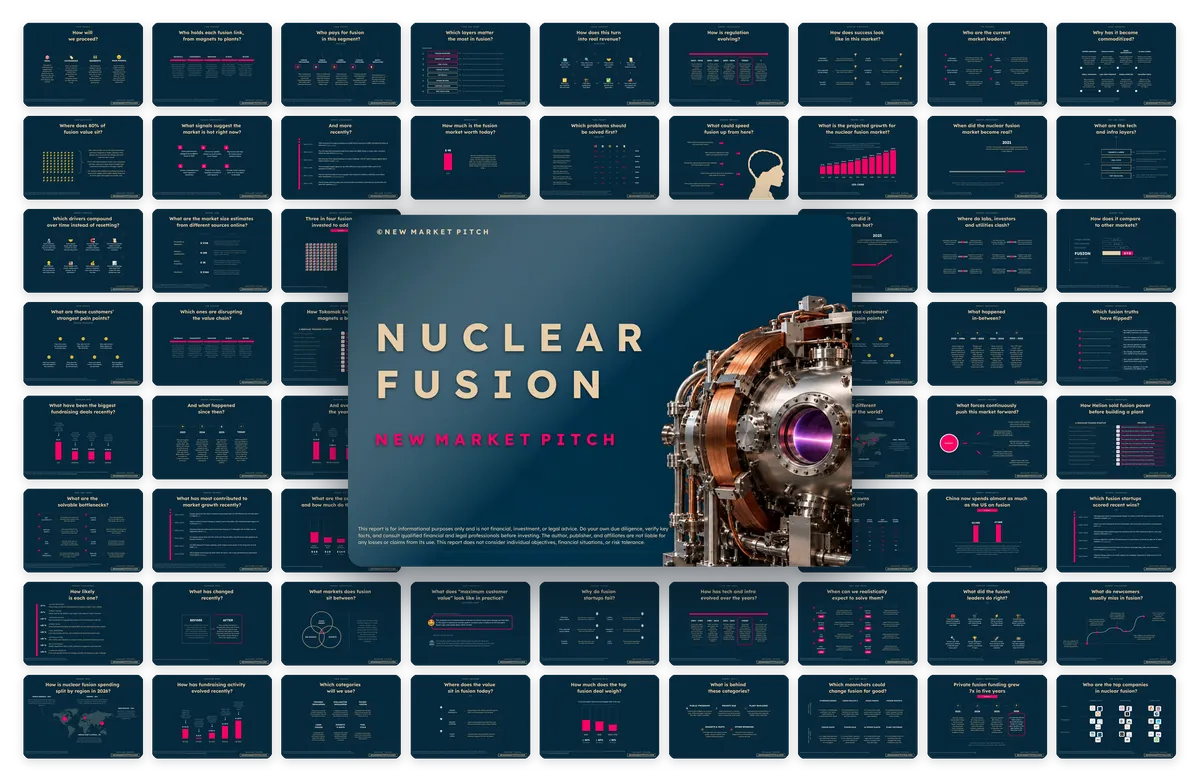
Whether you're building or investing in the nuclear fusion market, our report covers everything you need to know: the players, the money, and what's coming next.
Summary
Breakthrough Energy Ventures is the top nuclear fusion venture investor today, thanks to its backing of several leading developers across different reactor technologies. Google has built the strongest strategic position among major technology companies, while General Catalyst stands out for the scale and structure of its financing commitments.
Fusion investment has accelerated dramatically. The industry attracted $4.48 billion in the 12 months leading to July 2026, bringing cumulative reported funding to $14.24 billion. Investors are now financing companies that may need several billion dollars each to reach commercial electricity production.
Breakthrough's advantage is its portfolio breadth. It has backed Commonwealth Fusion Systems, Pacific Fusion, Zap Energy and Type One Energy, spreading its exposure across tokamaks, pulsed magnetic fusion, Z-pinch reactors and stellarators. Few investors have comparable exposure to so many competing approaches.
The largest announced funding packages can be misleading. General Catalyst led Pacific Fusion's financing commitments exceeding $900 million, but that capital is tied to technical milestones. Likewise, a fund leading a $500 million round does not mean it personally contributed $500 million.
Commonwealth Fusion Systems has become the industry's biggest disclosed private fundraising success, reaching $4 billion in cumulative capital by July 2026. Its backers include traditional venture funds, Google, Eni, Hyundai and a consortium of Japanese industrial companies. That mix increasingly resembles the investor base of a major infrastructure business.
Google's strategy goes beyond owning shares. It has invested in Commonwealth, TAE Technologies and Proxima Fusion, while agreeing to purchase 200 megawatts of electricity from Commonwealth's proposed ARC plant. It could benefit from both investment returns and future power supply.
Individual investors remain influential, particularly Bill Gates through Breakthrough Energy Ventures and Sam Altman through Helion Energy. But there is no reliable public ranking of their personal investments. Their association with large financing rounds says little about their actual individual contributions.
Europe is beginning to attract larger international financing rounds. Proxima Fusion raised €541 million across two rounds in approximately 13 months, bringing in Google, RWE and major European venture funds. The United States still dominates disclosed private fusion funding, but the gap is no longer quite as absolute.
Industrial investors may eventually have an advantage that traditional venture funds lack. Mitsubishi, Siemens Energy, Eni and JERA can contribute manufacturing expertise, power-market access, construction capabilities and potential customers. Their commercial relationships could remain valuable even when a particular reactor investment disappoints.
Investors are still making enormous bets on unproven economics. No private fusion developer has established routine, profitable commercial electricity production, and companies estimate that reaching a commercially viable plant will cost an average of $2.7 billion. Technical progress alone will not guarantee attractive financial returns.
Our ranking therefore favors investors with diversified technology exposure, continued participation and credible commercial relationships. Breakthrough leads among venture investors, Google among strategic technology companies, and General Catalyst among investors experimenting with financing structures designed for fusion's unusually expensive development cycle.

Written by the New Market Pitch teamWe track new markets so founders and investors can move faster. About us

In our report covering the nuclear fusion market, you will always find fresh funding data, taken straight from our own verified funding database.
Why are investors suddenly putting billions into nuclear fusion?
Nuclear fusion is attracting more private investment than ever, with $4.48 billion raised in the 12 months leading to July 2026, a 69% increase from the previous year.
According to the Fusion Industry Association's 2026 report, cumulative funding reported by the industry reached $14.24 billion, roughly seven times its 2021 level. The number of companies covered by its survey also rose from 23 in 2021 to 56 in 2026.
The money is flowing into increasingly large funding rounds. Commonwealth Fusion Systems raised $863 million in August 2025 and another $1 billion in July 2026. Helion Energy completed a $500 million Series G in September 2026, while German startup Proxima Fusion secured €411 million in July. Inertia Enterprises raised $450 million in February to commercialize laser-driven fusion.
Alongside venture capital firms such as Breakthrough Energy Ventures, General Catalyst and Lowercarbon Capital, companies including Google, Eni, Mitsubishi and Hyundai are putting money into fusion developers.
The attraction is straightforward: fusion could eventually provide enormous amounts of dependable electricity without the carbon emissions associated with fossil fuels. AI data centers, industrial electrification and energy security have made that possibility more commercially interesting. But no private fusion startup has yet demonstrated routine commercial electricity production.
Who actually qualifies as a top nuclear fusion investor?
The top nuclear fusion investors today are those putting significant money into leading developers, repeatedly backing different companies or helping turn fusion technology into a commercial business.
These measures don't necessarily identify the same investors. General Catalyst led Pacific Fusion's financing package exceeding $900 million, while Breakthrough Energy Ventures has backed several developers, including Commonwealth Fusion Systems, Pacific Fusion, Zap Energy and Type One Energy. Google combines equity investments with agreements to purchase fusion electricity.
There is also a major disclosure problem. Fusion companies frequently announce funding rounds without revealing how much each investor contributed. Commonwealth's July 2026 financing, for example, brought in $1 billion from institutional and industrial investors, but the company did not publish a complete breakdown of individual contributions.
We can identify the firms leading major rounds, the investors returning for additional financings and those building portfolios across different fusion technologies. We cannot reliably rank every investor by cumulative dollars invested.

In our research about nuclear fusion, we turn what is vague and complex into simple, useful visuals. Market maps like this one show you at a glance where every startup stands.
Is Breakthrough Energy Ventures the biggest nuclear fusion investor?
Breakthrough Energy Ventures is our strongest candidate for the leading nuclear fusion venture investor, thanks to its investments in at least four developers pursuing different reactor technologies.
The firm, founded with backing from Bill Gates and other prominent investors, has invested in Commonwealth Fusion Systems, Pacific Fusion, Zap Energy and Type One Energy. Those companies are working on tokamaks, pulsed magnetic fusion, Z-pinch reactors and stellarators, respectively.
That gives Breakthrough several chances to back a winning design. Commonwealth had raised $4 billion by July 2026, while Pacific announced more than $900 million in milestone-based financing commitments in 2024. Type One completed a $200 million Series B in October 2026, co-led by Breakthrough and Clutterbuck Capital.
That latest Type One investment shows Breakthrough is continuing to finance alternative technologies while Commonwealth, one of its earlier investments, is already preparing a large demonstration reactor and developing a commercial power plant.
Bill Gates is often described as one of fusion's biggest individual backers because of his association with Breakthrough. However, the total capital raised by Breakthrough-backed companies cannot be attributed personally to Gates. His individual ownership and investment amounts are not disclosed in a way that permits such a calculation.
Breakthrough leads our ranking on breadth and continued participation. Whether it has actually invested more money than every competing fund is another question, and the public figures don't settle it.
If you want more recent data on this point, please see our latest nuclear fusion market report.
Which venture capital firms are putting the most money into nuclear fusion?
General Catalyst, Breakthrough Energy Ventures, Lowercarbon Capital, Thrive Capital, Bessemer Venture Partners and Lightspeed Venture Partners are among the most important venture investors currently financing nuclear fusion.
General Catalyst helped arrange Pacific Fusion's financing commitment exceeding $900 million. Thrive Capital led Helion's Series G, which closed at $500 million and valued the company at $15.5 billion. Bessemer led Inertia Enterprises' $450 million Series A, one of the largest early-stage financings in the industry's history.
Lowercarbon and Lightspeed have invested across multiple fusion companies rather than concentrating exclusively on a single developer. Lowercarbon has backed Commonwealth, Pacific and Type One, while Lightspeed has appeared in financing rounds involving Helion, Pacific and Proxima.
Type One's $200 million Series B, announced in October 2026, ranks among the largest Series B financings in fusion over the past five years, according to PitchBook data cited by Reuters. It brought Siemens Energy Ventures into the investor group alongside Breakthrough, Clutterbuck and Lowercarbon.
One distinction is worth keeping in mind: a fund leading a $500 million financing doesn't necessarily invest $500 million itself. Individual equity contributions are generally private.
| Investor | Major fusion investments | Notable round | Main strength |
|---|---|---|---|
| Breakthrough Energy Ventures | Commonwealth, Pacific, Zap, Type One | Type One $200M Series B | Broad reactor exposure |
| General Catalyst | Pacific Fusion | $900M+ committed financing | Milestone-based financing |
| Lowercarbon Capital | Commonwealth, Pacific, Type One | Type One $200M Series B participation | Several reactor technologies |
| Thrive Capital | Helion Energy | $500M Series G | Major late-stage financing |
| Bessemer Venture Partners | Inertia Enterprises | $450M Series A | Large laser-fusion investment |
| Lightspeed Venture Partners | Helion, Pacific, Proxima | Helion $500M Series G participation | Multiple developer investments |
| Balderton Capital | Proxima Fusion | €130M Series A co-lead | European fusion exposure |
| Cherry Ventures | Proxima Fusion | €130M Series A co-lead | Early and follow-on backing |
| Clutterbuck Capital | Type One Energy | $200M Series B co-lead | Stellarator commercialization |

Your time is limited. In our market report about nuclear fusion, we put numbers on each part of the market, so you can see where it makes sense to focus.
Is Google becoming the most important corporate investor in nuclear fusion?
Google has probably established the strongest strategic position among corporate nuclear fusion investors, combining stakes in three major developers with a substantial future electricity agreement.
Its involvement with TAE Technologies goes back more than a decade. Google participated in TAE's financing exceeding $150 million in June 2025, alongside Chevron Technology Ventures and NEA. It has also invested in Commonwealth Fusion Systems and joined Proxima Fusion's €411 million round in July 2026.
These companies are pursuing different approaches. Commonwealth is developing high-temperature superconducting tokamaks, Proxima is building stellarators, and TAE is working on field-reversed configuration technology.
Google's relationship with Commonwealth goes further. In June 2025, it agreed to purchase 200 megawatts of electricity from Commonwealth's proposed ARC plant in Virginia, expected to deliver power in the early 2030s. Google also secured options to purchase electricity from additional plants.
Google could benefit through financial returns, closer access to emerging technology and future clean electricity for its computing infrastructure.
We can't prove Google has invested the most corporate capital because individual check sizes are undisclosed. But few other technology companies currently combine so many developer relationships with an agreement to buy the electricity they hope to produce.
If you want more recent data on this point, please see our latest nuclear fusion market report.
Is Sam Altman the biggest individual investor in nuclear fusion?
Sam Altman is one of the most prominent individual nuclear fusion investors, largely because of his long involvement with Helion Energy, but we cannot establish that he has personally invested more than anyone else.
Helion's funding history shows why Altman attracts so much attention. The company raised $425 million in January 2025 at a $5.425 billion post-money valuation. Its Series G, initially announced at $465 million in June 2026 and subsequently closed at $500 million in September, valued Helion at $15.5 billion.
That represents a valuation increase of approximately 186% in around 20 months. Helion's total disclosed investment had reached approximately $1.5 billion following the financing.
Altman has supported Helion for years, alongside investors such as Mithril Capital, Capricorn Technology Impact Funds, Lightspeed Venture Partners and Dustin Moskovitz through Good Ventures Foundation.
Other prominent individuals have taken different positions. Eric Schmidt and John Doerr backed Pacific Fusion, while Bill Gates has played a major role in establishing Breakthrough Energy Ventures, which holds investments across several developers.
Altman's association with Helion gives him considerable influence over one of the industry's highest-valued startups. Gates has wider exposure through Breakthrough's portfolio. The available disclosures don't allow us to determine which has committed more personal money.

In our document detailing everything you need to know about nuclear fusion, we always try to gather several sources and make estimates that make sense, so you can work with solid numbers.
Which investors are behind Commonwealth Fusion Systems?
Commonwealth Fusion Systems has attracted one of the deepest and most varied investor groups in nuclear fusion, including Tiger Global, Breakthrough Energy Ventures, Google, Eni, Khosla Ventures and major Asian industrial companies.
The company raised more than $1.8 billion in December 2021, with Tiger Global leading the Series B. Its $863 million Series B2 in August 2025 brought further investment from existing backers, including Breakthrough, Google, Eni, Khosla Ventures and Lowercarbon Capital.
That round also introduced new investors such as Counterpoint Global, NVentures and Stanley Druckenmiller. A Japanese consortium led by Mitsui and Mitsubishi participated as well.
In July 2026, Commonwealth raised another $1 billion, bringing cumulative funding to $4 billion. The company said the new financing included pension funds, sovereign wealth funds and industrial investors. Hyundai Motor Group confirmed in September that it had participated in the round.
According to Commonwealth's announcement, its $4 billion represented approximately 30% of all capital raised by the fusion industry at that point. No other private fusion developer has disclosed an equally large cumulative funding total.
The money supports two connected projects. SPARC, under assembly in Massachusetts, is intended to demonstrate net fusion energy. ARC, planned for Virginia, is designed to produce commercial electricity.
Hyundai is exploring collaboration on future power plants, while Google and Eni have agreed to purchase electricity from ARC. Commonwealth now has an investor group that could help finance, build and operate its future facilities.
Why did General Catalyst commit more than $900 million to Pacific Fusion?
General Catalyst helped Pacific Fusion secure more than $900 million in commitments because the company is pursuing a capital-intensive fusion design that can be financed against specific technical milestones.
The transaction, announced in October 2024, was led by General Catalyst's Hemant Taneja. Investors included Breakthrough Energy Ventures, Lowercarbon Capital, Lightspeed Venture Partners, Eric Schmidt, John Doerr, Patrick Collison and Ken Griffin.
Pacific is developing pulsed magnetic fusion technology. Its approach uses powerful electrical pulses to compress fusion fuel, aiming to build a commercially viable system without relying on the same plasma-confinement architecture as tokamak developers.
Rather than providing the entire sum unconditionally, investors committed capital that becomes available when Pacific achieves predefined milestones. This gives the company confidence that future financing is available if development proceeds as planned, while investors retain control over when additional funding is released.
And that's a big distinction. More than $900 million in commitments does not establish that Pacific has already received and spent $900 million.
General Catalyst is effectively linking a substantial financing package to engineering progress, an approach that could prove useful in an industry where development costs are enormous and technical timelines remain uncertain.
If you want more recent data on this point, please see our latest nuclear fusion market report.

Our report covering the nuclear fusion market gets updated several times a month, so you always get the latest view of where things stand.
Why are Japanese companies investing so heavily in nuclear fusion?
Japanese industrial groups are becoming major nuclear fusion investors because they want a role in building, supplying and operating future power plants.
In August 2025, a consortium of 12 Japanese companies participated in Commonwealth Fusion Systems' $863 million Series B2. The group included Mitsubishi, Mitsui, JERA, NTT, Kansai Electric Power and the Development Bank of Japan.
JERA explained that the investment would help the companies gain experience with Commonwealth's ARC commercialization plans, including regulation, construction, operations and maintenance.
This fits with Japan's broader effort to develop its own fusion supply chain. Kyoto Fusioneering, which specializes in components such as tritium fuel systems, breeding blankets and plasma-heating equipment, secured approximately ¥16.72 billion in equity financing in August 2026, alongside roughly ¥9 billion in credit and loan facilities.
Mitsubishi has invested in both Commonwealth and Kyoto Fusioneering, giving it exposure to a reactor developer and a specialist equipment supplier. JERA has also backed Kyoto Fusioneering.
Japanese companies are positioning themselves to supply equipment and industrial expertise even if the first commercially successful fusion reactor is developed overseas. The consortium brings companies from power generation, manufacturing, telecommunications and finance into the same investment.
Are energy companies becoming bigger players in nuclear fusion investment?
Energy companies are becoming increasingly important nuclear fusion investors, and several now combine equity stakes with commercial agreements or industrial partnerships.
Eni has been involved with Commonwealth Fusion Systems for years. In 2025, it participated in the company's Series B2, and it has since agreed to purchase electricity from Commonwealth's proposed ARC plant.
Chevron Technology Ventures invested in TAE Technologies' June 2025 financing, while JERA joined Commonwealth's investor consortium and has backed Kyoto Fusioneering.
Industrial electricity users are participating too. In September 2023, Nucor announced a $35 million direct investment in Helion Energy and plans to develop a potential 500-megawatt fusion facility to serve its steelmaking operations.
Siemens Energy Ventures joined Type One Energy's $200 million financing in October 2026. Type One is developing a stellarator-based reactor and pursuing an industrial partnership model, making Siemens' manufacturing and energy-equipment expertise particularly relevant.
Energy companies bring experience in power markets and plant development, manufacturers can supply equipment, and industrial customers can eventually buy the electricity. Their involvement could become increasingly valuable as fusion companies move toward commercial construction.

In our research about nuclear fusion, we look at what the winners do differently, so you can learn from the best instead of guessing.
Is Europe finally attracting major nuclear fusion investors?
Europe is attracting much larger nuclear fusion investments, with Proxima Fusion becoming the clearest example of a European startup reaching funding levels previously associated mainly with American developers.
Proxima raised €130 million in June 2025, with Cherry Ventures and Balderton Capital co-leading the Series A. In July 2026, it secured another €411 million at a €2.4 billion valuation.
Together, those rounds brought in €541 million over approximately 13 months. The second financing was more than three times the size of the first.
The new round was led by XTX Ventures and East X Ventures, with Google and German energy company RWE joining as strategic investors. Returning participants included Lightspeed, Balderton, Cherry Ventures, Plural, UVC Partners and redalpine.
Proxima is developing stellarator technology, aiming to build a fusion system capable of operating continuously while avoiding some of the control challenges associated with tokamaks. It has become Europe's best-funded private fusion company, according to its July 2026 announcement.
Europe still faces a large funding gap compared with the United States. Fusion for Energy's 2026 Global Fusion Energy Trends report showed that public funding and ITER contributions accounted for much of the European Union's fusion financing between 2022 and 2025.
The Proxima rounds demonstrate that European startups can now secure several hundred million euros from international investors, although the region still has relatively few companies attracting financing at that scale.
Are fusion investors already betting on one winning technology?
Nuclear fusion investors are still funding competing reactor designs, and no technology has established a decisive commercial lead.
Commonwealth Fusion Systems is developing a high-field tokamak using superconducting magnets. Proxima Fusion and Type One Energy are pursuing stellarators, which use complex magnetic fields designed to confine plasma without some of the current-driving requirements of conventional tokamaks.
Helion Energy is taking a different route, using pulsed fusion and direct electricity recovery. TAE Technologies is developing field-reversed configurations, while Pacific Fusion is pursuing pulsed magnetic inertial fusion.
Inertia Enterprises represents another major alternative. Its $450 million financing in February 2026 supports laser-driven fusion, building on scientific achievements at Lawrence Livermore National Laboratory's National Ignition Facility.
These technologies face different engineering challenges. Magnetic-confinement systems must operate reliably at extreme temperatures, while pulsed and laser-based systems need to repeat fusion reactions efficiently and cheaply.
The Fusion Industry Association's 2026 survey found that 48% of respondents used magnetic confinement, compared with 21% using inertial confinement and 14% using magneto-inertial approaches.
Investors such as Breakthrough and Lightspeed have spread their exposure across different technologies. Others have concentrated on particular developers. Thrive Capital's Helion investment and Bessemer's Inertia financing are prominent examples of major commitments to specific technical approaches.
We don't yet have the electricity-production data needed to decide which reactor design will deliver the lowest costs.

In our market report about nuclear fusion, we don't want to repeat what boring consulting reports say. Instead, we show you the real and latest market signals that matter.
Are nuclear fusion investors finally getting real electricity customers?
Nuclear fusion developers are now signing meaningful electricity agreements with companies such as Google, Microsoft and Nucor, although the proposed plants have yet to deliver commercial power.
Microsoft signed a power purchase agreement with Helion Energy in May 2023. The agreement targets electricity from a plant expected to begin operating in 2028, with at least 50 megawatts of generation after ramp-up.
Google followed with its June 2025 agreement to buy 200 megawatts from Commonwealth Fusion Systems' planned ARC plant in Virginia. Google has also secured options to purchase additional electricity from future plants.
Nucor's proposed Helion project is larger, with a potential capacity of 500 megawatts. The steel producer announced the partnership in 2023 alongside its $35 million equity investment.
Together, these three announcements represent at least 750 megawatts of proposed fusion generation. For perspective, that is comparable to the output capacity of a substantial conventional power station, although the projects differ in timing and contractual structure.
The Fusion Industry Association's 2026 survey found that five fusion companies had signed power purchase agreements, offtake agreements or similar commercial commitments, with two more in discussions.
Data-center operators and industrial manufacturers have strong incentives to secure dependable electricity. But these contracts don't prove that fusion developers can meet their delivery dates or generate electricity at a profitable cost.
Are governments investing more in nuclear fusion than venture capital firms?
Governments still provide enormous amounts of nuclear fusion funding, particularly for research facilities and technical infrastructure that private investors are unlikely to finance alone.
Fusion for Energy's 2026 Global Fusion Energy Trends report identified more than €20 billion in fusion financing across the United States, China, the European Union, the United Kingdom and Japan between 2022 and 2025.
The United States accounted for approximately €7.38 billion, followed by China with €6.94 billion. China's total included around €5.45 billion in public spending. The European Union accounted for €3.34 billion, including roughly €2.12 billion in contributions to ITER.
These figures combine different funding categories, so they cannot be treated as a ranking of government equity investments in private startups. Much of the money supports public laboratories, scientific research and shared infrastructure.
Governments also provide more direct support to private fusion developers. The U.S. Department of Energy's milestone-based fusion development program links public funding to technical achievements by participating companies.
China's position is especially interesting. It has committed enormous public resources to fusion development, while American startups have attracted the largest concentration of disclosed private capital. Much of China's effort takes place through state-backed institutions and public programs, making direct comparison difficult.

Learning from others' mistakes is the cheapest lesson there is. In our document detailing everything you need to know about nuclear fusion, we look at what broke startups before you, so you don't repeat it.
Could nuclear fusion investors lose billions before the technology works?
Nuclear fusion investors could lose substantial amounts of money because the industry now supports multibillion-dollar valuations without having demonstrated profitable commercial electricity generation.
Helion's valuation increased from $5.425 billion in January 2025 to $15.5 billion in 2026. Commonwealth Fusion Systems has raised $4 billion, while Proxima Fusion reached a €2.4 billion valuation in July 2026.
These valuations reflect expectations about future electricity production, technical progress and the commercial potential of fusion. None of the three companies has yet established a history of generating and selling electricity from commercial fusion plants.
In the Fusion Industry Association's 2026 survey, companies estimated that reaching a commercially viable fusion power plant would require anywhere from $100 million to $10.9 billion, averaging $2.7 billion.
That average is slightly above the previous year's estimate of $2.6 billion. The figures are company forecasts rather than independently verified construction budgets, but they show that financing needs remain enormous.
Technical problems are also unresolved. In the same survey, 64% of respondents identified power efficiency as a short-term challenge, while another 64% cited the need for neutron-resistant materials. Tritium self-sufficiency was among the major longer-term concerns.
These obstacles could delay construction, raise operating costs or force companies to redesign their systems. Even technically successful developers will need to build power plants at costs that make economic sense.
If you want more recent data on this point, please see our latest nuclear fusion market report.
Which nuclear fusion investors are best positioned to make money?
Breakthrough Energy Ventures, Google, General Catalyst and major industrial investors such as Mitsubishi appear particularly well positioned for nuclear fusion's next stage, although their potential returns depend on very different factors.
Breakthrough's main advantage is diversification. Through Commonwealth, Pacific, Zap Energy and Type One, it has exposure to several reactor technologies. A commercial breakthrough by one developer could offset disappointing outcomes elsewhere, depending on the size and price of its individual investments.
Google has a broader commercial interest. It has backed Commonwealth, TAE and Proxima while securing access to future electricity through its agreement with Commonwealth. A successful fusion industry could benefit its computing operations even beyond financial returns on its shares.
General Catalyst has taken a distinctive approach through Pacific Fusion's financing. By connecting committed capital to engineering milestones, it has built a structure intended to control financing risk while supporting expensive development.
Mitsubishi and other Japanese industrial groups may benefit through both investments and future supply contracts. Their existing expertise in power systems, manufacturing and industrial equipment could remain valuable even if the first successful reactor is developed by a company in which they hold no shares.
The financial winner could still be an investor currently associated with a single developer. Thrive Capital's position in Helion or Bessemer's investment in Inertia could become extremely valuable if either company reaches commercial production ahead of competitors.
But ownership stakes, entry prices, liquidation preferences and dilution are largely undisclosed. Those details will ultimately determine investment returns.

If you build or invest in the nuclear fusion market, you need to know which business models pay off now and which ones are fading. That's why our report covering it has a whole section on it.
Who are the top investors in nuclear fusion today?
Breakthrough Energy Ventures is our leading nuclear fusion venture investor today, while Google has built the strongest strategic position among major technology companies. General Catalyst, Lowercarbon Capital, Lightspeed Venture Partners, Thrive Capital and Bessemer Venture Partners are also among the most consequential financial backers.
Breakthrough earns first place through its repeated investments across different reactor technologies. It has backed Commonwealth Fusion Systems, Pacific Fusion, Zap Energy and Type One Energy, and its participation in Type One's October 2026 financing demonstrates that it is still actively adding to its exposure.
Google stands out because it has relationships with Commonwealth, TAE Technologies and Proxima Fusion, alongside a major commitment to purchase electricity from Commonwealth's future ARC plant.
General Catalyst deserves particular recognition for Pacific Fusion's financing package exceeding $900 million. Thrive Capital and Bessemer have led some of the largest recent rounds, while Lowercarbon and Lightspeed have built portfolios spanning several developers.
Among individual backers, Bill Gates and Sam Altman remain particularly influential. Among industrial companies, Eni, Mitsubishi, Mitsui, JERA, Chevron, Siemens Energy and Hyundai have become increasingly important.
The one ranking we cannot establish is who has invested the most actual dollars. Private funding announcements rarely disclose individual contributions.
Our overall judgment favors Breakthrough because of its breadth, sustained participation and backing of several credible fusion developers. Google is the strongest alternative when we include commercial relationships and future electricity purchasing. As fusion moves closer to commercial power plants, investors able to finance construction, supply complex equipment and secure electricity buyers could become increasingly influential.
If you want more recent data on this point, please see our latest nuclear fusion market report.
Our methodology
This analysis identifies the leading nuclear fusion investors by comparing five factors: investment scale, portfolio breadth, continued financial commitment, exposure to different reactor technologies and commercial positioning. We examined venture capital firms, individual investors and strategic corporate backers, prioritizing disclosed activity from 2025 and 2026 while using earlier investments to establish long-term involvement.
We distinguish total company fundraising from individual investor contributions. When a company announces a $500 million round, we do not attribute the entire amount to the lead investor. We also distinguish committed financing from capital already received, particularly in Pacific Fusion's milestone-based arrangement. Because individual investment amounts and ownership stakes are often undisclosed, our ranking reflects observable investor activity rather than an assumed ranking by capital deployed.
We also considered how investors could benefit commercially from fusion. Equity investments, electricity purchase agreements, manufacturing partnerships and government funding serve different purposes and are treated separately. Announced electricity agreements are evidence of customer interest, but they do not establish that commercial power has already been delivered or that the underlying projects will be profitable.
Our assessment prioritizes first-hand company announcements and authoritative industry research. We compared recent financing rounds, recurring investors, reactor technologies, proposed commercial projects and strategic partnerships. No single funding round or investor relationship determines the final ranking.
Key sources include the Fusion Industry Association's 2026 industry report, Fusion for Energy's Global Fusion Energy Trends report, Commonwealth Fusion Systems' July 2026 financing announcement, Commonwealth's Series B2 investor disclosures, Type One Energy's $200 million Series B announcement, Pacific Fusion's financing and founders' letter, Helion Energy's Series G announcement, Bessemer Venture Partners' analysis of Inertia Enterprises, Proxima Fusion's €411 million financing announcement, and Google's disclosure of its Commonwealth investment and electricity agreement.

In our research about nuclear fusion, we like to show you the big picture. We know your time is precious, so we make every page quick to read and packed with as much learning as possible per minute.
Written by the New Market Pitch teamWe track new markets so founders and investors can move faster. About us