
Nuclear fusion: what are the biggest unsolved problems?
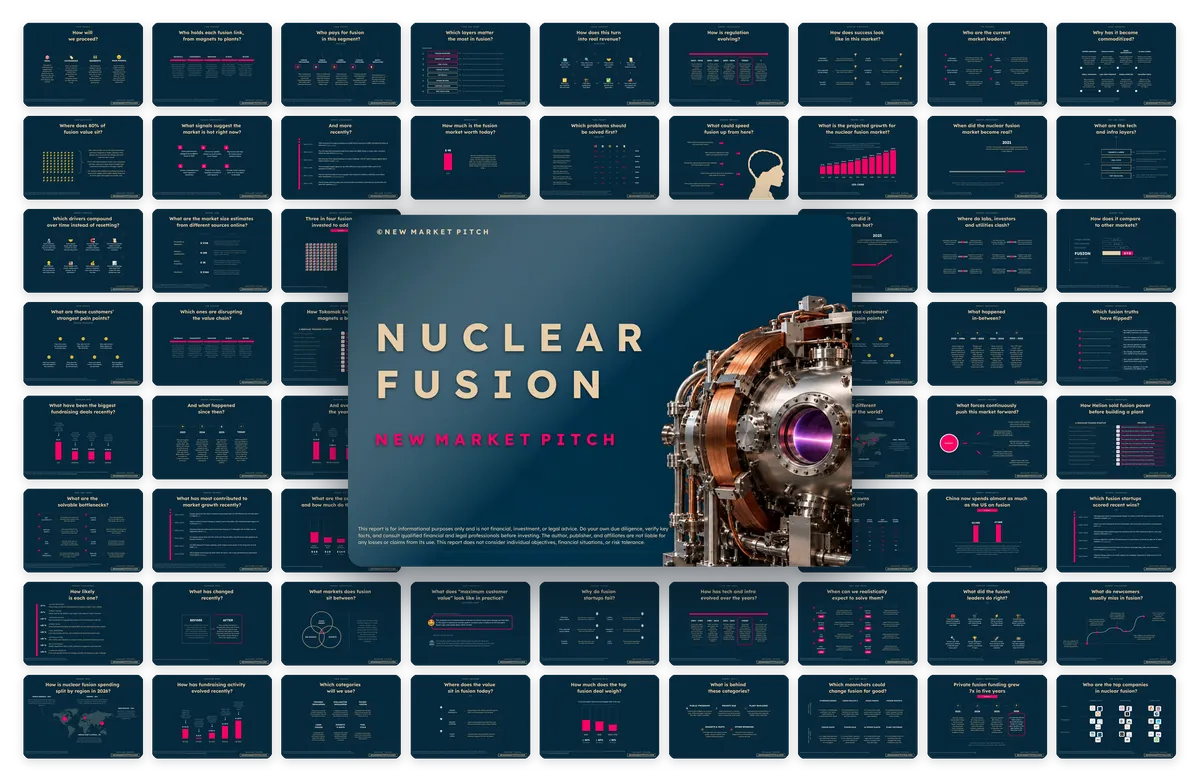
Whether you're building or investing in the nuclear fusion market, our report covers everything you need to know: the players, the money, and what's coming next.
Summary
Nuclear fusion's biggest unsolved problems are generating sustained net electricity, breeding enough tritium to fuel reactors, developing materials that survive intense neutron radiation, removing extreme heat and making complete power plants reliable and affordable.
The scientific breakthroughs are substantial. The National Ignition Facility produced 8.6 megajoules of fusion energy from 2.08 megajoules delivered to its target in April 2025, while JET generated 69 megajoules over six seconds. Neither achievement demonstrates a power station producing more electricity than it consumes.
Fusion's progress is fragmented across different experiments. China and France have sustained plasmas for more than 1,000 seconds, NIF has repeatedly achieved ignition, and stellarators have improved confinement performance. Nobody has combined long operating times, high fusion output and net electricity in one machine.
Tritium may be the most underestimated bottleneck. A one-gigawatt electric fusion plant operating at 90% availability and 40% thermal efficiency would theoretically burn about 126 kilograms annually, compared with projected peak CANDU-derived tritium stockpiles of just 35 to 48 kilograms. Commercial deuterium-tritium reactors will need to breed their own fuel.
Even successful tritium breeding would leave the materials problem. Approximately 80% of deuterium-tritium fusion energy emerges as high-energy neutrons, which damage reactor structures and can make component replacement expensive and frequent.
Heat exhaust could become an equally stubborn engineering constraint. ITER's divertor is designed for steady heat loads around 10 megawatts per square meter, and a commercial reactor must manage those conditions repeatedly without excessive erosion, melting or shutdowns.
More powerful magnets and stellarators improve the outlook, but introduce trade-offs. Compact high-field reactors have less room for shielding and breeding blankets, while stellarators avoid some tokamak disruptions at the expense of more complicated magnetic geometries.
Laser fusion has a completely different scaling problem. A hypothetical plant firing ten times per second at 90% availability would need approximately 284 million precision fuel targets annually, alongside efficient lasers and a chamber able to survive constant fusion pulses.
Economics could defeat an otherwise functional reactor. Under our illustrative assumptions, a $10 billion, one-gigawatt electric plant carries approximately $95 per megawatt-hour in construction capital costs alone, before maintenance, staffing or fuel processing. Plant availability may matter almost as much as construction price.
Investment is accelerating ahead of those demonstrations. The Fusion Industry Association reported $4.48 billion raised during the year to July 2026 and $14.24 billion cumulatively since 2021. Power-purchase agreements are multiplying, but reactor performance, reliability and operating costs remain commercially unproven.
Our assessment is that tritium breeding, neutron-resistant materials and maintenance could ultimately prove harder to commercialize than ignition itself. Fusion electricity in the 2030s is a plausible target for some developers, but the decisive milestone will be a plant that exports net electricity, sustains its own fuel cycle and operates at a demonstrably competitive cost.

Written by the New Market Pitch teamWe track new markets so founders and investors can move faster. About us
Has nuclear fusion actually solved its biggest scientific problem?
Nuclear fusion has proved that controlled fusion reactions can release more energy than is delivered directly to the fuel, but no fusion power plant has yet produced sustained net electricity. The biggest problems now involve keeping those reactions going, extracting useful power, producing fuel and building machines that can survive years of operation.
In April 2025, the National Ignition Facility (NIF) at Lawrence Livermore National Laboratory produced 8.6 megajoules of fusion energy from 2.08 megajoules of laser energy delivered to its target, achieving a target energy gain of 4.13. In June 2026, another experiment produced 7.9 megajoules, demonstrating that ignition could be repeated at high yields.
Europe's Joint European Torus (JET) also set a record during its final deuterium-tritium experiments, generating approximately 69.26 megajoules of fusion energy over six seconds. Meanwhile, experimental reactors in China, France and Germany have made considerable progress in keeping plasma confined for longer periods.
These results solve different pieces of the puzzle. NIF has repeatedly achieved ignition using lasers, JET demonstrated substantial fusion output using magnetic confinement, and long-duration experiments have improved our understanding of plasma control. None has combined these achievements into a working power station.
Why are investors pouring billions into nuclear fusion before it produces electricity?
Investors are putting record amounts of money into nuclear fusion because companies are moving from laboratory experiments toward building actual reactors, even though commercial electricity production remains unproven.
The Fusion Industry Association's 2026 survey recorded $4.48 billion raised by 56 fusion companies over the preceding 12 months, compared with $2.64 billion in the previous survey. That's an increase of approximately 70% in a single year. Cumulative funding reported since the association began tracking the industry in 2021 reached $14.24 billion.
The money is increasingly concentrated in companies building expensive hardware. Commonwealth Fusion Systems raised $863 million in August 2025 to advance its superconducting-magnet approach. Inertia Enterprises secured $450 million in February 2026 to develop laser-driven fusion, while Helion Energy initially raised $465 million in June, later closing that Series G round at $500 million in September. Proxima Fusion also attracted $518 million in July for its stellarator technology.
The four financings included in the association's annual survey totaled approximately $2.3 billion, equivalent to 51% of the $4.48 billion reported. That concentration shows how much investors are betting on a relatively small group of companies with ambitious engineering programs.
There's also growing interest from electricity buyers. Microsoft signed a power-purchase agreement with Helion in 2023, and Google announced an agreement with Commonwealth Fusion Systems in 2025. The Fusion Industry Association's 2026 survey found five companies with power-purchase, offtake or similar commercial commitments.
But those agreements have created expectations that developers have yet to meet. Helion's original agreement with Microsoft targeted 2028 for its Orion facility to begin producing electricity, with at least 50 megawatts expected after ramp-up. Reporting by Axios in September 2026 revealed that Helion now expected full 50-megawatt operation no earlier than 2029 or 2030, while maintaining its target of beginning initial operations in 2028.
Commonwealth Fusion Systems is taking a different approach, building its experimental SPARC tokamak before its planned ARC commercial power station. Even if SPARC achieves its target fusion gain, ARC will still need to demonstrate fuel breeding, reliable electricity generation and acceptable operating costs.
Publicly funded projects have faced similar scheduling difficulties. ITER's revised baseline, published in 2024, pushed its planned deuterium-tritium operations from 2035 to 2039.
The industry currently employs more than 16,000 people, according to the Fusion Industry Association, but still has no commercial plant exporting sustained net electricity. Investors are financing serious engineering progress. Whether the promised delivery dates are realistic is another matter.
If you want more recent data on this point, please see our latest nuclear fusion market report.

A good product starts with a real problem. In our report covering the nuclear fusion market, we show you the ones customers still live with.
Why hasn't nuclear fusion produced more electricity than it consumes?
Nuclear fusion still hasn't demonstrated net electricity because the energy needed to operate an entire reactor is much greater than the energy delivered directly to its fuel.
The National Ignition Facility provides the clearest example. Its April 2025 experiment released 8.6 megajoules of fusion energy from 2.08 megajoules of laser energy delivered to the target. That represents a gain of 4.13, but the facility's lasers consume far more electricity than the energy reaching the target.
Even a successful ignition experiment can therefore consume considerably more electricity than the fusion reaction produces. The same issue exists in magnetic-confinement machines, which need energy for plasma heating, magnets, refrigeration, cooling and other equipment.
ITER, the international fusion project under construction in France, aims to produce 500 megawatts of fusion power from 50 megawatts of external plasma heating. That would represent a plasma gain of ten, an enormous scientific achievement if demonstrated. However, ITER isn't designed to generate electricity for the grid, and those figures exclude much of the electricity needed to operate the facility.
There are several distinct milestones between making fusion happen and building a useful power plant.
| Fusion milestone | What it proves | Current status |
|---|---|---|
| Controlled fusion reactions | Atomic nuclei can fuse under laboratory conditions | Demonstrated |
| Burning plasma | Fusion products can provide substantial plasma heating | Demonstrated experimentally |
| Target energy gain above 1 | Fusion output exceeds energy delivered to the target | Demonstrated at NIF |
| Sustained high plasma gain | A reactor maintains much higher fusion output than external plasma heating | Not yet demonstrated at commercial conditions |
| Whole-facility energy breakeven | Fusion output exceeds the energy consumed by the facility | Not demonstrated |
| Net electricity generation | A plant exports more electricity than it consumes | Not demonstrated |
| Commercial power generation | A plant sells electricity reliably at a competitive cost | Not demonstrated |
Can scientists keep nuclear fusion running long enough to power a city?
Fusion researchers can now sustain some plasmas for more than 20 minutes, but nobody has maintained a commercially useful fusion burn for the operating periods a power station would need.
China's EAST tokamak maintained a high-confinement plasma for 1,066 seconds in January 2025, approximately 17.8 minutes. That was a major improvement over its previous 403-second achievement in 2023. France's WEST tokamak subsequently sustained a plasma for 1,337 seconds, roughly 22.3 minutes.
Neither experiment maintained a high-power deuterium-tritium burn while generating net electricity. JET, meanwhile, produced its record 69 megajoules of fusion energy over approximately six seconds. Researchers have achieved long plasma duration and impressive fusion energy output, but under very different operating conditions.
The difficulty comes from controlling plasma at temperatures around 100 million degrees Celsius or higher. Turbulence can carry heat and particles away from the plasma, while sudden instabilities can send enormous amounts of energy toward the reactor's internal components. Tokamaks also face major disruptions that can rapidly terminate the plasma current and generate powerful mechanical forces.
Experiments are tackling these problems from different directions. JET developed improved operating scenarios before shutting down in 2023. EAST demonstrated longer high-confinement operation. Germany's Wendelstein 7-X stellarator uses a magnetic configuration designed to operate without the large plasma current required by tokamaks.
For comparison, a power station operating at 90% availability would generate electricity for approximately 7,884 hours annually. Some fusion designs could achieve this through repeated pulses rather than one uninterrupted plasma, but the machine would still need to withstand millions of operating cycles or lengthy sustained burns.
The next challenge is combining long-duration confinement with high fusion output and stable operation. No facility has demonstrated that complete performance.

If you build or invest in the nuclear fusion market, you need to know which business models pay off now and which ones are fading. That's why our report covering it has a whole section on it.
Can fusion reactors survive temperatures above 100 million degrees?
The greatest heat problem in nuclear fusion is keeping the reactor's internal components alive while removing enormous amounts of energy from the plasma.
The plasma itself can reach temperatures above 100 million degrees Celsius, but magnetic fields prevent its hottest region from touching the surrounding walls directly. The most difficult area is often the divertor, where particles and heat escaping from the plasma are directed toward specially designed surfaces.
ITER's divertor is designed to handle approximately 10 megawatts per square meter of steady heat flux, with some conditions reaching 20 megawatts per square meter.
ITER uses tungsten for its plasma-facing armor because tungsten has one of the highest melting points of any metal. Yet even tungsten can crack, erode or melt when exposed to severe thermal loads, particularly during sudden plasma disturbances.
Researchers are testing ways to spread the heat before it reaches these surfaces. One approach, known as divertor detachment, uses radiation and interactions with cooler particles to reduce the energy striking the material. Experiments at JET and other facilities have shown that detached operation can be achieved under certain conditions.
The unresolved question is whether these techniques can work reliably in a high-power reactor without reducing fusion performance too much. Frequent divertor replacement could make an otherwise successful reactor too expensive to operate.
Will nuclear fusion reactors run out of tritium fuel?
Tritium supply could become a serious bottleneck for nuclear fusion because the fuel required by most leading reactor designs exists in extremely limited quantities.
Deuterium, one of the two fuels used in conventional fusion reactions, is abundant in seawater. Tritium is much harder to obtain. It's radioactive, has a half-life of approximately 12.3 years and is produced commercially in limited quantities, mainly through certain nuclear fission reactors.
A September 2026 study published in Fusion Engineering and Design examined future tritium availability. Under the scenarios considered, peak stockpiles from CANDU reactors reached approximately 35.1-47.5 kilograms. In some high-demand scenarios, shortages exceeded 28 kilograms by 2054, even assuming operating fusion reactors could eventually replace the tritium they consumed.
The scale of the problem becomes clearer when we calculate how much fuel a large power plant would need.
Each deuterium-tritium reaction releases 17.6 megaelectronvolts. From that, we can calculate that fully burning one kilogram of tritium releases approximately 560 terajoules of fusion energy.
A hypothetical reactor producing one gigawatt of thermal power continuously would consume around 56 kilograms of tritium annually. If we instead consider a one-gigawatt electric plant operating at 40% thermal efficiency and 90% availability, the theoretical requirement rises to approximately 126 kilograms per year.
That single plant would require several times the estimated peak CANDU-derived stockpile every year, before accounting for processing losses, startup inventories and operational reserves.
If you want more recent data on this point, please see our latest nuclear fusion market report.

Learning from others' mistakes is the cheapest lesson there is. In our market report about nuclear fusion, we look at what broke startups before you, so you don't repeat it.
Can fusion reactors make enough tritium to fuel themselves?
No commercial fusion reactor has demonstrated a complete self-sustaining tritium fuel cycle, and solving this problem is essential for scaling deuterium-tritium fusion beyond a handful of experimental plants.
The proposed solution is to surround the plasma with lithium-containing materials. Neutrons released by fusion reactions interact with lithium, producing fresh tritium that can be extracted, processed and injected back into the reactor.
The physics is well established. What remains uncertain is whether a complete breeding system can produce enough usable tritium while operating inside a reactor exposed to intense heat, radiation and mechanical stress.
The U.S. Department of Energy's June 2026 Fusion Science and Technology Roadmap identifies a tritium breeding ratio above 1.1 as a development target. A ratio of 1.1 means producing 1.1 tritium atoms for every atom consumed, allowing some margin for losses and inventory requirements.
Achieving that margin in an actual power plant is difficult. Some neutrons are absorbed by structural materials rather than lithium. Tritium can become trapped in materials or lost during processing. Fuel must also be stored, purified and moved through multiple systems without excessive leakage.
The breeding blanket must create tritium, capture heat for electricity generation, protect sensitive components from radiation and remain maintainable after prolonged neutron exposure.
ITER will test important breeding technologies, but the facility is not intended to operate as a fully tritium-self-sufficient commercial reactor. The Department of Energy's roadmap places an integrated self-sufficient fuel cycle among its longer-term development milestones.
Can fusion reactor materials survive radiation without constant repairs?
Fusion reactor materials have not yet demonstrated that they can survive years of commercial-scale neutron exposure without suffering damage that makes maintenance too frequent or expensive.
Around 80% of the energy from a deuterium-tritium reaction is carried by a neutron with an energy of 14.1 megaelectronvolts. Unlike charged particles, these neutrons pass through magnetic fields and penetrate surrounding structures.
When they strike metal atoms, they can knock them out of position and create defects throughout the material. Over time, this can cause swelling, embrittlement and changes in mechanical properties. Nuclear reactions within the materials also produce helium and radioactive isotopes.
These effects are difficult to reproduce fully in existing test facilities. Researchers are developing reduced-activation steels, tungsten alloys and silicon-carbide composites to address them. The United Kingdom Atomic Energy Authority's Fusion Materials Roadmap 2.0 identifies radiation resistance, high-temperature performance and material qualification as major priorities.
Material durability also determines how much radioactive waste fusion plants produce. Fusion avoids the spent uranium fuel and long-lived transuranic waste generated by conventional fission reactors, but its neutrons can activate reactor structures. Damaged components may require remote handling, storage, recycling or disposal.
ITER illustrates the maintenance challenge. Its divertor consists of 54 cassette assemblies, each weighing approximately ten tonnes, designed for replacement using remote-handling systems. Commercial reactors may need to replace similar components while maintaining much higher availability than research facilities.
Consider a hypothetical one-gigawatt power station. At 90% availability, it would generate approximately 7.88 terawatt-hours annually. At 60% availability, production would fall to 5.26 terawatt-hours.
That's one-third less electricity from a plant that may have cost billions of dollars to construct. Repair costs would add to the loss, particularly if components require specialized equipment and lengthy shutdowns.
The Department of Energy's 2026 roadmap identifies reliability, availability, maintainability and inspectability as major priorities. Yet no commercial fusion operator has years of operating data showing how long critical components survive or how quickly they can be replaced.

When you build or invest in the nuclear fusion market, you need clarity, not confusion. In our document detailing everything you need to know about nuclear fusion, we always try to put numbers on and quantify whatever is usually vague and confusing.
Are stellarators and superconducting magnets making fusion easier?
Stellarators and high-temperature superconducting magnets are making magnetic fusion more promising, but neither technology has yet proved it can deliver a cheaper or more reliable commercial reactor.
Superconducting magnets offer one particularly important advantage: stronger magnetic fields can improve plasma confinement and potentially allow smaller machines.
Commonwealth Fusion Systems demonstrated a high-temperature superconducting magnet reaching approximately 20 tesla in 2021. Its SPARC tokamak uses this technology, with the goal of demonstrating high fusion gain in a compact device.
Smaller reactors could reduce some construction costs, but they also have less room for shielding, fuel-breeding systems and maintenance access. Their magnets must operate at cryogenic temperatures while being protected from the radiation and heat generated nearby.
Stellarators approach the problem differently. Unlike conventional tokamaks, they use complex external magnetic fields without relying on a large plasma current to maintain confinement. That could reduce disruption risks and make long-duration operation easier.
Germany's Wendelstein 7-X has made the strongest experimental case for this approach. In May 2025, it maintained a high fusion triple product for 43 seconds, a result comparable to leading tokamak performance at similar durations. The triple product combines plasma density, temperature and energy confinement time.
Companies such as Proxima Fusion are trying to turn these advances into commercial systems. Yet stellarators require extremely precise magnetic geometries, which can make construction and maintenance more complicated.
Tokamaks still have a larger experimental evidence base and relatively simpler magnetic geometry. Stellarators offer potential advantages for sustained operation. Neither has demonstrated a complete commercial power plant.
If you want more recent data on this point, please see our latest nuclear fusion market report.
Can laser fusion work thousands of times faster than it does today?
Laser fusion faces an enormous manufacturing challenge because commercial plants would need to ignite fuel targets repeatedly, rather than perform carefully prepared experiments one shot at a time.
The National Ignition Facility has made remarkable progress. Its record fusion yield increased from 3.15 megajoules in December 2022 to 8.6 megajoules in April 2025, approximately 2.7 times the original result. By June 2026, the facility had achieved ignition eleven times.
But NIF is a research facility, and its experiments aren't designed around the speed or cost requirements of electricity production.
A commercial inertial-fusion power plant would need to manufacture fuel targets, deliver them into the reaction chamber with extreme precision, fire lasers repeatedly and recover the resulting energy.
Inertia Enterprises illustrates the size of this challenge. The company has described a proposed 1.5-gigawatt power plant using ten laser shots per second and a target energy gain of 45. Those figures are development objectives rather than demonstrated commercial results.
Ten shots per second would require 864,000 targets every day. At 90% operating availability, annual consumption would reach approximately 284 million targets.
The lasers themselves must also become much more electrically efficient, survive repeated operation and deliver consistent performance. Reactor chambers would need to handle frequent bursts of fusion energy without suffering unacceptable damage.

In our report covering the nuclear fusion market, we look at what the winners do differently, so you can learn from the best instead of guessing.
Can fusion reactors use fuels that are easier to find than tritium?
Alternative fusion fuels could reduce the tritium shortage and some neutron-related problems, but most require more difficult plasma conditions than conventional deuterium-tritium fusion.
The leading alternatives include deuterium-deuterium, deuterium-helium-3 and proton-boron-11 fusion.
Deuterium-deuterium reactions can use relatively abundant fuel, but their reaction rates are lower at comparable temperatures, and some of their products include tritium and neutrons.
Deuterium-helium-3 fusion produces a greater share of its energy in charged particles, potentially allowing more direct electricity conversion and less neutron damage. However, helium-3 is scarce, and the reaction requires more demanding conditions than deuterium-tritium fusion.
Proton-boron-11 fusion is attractive because its main reaction produces charged alpha particles rather than high-energy neutrons. Yet it requires considerably higher ion energies and must overcome substantial radiation losses.
Helion Energy is pursuing pulsed fusion technology with a longer-term focus on deuterium-helium-3 reactions and direct electricity recovery. Other developers are investigating proton-boron fusion and related approaches.
No alternative-fuel developer has yet demonstrated sustained commercial net electricity production. For now, deuterium-tritium remains the best-supported route to high fusion power based on existing experimental evidence.
Can nuclear fusion become cheap enough to compete with solar and nuclear power?
Fusion electricity could eventually be competitive, but no developer has demonstrated the construction costs, operating lifetime and plant availability needed to prove it.
The economics are especially sensitive to construction expense. A reactor could achieve positive net electricity and still be an unattractive investment if the facility costs too much to build.
Consider a hypothetical one-gigawatt electric fusion plant costing $10 billion. Assuming a 40-year operating life, 90% availability and a 7% real cost of capital, its annualized construction expense would be approximately $750 million.
Spread across the electricity produced each year, that represents around $95 per megawatt-hour, or 9.5 cents per kilowatt-hour, before maintenance, fuel processing, staff and other operating expenses.
If construction cost fell to $5 billion, the capital component would drop to roughly $48 per megawatt-hour. At $15 billion, it would rise to approximately $143 per megawatt-hour.
| Construction cost | Capital cost per MWh | Capital cost per kWh |
|---|---|---|
| $3B | $29 | 2.9 cents |
| $5B | $48 | 4.8 cents |
| $7B | $67 | 6.7 cents |
| $10B | $95 | 9.5 cents |
| $12B | $114 | 11.4 cents |
| $15B | $143 | 14.3 cents |
| $20B | $191 | 19.1 cents |
Illustrative calculation for a 1 GW electric plant, 40-year operating life, 90% availability and 7% real cost of capital. Figures cover construction capital only, not total electricity costs.
If you want more recent data on this point, please see our latest nuclear fusion market report.

Your time is limited. In our research about nuclear fusion, we put numbers on each part of the market, so you can see where it makes sense to focus.
What could still stop nuclear fusion from becoming commercial in the 2030s?
The biggest risk to commercial fusion in the 2030s is that developers may solve individual technical problems without getting the whole power plant to work reliably.
The U.S. Department of Energy's June 2026 roadmap identifies six major research challenges: structural materials, plasma-facing components, plasma confinement, fuel cycles, breeding blankets and whole-plant integration.
These systems affect one another. Improving confinement can increase fusion output, but that also raises heat and neutron loads. Better shielding protects sensitive equipment but takes up space that could otherwise support fuel breeding or maintenance access. More durable components may require expensive materials or complicated manufacturing.
The next generation of experimental machines will help resolve some of these uncertainties. SPARC aims to test compact high-field tokamak performance. ITER will investigate reactor-scale plasma operation and related technologies. Wendelstein 7-X continues exploring long-duration stellarator confinement. Laser-fusion developers will need to demonstrate rapid repetition rates and efficient electricity production.
The financing requirements are another concern. In the Fusion Industry Association's 2025 survey, the median responding company estimated needing another $700 million to bring its first pilot plant online.
We currently see a credible path toward more advanced demonstration machines during the 2030s. Widespread deployment is a harder claim to defend because it would require several companies to solve fuel supply, materials, maintenance and economic problems within a relatively short period.
Which nuclear fusion problems are actually the hardest to solve?
The hardest unsolved nuclear fusion problems are integrated net electricity generation, tritium self-sufficiency, neutron-resistant materials and heat exhaust. These challenges are the most likely to determine whether the technology becomes a useful electricity source or remains a collection of impressive experiments.
Plasma confinement still deserves considerable attention, but decades of research have produced a much stronger understanding of the underlying physics. We have less direct evidence about how complete fusion power plants will behave over years of operation.
The ranking below reflects our assessment of commercial importance, based on current experimental evidence and the extent to which each problem could prevent deployment. It isn't a numerical estimate of the probability of failure.
| Rank | Unsolved problem | Current evidence | Commercial risk |
|---|---|---|---|
| 1 | Net electricity generation | No sustained net-electric fusion plant demonstrated | Critical |
| 2 | Tritium breeding | No commercial self-sufficient fuel cycle | Critical for D-T reactors |
| 3 | Neutron-resistant materials | Long-term fusion-spectrum exposure insufficiently validated | Very high |
| 4 | Heat exhaust | Reactor-scale loads remain difficult to manage | Very high |
| 5 | Maintenance and availability | No commercial operating history | Very high |
| 6 | Construction and electricity costs | No proven commercial cost structure | Very high |
| 7 | Sustained high-power plasma | Major progress, limited integrated operating evidence | High |
| 8 | Industrial manufacturing | First-of-a-kind components and production systems | High |
| 9 | Fuel processing and containment | Integrated tritium systems still being developed | High |
| 10 | Financing commercial deployment | Large funding rounds, substantial remaining capital needs | High |
If you want more recent data on this point, please see our latest nuclear fusion market report.

In our market report about nuclear fusion, we always try to gather several sources and make estimates that make sense, so you can work with solid numbers.
Final verdict: What are nuclear fusion's biggest unsolved problems?
Nuclear fusion's biggest unsolved problems are generating sustained net electricity, producing enough tritium to fuel future reactors, developing materials that survive intense neutron exposure, removing extreme heat and keeping complete power plants running at a competitive cost.
The scientific progress is real. The National Ignition Facility has repeatedly achieved ignition, JET demonstrated substantial deuterium-tritium fusion output, experiments in Asia and Europe have extended plasma operating times, and high-temperature superconducting magnets are making compact magnetic reactors more plausible.
The industry also has more money than ever. According to the Fusion Industry Association's 2026 survey, annual investment reached $4.48 billion, with cumulative reported funding of $14.24 billion since 2021.
Among the remaining challenges, we give particular weight to tritium breeding, neutron damage and maintenance. These problems receive less attention than ignition records, yet they could determine whether commercial fusion becomes practical even after scientists achieve much higher energy gains.
Fusion electricity in the 2030s remains a credible target for some developers. Large-scale deployment at competitive prices is considerably less certain.
The milestone that will truly change the industry's position is a reactor that generates sustained net electricity, maintains its fuel supply, operates reliably and demonstrates how much each megawatt-hour costs.
Our methodology
This analysis identifies the biggest unsolved problems in nuclear fusion by examining the gap between demonstrated scientific results and the requirements of a commercially viable power plant. We assess plasma performance, energy gain, tritium supply and breeding, heat exhaust, radiation-resistant materials, reactor reliability, manufacturing and electricity costs.
We prioritized primary experimental results, laboratory records, government technical roadmaps, peer-reviewed research and original industry disclosures. In particular, we used the National Ignition Facility's ignition records, JET's final deuterium-tritium experiments, ITER's technical specifications and operating plans, EAST and WEST confinement records, and Wendelstein 7-X's stellarator performance results.
We distinguish target-level energy gain, plasma energy gain, whole-facility energy breakeven and net electricity generation. These are different technical milestones, so we do not treat ignition records or long-duration plasma experiments as evidence that a complete power station can generate electricity profitably.
For tritium availability, we use the September 2026 study by Harris and colleagues in Fusion Engineering and Design alongside international research on fuel breeding and the U.S. Department of Energy's June 2026 Fusion Science and Technology Roadmap. Our illustrative tritium calculations use the 17.6 MeV released per deuterium-tritium reaction and assume complete fuel burnup; real operating systems also require processing inventories, recycling and reserves.
For commercial readiness, we compare company funding announcements, electricity offtake agreements and development schedules with observable engineering milestones. Fusion Industry Association survey figures are treated as industry-reported financing data, while company timelines and proposed reactor specifications are treated as development targets until independently demonstrated.
Our electricity cost calculations assume a one-gigawatt electric plant, a 40-year operating life, 90% availability and a 7% real cost of capital. They illustrate how construction costs affect electricity economics, excluding operating expenses, fuel processing, maintenance and other costs. Our final ranking is a qualitative assessment of commercial risk, informed by the strength of available evidence and the consequences of failing to solve each problem.
Key sources used for this analysis include: Lawrence Livermore National Laboratory's fusion ignition records, the U.S. Department of Energy's 2026 Fusion Science and Technology Roadmap, EUROfusion's JET energy record, EUROfusion's detailed analysis of JET's final experiments, ITER's fusion power objectives, ITER's revised operating schedule, ITER's divertor specifications, the Chinese Academy of Sciences on EAST, the French CEA on WEST, the Max Planck Institute on Wendelstein 7-X, Harris and colleagues on future tritium supply and demand, the International Atomic Energy Agency on tritium breeding, the UK Atomic Energy Authority's Fusion Materials Roadmap 2.0, and MIT's superconducting magnet research.
For industry funding and commercialization milestones, we also used the Fusion Industry Association's 2026 industry survey, Commonwealth Fusion Systems' funding announcement, Helion Energy's Series G announcement and September update, Helion's Orion project information, Axios on Helion's revised operating expectations, and Google's electricity agreement with Commonwealth Fusion Systems.

In our document detailing everything you need to know about nuclear fusion, we turn what is vague and complex into simple, useful visuals. Market maps like this one show you at a glance where every startup stands.
Written by the New Market Pitch teamWe track new markets so founders and investors can move faster. About us