Which physical AI startup is growing the fastest?
Whether you're building or investing in the physical AI market, our report covers everything you need to know: the players, the money, and what's coming next.
Summary
AgiBot is currently the fastest-growing major private humanoid robotics startup by shipments, with deliveries increasing 562% year over year to approximately 8,400 robots in the first half of 2026. Unitree has the stronger documented revenue-growth record, while a definitive winner across all physical AI categories cannot yet be established.
AgiBot has overtaken Unitree remarkably quickly. In the first half of 2025, Unitree shipped roughly 72% more humanoids than AgiBot. One year later, AgiBot was shipping around 42% more than Unitree and controlled an estimated 44% of the global market.
The wider humanoid market is expanding at an extraordinary pace. Smart Analytics Global estimates that global shipments grew approximately 272% year over year in the first half of 2026, although different research firms report different absolute volumes.
Unitree's financial growth is arguably more impressive than its shipment position suggests. Annual revenue rose from RMB159 million in 2023 to RMB1.70 billion in 2025, and the company reported approximately RMB278 million in net profit. It has combined rapid expansion with profitability, something few emerging robotics companies have demonstrated publicly.
UBTECH illustrates how quickly industrial humanoid demand can translate into revenue. Its humanoid robotics segment grew 1,445% in the first half of 2026, reaching RMB590 million, although the company remains publicly traded and loss-making rather than a private startup.
Manufacturing scale is becoming a competitive advantage in its own right. AgiBot increased cumulative production from 10,000 to 15,000 robots in approximately three months, but production numbers cannot tell us how many machines are already performing valuable work for paying customers.
The clearest evidence of practical industrial adoption comes from deployments such as Figure AI's BMW factory pilot and Agility Robotics' commercial relationship with GXO. These programs involve relatively narrow tasks, yet customer-confirmed operating results and repeat deployments are more revealing than demonstrations alone.
Figure AI's $39 billion valuation shows how far investor expectations have moved ahead of publicly measurable commercial performance. The company has demonstrated real technical progress, but its disclosed information does not establish a comparable revenue-growth rate.
Lower-cost robots are widening the customer base, particularly among universities, researchers, and organizations experimenting with automation. UBTECH's declining blended revenue per humanoid also suggests that rapid volume growth can come with changing product economics, making shipment and revenue rankings increasingly different.
AgiBot's latest 562% shipment growth will become increasingly difficult to repeat. Maintaining that rate on its new base would require approximately 55,600 shipments in the first half of 2027, nearly three times the entire global humanoid market estimated for the first half of 2026.
Our current preference is AgiBot for shipment momentum and Unitree for demonstrated financial performance. The longer-term winner may be decided less by the number of robots manufactured than by how often customers reorder them, how reliably they operate, and whether they can deliver useful work at an attractive cost.

Written by the New Market Pitch teamWe track new markets so founders and investors can move faster. About us

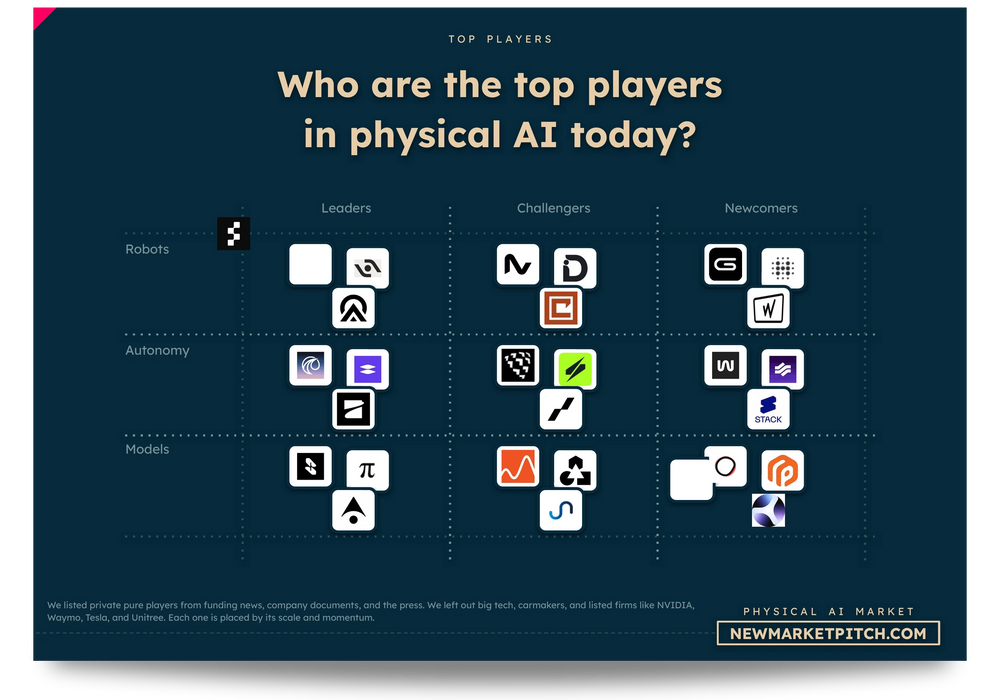
In our report covering the physical AI market, we turn what is vague and complex into simple, useful visuals. Market maps like this one show you at a glance where every startup stands.
Which physical AI startup is growing the fastest right now?
AgiBot is currently the fastest-growing major private physical AI startup by humanoid robot shipments, while Unitree has the strongest publicly documented multiyear revenue growth among its closest private competitors.
According to research firm Smart Analytics Global, AgiBot shipped approximately 8,400 humanoid robots in the first half of 2026, up 562% year over year. Unitree shipped around 5,900 over the same period, representing 170% growth. AgiBot has therefore overtaken a competitor that was considerably larger just one year earlier.
The financial comparison is less straightforward. Unitree's IPO prospectus shows annual revenue growing from RMB159.13 million in 2023 to RMB1.70 billion in 2025. UBTECH, a publicly traded competitor, reported a 1,445% increase in humanoid robotics revenue during the first half of 2026.
These figures point to three different leaders. AgiBot is growing fastest in robot shipments, Unitree has demonstrated exceptional company-wide sales growth over several years, and UBTECH currently has one of the highest disclosed growth rates in humanoid revenue.
We give AgiBot the overall lead among private humanoid startups because its latest growth is supported by both substantial shipment volumes and a sharp increase in market share. But naming the fastest-growing company across all of physical AI, including autonomous vehicles and warehouse automation, would require financial data that many private companies still do not publish.
If you want more recent data on this point, please see our latest physical AI market report.
Why are physical AI startups growing so fast now?
Physical AI startups are growing so quickly because humanoid robots are finally being manufactured and shipped in meaningful numbers, although their use in everyday industrial operations is still developing.
Smart Analytics Global estimates that worldwide humanoid shipments increased from approximately 5,100 in the first half of 2025 to 19,100 in the first half of 2026. Its reported year-over-year growth rate is approximately 272%.
The acceleration is striking because this is still a young market. Counterpoint Research separately estimated more than 22,000 shipments during the same period, while IDC put the figure near 25,000. The estimates differ, but all three research firms found a dramatic increase.
Several changes are happening together. Manufacturers such as AgiBot and Unitree are producing smaller, relatively accessible robots alongside larger industrial machines. UBTECH is selling full-size humanoids into commercial applications. Figure AI and Agility Robotics have started demonstrating what their robots can do inside real factories and warehouses.
The increase in production is especially important. A few years ago, the industry was largely defined by prototypes and demonstrations. Today, leading manufacturers can deliver thousands of machines over six months.
However, the kinds of customers buying these robots vary considerably. Research laboratories, universities, entertainment companies, and manufacturers have different expectations. Selling a robot to a university is much easier than proving that the same machine can replace several hours of paid factory work every day.
That helps explain why robot shipments are growing faster than the evidence of widespread industrial adoption.

Our research about physical AI gets updated several times a month, so you always get the latest view of where things stand.
How can we tell which physical AI startup is actually growing fastest?
Revenue growth is the strongest way to identify the fastest-growing physical AI business, but robot shipments currently provide a more consistent comparison between private humanoid manufacturers.
Physical AI covers systems that use artificial intelligence to understand and interact with the physical world. Humanoid robots are one part of that market, alongside autonomous vehicles, warehouse robots, and intelligent industrial machines.
For companies selling robots, we can examine revenue, units shipped, customer deployments, and repeat orders. These figures reveal different aspects of growth.
Revenue measures how much customers are paying. Shipments show how quickly manufacturers are expanding production and distribution. Commercial deployments help establish whether customers are putting those machines to work.
Funding and valuation tell us something else: how much investors are prepared to bet on the company's future.
This distinction is particularly important for Figure AI, whose $39 billion valuation is far larger than the disclosed annual revenues of many competing robot manufacturers. Figure has demonstrated valuable technology, but its valuation cannot establish how quickly its sales are growing.
We therefore give the greatest weight to comparable revenue figures when available, followed by shipment growth and evidence of customers expanding their deployments. The strongest conclusions come when several of these measures point in the same direction.
Is AgiBot growing faster than Unitree?
AgiBot is growing much faster than Unitree in humanoid shipments right now, and it has already turned that advantage into global market leadership.
Smart Analytics Global estimates that Unitree shipped approximately 2,185 humanoids during the first half of 2025, compared with roughly 1,269 for AgiBot. These figures are calculated from the research firm's latest shipment totals and reported growth rates.
One year later, the positions had reversed. AgiBot was shipping around 2,500 more robots than Unitree over the equivalent six-month period.
We calculate that AgiBot added approximately 7,100 shipments year over year, compared with roughly 3,700 for Unitree. AgiBot generated nearly twice as many additional shipments as its closest competitor.
That is more revealing than the growth percentages alone. AgiBot was already selling more than a thousand robots before its latest acceleration, so this was hardly a tiny startup growing from a handful of units.
The company also expanded its estimated worldwide market share from 25% to 44%. Unitree, meanwhile, held around 31% in the latest period.
IDC and Counterpoint Research reached similar conclusions about AgiBot's leadership, although their absolute shipment estimates differed.
For now, AgiBot has the clearest lead in the private humanoid shipment race.
| Metric | AgiBot | Unitree |
|---|---|---|
| H1 2025 shipments, estimated | ~1,269 | ~2,185 |
| H1 2026 shipments | ~8,400 | ~5,900 |
| Year-over-year growth | +562% | +170% |
| Additional shipments | ~7,131 | ~3,715 |
| Latest global market share | 44% | 31% |
| Share of combined shipments | 58.7% | 41.3% |
| Main product advantage | Broad humanoid range | Accessible humanoids and quadrupeds |
| Source | Smart Analytics Global | Smart Analytics Global |
If you want more recent data on this point, please see our latest physical AI market report.

In our market report about physical AI, we look at what the winners do differently, so you can learn from the best instead of guessing.
How quickly is AgiBot increasing robot production?
AgiBot's manufacturing output has accelerated dramatically, with the company producing 5,000 additional robots in roughly three months during the first half of 2026.
AgiBot announced its 5,000th mass-produced humanoid in December 2025. It reached 10,000 cumulative units on March 30, 2026, and announced its 15,000th unit on June 28.
The latest increase represents approximately 56 robots produced per calendar day between those milestones.
This production pace helps explain how AgiBot managed to overtake Unitree. The company has expanded beyond a single humanoid design, offering full-size A-series robots, smaller X-series models, and wheeled G-series machines.
These products address different buyers. A research institution might want a smaller, more affordable robot for experimentation, while a factory could prefer a wheeled system designed to move materials or manipulate objects.
Offering several configurations gives AgiBot more opportunities to sell machines without depending entirely on the adoption of expensive bipedal robots.
Still, production milestones have limitations. A robot leaving a factory does not necessarily mean a customer has paid for it, deployed it, or found it useful.
The manufacturing acceleration is clear. The company's precise revenue growth remains harder to establish because comparable audited financial statements are not publicly available.
Is Unitree growing faster than AgiBot in revenue?
Unitree currently has stronger public evidence of sustained revenue growth than AgiBot, with annual sales increasing more than tenfold between 2023 and 2025.
According to Unitree's IPO prospectus, revenue increased from RMB159.13 million in 2023 to RMB392.77 million in 2024, then reached approximately RMB1.70 billion in 2025.
We calculate growth of around 147% in 2024 and 333% in 2025. The company therefore grew faster in percentage terms in the second year, despite operating from a much larger revenue base.
The absolute increase is even more interesting. Unitree added approximately RMB234 million in revenue in 2024, followed by more than RMB1.30 billion in 2025. Its annual increase became more than five times larger.
The company has also built a business extending beyond humanoids. Its quadruped robots serve research, commercial, and industrial markets, giving Unitree more ways to generate sales than manufacturers focused entirely on human-shaped robots.
The prospectus reported 33,294 quadruped robots sold between 2023 and 2025, alongside 5,632 humanoids. Overseas sales generated RMB731.66 million in 2025, representing approximately 43.65% of main-business revenue.
That international exposure is significant. Unitree's revenue growth has been supported by customers outside China as well as domestic demand.
We cannot compare these financial results directly with AgiBot's revenue because AgiBot has not published equivalent figures.
So Unitree wins the documented multiyear revenue comparison, while AgiBot leads on current shipment growth.

In our document detailing everything you need to know about physical AI, you will always find fresh funding data, taken straight from our own verified funding database.
Is UBTECH growing even faster than these private robotics startups?
UBTECH is currently reporting faster humanoid revenue growth than either AgiBot's shipment growth or Unitree's latest annual revenue growth, although its publicly listed status places it outside a strict private-startup ranking.
The company's Hong Kong Stock Exchange interim results show that full-size humanoid robotics revenue increased from RMB38.2 million in the first half of 2025 to RMB590.3 million in the first half of 2026.
That is a 1,445% increase.
Unit sales grew even faster, rising from approximately 45 to 921 machines, or nearly 20.5 times the previous year's volume.
We can calculate another useful figure from these disclosures. Dividing humanoid revenue by reported units sold gives approximately RMB849,000 per robot in the earlier period and RMB641,000 in the latest period.
These are blended revenue-per-unit figures rather than actual selling prices, since the category includes related services. Nevertheless, they suggest that UBTECH generated roughly 25% less revenue per robot on average while sharply expanding volume.
The company is also becoming much more dependent on humanoids. Full-size humanoid products and services accounted for 46.5% of consolidated revenue in the latest half-year, compared with just 6.1% one year earlier.
In a remarkably short period, humanoid robotics became UBTECH's largest reported product category.
UBTECH is now one of the clearest examples of how quickly commercial physical AI revenue can grow. Its results also show why the answer changes when we include publicly traded companies.
If you want more recent data on this point, please see our latest physical AI market report.
Which physical AI companies have the highest reported growth rates?
UBTECH, AgiBot, and Unitree currently stand out for exceptional growth, while Horizon Robotics, Geek+, and Symbotic provide useful comparisons with more established physical AI businesses.
The difference is clearest when we compare the pace of expansion with the size of the underlying business.
UBTECH's humanoid segment grew from a relatively small revenue base. Unitree generated hundreds of millions of yuan in additional annual sales. AgiBot increased its robot shipments by several thousand units in a single year.
Meanwhile, more established companies are growing at lower percentages but from much larger commercial operations.
Horizon Robotics, which develops intelligent driving technology, reported RMB2.055 billion in first-half 2026 revenue, up 32.9%. Geek+, a warehouse robotics specialist, recorded 25.3% revenue growth during the same period.
Symbotic, which provides warehouse automation systems, generated $721 million in its fiscal third quarter of 2026, a 22% increase.
These companies show what a more developed robotics business can look like. Their growth percentages are less spectacular, but they are generating substantial revenue from customers already using automation.
The figures below preserve their original measurement periods. A six-month shipment increase and a full-year revenue increase are different measurements, even when their percentages appear in the same table.
| Company | Business | Latest growth | Measurement |
|---|---|---|---|
| UBTECH | Humanoid robotics | +1,445% | H1 2026 segment revenue |
| AgiBot | Humanoid robotics | +562% | H1 2026 shipments |
| Unitree | Humanoids and quadrupeds | ~+333% | 2025 annual revenue |
| UBTECH | Robotics and hardware | +104.2% | H1 2026 group revenue |
| Horizon Robotics | Autonomous driving technology | +32.9% | H1 2026 revenue |
| Geek+ | Warehouse robotics | +31.6% | 2025 annual revenue |
| Geek+ | Warehouse robotics | +25.3% | H1 2026 revenue |
| Symbotic | Warehouse automation | +22% | Fiscal Q3 2026 revenue |

Learning from others' mistakes is the cheapest lesson there is. In our report covering the physical AI market, we look at what broke startups before you, so you don't repeat it.
Are companies actually using humanoid robots at work now?
Humanoid robots are already doing real jobs inside factories and warehouses, with Figure AI and Agility Robotics providing some of the clearest examples of commercial progress.
Figure AI's deployment at BMW's Spartanburg plant is particularly revealing.
According to Figure's November 2025 report, its Figure 02 robots operated for more than 1,250 hours, handled over 90,000 sheet-metal parts, and supported the production of more than 30,000 BMW X3 vehicles.
BMW independently confirmed these figures and described the deployment as a successful industrial pilot.
The robots performed a defined parts-handling task rather than assembling entire vehicles. Still, the project involved actual factory operations, with robots working ten-hour shifts on production days.
Agility Robotics has taken another approach with Digit, a humanoid designed for warehouse work.
At GXO's Flowery Branch facility in Georgia, Digit has handled tasks involving the movement of totes through a live logistics operation. The companies signed a multiyear commercial agreement in 2024.
These applications are relatively narrow. They involve repetitive work in controlled environments where the robot can learn a specific task and perform it consistently.
That is where humanoid robotics currently has the strongest practical evidence. More complicated work involving unfamiliar objects, changing environments, and frequent unexpected situations remains harder to automate reliably.
Is Agility Robotics becoming a serious competitor to AgiBot and Unitree?
Agility Robotics is becoming a serious competitor in industrial humanoid deployments, particularly because existing customers are expanding their use of its Digit robots.
GXO and Agility announced an expansion of their partnership in October 2026, with additional deployments planned for facilities in North Carolina and Tennessee during 2027.
The announcement followed their original commercial agreement covering GXO's warehouse in Georgia.
The relationship has therefore moved through several stages: initial testing, a multiyear commercial agreement, and planned expansion into additional operating sites.
That progression gives Agility an advantage in demonstrating repeat customer demand.
The company also reported more than 65,000 hours of real-world robot operation across its commercial activities and customer programs. It disclosed three additional manufacturing customers and an active pipeline exceeding 30 prospective customers.
We should distinguish confirmed customers from companies still evaluating potential deployments. A sales pipeline does not establish future revenue, and announced expansions scheduled for 2027 have not yet become completed deployments.
Agility also has RoboFab, a manufacturing facility designed for annual capacity of up to 10,000 robots. That figure describes potential capacity rather than actual output.
Even so, Agility's customer history is impressive. A warehouse operator choosing to expand an existing robot program gives us stronger evidence of useful technology than another impressive demonstration video.
We cannot currently establish that Agility is growing faster in revenue or shipments than the Chinese leaders, but it is becoming one of the more credible industrial humanoid competitors.

In our research about physical AI, we always try to gather several sources and make estimates that make sense, so you can work with solid numbers.
Has Figure AI's $39 billion valuation turned into real commercial growth?
Figure AI has demonstrated meaningful factory results, but there is still insufficient public revenue data to establish that its commercial business is growing as fast as its valuation suggests.
In September 2025, Figure announced more than $1 billion in committed Series C capital at a $39 billion post-money valuation.
That financing placed Figure among the world's most highly valued private robotics companies.
The company has several advantages. Its Helix AI system is designed to help robots learn physical tasks, its newer Figure 03 platform builds on earlier hardware, and its BotQ manufacturing strategy aims to support larger-scale production.
Its BMW deployment also produced useful operational data.
Figure disclosed that the forearm was the main hardware failure point during the factory program. The company subsequently redesigned the wrist electronics and communication systems for Figure 03.
That is a concrete example of how real factory experience can improve a robot's design.
However, BMW's successful pilot does not tell us how many commercial robots Figure has sold, how much revenue it recognizes, or what customers currently pay for deployments.
Figure's valuation reflects expectations about future adoption, rather than an independently established position in the current revenue rankings.
Figure could become a major competitor, especially if its technology scales across industrial customers. For now, its commercial growth rate remains unverified.
If you want more recent data on this point, please see our latest physical AI market report.
Are autonomous driving startups growing faster than humanoid robot companies?
Autonomous driving startups are already pursuing much larger commercial markets than humanoid robot manufacturers, but we do not have enough comparable financial data to declare an autonomous driving startup the fastest-growing physical AI company.
Wayve is an important example. The British startup develops AI driving software designed to work across different vehicle platforms.
In February 2026, Wayve announced a $1.2 billion Series D financing at an $8.6 billion post-money valuation, alongside additional milestone-dependent financing connected to Uber.
Its partnerships include plans for robotaxi trials and integration of driving software into production vehicles.
That approach could eventually give Wayve access to much larger deployment volumes than a humanoid manufacturer building robots individually.
But planned vehicle deployments are not the same as completed sales. Wayve does not publish a comparable annual revenue series that would allow us to calculate its current growth rate against Unitree.
The broader autonomous driving market is also more commercially mature in some areas.
Horizon Robotics already earns billions of yuan in revenue from intelligent driving products and services. Autonomous vehicle operators such as Waymo have also reached substantial real-world deployment scale.
Autonomous driving is already a major part of physical AI growth, especially in absolute market size.
The current evidence simply does not support combining autonomous driving companies and humanoid manufacturers into one definitive percentage-growth ranking.

If you build or invest in the physical AI market, you need to know which business models pay off now and which ones are fading. That's why our report covering it has a whole section on it.
Are cheaper robots helping AgiBot and Unitree sell more?
More affordable robots are helping AgiBot and Unitree reach customers beyond major industrial buyers, although price reductions alone cannot explain the industry's rapid growth.
Unitree has been especially aggressive in making advanced robotics accessible to researchers, developers, and smaller organizations.
Its product range includes quadruped robots and relatively compact humanoids such as the G1, alongside more sophisticated platforms.
AgiBot has followed a broad product strategy of its own, developing compact humanoids, full-size bipedal robots, and wheeled manipulation systems.
These companies can therefore address different customer budgets and use cases without waiting for expensive general-purpose robots to become commercially viable.
UBTECH's financial results add another piece of evidence. As seen above, its blended humanoid revenue per unit declined while sales volumes increased sharply.
We cannot automatically conclude that individual models became 25% cheaper, since changes in product mix and services can affect the average. But the figures show that the company sold many more robots while generating less revenue per unit on average.
Cheaper hardware also changes what buyers can afford to experiment with.
A university may purchase several compact humanoids for research, while a large manufacturer might test a more expensive robot on one production line before expanding the deployment.
The harder question comes afterward: whether the machine can perform enough useful work to justify its total cost.
That calculation includes maintenance, software, integration, supervision, and downtime. Low purchase prices help open the market, but industrial customers will ultimately judge the robots by productivity.
Are the fastest-growing physical AI companies profitable yet?
Unitree has already reported substantial profits, while UBTECH remains loss-making despite its extraordinary humanoid revenue growth. The two companies show how differently financial performance can develop during rapid expansion.
Unitree's IPO prospectus reported approximately RMB278.21 million in net profit for 2025.
Against RMB1.70 billion in revenue, that represents a reported net margin of roughly 16.4%.
The company also disclosed RMB590.75 million in profit attributable to its parent after excluding non-recurring items. That is a different accounting measure and should not be treated as equivalent to consolidated net profit.
UBTECH offers a useful contrast.
Despite its rapid humanoid growth, the company recorded a loss of RMB338.8 million in the first half of 2026. This was an improvement from RMB440 million a year earlier, but the business had not yet reached profitability.
UBTECH's overall gross margin improved from 35.0% to 44.7%, suggesting stronger product economics even as development and operating expenses remained substantial.
Symbotic shows what profitability can look like in a more established robotics business. Its fiscal third-quarter 2026 results included $55 million in net income, compared with a $21 million loss one year earlier.
Unitree's position is particularly interesting. It has combined exceptionally fast revenue growth with reported profits, which is still uncommon among highly valued robotics challengers.
AgiBot, Figure AI, and Agility Robotics have not released sufficiently comparable financial statements for us to make the same profitability assessment.

In our document detailing everything you need to know about physical AI, we don't want to repeat what boring consulting reports say. Instead, we show you the real and latest market signals that matter.
Can AgiBot keep growing faster than Unitree?
AgiBot can maintain its shipment lead over Unitree, but continuing to grow at its latest percentage rate would require an enormous increase in manufacturing and customer demand.
Consider the arithmetic.
AgiBot's latest six-month shipment base is approximately 8,400 units. Repeating the same year-over-year percentage increase would require roughly 55,600 shipments during the equivalent period the following year.
That would be almost three times the entire worldwide humanoid shipment market estimated by Smart Analytics Global for the first half of 2026.
AgiBot therefore faces a different challenge now that it has become the largest manufacturer in that dataset.
The company needs to retain customers, support expanding deployments, and maintain product quality as its installed base grows. Its ability to sell internationally will also become more important as competition increases in China.
Unitree has an advantage in having already demonstrated a sizable international business. Its 2025 overseas revenue exceeded RMB730 million, giving it experience serving buyers across different regions.
Agility Robotics has experience with long-running industrial programs, while Figure is using lessons from factory work to improve its next generation of hardware.
AgiBot's shipment lead is real, but the next stage of competition will increasingly depend on repeat purchases and customer economics.
It is entirely possible for AgiBot to remain the largest humanoid manufacturer while another company grows faster in revenue or earns better margins.
Which physical AI startup has the best chance of winning the market?
AgiBot currently looks best positioned to lead humanoid robot shipments, while Unitree has a particularly strong combination of revenue growth, international sales, and reported profitability.
AgiBot benefits from its ability to serve several customer categories and manufacture large quantities of different robot models. Its rapid market-share gains suggest that this strategy is working.
Unitree's business has a different strength. The company has built significant sales across humanoid and quadruped robots, rather than relying on one emerging application.
UBTECH is developing a substantial industrial humanoid business, but its continuing losses show that turning sales growth into profits remains difficult.
Agility Robotics has a credible path through warehouse operations, especially if GXO and other industrial customers expand their deployments. Figure has the financing and technical resources to compete for larger factory programs.
These companies are pursuing somewhat different markets, so the winner may depend on what customers actually want humanoid robots to do.
For research institutions, affordability and access to development tools can be decisive. For factories, reliability and output per hour matter much more. Logistics operators also need robots that integrate with existing warehouse systems.
The companies that succeed in one category will not automatically dominate the others.
Our current preference is AgiBot for near-term shipment leadership and Unitree for demonstrated financial performance. Agility and Figure remain important challengers in industrial deployments, where the potential long-term revenue per customer could be substantial.
If you want more recent data on this point, please see our latest physical AI market report.

In our report covering the physical AI market, we like to show you the big picture. We know your time is precious, so we make every page quick to read and packed with as much learning as possible per minute.
So which physical AI startup is growing the fastest today?
AgiBot is currently the fastest-growing major private physical AI startup by humanoid robot shipments, while Unitree is the strongest contender when we prioritize documented multiyear revenue growth.
AgiBot's expansion is especially convincing because it has overtaken Unitree while increasing its share of a rapidly growing global market. Its production milestones also support the picture of a company manufacturing robots at a much larger scale than before.
Unitree, however, has something equally valuable: financial statements showing that its revenue has grown more than tenfold in two years, alongside reported profitability.
Among publicly traded companies, UBTECH has demonstrated even faster growth in its humanoid business, although the company is still losing money.
Our judgment is therefore clear within the market where comparable evidence exists. AgiBot leads the private humanoid shipment-growth race, Unitree has the strongest documented commercial growth history among the closest private competitors, and UBTECH leads the disclosed humanoid revenue-growth comparison.
Calling AgiBot the fastest-growing startup across every category of physical AI would go further than the available data allows. Private autonomous driving and warehouse robotics companies do not disclose enough consistent revenue information to establish that broader claim.
The most revealing development is that these companies are increasingly being judged on products shipped, customer spending, and real operating experience. The next leader will be the company that can keep growing those numbers after the initial wave of robot purchases and experiments.
Our methodology
We compared physical AI companies using their latest reported revenue growth, robot shipments, production milestones, customer deployments, and financial performance. We separated private humanoid manufacturers from publicly traded robotics businesses and autonomous driving companies because their disclosures, products, and growth measures differ considerably.
We used revenue growth as the clearest measure of commercial expansion, while comparing humanoid shipments to assess momentum among private manufacturers without equivalent published financial statements. AgiBot and Unitree's shipment figures come primarily from Smart Analytics Global, with Counterpoint Research and IDC used to assess the wider market. We calculated prior-year shipments, absolute increases, and market-share comparisons from the reported figures. Unitree's financial results and UBTECH's humanoid segment disclosures provided the principal revenue comparisons.
We examined manufacturing milestones separately from customer adoption, prioritizing customer-confirmed operating results and expanding commercial relationships when assessing industrial progress. Figure AI's deployment at BMW and Agility Robotics' work with GXO provided concrete examples. We also compared financial profitability where disclosed, and treated funding rounds and valuations as indicators of investor expectations rather than evidence of revenue growth.
We retained the original reporting periods for each company and distinguished company-wide revenue from humanoid segment revenue and unit shipments. The overall assessment favors recent, measurable expansion at meaningful scale, with separate conclusions for shipment leadership, documented financial growth, and industrial deployment progress.
Key sources for this analysis include: Smart Analytics Global's H1 2026 shipment rankings, Counterpoint Research's humanoid market estimates, AgiBot's 10,000-unit production milestone, AgiBot's 15,000-unit production milestone, Shanghai Stock Exchange reporting on Unitree's IPO disclosures, Hong Kong Stock Exchange filings for UBTECH, Hong Kong Stock Exchange filings for Geek+, and Symbotic's fiscal third-quarter 2026 results.
For commercial deployments, valuation, and technology, we also used Figure AI's BMW production report, BMW Group's independent deployment confirmation, Agility Robotics' original GXO agreement, GXO's October 2026 expansion announcement, Agility Robotics' customer momentum disclosure, Figure AI's Series C announcement, Figure AI's engineering and manufacturing update, Wayve's Series D announcement, and Geek+'s 2026 interim results.

When you build or invest in the physical AI market, you need clarity, not confusion. In our research about physical AI, we always try to put numbers on and quantify whatever is usually vague and confusing.
Written by the New Market Pitch teamWe track new markets so founders and investors can move faster. About us