Can solid-state battery firms make money just licensing?
Whether you're building or investing in the solid-state battery market, our report covers everything you need to know: the players, the money, and what's coming next.
Summary
Solid-state battery firms can make money just licensing their technology, but none of the leading independent developers has yet proved that pure licensing can generate consistent profits. The commercial agreements are real; large-scale recurring royalties are still missing.
Licensing solves one of the industry's biggest financial problems: building battery factories can require billions of dollars. QuantumScape and Solid Power are instead asking established manufacturers to finance industrial production while they develop and license the underlying technology.
The money available before commercial production is substantial but often misunderstood. QuantumScape's PowerCo arrangements contemplate up to approximately $261 million in conditional payments, while Solid Power's original SK On agreements covered roughly $50.3 million across licensing, manufacturing-line installation and electrolyte supply. Neither figure represents recurring annual royalties.
There is a striking gap between industrial engagement and financial performance. QuantumScape reported no operating revenue in the first half of 2026, Solid Power's revenue and grant income fell sharply over the same period, and Factorial Energy reported no revenue despite working with several major automakers.
The potential royalty economics become attractive at scale. At an illustrative $80/kWh cell price and a hypothetical 3% royalty, 40 GWh of annual licensed battery production would generate $96 million in royalties. QuantumScape's expanded 80 GWh PowerCo framework would imply $192 million if all that capacity were producing and paying royalties.
A billion-dollar licensing business would require far more capacity. Under those same assumptions, approximately 417 GWh of annual production would be needed. That's more than five times QuantumScape's maximum contemplated PowerCo capacity, and it assumes commercial output rather than merely installed manufacturing capacity.
The difficult part is that battery licensing cannot scale like software licensing. Every manufacturing partner must reproduce complex chemistry and processes at industrial yields, often requiring continuing engineering support from the licensor. Factory ownership disappears from the developer's balance sheet, but industrialization expenses do not.
Automakers are also keeping their options open. PowerCo works with both QuantumScape and Factorial, while BMW's solid-state efforts involve Solid Power and Samsung SDI. Multiple partnerships demonstrate industry interest, but they also weaken the assumption that every development agreement will become a high-volume production contract.
Competition from conventional batteries is tightening the economics. As lithium-ion and especially LFP batteries become cheaper, solid-state technology must justify its manufacturing complexity and licensing fees through better energy density, safety, charging performance or other valuable advantages. Premium vehicles and specialized applications may become commercial markets before mass-market cars.
A hybrid model currently looks more practical than pure licensing. Solid Power's combination of technology agreements, manufacturing services and proprietary electrolyte supply illustrates how developers can earn money during commercialization without owning gigafactories. That diversification also creates costs a pure royalty business would avoid.
The decisive test is still ahead. Investors need to see licensed factories producing batteries commercially, royalties arriving across consecutive reporting periods, and development expenses growing more slowly than licensing income. The companies that ultimately win will be those whose patents, materials and processes remain indispensable even after manufacturing partners learn how to produce the batteries themselves.

Written by the New Market Pitch teamWe track new markets so founders and investors can move faster. About us

A good product starts with a real problem. In our report covering the solid-state battery market, we show you the ones customers still live with.
Why are solid-state battery companies trying to avoid building factories?
Solid-state battery companies are increasingly choosing licensing because building battery factories can consume billions of dollars before a single cell is sold.
QuantumScape offers the clearest example. In July 2024, the company replaced its proposed manufacturing joint venture with Volkswagen's PowerCo with a licensing agreement covering an initial 40 GWh of annual production capacity, expandable to 80 GWh. PowerCo would take responsibility for industrial production while QuantumScape focused on battery technology, process development and intellectual property.
Solid Power has pursued a similar approach through agreements with SK On and BMW. The company develops solid electrolytes, transfers manufacturing expertise and licenses technology to established manufacturers rather than building its own gigafactories.
The appeal is obvious when we consider what these companies are trying to commercialize. A new battery chemistry can require years of qualification, expensive manufacturing equipment and repeated production trials before reaching automotive volumes. Every factory a developer finances increases the capital it needs to raise and the financial damage if commercialization takes longer than expected.
Licensing allows battery specialists to concentrate on their inventions while established manufacturers pay for most of the industrial infrastructure. The catch is that a promising battery design still needs to work reliably on somebody else's production line.
Are solid-state battery firms actually making money from licensing today?
Leading solid-state battery developers have started earning money from technology agreements, but recurring royalties from mass-produced batteries are still largely absent.
QuantumScape's financial statements for the first half of 2026 reported no operating revenue despite its extensive partnership with PowerCo. Solid Power generated $21.7 million in revenue and grant income during 2025, primarily from collaboration agreements, development work and government support rather than royalties on commercially manufactured batteries.
Factorial Energy offers an even sharper contrast. The company works with Mercedes-Benz, Stellantis, Hyundai/Kia and PowerCo, yet its second-quarter 2026 filing described Factorial as a development-stage company with no revenue to date.
Across the three companies, we find different levels of commercial progress but no established stream of large-scale production royalties.
A manufacturer can pay for research, prototype development or technology transfer years before it starts producing batteries under a commercial license. Those payments are useful, but they are a very different business from earning a percentage of every battery manufactured.
For now, the industry has demonstrated that major battery manufacturers will spend money accessing new technology. Whether those agreements can support profitable, recurring licensing businesses remains a separate question.
If you want more recent data on this point, please see our latest solid-state battery market report.

If you build or invest in the solid-state battery market, you need to know which business models pay off now and which ones are fading. That's why our report covering it has a whole section on it.
How much licensing money has QuantumScape secured from Volkswagen?
QuantumScape has negotiated up to approximately $261 million in potential payments linked to its PowerCo commercialization arrangements, although most of that amount remains conditional and none should be confused with established production royalties.
The original July 2024 agreement contemplated a $130 million prepaid royalty associated with licensing battery technology for up to 40 GWh of annual manufacturing capacity. That prepayment depends on contractual conditions and would be credited against future royalties.
In July 2025, QuantumScape and PowerCo expanded their cooperation. PowerCo agreed to contribute up to another $130.7 million over two years, depending on technical milestones and industrialization targets.
QuantumScape's second-quarter 2026 filing showed that $10.4 million had been received under the expanded arrangement. The company recorded that amount as a capital contribution rather than operating revenue.
The accounting reveals how the arrangement works. PowerCo is financing the commercialization effort, but QuantumScape has not yet established a conventional royalty business.
The potential payments also have different economic meanings. The $130 million royalty prepayment would bring forward money otherwise associated with future production, while the additional $130.7 million supports development and industrialization.
We should therefore avoid treating the combined $261 million as either guaranteed income or a recurring annual revenue figure. The agreement is substantial, but its ultimate value will depend on licensed manufacturing reaching commercial scale.
Does Solid Power's deal with SK On prove that battery licensing works?
Solid Power has proved that battery manufacturers will pay millions for access to solid-state technology, but its SK On agreements have not made the company profitable.
The companies signed several agreements in January 2024 covering research licensing, manufacturing-line installation and electrolyte supply.
The research-and-development license provided for $20 million in milestone payments through 2027. A separate agreement covered approximately $22 million for installing a manufacturing line, while an electrolyte supply contract involved minimum expected purchases worth $8.3 million through 2030.
Together, the arrangements represented approximately $50.3 million in potential payments, subject to their terms. Only $20 million came from the research licensing component.
By August 2026, Solid Power reported that it had completed the manufacturing-line installation agreement and received the associated milestone payment. It was also negotiating a new collaboration with SK On.
The financial results put these achievements into perspective. Solid Power generated $21.7 million in revenue and grant income in 2025 while reporting $122.6 million in operating expenses. During the first half of 2026, revenue and grant income fell to $2.8 million, compared with approximately $13.6 million a year earlier.
The second quarter even included a $1.2 million reversal of previously recognized revenue after the company revised assumptions about certain milestone payments.
That's the problem with relying on development contracts. Payments can arrive irregularly, depend on technical targets and decline sharply between reporting periods.
Solid Power has successfully sold technology and engineering services to a major battery manufacturer. Turning those activities into a profitable company will require significantly more recurring income.

Learning from others' mistakes is the cheapest lesson there is. In our market report about solid-state batteries, we look at what broke startups before you, so you don't repeat it.
How much could QuantumScape earn if PowerCo starts mass-producing batteries?
QuantumScape could theoretically generate nearly $100 million in annual royalties from 40 GWh of licensed battery production under a 3% royalty scenario, although its actual royalty terms have not been publicly established at that level.
We can calculate the potential using the manufacturing capacity specified in the PowerCo agreement.
Forty gigawatt-hours represent 40 million kilowatt-hours of batteries annually. Assuming an illustrative cell selling price of $80 per kWh, full production would generate $3.2 billion in annual battery sales.
At a hypothetical 3% royalty on that sales value, QuantumScape would receive $96 million annually. At 80 GWh, the corresponding amount would double to $192 million.
The numbers become especially interesting because QuantumScape would not need to finance the entire manufacturing capacity itself.
However, the royalty percentage, selling price, production utilization and contractual offsets all affect the outcome. The agreement's proposed royalty prepayment could also reduce later payments because it would be credited against future royalties.
Here is how different production volumes and hypothetical royalty rates change the economics.
| Annual licensed production | 1% royalty | 3% royalty | 5% royalty |
|---|---|---|---|
| 1 GWh | $0.8M | $2.4M | $4M |
| 5 GWh | $4M | $12M | $20M |
| 10 GWh | $8M | $24M | $40M |
| 20 GWh | $16M | $48M | $80M |
| 40 GWh | $32M | $96M | $160M |
| 80 GWh | $64M | $192M | $320M |
| 120 GWh | $96M | $288M | $480M |
| 250 GWh | $200M | $600M | $1B |
These figures assume an illustrative cell price of $80/kWh, full utilization and royalties calculated on cell sales, before any contractual adjustments. They are scenario calculations rather than company guidance.
If you want more recent data on this point, please see our latest solid-state battery market report.
Could solid-state battery licensing become a billion-dollar business?
A solid-state battery company could eventually earn $1 billion annually from licensing, but the production volumes required would be enormous.
At an illustrative $80/kWh selling price and a 3% royalty rate, a developer would need approximately 417 GWh of annual licensed production to generate $1 billion in royalties.
Even at a 5% royalty rate, the required volume would be 250 GWh.
For comparison, QuantumScape's PowerCo agreement currently contemplates up to 80 GWh of annual capacity. Under our 3% scenario, that entire capacity would produce around $192 million in annual royalties if fully utilized.
A billion-dollar royalty business would therefore require several manufacturing partnerships of comparable scale, a much higher royalty rate, higher battery prices or a combination of these.
There is another constraint: cell prices will probably change as manufacturing improves and competition increases. A royalty tied to battery sales could decline per kilowatt-hour even while the number of batteries produced rises.
That makes licensing volume particularly important. A developer with technology used across several manufacturers may eventually have a more valuable business than one dependent on a single automaker, even if the latter has a larger initial agreement.
For now, $1 billion in annual solid-state battery royalties remains a possible long-term outcome rather than a revenue level supported by existing commercial production.

When you build or invest in the solid-state battery market, you need clarity, not confusion. In our document detailing everything you need to know about solid-state battery, we always try to put numbers on and quantify whatever is usually vague and confusing.
Why is solid-state battery licensing harder than software licensing?
Solid-state battery licensing is much harder to scale than software licensing because every new manufacturing partner must learn how to reproduce the technology reliably in a factory.
Software can often be distributed to thousands of customers with relatively little additional production cost. Battery technology requires physical materials, specialized equipment, process engineering and strict quality control.
A manufacturer may need to adjust electrolyte preparation, electrode processing, separator production, pressure management or equipment settings before achieving acceptable battery performance.
QuantumScape's separator technology illustrates the challenge. Making a high-performance separator in a laboratory is only one part of the work. Manufacturing large quantities with consistent quality and competitive costs requires a separate industrialization effort.
Solid Power faces similar demands with sulfide-based solid electrolytes. The company has invested in a continuous manufacturing pilot line designed to produce up to 75 metric tons annually, allowing it to validate production processes before moving toward commercial-scale supply.
These activities require engineers, equipment and continuous development even when the company does not own the final battery factory.
Licensing can become very profitable once a manufacturing process is established and widely adopted. The difficult part is getting to the point where a customer can keep manufacturing batteries without extensive intervention from the technology developer.
Can upfront licensing payments cover a solid-state battery company's costs?
Upfront licensing payments can help finance solid-state battery development, but the agreements disclosed so far are generally too small or irregular to cover the leading developers' ongoing expenses.
Solid Power's $20 million SK On research license is spread across several years and linked to milestones. Its operating expenses reached $122.6 million in 2025, showing how quickly research and industrial preparation can absorb commercial payments.
QuantumScape's potential $130 million PowerCo royalty prepayment is considerably larger. Yet the company reported a net loss of roughly $199 million for the first half of 2026.
Net losses are not the same as cash spending, particularly when stock-based compensation and other noncash items are involved. Even allowing for that distinction, the financial scale of these companies' development programs is substantial.
The timing of payments creates another problem. A developer cannot necessarily sign a new manufacturing agreement every quarter. Battery customers typically need extensive testing before committing to additional licensing rights.
And once a manufacturer has licensed a particular technology, future development work may fall under an existing contract rather than generate an entirely new upfront fee.
A business built exclusively around upfront payments would therefore need a steady pipeline of new customers, applications or technology generations.
We have yet to see evidence that the current group of independent solid-state battery developers can repeat large licensing deals frequently enough to finance their entire operations that way.
If you want more recent data on this point, please see our latest solid-state battery market report.

In our report covering the solid-state battery market, we look at what the winners do differently, so you can learn from the best instead of guessing.
Are automakers paying several solid-state battery companies at the same time?
Major automakers are working with several solid-state battery developers simultaneously, which shows strong interest in the technology but also means that individual partnerships do not guarantee future manufacturing volumes.
Volkswagen's PowerCo has its established relationship with QuantumScape, while Factorial disclosed a separate development agreement with PowerCo in February 2026.
BMW works with Solid Power and has participated in joint battery development with Samsung SDI. Mercedes-Benz and Stellantis have both backed Factorial through partnerships and strategic investments.
In June 2026, QuantumScape also announced a joint research agreement with Honda R&D, adding another automaker to its development network.
Technology developers are gaining access to more automotive partners, while those manufacturers are keeping multiple technological options open.
An automaker may finance several development programs before selecting the chemistry, supplier and manufacturing process it intends to use. Some partnerships will probably never progress beyond testing.
For licensors, non-exclusive agreements can still create an attractive opportunity. QuantumScape's PowerCo framework is non-exclusive, allowing the company to pursue other manufacturing partners.
But each new customer has its own technical requirements and industrial capabilities. The number of automotive partnerships is therefore a useful measure of industry interest, though a much weaker measure of future licensing income.
Is Factorial Energy getting closer to commercial royalties?
Factorial Energy is making genuine progress toward commercial battery production, but its automotive demonstrations have not yet produced revenue.
The company has achieved several milestones with major automakers.
In April 2025, Stellantis reported validation of Factorial's 77 Ah solid-state battery cells, citing an energy density of 375 Wh/kg and more than 600 test cycles. In June 2026, the companies announced that Factorial cells had been integrated into a Dodge Charger Daytona development vehicle for road testing.
Mercedes-Benz also demonstrated solid-state technology using Factorial cells in an EQS-based test vehicle that completed a 1,205 km public-road journey in 2025.
Full-size cells have been validated, integrated into actual vehicles and tested outside laboratory conditions. That's meaningful engineering progress.
However, Factorial's second-quarter 2026 financial filing reported no revenue to date and an accumulated deficit of approximately $275.5 million. The company recorded an $11.3 million net loss during the quarter.
Its Mercedes-Benz agreement also leaves future commercial supply subject to further discussions and contractual decisions.
The missing piece is a firm commitment to manufacture and sell large quantities of batteries under a revenue-generating arrangement.
Factorial has demonstrated enough to keep major automotive partners engaged. It now needs those technical achievements to translate into commercial orders, licensing payments or another source of recurring income.

Your time is limited. In our research about solid-state batteries, we put numbers on each part of the market, so you can see where it makes sense to focus.
Could selling solid electrolytes make more money than licensing battery patents?
Selling proprietary solid electrolytes could give solid-state battery firms a more dependable source of recurring revenue, particularly while commercial battery royalties remain years away.
Solid Power is already pursuing this approach. Alongside licensing cell technology, the company develops sulfide-based solid electrolytes that manufacturers can use in their own batteries.
Its supply agreement with SK On included minimum expected purchases worth approximately $8.3 million through 2030. That is relatively modest, but it provides a route to revenue based on physical material shipments rather than patent royalties.
The company's planned continuous manufacturing line, with capacity of up to 75 metric tons annually, is intended to validate larger-scale electrolyte production. Solid Power has also discussed a potential joint venture in South Korea for commercial-scale electrolyte manufacturing.
Toyota and Idemitsu Kosan have adopted a related industrial approach, combining Toyota's battery development with Idemitsu's solid-electrolyte production capabilities. Their work has targeted commercialization around 2027–2028.
Solid-electrolyte production could become a distinct business within the broader solid-state battery industry.
There is a trade-off, of course. A materials supplier must invest in equipment, purchase raw materials and control production costs. Unlike a pure licensor, its expenses grow with manufacturing activity.
But supplying an essential material could generate revenue across many battery models and customers without waiting for a separate royalty negotiation on every completed cell.
For companies with valuable chemistry and manufacturing expertise, combining electrolyte sales with licensing may prove more commercially practical than depending exclusively on intellectual property fees.
If you want more recent data on this point, please see our latest solid-state battery market report.
Will cheaper lithium-ion batteries make solid-state licensing unprofitable?
Falling lithium-ion battery prices are making life harder for solid-state battery licensors because manufacturers need a stronger reason to pay extra for new technology.
According to the International Energy Agency's Global EV Outlook 2026, average battery prices fell another 8% in 2025. Lithium iron phosphate batteries accounted for more than 55% of global EV battery deployment, up from nearly 50% the previous year.
LFP battery packs were also more than 40% cheaper on average than nickel-manganese-cobalt alternatives, although differences in application and energy requirements contributed to that gap.
A battery with higher energy density may allow a vehicle to travel further or use a smaller pack. Faster charging, improved safety or reduced weight can also justify higher prices in certain applications.
But conventional batteries are already improving, and a manufacturer must consider the total cost of adopting a new chemistry. That includes equipment changes, manufacturing yield, qualification expenses and licensing payments.
Solid-state technology may initially find better economics in premium vehicles, aerospace, specialized robotics and other applications where weight or performance matters more than the lowest possible cost.
Factorial has already identified drones and mobile robots among its target applications, alongside passenger vehicles and energy storage.
These markets could support better prices per kilowatt-hour, although their production volumes are usually smaller than those of mainstream electric vehicles.
Cheaper lithium-ion batteries therefore push solid-state developers toward applications where their performance advantage is large enough to cover the additional manufacturing and licensing costs.

In our market report about solid-state batteries, we always try to gather several sources and make estimates that make sense, so you can work with solid numbers.
Could battery manufacturers eventually stop paying solid-state technology licensors?
Battery manufacturers could become less dependent on their original solid-state technology partners as they learn how to manufacture the batteries themselves, but strong patents and carefully designed contracts can preserve long-term royalty rights.
During technology-transfer programs, manufacturers acquire detailed knowledge of production processes. They learn which equipment settings improve yield, how materials behave under industrial conditions and which design changes reduce costs.
That knowledge can make future production easier. It can also create disagreements about who owns improvements developed during joint research.
Solid Power's agreements with BMW distinguish between existing intellectual property, jointly developed inventions and technology created independently by each party. Factorial's partnerships also contain provisions governing intellectual property rights and cross-licensing.
These terms determine which company can use a process, license it elsewhere or develop an alternative version.
The strongest licensing position belongs to a developer whose patents cover technology that manufacturers still need after learning how to operate the production line.
A proprietary electrolyte chemistry or essential separator process may be difficult to replace without redesigning the battery. General manufacturing expertise may become less valuable once a partner has acquired enough practical experience.
As we saw above with the PowerCo and SK On arrangements, successful technology transfer is an important step toward commercial revenue. It can also reduce a manufacturer's technical dependence on the original developer.
For licensors, the goal is to make the manufacturing process easier for customers while keeping the underlying technology valuable enough to support payments over many years.
What would prove that solid-state battery licensing is actually profitable?
Solid-state battery licensing would be commercially proven once developers receive recurring royalties from mass-produced batteries and those payments consistently exceed the cost of maintaining their technology businesses.
We can already identify several intermediate achievements across the industry. QuantumScape has negotiated a large manufacturing license. Solid Power has received payments for research licensing and technology transfer. Factorial has demonstrated batteries in actual vehicles.
The next commercial milestones are more demanding: licensed factories must produce reliable batteries at scale, customers must purchase them, royalties must become recurring income and developers must control their continuing research expenses.
The table below separates the progress of major partnerships from the financial evidence still missing.
| Company or partnership | What has been demonstrated | What remains unproven |
|---|---|---|
| QuantumScape / PowerCo | Large commercial licensing framework | Recurring manufacturing royalties |
| QuantumScape / Honda | Joint research relationship | Commercial licensing agreement |
| Solid Power / SK On | Paid technology license and completed line installation | Profitable recurring licensing income |
| Solid Power / BMW | Development licensing and automotive testing | Commercial production royalties |
| Solid Power / Samsung SDI | Joint electrolyte evaluation | Commercial material orders at scale |
| Factorial / Mercedes-Benz | Solid-state vehicle testing | Revenue-generating commercial production |
| Factorial / Stellantis | Validated cells and vehicle integration | Large-scale commercial sales |
| Toyota / Idemitsu | Electrolyte industrialization collaboration | Profitable solid-state production at scale |
What stands out is how much progress has occurred before meaningful production royalties have appeared.
Several partnerships have lasted for years, involved major automotive groups and produced tangible engineering results. Yet current financial statements still show substantial development spending and limited operating income.
The strongest proof will come from a company reporting increasing royalties over several consecutive periods while its research costs grow much more slowly. That would finally establish the financial advantage behind the licensing strategy.
If you want more recent data on this point, please see our latest solid-state battery market report.

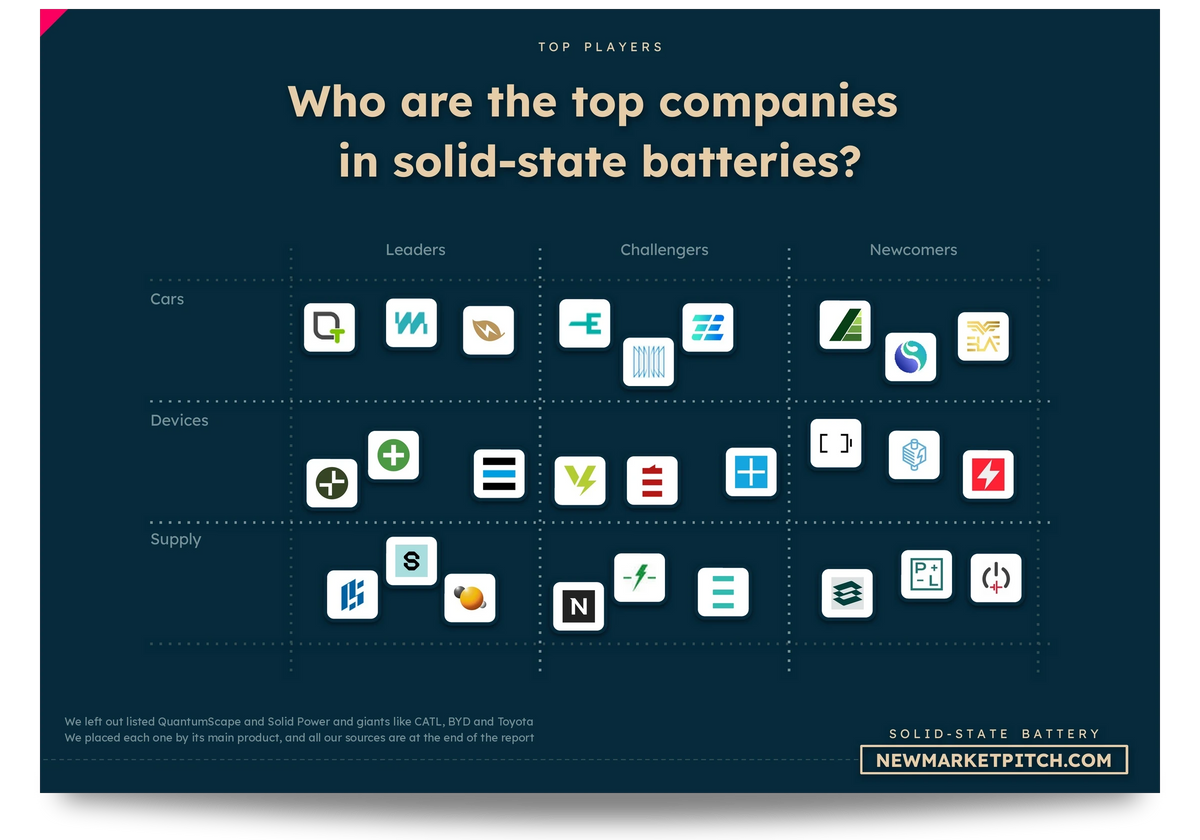
In our document detailing everything you need to know about solid-state battery, we turn what is vague and complex into simple, useful visuals. Market maps like this one show you at a glance where every startup stands.
Can solid-state battery firms make money just licensing?
Yes, solid-state battery firms can make money from licensing, but pure licensing has not yet become a proven, consistently profitable business model among the leading independent developers.
QuantumScape has established the most visible large-scale licensing framework, with PowerCo's agreement covering up to 80 GWh of annual manufacturing capacity. Solid Power has already generated payments from research licensing and manufacturing technology transfer. Factorial has secured extensive automotive partnerships and reached meaningful technical milestones without generating revenue.
Across these companies, there is genuine demand for solid-state battery intellectual property. The problem is converting that demand into recurring payments large enough to cover years of expensive development.
The potential economics are attractive. Under our illustrative calculations, 80 GWh of licensed annual production could generate $192 million in royalties at a 3% rate and an $80/kWh cell price. A company licensing the same technology across several manufacturers could eventually generate substantial revenue without owning their factories.
However, those calculations depend on successful mass production, commercially competitive batteries and enforceable royalty agreements. None of those conditions can simply be assumed from an automotive partnership announcement.
A hybrid business currently looks more realistic. Selling proprietary electrolytes, collecting development payments and licensing manufacturing technology gives companies several ways to earn revenue while their customers move toward commercial production.
The pure-licensing model could become highly profitable once solid-state batteries are manufactured at scale. For now, the financial evidence favors companies that can monetize their technology throughout the development process rather than waiting years for royalties.
The eventual winners will be the developers whose inventions remain essential after automakers have mastered production. That is when solid-state battery licensing could start resembling the high-margin business its supporters have been promising.
Sources and methodology
This analysis examines whether solid-state battery developers can build profitable businesses by licensing their technologies without owning large-scale cell factories. We assessed recent developments through 2026 across QuantumScape, Solid Power and Factorial Energy, alongside manufacturing partnerships involving PowerCo, SK On, BMW, Samsung SDI, Mercedes-Benz, Stellantis, Toyota and Idemitsu.
Our approach was to identify recent financial, contractual and industrial developments for each part of the business model, aggregate comparable evidence across companies, and assess what that evidence establishes about commercial viability. We examined six dimensions: upfront licensing income, potential production royalties, industrialization costs, manufacturing scalability, intellectual property protection and competition from established battery chemistries.
For contractual economics, we distinguish announced maximum agreement values from payments actually received, and separate research-and-development fees, manufacturing-line installation payments, electrolyte supply commitments and production royalties. QuantumScape's proposed $130 million royalty prepayment and additional conditional PowerCo contributions are analyzed separately. Solid Power's SK On agreements are likewise divided according to their underlying payment arrangements rather than treated as a single licensing revenue stream.
Reported revenue, grant income, operating expenses and losses are taken from company financial disclosures. We use these figures to assess whether licensing and technology-transfer activities are sufficient to support ongoing operations. Accounting revenue, capital contributions and cash payments are not treated as interchangeable, and reported net losses are distinguished from actual cash expenditure.
We modeled potential royalty income independently using hypothetical rates of 1%, 3% and 5%, an illustrative battery cell selling price of $80/kWh, and annual licensed production ranging from 1 GWh to 250 GWh. We also estimated the capacity required to generate $1 billion in annual royalties. These calculations assume realized manufacturing output and royalties based on cell sales; they are not forecasts, disclosed contractual rates or company guidance. Actual results would depend on utilization, prices, eligible production, payment offsets and contractual terms.
Our industrial assessment compares technical validation with evidence of commercial manufacturing. Automotive cell testing, successful vehicle demonstrations and manufacturing-line installation are meaningful milestones, but do not establish production yields, sustainable unit economics or recurring royalty payments. We used these distinctions to compare the progress of QuantumScape, Solid Power and Factorial without treating very different development stages as equivalent.
We also examined the durability of the licensing business. Manufacturing partners can acquire technical knowledge as production scales, so patent ownership, proprietary materials, jointly developed intellectual property and contractual rights influence future royalty retention. Battery market pricing and the growing adoption of LFP chemistry were included to assess whether solid-state performance advantages could justify additional manufacturing and licensing costs.
Key sources include QuantumScape's PowerCo licensing and collaboration announcements, QuantumScape's financial and SEC filings, Solid Power's SK On agreements, Solid Power's SEC disclosures, and Solid Power's financial results. These sources provide the primary basis for evaluating agreement values, recognized revenue, milestone payments and development expenses.
For commercialization milestones, we used BMW's Solid Power vehicle testing announcement, BMW's Samsung SDI and Solid Power collaboration disclosure, Stellantis's Factorial cell validation announcement, Mercedes-Benz's solid-state EQS demonstration, and regulatory filings covering Factorial Energy.
Industry-level context comes from the International Energy Agency's Global EV Outlook 2026 battery analysis, together with Toyota's Idemitsu solid-electrolyte collaboration announcement and Toyota's material industrialization update. We prioritized original company documents, regulatory disclosures and first-hand industrial announcements when comparing financial progress and manufacturing readiness.
Our assessment rests on the combined evidence across these dimensions. The profitability threshold is deliberately stricter than the existence of a licensing agreement: a sustainable pure-licensing business requires recurring commercial royalties sufficient to cover ongoing research, engineering, technology support and corporate costs. This distinction separates the value of today's partnerships from the economics that still need to be demonstrated at industrial scale.

Our report covering the solid-state battery market gets updated several times a month, so you always get the latest view of where things stand.
Written by the New Market Pitch teamWe track new markets so founders and investors can move faster. About us