What are the most valuable solid-state battery startups?
Whether you're building or investing in the solid-state battery market, our report covers everything you need to know: the players, the money, and what's coming next.
Summary
QingTao Energy leads the solid-state battery startups we track, reportedly valued at ~$3.93B. ProLogium is close behind at $3.8B, followed by WeLion New Energy at a reported ~$2.6B.
That lead is thin. QingTao's ~$3.93B is barely above ProLogium's $3.8B, and the two prices come from different kinds of deals.
Only 3 of the 34 companies we track clearly qualify as unicorns. The other 31, or 91%, are below $1B. Big prices are still the exception in solid-state batteries.
China has much of the lead in private-company valuations, with two of the three unicorns. American developers such as Blue Current have not clearly passed $1B yet.
QingTao has supplied batteries for vehicles and applied to list in Hong Kong. It has gone further into the automotive market than startups still testing cells in small batches.
ProLogium already makes ceramic batteries in Taiwan, and its planned factory in France could take production much further. But the company is still early in selling its newer products at scale.
WeLion's battery technology reached NIO vehicles. Then weak demand for an expensive long-range pack showed how quickly a technical success can become a commercial disappointment.
The American companies are taking other routes. Blue Current is building up pilot production, while ION Storage Systems has passed a customer qualification step. Neither result guarantees large orders.
Cars are only part of this market. ITEN makes miniature batteries for electronics, while other startups sell solid electrolytes or develop sodium-based cells for storage.
For now, QingTao is worth the most. But the gap at the top is small, and the next big test is whether these companies can produce batteries that customers keep buying at a price that works.

Written by the New Market Pitch teamWe track new markets so founders and investors can move faster. About us

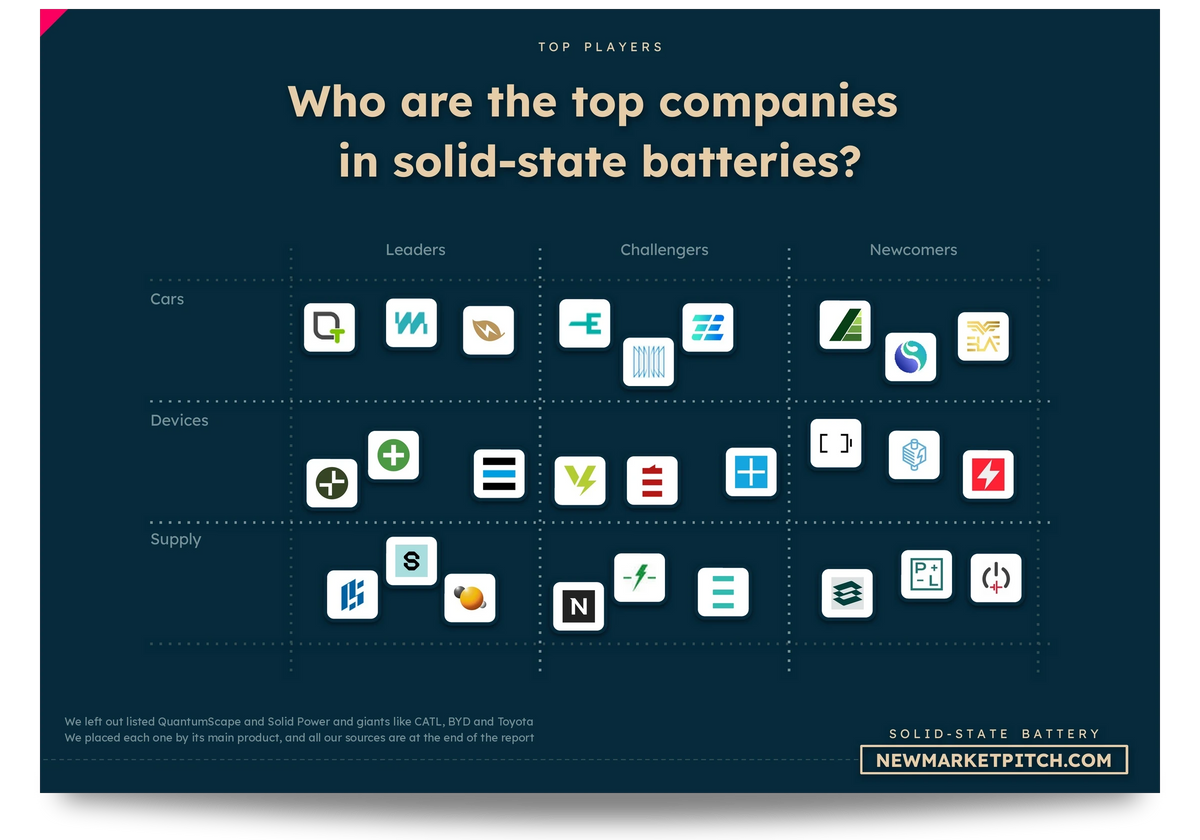
In our report covering the solid-state battery market, we turn what is vague and complex into simple, useful visuals. Market maps like this one show you at a glance where every startup stands.
Top startups in the solid-state battery market ranked by valuation
Here is the current ranking of the most valuable solid-state battery startups. For each one you will also find our confidence level and the valuation basis we used.
If you want to go deeper into the solid-state battery startup landscape, check our report covering the solid-state battery market.
| # | Startup | Valuation | Confidence | Valuation basis | Last round | Total funding |
|---|---|---|---|---|---|---|
| Private startups | ||||||
| 1 | QingTao EnergyManufactures solid-state vehicle batteries | ~$3.93Bas of Feb 2026 | Strong | Reported private round valuation | $277MSeries H · Feb 2026 | $648M+valued at 6.1× this |
| 2 | ProLogiumManufactures ceramic solid-state batteries | $3.8Bas of Jul 2026 | Partial | Merger valuation | $110MStrategic equity · Jan 2022 | $536M+valued at 7.1× this |
| 3 | WeLion New EnergyManufactures hybrid solid-state lithium batteries | ~$2.6Bas of Jun 2025 | Strong | Reported private round valuation | UndisclosedSeries D+ · Oct 2025 | $78M+valued at 33.3× this |
| 4 | INX TechnologyProduces lithium-metal solid-state batteries | $667M–$1.3Bas of Aug 2026 | Low | Estimated from last round | $100M+Series B · Aug 2026 | $146M+valued at 6.2× this |
| 5 | Blue CurrentDevelops silicon-composite solid-state batteries | $540M–$1.0Bas of Dec 2025 | Strong | Implied valuation from raise | $81MSeries D+ · Dec 2025 | $111M+valued at 6.7× this |
| 6 | ITENManufactures miniature ceramic solid-state batteries | $523M–$980Mas of Oct 2022 | Low | Estimated from last round | $78MUnnamed €80M equity round · Oct 2022 | $95Mvalued at 7.6× this |
| 7 | Talent New EnergyDevelops hybrid solid-state battery systems | $373M–$700Mas of Dec 2025 | Low | Estimated from last round | $56M+Series B+ · Dec 2025 | $56M+valued at 9.1× this |
| 8 | LionGo New EnergyDevelops and manufactures oxide-based solid electrolytes and related hybrid electrolytes for semi-solid and all-solid-state battery cells. | $183M–$344Mas of Nov 2026 | Low | Estimated from last round | ~$28MSeries B+ · Nov 2026 | $86M+valued at 2.9× this |
| 9 | Yaoshi LithiumSolid-state lithium battery technology | $144M–$240Mas of Feb 2026 | Low | Estimated from last round | ~$29MSeries A · Feb 2026 | $29Mvalued at 6.5× this |
| 10 | SolivisManufactures sulfide solid electrolyte materials | $113M–$213Mas of Aug 2026 | Low | Estimated from last round | $17MSeries C · Aug 2026 | $44M+valued at 3.5× this |
| 11 | Ion Storage SystemsDevelops anodeless ceramic solid-state batteries | $100M–$240Mas of Nov 2026 | Partial | Comparables-based estimate | $30MSeries A · Jun 2022 | $30Mvalued at 5.2× this |
| 12 | Adden EnergyDevelops fast-charging lithium-metal batteries | $113M–$211Mas of Sep 2026 | Low | Estimated from last round | $17MSeries B · Sep 2026 | $37Mvalued at 4.2× this |
| 13 | Hytzer EnergyCommercializes polymer solid-state batteries | >$150Mas of Jul 2024 | Full | Announced private round valuation | UndisclosedPre-A (strategic) · Aug 2025 | Undisclosed |
| 14 | Enpower GreentechDevelops advanced solid-state lithium batteries | $100M–$167Mas of Jul 2022 | Low | Estimated from last round | $20M+Series A+ · Jul 2022 | $36M+valued at 3.6× this |
| 15 | Anthro EnergyDevelops polymer-based battery electrolytes | $100M–$167Mas of Feb 2024 | Low | Estimated from last round | $20MSeries A · Feb 2024 | $27M+valued at 4.7× this |
| 16 | Gaoneng Digital ManufacturingDevelops dry-electrode equipment and integrated manufacturing lines designed for all-solid-state battery cell production. | $93M–$175Mas of Nov 2026 | Low | Estimated from last round | ~$14MSeries B · Nov 2026 | $14Mvalued at 9.1× this |
| 17 | LionVoltSolid-state battery cells for drones | $83M–$138Mas of Feb 2024 | Low | Estimated from last round | $17MSeries A · Feb 2024 | $22Mvalued at 4.8× this |
| 18 | Ampcera1Manufactures advanced solid electrolyte materials | $75M–$125Mas of Dec 2022 | Low | Estimated from last round | $15MSeries A · Dec 2022 | $15Mvalued at 6.5× this |
| 19 | BasquevoltDevelops lithium-metal solid-state battery cells | $58M–$96Mas of Mar 2025 | Low | Estimated from last round | UndisclosedStrategic equity · Mar 2026 | $22Mvalued at 3.4× this |
| 20 | SoelectLithium-metal anodes and solid electrolyte membranes | $55M–$92Mas of Feb 2022 | Low | Estimated from last round | $11MSeries A · Feb 2022 | $11M+valued at 6.5× this |
| 21 | Guxin EnergyProduces specialized hybrid solid-state batteries | $46M–$86Mas of Mar 2025 | Low | Estimated from last round | UndisclosedSeries B · Aug 2026 | $6.9M+valued at 9.1× this |
| 22 | SOLiTHOR1Develops solid-state lithium battery cells | $44M–$73Mas of May 2022 | Low | Estimated from last round | $11MSeed · May 2022 | $11Mvalued at 5.2× this |
| 23 | Zhonggu EraSolid-state battery cells for energy storage | ~$40Mas of Feb 2026 | Full | Announced private round valuation | $2.1MSeries B+ · May 2026 | $4.9M+valued at 8.1× this |
| 24 | GTC-PowerDevelops solid-state battery electrolyte materials | $28M–$47Mas of Mar 2022 | Low | Estimated from last round | $7M+Angel · Mar 2022 | $7M+valued at 5.2× this |
| 25 | Keyuan Solid EnergySolid-state battery electrolyte materials | $22M–$56Mas of Aug 2026 | Low | Estimated from last round | $5.6MOther · Aug 2026 | $5.6Mvalued at 6.3× this |
| 26 | LiNa EnergyDevelops solid-state sodium storage batteries | $20M–$45Mas of Nov 2026 | Partial | Comparables-based estimate | $3.5MSeed · Mar 2024 | $14Mvalued at 2.1× this |
| 27 | BTRYDevelops ultra-thin solid-state microbatteries | $23M–$38Mas of Nov 2025 | Low | Estimated from last round | $5.7MSeed · Nov 2025 | $6.7M+valued at 4.4× this |
| 28 | NatrionDevelops solid electrolyte battery components | $18M–$46Mas of Nov 2025 | Low | Estimated from last round | $4.6MLater-stage venture equity, reported · Nov 2025 | $6.9Mvalued at 4.2× this |
| 29 | TaiSanDevelops polymer electrolytes for sodium batteries | $21M–$35Mas of Jul 2026 | Low | Estimated from last round | $5.3MSeed · Jul 2026 | $7M+valued at 3.9× this |
| 30 | ASETSolid state battery materials and cells | $8.9M–$15Mas of Sep 2025 | Low | Estimated from last round | $2.2MSeed · Sep 2025 | $5.3Mvalued at 2.2× this |
| 31 | Solid IonicsSolid-state battery electrolyte materials | $8.9M–$15Mas of Mar 2024 | Low | Estimated from last round | $2.2MSeed · Mar 2024 | $4.4Mvalued at 2.6× this |
| 32 | PiersicaDevelops high-energy solid-state battery components | $8.4M–$14Mas of Jan 2026 | Low | Estimated from last round | $2.1MSeed · Jan 2026 | $4.6Mvalued at 2.4× this |
| 33 | Tuopu TechnologyDevelops and produces quasi-solid battery cells with oxide-polymer composite solid electrolytes for drones and other high-energy applications. | $7M–$12Mas of Nov 2026 | Low | Estimated from last round | $1.4M+Series A · Nov 2026 | $1.4M+valued at 6.5× this |
| 34 | Johnson Energy StorageDevelops solid-state battery technology | $5M–$8.3Mas of Oct 2024 | Low | Estimated from last round | $1MSeries A · Oct 2024 | $3.6Mvalued at 1.8× this |
| Listed in the last 5 years or acquired in the last 3 years · not ranked | ||||||
| Factorial Energy2Develops automotive solid-state battery cells | $478Mas of Nov 2026 | Full | Public market cap | $112MPost-IPO equity · Jun 2026 | $312Mvalued at 1.5× this | |
| Solid Power2Develops sulfide electrolytes and solid-state batteries | $446Mas of Nov 2026 | Full | Public market cap | ~$543MSPAC business combination, including associated equity financing · Dec 2021 | $699Mvalued at 0.6× this | |
No startups match this search.
- Total funding is a minimum: undisclosed rounds may raise these totals.
- Total funding includes the primary proceeds of its IPO.

Our research about solid-state batteries gets updated several times a month, so you always get the latest view of where things stand.
Why are solid-state battery startups worth billions already?
Investors value some solid-state battery startups in the billions because they have moved beyond lab experiments, even though mass-market adoption is still a long way off.
A solid electrolyte could help battery makers improve safety and use different materials in the electrodes. Those benefits matter for electric cars, but they are difficult to deliver together. Cells must survive years of charging, withstand temperature changes and come off a production line consistently. The challenge gets harder when a customer also wants the battery to be affordable.
There is real progress behind some of the high prices. QingTao Energy has put batteries into vehicles. ProLogium makes ceramic cells and works with automakers on testing. Toyota and Idemitsu are building a supply chain for solid electrolytes, showing that established manufacturers also expect the technology to matter. Still, these are different kinds of progress. A shipped battery, a qualified prototype and a factory plan are not interchangeable.
The high valuations are bets on which companies can turn the chemistry into a business. We give the most weight to repeat customers and reliable production, because those are the things that turn an impressive battery into something worth paying for.
Is QingTao Energy really ahead of ProLogium?
Yes, but QingTao Energy's lead over ProLogium in solid-state battery startup valuations is too small to call the race settled.
QingTao is reportedly valued at ~$3.93B, compared with ProLogium's $3.8B value in its proposed business combination with Translational Development Acquisition Corp. The top-two ratio rounds to 1.0x. That does not mean the companies are tied exactly. Their values also come from different places: a reported private price for QingTao and an agreed merger value for ProLogium, not two identical funding rounds.
QingTao's application to list in Hong Kong describes passenger-vehicle and commercial-vehicle battery deployments. ProLogium has a running factory in Taiwan and has sent cells to customers for evaluation. These achievements tell us more than the tiny difference between their quoted values. One company has already reached vehicle programs; the other is trying to turn a long record of cell manufacturing into much larger sales.
For now we put QingTao first, exactly as the prices indicate. But a single large vehicle order, a failed factory ramp or a new priced transaction could easily change how investors see this close contest.

In our market report about solid-state batteries, we look at what the winners do differently, so you can learn from the best instead of guessing.
Can ProLogium really justify its multibillion-dollar valuation?
ProLogium makes real solid-state batteries, but its $3.8B merger valuation depends on sales growing far beyond today's level.
ProLogium agreed its proposed combination with Translational Development Acquisition Corp. in May 2026. The agreement describes a proposed public-market transaction, not a completed private funding round. A later SEC filing gives an unusually useful reality check: ProLogium reported $6.2 million in revenue for 2024 and $2.9 million for 2025. Those numbers are small next to the proposed company value, and revenue went in the wrong direction before the next production ramp.
ProLogium has more manufacturing history than many young battery companies. In its merger announcement, it said it had shipped more than 2.4 million cells since 2013. The company also announced further testing with Mercedes-Benz in September 2026. Its French factory project could eventually increase output, but construction is still work to be done, not sales already booked.
We take ProLogium's ability to make cells seriously. Its price today, though, asks investors to believe the company can find buyers for much greater volumes of its newer batteries. The SEC numbers make that hurdle impossible to ignore.
Is WeLion New Energy still worth billions?
WeLion New Energy still carries a reported ~$2.6B valuation, but its best-known semi-solid car battery failed to attract enough buyers.
The Chinese company developed cells used in NIO's long-range battery program. That was a genuine technical achievement: WeLion's product reached a real vehicle rather than remaining a laboratory prototype. But NIO chief executive William Li said in a November 2025 interview that the automaker stopped making the premium pack after producing only several hundred units. Customers rarely chose it because the extra range cost too much, especially when charging and battery swapping were readily available.
WeLion is pursuing more than that one pack. Its published technology plans cover newer semi-solid cells, fast charging and applications outside premium passenger cars. Those changes could help it find customers with different needs. We should not assume that demand for one unusually expensive car battery tells us the fate of every product the company makes.
The lesson for valuation is sharp: delivering a technically advanced pack is not enough. WeLion now needs orders that come back regularly and products that customers will pay for without a special marketing campaign.
How many solid-state battery unicorns are there?
Only 3 of the 34 solid-state battery startups we track have valuations fully above $1B: QingTao Energy, ProLogium and WeLion New Energy.
That is 9% of the group. The other 31, or 91%, remain below the threshold on the valuation measure we use. A company with a broad estimated range stretching past $1B is not automatically a unicorn. Its lower end has to clear the line too.
This distinction matters for newer contenders. INX Technology's $667M–$1.3B range crosses the threshold, while Blue Current's $540M–$1.0B range reaches it at the top. INX's range is our estimate from the size of its August 2026 equity round, dated to that round; it was not announced by investors. Blue Current's range follows from disclosed financing terms, rather than from a single company-stated price.
We also keep listed companies separate. A stock-market price can change every trading day, while private values often stay on record until the next deal. The result is a much smaller unicorn group than the number of ambitious battery developers might suggest.

In our document detailing everything you need to know about solid-state battery, you will always find fresh funding data, taken straight from our own verified funding database.
Are Chinese startups winning the solid-state battery race?
China leads the private solid-state battery valuation race, although that does not prove Chinese cells will win every market.
Two of the three solid-state battery unicorns, QingTao Energy and WeLion New Energy, are Chinese, and INX Technology is close behind with an estimated $667M–$1.3B, followed by younger cell and electrolyte developers. That breadth gives Chinese automakers and parts suppliers several local technologies to test, rather than forcing them to depend on one laboratory or one battery design.
But the strongest valuation outside mainland China belongs to Taiwan's ProLogium. French ITEN has a real electronics business, and American companies are developing ceramics, polymers and composite cells. These products do not all compete for the same orders. A battery for a medical sensor can become a commercial product much sooner than a large cell destined for millions of vehicles.
We think China's lead in private valuations is clear. Its ultimate lead in sales will depend on which battery types drivers, factories and electronics makers decide are worth paying for.
The table below shows the most valuable Chinese solid-state battery startups in their valuation order.
| Company | Valuation |
|---|---|
| QingTao Energy | ~$3.93B |
| WeLion New Energy | ~$2.6B |
| INX Technology | $667M–$1.3B |
| Talent New Energy | $373M–$700M |
| LionGo New Energy | $183M–$344M |
| Yaoshi Lithium | $144M–$240M |
| Hytzer Energy | >$150M |
Ranges are ranked on their middle value. Hytzer Energy's floor is ranked at $150M.
Why hasn't the U.S. produced a private solid-state battery unicorn?
No U.S.-headquartered private solid-state battery startup has a valuation fully above $1B in our research, despite real progress in battery development.
Blue Current is among the higher-valued American contenders. ION Storage Systems makes an anodeless ceramic battery, Adden Energy works on fast-charging lithium-metal cells, and Anthro Energy develops polymer-based electrolyte technology. These companies face different technical problems and different markets, so they should not be judged against one automotive factory timetable.
There are signs that customers are getting closer to using the products. In March 2026, ION Storage Systems announced that its Cornerstone ceramic battery had passed a customer qualification step. That is more useful than simply reporting a promising lab result, but qualification does not say how much a customer will order. The gap between passing tests and earning repeat revenue remains wide.
Another source of confusion is the American listed companies. Factorial Energy and Solid Power attract attention because investors can trade their shares, but public-market values do not belong in a ranking of private financing prices. America's absence from the private unicorn group is therefore a statement about confirmed valuations, not a claim that its battery companies have stopped making progress.

Learning from others' mistakes is the cheapest lesson there is. In our report covering the solid-state battery market, we look at what broke startups before you, so you don't repeat it.
Could Blue Current become a solid-state battery unicorn soon?
Blue Current could become a private solid-state battery unicorn, but its current implied valuation does not yet make that official.
Blue Current has an implied value of $540M–$1.0B, based on financing terms, with at least $111M in equity funding in our count. The range ends at the unicorn threshold; it does not place the company clearly above it. A new round with an openly stated price would settle that question much better than picking the highest point in today's range.
There is more to watch than the valuation. Blue Current is developing silicon-composite solid-state cells, and its Hayward pilot line began producing test cells in 2026. Amazon participated in its 2025 financing, a useful sign of investor interest but not evidence that Amazon has placed a huge battery order. For automakers and other customers, the next questions are how often a cell performs as specified and whether the manufacturing process can be repeated cheaply.
We see Blue Current as a plausible future unicorn. It will get there on a stronger funding price or on customer demand that changes what buyers are willing to pay for the business, not on an optimistic reading of a range.
Which Chinese solid-state battery startup could hit $1B next?
INX Technology is one of China's closest solid-state battery unicorn contenders, but its valuation is still an estimate rather than an established billion-dollar price.
We estimate INX Technology at $667M–$1.3B using the size of its August 2026 equity round. That estimate is dated to the round and was not announced by the company or its investors. INX designs lithium-metal solid-state batteries for aircraft, drones, robots and vehicles. Its published plans include pilot work and larger manufacturing facilities, although plans and products delivered to paying customers are very different things.
Other Chinese startups show how wide the next group is. Talent New Energy is estimated at $373M–$700M from its December 2025 Series B. LionGo New Energy is estimated at $183M–$344M from its November 2026 Series B and works on oxide-based solid electrolytes. Those are also our estimates from the sizes of the companies' last equity rounds, dated to those rounds, not valuations stated by their investors.
Hytzer Energy, another Chinese developer, has announced a valuation of more than $150M. We rank that floor at $150M, which is why Hytzer sits just behind startups whose estimated ranges include $150M, such as Yaoshi Lithium ($144M–$240M) and Adden Energy ($113M–$211M), even though its real value may well be higher. INX looks promising, but a confirmed new price is still missing.

Your time is limited. In our research about solid-state batteries, we put numbers on each part of the market, so you can see where it makes sense to focus.
Can tiny solid-state batteries make a startup worth hundreds of millions?
ITEN shows that miniature solid-state batteries can support a substantial startup valuation without trying to power electric cars.
We estimate French manufacturer ITEN at $523M–$980M from the size of its October 2022 equity round. The range is dated to that round and was not a company-announced valuation. ITEN makes small ceramic batteries for electronic products where size, safety and the ability to supply short bursts of power matter more than highway range.
In September 2026, ITEN announced that it had made its millionth solid-state battery. That is a concrete production milestone for a specialized product. It does not mean ITEN is comparable to a car-battery gigafactory: a tiny electronics cell stores far less energy. But it does show that a solid-state battery company can have an actual manufactured product while much larger cells are still waiting for commercial approval.
Switzerland's BTRY is exploring another small-scale market. It announced work with InsightSilica to adapt its thin batteries for semiconductor applications. This kind of business may grow through many modest orders instead of waiting for one giant automaker contract. We would judge ITEN and BTRY by how many devices use their batteries and how reliably they can supply them, not by the size of an EV factory they never planned to build.
Are solid-state battery startups selling batteries at scale yet?
Some solid-state battery startups already supply customers, but large-scale sales of fully solid-state EV cells remain far less established than factory announcements suggest.
The answer depends on what battery a company sells. QingTao Energy's Hong Kong listing application describes deployments in passenger and commercial vehicles. ITEN produces tiny cells for electronics. Neither result tells us how many fully solid-state car batteries can be produced profitably every year. The products serve different buyers, and a production count for one kind cannot stand in for the other.
Pilot lines are another step again. Blue Current is making cells for testing, while ION Storage Systems has reported a customer qualification milestone. Those achievements help engineers improve consistency and give customers samples they can evaluate. A pilot line does not become a profitable factory simply because it can manufacture a working battery. The customer still needs to approve the cell, buy enough of it, and keep buying after the first batch.
We separate a laboratory demonstration, a pilot process, a qualified product and repeat commercial deliveries. Valuations can rise at any of those stages, but the strongest case belongs to businesses that have already shown buyers will return at a workable price.
Are semi-solid battery startups worth as much as fully solid-state ones?
Yes, semi-solid battery developers are among the highest-valued solid-state startups, even though their cells still use some liquid or gel.
QingTao Energy works on both hybrid and all-solid-state batteries, and WeLion New Energy brought semi-solid cells into a real car program. ProLogium, meanwhile, focuses on ceramic electrolyte technology. All sit in the highest-value group in our research. Investors appear willing to pay for an architecture that customers can use now, rather than reward technical purity on its own.
The distinction still matters. A genuine semi-solid cell has a functional solid-electrolyte phase alongside its liquid or gel component. An all-solid-state cell removes the liquid component but brings a different set of engineering problems, especially where electrodes meet the electrolyte. Both can be useful; neither automatically wins on price, safety, life span and performance at the same time.
We include genuine hybrid cells because the solid electrolyte is central to how they work. We exclude ordinary liquid-electrolyte producers that happen to have a solid-state research project. Otherwise an article about the value of solid-state battery startups would quickly become a list of large conventional battery companies.

In our market report about solid-state batteries, we always try to gather several sources and make estimates that make sense, so you can work with solid numbers.
Could solid-state electrolyte suppliers become unicorns?
Solid-state electrolyte suppliers could reach $1B valuations, but the independent specialists we track are still below that level.
A company that makes the electrolyte does not always need to build the finished battery. It can supply material to different cell manufacturers, provided its product works in each customer's process and can be made consistently. Ampcera, for example, develops sulfide electrolytes and related production know-how. Solivis focuses on similar materials, while Gaoneng Digital Manufacturing works on equipment and production lines for advanced cells.
The valuations are smaller than those of the best-known vehicle battery makers. LionGo New Energy is at $183M–$344M, Solivis at $113M–$213M and Ampcera at $75M–$125M. Each is our estimate from the size of its last equity round, dated to that round, not a price its investors announced. Those ranges are evidence of investor interest, but they say little about how much material a customer will eventually buy.
A supplier could win by making a component that many factories need. Before calling one a future unicorn, we would want to see actual supply contracts and repeat orders, not just a material that looks excellent in a laboratory.
The table below shows selected solid-state electrolyte, membrane and production specialists in valuation order.
| Company | Valuation |
|---|---|
| LionGo New Energy | $183M–$344M |
| Solivis | $113M–$213M |
| Gaoneng Digital Manufacturing | $93M–$175M |
| Ampcera | $75M–$125M |
| Soelect | $55M–$92M |
| GTC-Power | $28M–$47M |
| Keyuan Solid Energy | $22M–$56M |
| Natrion | $18M–$46M |
Ranges are ranked on their middle in proportion (geometric mean), which puts GTC-Power's narrower range just ahead of Keyuan Solid Energy's wider one.
Is Europe losing the solid-state battery startup race?
European solid-state battery startups trail the biggest private valuations, but several already have products or automotive partners.
ITEN in France makes batteries for electronics. Spain's Basquevolt signed a development agreement with Renault Group's Ampere in February 2026, then announced an aerospace project with Battera Technologies later that year. Belgium's SOLiTHOR works on batteries for aviation and other demanding applications. Dutch company LionVolt is pursuing high-energy cells for drones. None needs to sell the exact same battery to find a business.
The geographic picture can be misleading. ProLogium is headquartered in Taiwan even though it plans to manufacture in Dunkirk, France. That factory would matter for European battery production, but it would not turn ProLogium into a French-headquartered startup. We count headquarters for the valuation comparison and discuss factories separately.
Europe's gap is therefore a gap in the size of confirmed private-company values. It is not proof that European engineers lack working products. The harder question for these developers is whether small commercial programs can become orders large enough to support the next stage of production.
The table below shows European-headquartered solid-state battery startups in their valuation order.
| Company | Country | Valuation |
|---|---|---|
| ITEN | France | $523M–$980M |
| LionVolt | Netherlands | $83M–$138M |
| Basquevolt | Spain | $58M–$96M |
| SOLiTHOR | Belgium | $44M–$73M |
| LiNa Energy | United Kingdom | $20M–$45M |
| BTRY | Switzerland | $23M–$38M |
| TaiSan | United Kingdom | $21M–$35M |
LiNa Energy ranks above BTRY on the middle of its range, even though its range starts lower.

If you build or invest in the solid-state battery market, you need to know which business models pay off now and which ones are fading. That's why our report covering it has a whole section on it.
Can sodium solid-state startups catch the lithium leaders?
Sodium-based solid-state battery startups are still valued far below the lithium leaders, and they are aiming at quite different buyers.
LiNa Energy has an estimated value of $20M–$45M, based on comparable companies. TaiSan is valued at an estimated $21M–$35M from the size of its July 2026 equity round, dated to that round rather than an investor-announced price. Neither range comes close to the companies making high-priced lithium batteries for cars.
That may be the wrong comparison for their products. LiNa opened a pilot facility in Lancaster in June 2025 to develop solid-state sodium batteries for energy storage. Buyers of stationary storage often care more about long operating life, safety and cost than about squeezing extra driving range into a small space. TaiSan is working on polymer-electrolyte sodium cells for smaller mobility applications.
Sodium describes the charge carrier; solid-state describes the electrolyte. A company can belong to both markets when it develops sodium batteries built around a genuine solid electrolyte. We see a plausible path to paying customers, but no evidence yet that the private valuations of these sodium specialists have caught the lithium leaders.
Will drone buyers pay for solid-state batteries before car buyers?
Drones could give solid-state battery startups an earlier market because extra flight time and lower weight can be worth a higher battery price.
Aircraft and drones put a premium on how much energy a cell stores for its weight. They also need batteries that perform reliably under demanding conditions. Those requirements create an opening for a developer whose cell is too expensive for a mass-market car but useful in a specialized aircraft. LionVolt is one European company pursuing drone applications, while INX Technology has also described aviation and robotics as target markets.
The idea is attracting companies beyond the private startup group. In July 2026, publicly listed Factorial Energy announced work with Tulip after drone flight tests. Basquevolt and Battera Technologies announced an aerospace battery project in October. These are development steps rather than evidence of big recurring sales, but they show companies are testing uses where a customer might pay more for a meaningful performance advantage.
We would not turn a successful drone test into a forecast of an automotive breakthrough. The useful question is whether a smaller customer group will order the cells repeatedly. If that happens, drone work can help a startup learn to manufacture reliably long before a passenger-car factory is ready.

In our report covering the solid-state battery market, we don't want to repeat what boring consulting reports say. Instead, we show you the real and latest market signals that matter.
Are Factorial Energy and Solid Power still private battery startups?
Factorial Energy and Solid Power are publicly traded solid-state battery developers, so their market values sit outside the private startup comparison.
Factorial Energy completed its public-market combination in June 2026. Factorial's market capitalization in our research is $478M, versus $446M for Solid Power. Both are included separately as recently listed businesses. Their share prices are updated by trading, while a private company's last agreed value may remain on record long after investors begin thinking differently about it.
Their technology work is still relevant. Factorial's cells powered a Mercedes-Benz EQS demonstration drive, and its SEC disclosures make clear that much more work is needed before full commercial production. Solid Power reported in August 2026 that it was developing a continuous electrolyte pilot line and working with BMW and Samsung SDI. A public listing has not made the battery-manufacturing problems disappear.
A higher private valuation is therefore not proof that a startup has better technology or sells more batteries than a listed developer. We keep the price comparisons separate so readers can see where the money comes from without confusing private deals with stock-market trading.
Is QuantumScape still a solid-state battery startup?
QuantumScape is still developing solid-state batteries, but it has been publicly listed too long to count among the private and recently listed startups we compare.
The company began trading in 2020. Our startup definition covers independent businesses founded in 2000 or later, with recently listed companies shown separately. QuantumScape falls outside that recent-listing window, which explains why it has no private startup position here. Its absence says nothing about whether its technology is promising.
QuantumScape opened its Eagle Line in San Jose in February 2026. The line uses its Cobra separator process to help produce sample cells and develop a model for future partners to manufacture them. That matters for a company whose future depends on making a new battery design repeatably, but a pilot process still has to turn into commercially viable production.
Anyone comparing QuantumScape with QingTao Energy or ProLogium should decide what they want to measure first. Our comparison answers who has the highest private startup values. A comparison of technical progress, public-market prices or cars actually using the batteries would need different evidence.
Could Toyota and CATL wipe out solid-state battery startups?
Toyota and CATL could make life much harder for solid-state battery startups because they already have the factories, suppliers and vehicle customers that new companies need to win.
Toyota is working with Idemitsu on a supply chain for solid-electrolyte materials, with electric-vehicle introductions targeted for 2027 or 2028. CATL is also developing the technology, although its chairman cautioned in June 2026 that fully solid-state batteries remain far from mass production. Neither company counts as an independent solid-state battery startup under our definition. Their advantage comes from being established manufacturers with resources to test several approaches at once.
A startup can still have something a large manufacturer needs. A new electrolyte supplier might become a partner rather than a competitor. Basquevolt's agreement with Renault Group's Ampere shows one route: work with an automaker before trying to manufacture everything alone. A specialist could also succeed in drones, medical devices or storage without taking on CATL in mainstream electric cars.
The biggest risk is that a startup spends years perfecting a cell that established producers can eventually make cheaply enough themselves. Strong patents and a dramatic laboratory result help, but a customer who keeps buying the battery is a much better defense.

In our research about solid-state batteries, we like to show you the big picture. We know your time is precious, so we make every page quick to read and packed with as much learning as possible per minute.
Could solid-state battery unicorn valuations fall sharply?
Yes, solid-state battery unicorn valuations could fall if production costs stay high or customers refuse to pay for the promised improvements.
ProLogium has a long manufacturing history, but its recent revenue is still very small compared with its proposed price. A cell maker can also lose money while trying to raise its production yield or cut the cost of materials. QingTao has vehicle deployments, although its move toward public markets would expose it to more regular scrutiny from investors. None guarantees a fall, but buyers will have to judge whether sales and factory costs justify the price.
There is another reason to be careful with apparent precision. Among the private companies we follow, only 5 have valuations stated by a source or implied by disclosed terms; 29 values are estimates. Of those, 26 come from the sizes of last equity rounds. A new priced deal could put a very different number on a business that has not raised for some time.
Our preference is for companies that show repeat orders and dependable output before spending heavily on bigger plants. The next painful adjustment, if one comes, will most likely hit prices built on production plans that customers never turn into sales.
So, which solid-state battery startups are worth the most today?
QingTao Energy is the most valuable solid-state battery startup we track, reportedly valued at ~$3.93B.
ProLogium remains close behind, and WeLion New Energy completes the small group at the top. Below those names, the apparent order gets harder to interpret because many valuations are ranges based on past funding rather than current prices agreed by buyers and sellers. China leads the private valuation market, but there are plausible challengers in the United States and Europe.
The next change may come from outside the biggest car-battery plans. Some smaller cells already have paying markets, and specialist electrolyte makers may sell to several manufacturers. None of this makes the current leader less valuable. It does mean that ranking the companies by today's price cannot tell us who will produce the most profitable batteries in the future.
The table below shows what we found.
| Question | Answer |
|---|---|
| Does the top value prove QingTao has won? | No, QingTao's lead is too narrow to settle the race. QingTao's ~$3.93B is barely above ProLogium's $3.8B. ProLogium's deal also uses a different kind of price. |
| Can ProLogium support its proposed price with sales? | Not yet, ProLogium has a strong factory record but limited sales. ProLogium's 2025 revenue was $2.9M in its SEC filing. The proposed merger price therefore depends on a much larger business. |
| Is WeLion's car battery enough to justify its price? | WeLion built a real vehicle battery, but demand proved weak. WeLion's reported valuation remains ~$2.6B despite weak demand for its premium pack. Smaller formats could yet produce a steadier customer base. |
| Are billion-dollar solid-state valuations common now? | No, only a few private specialists clear that bar. Just 3 of the 34 startups we follow fully qualify. Most valuations remain below the line despite the excitement. |
| Has the U.S. fallen permanently behind China? | No, American firms have promising cells but smaller private values. No U.S. private startup is fully above $1B in our research. The next valuation jump still needs stronger customer demand. |
| Is a factory announcement enough to impress buyers? | Not by itself, because buyers need reliable batteries every time. Blue Current's implied value is $540M–$1.0B as production develops. Strong customer orders are still needed to establish that price. |
| Can tiny cells be a serious business? | Yes, miniature solid-state cells already go into real devices. ITEN's estimated value is $523M–$980M in our research. Electronics can grow without waiting for mass-market electric cars. |
| Have electrolyte makers reached the unicorn club? | No, their private valuations are still below that threshold. Ampcera's estimate is $75M–$125M based on its last round. The next step is repeat orders from battery factories. |
| Could Europe catch up outside vehicle batteries? | Yes, electronics and aerospace offer real markets for European startups. Basquevolt has a current estimated valuation of $58M–$96M. Customer projects matter more than copying a Chinese factory strategy. |
| Are sodium battery startups worth billions yet? | No, their current private values remain far below lithium leaders. LiNa Energy is estimated at $20M–$45M in our research. Storage customers may reward safer, cheaper cells over extra range. |
| Do listed stocks change the private-company story? | Yes, public prices provide a different and more frequently tested benchmark. Factorial Energy's public market capitalization is $478M in our research. Private valuations should not be read as live stock prices. |

When you build or invest in the solid-state battery market, you need clarity, not confusion. In our market report about solid-state batteries, we always try to put numbers on and quantify whatever is usually vague and confusing.
Our methodology
Our data runs through November 14, 2026. We then reviewed this article and updated its answers on November 17, 2026, the date shown under the title. We define this market around independent companies principally making or licensing solid-electrolyte battery cells, genuine semi-solid or quasi-solid hybrids, and specialized electrolytes, membranes and production processes for those cells. We include companies on the border of that definition rather than exclude relevant technologies, but not ordinary liquid-electrolyte batteries or diversified battery giants merely researching solid-state products. Every company in the main ranking is an independent startup under our definition: founded in 2000 or later and built to grow around new technology. Acquired and listed companies are shown apart.
Every startup in this ranking has raised equity funding, and each valuation comes with a confidence level that shows how it was obtained. A Full rating means the company announced the valuation itself, or several independent sources report the same figure. A Strong rating means a credible press report gives the valuation, or it follows directly from the terms of a funding round, such as the amount raised and the stake sold.
When no valuation has been disclosed, it is estimated. A Partial rating means the startup was compared with similar companies at the same stage, using indicators such as revenue, deal terms or recent transactions in the sector. A Low rating means the only reliable data point is the last equity round: the valuation is then derived from the amount raised and the share of the company that startups usually give up at that stage, which is why it is shown as a range and dated to that round.
Several safeguards keep these figures honest. Valuations that appear only in commercial databases, with no article or company statement behind them, are not used, and neither are share sales between existing shareholders, which often take place at a discount or a premium. Rounds older than five years are not used to estimate a valuation, debt and grants never count as equity, and companies whose claims are disputed are left out of the ranking. Startups that have since been acquired or have gone public are listed separately, valued at their acquisition price or market capitalization rather than at a past private round.
We examine each startup's full financing history, not only rounds from a recent reporting period. We order ranges using the geometric mean of their low and high ends, so an optimistic upper bound does not pull a company unfairly upward. Total funding counts equity only; debt, grants and post-IPO offerings are excluded, and a "+" means that the amount is a minimum. We count a round only when confirmed by a company statement, filing or press report, or by two recognized databases agreeing on its date and amount when no article exists. That database-only exception has Low confidence and never applies to a company above $100M raised; a round from only one database stays out. Valuations require announcements, filings or credible press evidence, never an unsupported database price.
An estimated range can appear ahead of an announced valuation without claiming that the estimated price is certain. We rank the middle of each range in proportion, using the geometric mean, while Low estimates reflect the equity normally sold in a round of that stage and remain dated to the last financing. A published valuation floor is not an upper limit, either. Readers can therefore use the confidence rating to distinguish an observed transaction from an indicative range, especially when estimated ranges such as Yaoshi Lithium's or Adden Energy's appear ahead of Hytzer Energy's stated floor. Two pairs share exactly the same estimated range and are effectively tied: Enpower Greentech and Anthro Energy at $100M–$167M, and ASET and Solid Ionics at $8.9M–$15M. Proposed merger valuations and public share prices are identified separately so they are not confused with ordinary private funding rounds.
Key sources include QingTao Energy's listing application, product deployments and business risks, ProLogium merger agreement and manufacturing history, ProLogium and Mercedes-Benz announce further Gen4 cell testing, QuantumScape's public listing in 2020, WeLion's semi-solid product and development roadmap, Direct interview reporting NIO chief executive's battery decision, Blue Current's pilot manufacturing and commercialization timeline, INX Technology's products, facilities and intended markets, ITEN's miniature-battery manufacturing milestone, ION Storage Systems' customer qualification announcement, Ampcera's solid electrolyte production and licensing approach, BTRY's semiconductor-sector solid-state battery collaboration, Basquevolt and Renault Ampere development agreement, Basquevolt's aerospace battery partnership, LiNa Energy's sodium battery pilot plant, TaiSan's solid polymer-electrolyte sodium cell design, ProLogium revenue, proposed merger and commercial risks, Factorial's drone flight testing and partnership, Factorial's public listing and commercialization risks, Solid Power's electrolyte pilot work and battery partners, QuantumScape's Eagle Line and Cobra manufacturing process, Toyota and Idemitsu cooperation on solid-state battery materials, and CATL chairman's caution on solid-state manufacturing readiness.

A good product starts with a real problem. In our document detailing everything you need to know about solid-state battery, we show you the ones customers still live with.
Written by the New Market Pitch teamWe track new markets so founders and investors can move faster. About us