What are the top stablecoin payments startups by revenue?
Whether you're building or investing in the stablecoin payments market, our report covers everything you need to know: the players, the money, and what's coming next.
Summary
Coinbase ranks first among stablecoin payments startups by revenue, with $6.9B in FY2025 sales, followed by Stripe, Revolut, Circle and Payward. These five companies operate at multibillion-dollar scale, although most of their revenue comes from businesses beyond stablecoin payments.
The biggest names in the ranking are not necessarily the biggest earners from stablecoin payment fees. Coinbase makes much of its money from cryptocurrency trading, Stripe from conventional payment processing, and Revolut from a wide range of banking and financial services.
Circle is the clearest example of how different stablecoin economics can be. It generated $2.75B in 2025 revenue and reserve income, but 96% came from the assets backing its stablecoins, making interest rates and USDC circulation central to its business.
Established cross-border payment platforms already have a major commercial advantage. Airwallex and Deel each reached $1.5B in annualized revenue measures, while Nium crossed $200M ARR, giving these companies existing customers and payment infrastructure through which to introduce stablecoin services.
Among more specialized businesses, RedotPay stands out with a $180M annualized revenue run-rate, while OpenPayd reported more than $96M ARR and Mesh reached an estimated $52M run-rate. Rapyd's $10M in stablecoin settlement revenue for the first half of 2025 is particularly useful because it isolates income from a specific stablecoin activity.
Payment volume tells a much bigger story than reported revenue. OpenFX exceeded $70B in annualized payment activity, Bitso reported approximately $82B, and BVNK reached $39B, but the revenue retained from those flows remains unclear.
The market is growing quickly from a surprisingly small base. McKinsey and Artemis estimated genuine stablecoin payments at roughly $390B annually based on December 2025 activity, more than twice the 2024 level but only about 0.02% of global payment volume.
Stablecoin-linked cards are becoming a serious distribution channel. RedotPay has substantial reported revenue, Rain and Wirex process billions in card spending, and Visa counted more than 160 live stablecoin-linked card programs in 2026.
Acquisitions are reshaping the competitive landscape. Stripe bought Bridge, Mastercard acquired BVNK, and MoonPay acquired Helio, suggesting that established payments groups increasingly see stablecoin infrastructure as something worth owning rather than building entirely themselves.
Our ranking identifies 22 startups with monetary revenue measures and another 31 with commercial activity indicators, while four notable companies remain unranked. Coinbase leads on selected financial scale, but the race to earn the most revenue specifically from stablecoin payments remains wide open.

Written by the New Market Pitch teamWe track new markets so founders and investors can move faster. About us

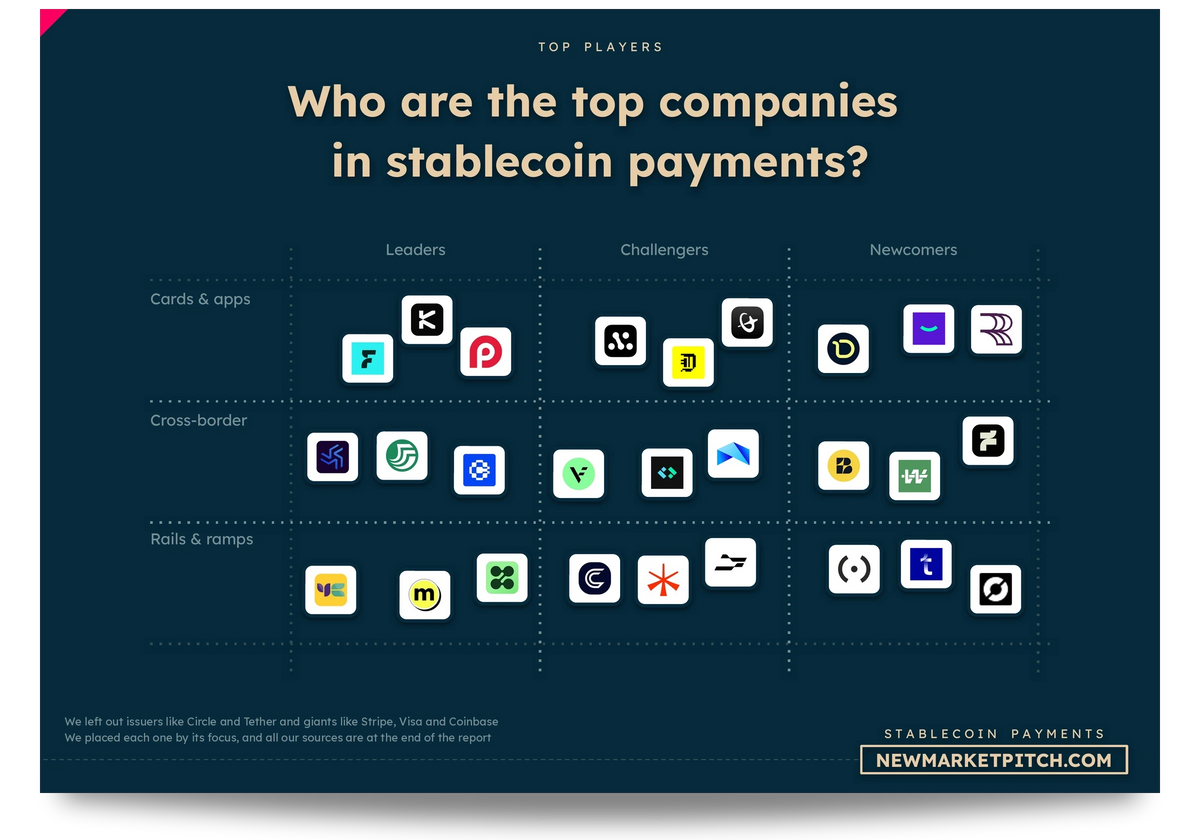
In our report covering the stablecoin payments market, we turn what is vague and complex into simple, useful visuals. Market maps like this one show you at a glance where every startup stands.
The ranking of top startups in the stablecoin payments market by revenue
Below is a table ranking the startups of this market by their current revenue scale. You can find our methodology at the end of this page.
If you want a deeper understanding of the market and its current dynamics, get our report on the stablecoin payments market.
| Ranking | Company | Latest Metric | Metric Type | Freshness | Disclosed When | Source Quality | Confidence | Segment | Why This Ranking | Local Metric | Country |
|---|---|---|---|---|---|---|---|---|---|---|---|
| 1 | Coinbase | $6.9B | Fiscal-Year Revenue | Fresh · 10mo | Feb 12, 2026 | Filed / Audited | High | Payment Platforms | Established crypto-services benchmark with stablecoin payment products, but most reported income relates to broader exchange and subscription activities. | us | |
| 2 | Stripe | $6.79B | Segment Revenue | Fresh · 10mo | Sep 23, 2026 | Credible Reported | Medium | Payment Platforms | Regional-entity revenue is not worldwide Stripe revenue and most payment activity uses conventional rails; nonetheless a stronger cash-income measure than volume-only peers. | us | |
| 3 | Revolut | ~$6B | Fiscal-Year Revenue | Fresh · 10mo | Mar 24, 2026 | Filed / Audited | High | Payment Platforms | Substantial realized banking and payment revenue, but stablecoin conversion and spending are only a portion of the broad business. | £4.5B | gb |
| 4 | Circle | $2.75B | Fiscal-Year Revenue | Fresh · 10mo | Feb 25, 2026 | Filed / Audited | Medium | Stablecoin Payment Networks | Recently listed company operates a payment network, but the reported top line includes substantial stablecoin reserve income rather than only payment-service fees. | us | |
| 5 | Payward | $2.2B | Annual Revenue | Fresh · 10mo | Feb 3, 2026 | Company Disclosed | Medium | Payment Platforms | Parent of Kraken and Reap has reported adjusted revenue, not necessarily comparable with audited net sales; most activity extends beyond payment services. | us | |
| 6 | Airwallex | $1.5B | ARR | Very Fresh · 5mo | May 28, 2026 | Credible Reported | Medium | Cross-Border Payments | Recent annualized group revenue is more current than older realized results, but includes conventional foreign-exchange and payment activity alongside stablecoins. | sg | |
| 7 | Deel | $1.5B | Revenue Run-Rate | Very Fresh · 4mo | 2026 | Third-Party Estimate | Low | Payroll Payments | Large payroll and HR run-rate is externally estimated, not audited, and only a small fraction of group operations are stablecoin payroll payouts. | us | |
| 8 | Checkout.com | $750M | Revenue Run-Rate | Very Fresh · 1mo | Sep 29, 2026 | Company Disclosed | Medium | Merchant Acceptance | Recent company-reported net revenue run-rate is not booked full-year revenue; most merchant acceptance is still traditional card processing. | gb | |
| 9 | Flywire | $623M | Fiscal-Year Revenue | Fresh · 10mo | Feb 2026 | Filed / Audited | High | Cross-Border Payments | Public-company benchmark based on realized global payments revenue; stablecoins are a small part of its wider collection and payout business. | us | |
| 10 | dLocal | $400M | Quarterly Revenue | Very Fresh · 4mo | Aug 13, 2026 | Filed / Audited | Medium | Cross-Border Payments | More recent revenue evidence than many private firms, but the disclosed amount is one quarter and includes traditional local payment methods. | uy | |
| 11 | Ripple | ~$900M | Revenue Run-Rate | Forecast | Oct 28, 2026 | Company Disclosed | Low | Stablecoin Payment Networks | The large figure is an unachieved year-end target at the time of writing and covers multiple products; ranked below realized or current operating revenue despite its headline size. | us | |
| 12 | Slash | $255M | Revenue Run-Rate | Fresh · 7mo | 2026 | Third-Party Estimate | Low | Payment Platforms | Recent third-party run-rate is less reliable than company-disclosed revenue; payment cards and business banking include fiat as well as stablecoins. | us | |
| 13 | Nium | >$200M | ARR | Very Fresh · 0mo | Oct 18, 2026 | Company Disclosed | Medium | Cross-Border Payments | Company-confirmed ARR is more persuasive than estimated run-rates nearby, although the threshold was crossed earlier in 2026 and includes traditional as well as stablecoin rails. | sg | |
| 14 | RedotPay | $180M | Revenue Run-Rate | Very Fresh · 2mo | Aug 20, 2026 | Company Disclosed | Medium | Stablecoin Cards | Recent company-disclosed revenue run-rate directly reflects a stablecoin card and wallet offering; it is not recognized annual revenue. | hk | |
| 15 | Fireblocks | $124M | Annual Revenue | Aging · 22mo | Mar 3, 2026 | Credible Reported | Medium | Payment Infrastructure | Real historical revenue covers both custody and stablecoin payment infrastructure, with 2024 financials much older than newer recurring-revenue peers. | us | |
| 16 | Flutterwave | ~$100M | Annual Revenue | Fresh · 10mo | 2026 | Third-Party Estimate | Low | Cross-Border Payments | The rough group-revenue estimate is not a company filing; conventional African payments are a much larger perimeter than newer stablecoin services. | us | |
| 17 | OpenPayd | >$96M | ARR | Very Fresh · 3mo | Aug 26, 2026 | Company Disclosed | Medium | Payment Infrastructure | Current reported ARR exceeds its audited FY2026 revenue of $73M, but it is a non-IFRS annualized metric and stablecoin orchestration is one component. | gb | |
| 18 | KAST | ~$78M | Revenue Run-Rate | Very Fresh · 3mo | Jul 2026 | Third-Party Estimate | Low | Stablecoin Cards | Estimated annual card revenue suggests material scale but depends on assumptions about card margins, rather than disclosed company earnings. | sg | |
| 19 | Mesh | ~$52M | Revenue Run-Rate | Very Fresh · 4mo | Aug 28, 2026 | Third-Party Estimate | Low | Merchant Acceptance | Estimate tracks payment infrastructure monetization, but cannot be treated as the same evidence quality as filed revenue or company-confirmed ARR. | us | |
| 20 | Rapyd | $10M | Segment Revenue | Fresh · 16mo | 2025 | Company Disclosed | Medium | Cross-Border Payments | Narrower stablecoin-service revenue is more relevant than broad group payment volume, but only covers half a year and not consolidated income. | gb | |
| 21 | COCA | >$3M | ARR | Fresh · 9mo | Jan 20, 2026 | Company Disclosed | Medium | Stablecoin Cards | Direct ARR claim supports a nascent recurring-revenue business, though it is far smaller than comparable infrastructure players and unaudited. | gb | |
| 22 | BlindPay | ~$2M | ARR | Fresh · 10mo | 2026 | Third-Party Estimate | Low | Payment Infrastructure | Low-confidence third-party ARR is materially less reliable than direct annual revenue and remains small despite payment-infrastructure fit. | us | |
| 23 | OpenFX | >$70B | GMV | Very Fresh · 4mo | Jun 9, 2026 | Company Disclosed | Low | Cross-Border Payments | Fast-growing stablecoin-enabled FX throughput is not recognized revenue, but the current annualized payment figure is considerably more useful than funding totals. | us | |
| 24 | Bitso | ~$82B | GMV | Fresh · 10mo | 2026 | Company Disclosed | Low | Cross-Border Payments | Large B2B payment flows are not revenue and include bank or other non-stablecoin transfers; ranked below businesses with direct income evidence. | mx | |
| 25 | Turnkey | >$100B | GMV | Very Fresh · 5mo | May 5, 2026 | Company Disclosed | Low | Payment Infrastructure | Very high cumulative infrastructure transfers are not merchant payment sales or company revenue; useful for network reach, not margin comparison. | us | |
| 26 | BVNK | $39B | GMV | Very Fresh · 1mo | Sep 22, 2026 | Company Disclosed | Low | Payment Infrastructure | Recent payment volume is directly relevant but represents client funds moved, not BVNK earnings; now owned by Mastercard following its 2026 acquisition. | gb | |
| 27 | Paga | >$11B | GMV | Fresh · 10mo | Jun 10, 2026 | Company Disclosed | Low | Cross-Border Payments | Substantial 2025 platform transaction volume precedes its broader stablecoin rollout and is not operating revenue. | >NGN 17T | ng |
| 28 | Orbital | ~$12B | GMV | Very Fresh · 4mo | Jun 11, 2026 | Company Disclosed | Low | Cross-Border Payments | Annualized global throughput includes fiat and stablecoin flows and is not earned revenue. Its direct current disclosure is more useful than undated scale indicators. | gi | |
| 29 | Diameter Pay | >$10B | GMV | Very Fresh · 2mo | Sep 3, 2026 | Credible Reported | Low | Cross-Border Payments | Recent payment throughput shows adoption, but it is not income and does not justify ranking above companies with audited or ARR figures. | us | |
| 30 | Yellow Card | $6.9B | GMV | Fresh · 10mo | 2026 | Company Disclosed | Low | Cross-Border Payments | Large reported African payment throughput is not a revenue measure; historic 2025 volume is less current than comparable 2026 payment metrics. | us | |
| 31 | Félix Pago | >$8B | GMV | Very Fresh · 1mo | Sep 2026 | Company Disclosed | Low | Cross-Border Payments | Cumulative remittance throughput spans several years, so it ranks below comparably large annual payment volumes and all direct revenue disclosures. | us | |
| 32 | Fuze Finance | $5.6B | GMV | Fresh · 10mo | Oct 8, 2026 | Credible Reported | Low | Payment Infrastructure | Reported platform-wide transaction value includes services beyond stablecoin cross-border settlement; no associated net revenue was disclosed. | ae | |
| 33 | Rain | >$3B | GMV | Fresh · 9mo | Jan 9, 2026 | Credible Reported | Low | Stablecoin Cards | Card-issuing payment volume is more specific than broad crypto transfers, but represents money spent by cardholders, not revenue to the issuer. | us | |
| 34 | Wirex | >$2B | GMV | Very Fresh · 3mo | Aug 24, 2026 | Company Disclosed | Low | Stablecoin Cards | Very current card spending is not revenue and covers an issuing-as-a-service network rather than just direct consumer subscriptions. | gb | |
| 35 | Mural | $2.1B | GMV | Very Fresh · 0mo | Oct 20, 2026 | Company Disclosed | Low | Payment Infrastructure | Cumulative API transfer volume provides real operating scale but cannot be compared directly with annual sales or an annual card-spend run-rate. | us | |
| 36 | Helio | >$1.5B | GMV | Aging · 21mo | Jan 13, 2025 | Company Disclosed | Low | Merchant Acceptance | Acquired by MoonPay and integrated into MoonPay Commerce; historical cumulative checkout volume includes non-stablecoin crypto and is not merchant-service revenue. | gb | |
| 37 | Conduit | >$10B | GMV | Aging · 22mo | May 28, 2025 | Company Disclosed | Low | Cross-Border Payments | The much larger throughput is already 22 months old and has no disclosed take rate or net revenue; freshness discounts it relative to 2026 signals. | us | |
| 38 | LemFi | >$2B | GMV | Very Fresh · 1mo | Oct 21, 2026 | Company Disclosed | Low | Cross-Border Payments | Large monthly transfer volume is not revenue, and only part of its remittance stack uses stablecoin technology; not annualized. | gb | |
| 39 | ether.fi | $129M | GMV | Very Fresh · 1mo | Oct 2026 | Third-Party Estimate | Low | Stablecoin Cards | Independent card-spending estimate is an observed monthly flow, not issuer revenue, and includes an associated crypto staking platform. | us | |
| 40 | Plasma | $25.6M | GMV | Very Fresh · 1mo | Oct 2026 | Third-Party Estimate | Low | Stablecoin Cards | Observed spend relates to a stablecoin payment product within a wider blockchain operation; no company-wide revenue is available. | us | |
| 41 | Tria | $21.9M | GMV | Very Fresh · 1mo | Oct 2026 | Third-Party Estimate | Low | Stablecoin Cards | Card spend is a tangible but indirect sales proxy; competing claims about ARR are insufficiently substantiated to supersede observed transaction activity. | us | |
| 42 | Kolo | $19.6M | GMV | Very Fresh · 1mo | Oct 2026 | Third-Party Estimate | Low | Stablecoin Cards | Third-party monthly card spend is more directly payment-related than user counts but remains a low-confidence proxy for company earnings. | gb | |
| 43 | xPlace | $10.3M | GMV | Very Fresh · 1mo | Oct 2026 | Third-Party Estimate | Low | Stablecoin Cards | Early card-spending volume shows usage, although no realized revenue is public and brand-level spend estimates may be incomplete. | us | |
| 44 | Gnosis Pay | $7.58M | GMV | Very Fresh · 1mo | Oct 2026 | Third-Party Estimate | Low | Stablecoin Cards | Small observed card volume is not payment-service revenue; operated within the Gnosis group rather than as an independent company. | gb | |
| 45 | Avici | $3.38M | GMV | Very Fresh · 1mo | Oct 2026 | Third-Party Estimate | Low | Stablecoin Cards | Early monthly spending volumes provide an independent use signal but no defensible income estimate. | us | |
| 46 | Peanut | $112K | GMV | Very Fresh · 1mo | Oct 2026 | Third-Party Estimate | Low | Stablecoin Cards | Observed limited card activity is substantially smaller than nearby monthly card proxies, and still not company revenue. | us | |
| 47 | CoinGate | 782K transactions | Transactions | Very Fresh · 4mo | Oct 5, 2026 | Company Disclosed | Low | Merchant Acceptance | A specific merchant payment-order count is verified but cannot reveal fee revenue without average ticket size and take rate. | lt | |
| 48 | Noah | >150 customers | Other Scale Signal | Very Fresh · 0mo | Oct 7, 2026 | Company Disclosed | Low | Payment Infrastructure | Recently signed enterprise customers show traction, but 538% year-to-date revenue growth has no disclosed base or absolute revenue amount. | gb | |
| 49 | Triple-A | >1,000 enterprise customers | Other Scale Signal | Undated | Company Disclosed | Low | Merchant Acceptance | Enterprise merchant reach is valuable evidence but contract values and fees are not public; no exact operating date is stated. | sg | ||
| 50 | MoonPay | >500 enterprise customers | Other Scale Signal | Very Fresh · 4mo | Jun 11, 2026 | Company Disclosed | Low | Payment Infrastructure | Enterprise integrations support a broad crypto-to-fiat payment business; large cumulative crypto trading volumes would be less specific to stablecoin payments. | us | |
| 51 | Transak | >10M users | Users | Undated | Company Disclosed | Low | Payment Infrastructure | End users are reached through integrated wallets and apps, not necessarily direct paying Transak customers, so scale cannot be translated into revenue. | us | ||
| 52 | NALA | >1M users | Users | Undated | Company Disclosed | Low | Cross-Border Payments | Large remittance customer base demonstrates adoption, but it spans traditional and stablecoin transfers and is not a measure of fees earned. | gb | ||
| 53 | BitPay | 40% of payment volume | Other Scale Signal | Fresh · 10mo | Dec 22, 2025 | Company Disclosed | Low | Merchant Acceptance | Stablecoins account for a material share of transactions, but a percentage without total dollar volume or take rate cannot rank revenue precisely. | us | |
| NR | Bridge | Not disclosed | Other Scale Signal | Undated | Company Disclosed | Low | Payment Infrastructure | Acquired recently by Stripe and operates important payment rails, but public fourfold growth commentary contains no comparable absolute revenue or volume. | us | ||
| NR | Rail | Not disclosed | Other Scale Signal | Undated | Company Disclosed | Low | Payment Infrastructure | Standalone payment-processing revenues have not been disclosed; the recent Ripple acquisition does not establish operating sales. | ca | ||
| NR | Zero Hash | Not disclosed | Other Scale Signal | Undated | Company Disclosed | Low | Payment Infrastructure | Stablecoin payments and conversion infrastructure are core offerings, but processing assets and platform usage are not net revenue. | us | ||
| NR | Paxos | Not disclosed | Other Scale Signal | Undated | Company Disclosed | Low | Payment Infrastructure | Included for its payment-service and settlement offerings, not token issuance alone; reserve income and token supply are not used as payment revenues. | us |

Our research about stablecoin payments gets updated several times a month, so you always get the latest view of where things stand.
Which stablecoin payments startups make the most money today?
Coinbase currently ranks first among stablecoin payments startups by revenue, followed by Stripe, Revolut, Circle and Payward. The five companies have reached multibillion-dollar financial scale, although much of their income still comes from services other than stablecoin payments.
Coinbase reported $6.9B in fiscal-year 2025 revenue, while Stripe generated $6.79B from its European and Asia-Pacific reporting perimeter during the same fiscal year. Revolut reported £4.5B, Circle recorded $2.75B in combined revenue and reserve income, and Payward, the parent company of Kraken, reported $2.2B in adjusted annual revenue.
The next group includes Airwallex at $1.5B ARR, Deel at a $1.5B estimated revenue run-rate, and Checkout.com at a $750M annualized net revenue run-rate. Further down, RedotPay, Fireblocks and OpenPayd show that smaller and more specialized payment businesses are also generating substantial income.
Our ranking exposes a gap between the biggest financial technology companies using stablecoins and the businesses earning money specifically from stablecoin transactions. Coinbase, Stripe and Revolut operate much broader platforms. Circle earns most of its revenue from reserves backing its stablecoins. RedotPay and Rapyd offer more direct evidence of stablecoin payment monetization, although their figures cover different activities and periods.
| Rank | Startup | Revenue measure | Period |
|---|---|---|---|
| 1 | Coinbase | $6.9B fiscal-year revenue | FY2025 |
| 2 | Stripe | $6.79B regional segment revenue | FY2025 |
| 3 | Revolut | £4.5B fiscal-year revenue | FY2025 |
| 4 | Circle | $2.75B revenue and reserve income | FY2025 |
| 5 | Payward | $2.2B adjusted annual revenue | 2025 |
| 6 | Airwallex | $1.5B ARR | May 2026 |
| 7 | Deel | $1.5B estimated revenue run-rate | June 2026 |
| 8 | Checkout.com | $750M net revenue run-rate | September 2026 |
| 9 | Flywire | $623M fiscal-year revenue | FY2025 |
| 10 | dLocal | $400M quarterly revenue | Q2 2026 |
| 11 | Ripple | ~$900M projected product revenue run-rate | December 2026 target |
| 12 | Slash | $255M estimated revenue run-rate | March 2026 |
| 13 | Nium | >$200M ARR | Early 2026 threshold |
| 14 | RedotPay | $180M revenue run-rate | August 2026 |
| 15 | Fireblocks | $124M annual revenue | 2024 |
| 16 | Flutterwave | ~$100M estimated annual revenue | 2025 |
| 17 | OpenPayd | >$96M ARR | July 2026 |
| 18 | KAST | ~$78M estimated revenue run-rate | July 2026 |
| 19 | Mesh | ~$52M estimated revenue run-rate | June 2026 |
| 20 | Rapyd | $10M stablecoin segment revenue | H1 2025 |
| 21 | COCA | >$3M ARR | January 2026 |
| 22 | BlindPay | ~$2M estimated ARR | 2025 |
Why are stablecoin payment startups suddenly attracting so much attention?
Stablecoin payment startups are getting more attention because businesses have started using digital dollars for settlement, international transfers and everyday card spending. Actual payment activity is growing quickly, even if it remains a tiny part of the global payments industry.
In February 2026, McKinsey and Artemis Analytics estimated that genuine stablecoin payments were running at approximately $390B annually, based on December 2025 activity. That was more than twice the 2024 level, but represented only around 0.02% of global payment volume.
The researchers excluded cryptocurrency trading, internal wallet movements and other blockchain transfers that do not represent actual payments. A stablecoin can move between wallets many times without anyone buying anything.
Traditional financial companies are taking the market seriously. Stripe completed its acquisition of Bridge in February 2025, Mastercard acquired BVNK in August 2026, and Visa reported that stablecoin settlement had surpassed a $20B annualized run-rate by September 2026.
These deals have changed the commercial opportunity. Stablecoin startups can sell payment infrastructure to banks, fintech companies and merchants that already have customers, instead of relying entirely on cryptocurrency users.

In our market report about stablecoin payments, we look at what the winners do differently, so you can learn from the best instead of guessing.
Is Coinbase really the biggest stablecoin payments startup?
Coinbase is the highest-ranked stablecoin payments startup, with $6.9B in fiscal-year 2025 revenue, although most of that money comes from its broader cryptocurrency business rather than stablecoin payment processing.
Coinbase makes money from trading, subscriptions, financial services and its participation in the USDC ecosystem. Its consolidated revenue is therefore much wider than merchant acceptance, cross-border settlement or stablecoin transfer fees.
The distinction becomes clearer when we compare Coinbase with Circle, which ranks fourth. Coinbase benefits from the broader cryptocurrency economy, while Circle earns most of its income from the reserves backing USDC and EURC.
Coinbase also has an important distribution advantage. It already serves consumers and institutions that hold, trade and transfer digital assets, giving it opportunities to introduce payment products without building a completely new customer base.
Is Stripe earning more from stablecoin payments than Circle?
Stripe ranks second with $6.79B in fiscal-year 2025 regional revenue, ahead of Circle at $2.75B, but we cannot conclude that Stripe earns more from stablecoin payment services.
The Stripe figure comes from Stripe Payments International Holdings Limited, which covers its European and Asia-Pacific operations. According to financial results reported by RTÉ in September 2026, revenue increased 33% from $5.12B in 2024 to $6.79B in 2025.
That is substantial growth for an already large payments business. However, conventional payment processing still accounts for a major part of Stripe's activity.
Stripe's acquisition of Bridge shows how seriously the company takes stablecoin infrastructure. Completed in February 2025, the transaction brought stablecoin orchestration and money movement into Stripe's product range. Bridge remains unranked separately because its standalone revenue has not been disclosed.
Circle operates a different model. Its reported income comes primarily from reserves rather than merchant processing fees.
Stripe has the larger selected financial figure, while Circle has a more concentrated stablecoin business. Neither company's consolidated revenue tells us exactly how much it earns from processing stablecoin payments.

In our document detailing everything you need to know about stablecoin payments, you will always find fresh funding data, taken straight from our own verified funding database.
How much revenue does Circle actually make from stablecoins?
Circle generated $2.75B in combined revenue and reserve income during fiscal-year 2025, placing it fourth in the stablecoin payments startup ranking. Nearly all that income came from interest earned on assets backing its stablecoins.
Circle's 2025 SEC filing shows that reserve income accounted for 96% of total revenue, compared with 99.1% in 2024.
That means roughly $110M of its 2025 revenue came from other sources, based on our calculation using the rounded 4% share. Those sources include integration services, blockchain rewards, redemption fees and other activities. The amount should not be interpreted as pure payment-processing revenue.
Circle's business also grew considerably in scale. USDC circulation reached $75.3B at the end of 2025, up 72% year over year. Reserve income increased by approximately $976M, or 58.7%, during the year.
The company has been developing Circle Payments Network and Arc to make its infrastructure more useful for institutional transfers and financial applications. These products could eventually make payment-related fees more important.
For now, Circle's financial success remains closely tied to stablecoin circulation and reserve yields. That makes it unusually sensitive to changes in interest rates compared with traditional payment processors.
Is Ripple bigger than Circle in stablecoin payments?
Circle ranks ahead of Ripple in our stablecoin payments revenue ranking, with $2.75B in fiscal-year 2025 revenue and reserve income versus Ripple's approximately $900M projected product revenue run-rate for the end of 2026.
Ripple ranks eleventh, partly because its selected figure is a forward-looking target covering several products rather than achieved annual revenue.
Ripple operates payment infrastructure alongside businesses connected to XRP, RLUSD and institutional financial services. Its projected run-rate therefore covers more than stablecoin payment fees.
Circle's figure comes from a completed accounting period and includes substantial USDC-related reserve income. That gives it stronger evidence of realized financial scale, even though the revenue models are different.
Ripple has also expanded through acquisitions. Its acquisition of Rail, previously Layer2 Financial, strengthened its business-to-business stablecoin payments offering. Rail's standalone revenue has not been disclosed, so the acquisition cannot be used to establish additional revenue for Ripple.

Learning from others' mistakes is the cheapest lesson there is. In our report covering the stablecoin payments market, we look at what broke startups before you, so you don't repeat it.
Which stablecoin payments startups have more than $100 million in revenue?
The first 16 stablecoin payments startups have selected revenue measures of approximately $100M or more, although several figures are annualized estimates, partial-period revenue or projections rather than completed annual sales.
The first five companies are already in the billions. Airwallex and Deel follow with $1.5B annualized measures, while Checkout.com reports a $750M net revenue run-rate.
Flywire reported $623M in fiscal-year 2025 revenue, and dLocal reported $400M for the second quarter of 2026 alone. Those are realized financial figures, although dLocal's covers only three months.
Further down, Ripple has a projected ~$900M product revenue run-rate for the end of 2026, Slash has a third-party estimated $255M run-rate, Nium reports >$200M ARR, and RedotPay reports a $180M run-rate.
Fireblocks reported $124M in 2024 revenue, while Flutterwave has approximately $100M in estimated annual revenue for 2025.
Of those 16 companies, many built their businesses around conventional financial services before introducing stablecoin products. The number of startups with independently verified nine-figure stablecoin-specific annual revenue is much smaller.
Which stablecoin payments startups are growing fastest right now?
RedotPay, Nium and OpenPayd have some of the more useful recent revenue disclosures, while OpenFX and BVNK show rapid commercial activity through payment volumes. We cannot identify a definitive fastest-growing company without comparable revenue growth figures across multiple periods.
RedotPay reported a $180M annualized revenue run-rate in August 2026. Nium confirmed that it crossed $200M ARR earlier in 2026, while OpenPayd disclosed >$96M ARR in July 2026.
OpenPayd also reported $73M in fiscal-year 2026 revenue. The gap between that historical revenue and its later ARR indicates a larger current annualized business, although comparing the two directly would overstate what we know about actual year-over-year growth.
For payment volumes, the picture is more dramatic. OpenFX disclosed >$70B in annualized payment activity in June 2026, while BVNK reported $39B in annualized stablecoin payment volume in September.
Visa offers a useful industry-wide comparison. In September 2026, it reported that stablecoin settlement volume had increased more than fifteenfold year over year, while spending through stablecoin-linked cards was up nearly 200%.
Those growth rates are exceptional, but they also reflect a market starting from a relatively small base.

Your time is limited. In our research about stablecoin payments, we put numbers on each part of the market, so you can see where it makes sense to focus.
Are stablecoin card startups actually making serious money?
Stablecoin card startups are becoming real revenue businesses, particularly RedotPay and KAST, although most competitors still disclose spending volume rather than the money they earn.
RedotPay ranks fourteenth with a company-disclosed $180M annualized revenue run-rate for August 2026. KAST ranks eighteenth with approximately $78M in estimated annualized revenue for July 2026. COCA ranks twenty-first after reporting >$3M ARR in January 2026.
The quality of those figures differs. RedotPay disclosed its own run-rate, KAST's amount comes from third-party card economics analysis, and COCA's ARR is a company claim.
Rain and Wirex offer another view of the market. Rain reported >$3B in annualized card payment volume, while Wirex disclosed >$2B in annualized spending through its card infrastructure.
A company processing $3B in card spending would generate $30M at a hypothetical 1% effective revenue yield, or $60M at 2%. These calculations illustrate the economics but are not estimates of Rain's actual income.
Visa reported more than 160 live stablecoin-linked card programs in its fiscal second quarter of 2026. In October, it added that approximately 17% of stablecoin-linked card volume during fiscal-year 2026 to date came from business and commercial programs.
Stablecoin cards have clearly moved beyond their early experimental stage. RedotPay currently has the strongest disclosed revenue-scale evidence among the specialized card businesses in our ranking.
How much revenue do stablecoin payment infrastructure startups make?
Fireblocks, OpenPayd, Mesh and BlindPay show how widely revenue differs among stablecoin payment infrastructure startups, from established nine-figure businesses to companies earning only a few million dollars annually.
Fireblocks ranks fifteenth with $124M in 2024 annual revenue, according to Forbes. Its services cover cryptocurrency custody and wider digital asset infrastructure as well as payment-related products.
OpenPayd ranks seventeenth with >$96M ARR as of July 2026. Its financial infrastructure includes banking, payments and stablecoin orchestration, so the figure covers more than stablecoin services.
Mesh ranks nineteenth with approximately $52M in estimated annualized revenue, while BlindPay ranks twenty-second with approximately $2M in estimated ARR.
The larger transaction-processing companies are harder to compare. Turnkey has reported >$100B in cumulative wallet transaction volume, BVNK $39B in annualized payment volume, and Mural $2.1B in cumulative payment activity since its API launch in 2025.

In our market report about stablecoin payments, we always try to gather several sources and make estimates that make sense, so you can work with solid numbers.
How big is BVNK now that Mastercard owns it?
BVNK ranks twenty-sixth among stablecoin payments startups, with $39B in annualized payment volume as of September 2026. Mastercard completed its acquisition in August 2026, but BVNK's standalone payment-service revenue remains undisclosed.
BVNK helps businesses move money between stablecoins and conventional currencies. Its infrastructure connects wallets, bank accounts, international payments and financial applications.
The acquisition produced a concrete commercial result in October 2026, when Mastercard and BVNK launched Mastercard Global Money Platform.
The platform combines multi-currency accounts, stablecoin capabilities, real-time conversion, card services and local payouts through Mastercard Move. Banks, fintech companies and enterprises can access these services through a single integration.
BVNK now has access to Mastercard's distribution network and existing institutional relationships, potentially reducing the need to acquire each customer independently.
Can OpenFX and Bitso make serious money from their stablecoin payment volumes?
OpenFX and Bitso have reached enormous transaction volumes, giving both businesses the potential to earn substantial payment revenue. Their selected disclosures do not reveal how much money they actually retain.
OpenFX ranks twenty-third with >$70B in annualized payment volume in June 2026. Bitso ranks twenty-fourth with approximately $82B in annualized payment volume reported for 2025.
The two measures come from different periods and payment operations. Their positions reflect our ranking's selected evidence, rather than a direct ordering by payment-volume size.
To understand the possible economics, consider OpenFX's >$70B annualized volume. At a hypothetical 0.10% effective take rate, $70B would produce $70M of revenue. At 0.50%, it would produce $350M.
Neither percentage represents OpenFX's disclosed pricing. The calculation shows why transaction volume alone leaves such a large range of possible financial outcomes.
Bitso also operates broader cryptocurrency and business payment services, including transfers that may use conventional banking rails.
Other startups demonstrate meaningful scale through different measures. Orbital reports approximately $12B annualized payment volume, Diameter Pay processed >$10B during the first eight months of 2026, and Conduit previously reported >$10B in annualized payment flow at the end of 2024.

If you build or invest in the stablecoin payments market, you need to know which business models pay off now and which ones are fading. That's why our report covering it has a whole section on it.
Why are so many stablecoin startups focused on cross-border payments?
Cross-border transfers are a natural market for stablecoin startups because businesses and consumers frequently face slow settlement, expensive currency conversion and limited access to foreign currencies. Stablecoins can reduce these costs, particularly where international transfers involve several banking intermediaries.
A conventional international transfer may require correspondent banks, local payment partners, prefunded accounts and multiple currency conversions. Stablecoins allow financial institutions to move digital dollars across blockchain networks without relying on the same correspondent-banking chain for every transaction.
The companies approaching this problem are very different in size.
Airwallex ranks sixth with $1.5B ARR, Nium ranks thirteenth with >$200M ARR, and Flutterwave ranks sixteenth with approximately $100M in estimated annual revenue. Their businesses already include traditional payment products alongside newer stablecoin capabilities.
Other providers show scale primarily through transaction activity. Paga processed >NGN 17T in 2025, Yellow Card handled $6.9B in transaction volume, Félix Pago reported >$8B in cumulative remittances, and Fuze Finance recorded $5.6B in 2025 transaction activity.
LemFi reported >$2B in monthly remittances in September 2026, while NALA has served more than one million users.
Rapyd provides one of the clearest examples of direct monetization. The company disclosed $10M in stablecoin settlement revenue during the first half of 2025, showing that stablecoin services can already produce identifiable income inside a broader payment platform.
However, blockchain transfer fees are only one part of the total cost. Providers still pay for compliance, fraud prevention, custody, liquidity, local currency conversion and access to banking systems. We cannot conclude that stablecoin companies are generally more profitable than traditional payment providers.
The repeated focus on international transfers is revealing. Stablecoins are particularly attractive in parts of Latin America, Africa and the Middle East, where businesses and consumers often need to connect local payment methods with international financial systems.
Are stablecoin merchant payments becoming mainstream?
Stablecoin merchant payments are growing, but ordinary card payments and bank transfers still dominate commercial transactions. The available data show a developing market rather than widespread replacement of conventional checkout systems.
CoinGate reported approximately 782K cryptocurrency payment orders in the first half of 2026. Triple-A has more than 1,000 enterprise customers, while BitPay reported that stablecoins accounted for 40% of its payment volume in 2025.
These figures offer three different views of merchant adoption: completed payment orders, merchant reach and the share of cryptocurrency payment activity represented by stablecoins.
Helio provides another example. Before its acquisition by MoonPay, the company had processed >$1.5B in cumulative cryptocurrency merchant payments. It now operates through MoonPay Commerce, which combines checkout technology with broader cryptocurrency payment infrastructure.
MoonPay itself reports more than 500 enterprise customers, while Transak reaches more than ten million end users through integrated wallets and applications.
The numbers suggest that stablecoins are becoming familiar infrastructure for cryptocurrency-friendly merchants and online financial services. They are still a long way from becoming the default payment method for ordinary retail purchases.

In our report covering the stablecoin payments market, we don't want to repeat what boring consulting reports say. Instead, we show you the real and latest market signals that matter.
Which stablecoin payment startups process the most transactions?
Turnkey, Bitso, OpenFX and BVNK have some of the largest disclosed payment or transaction-volume figures in our stablecoin startup ranking, although the underlying measures are too different to identify a single winner by comparable annual payment activity.
Turnkey reports >$100B in cumulative stablecoin wallet transactions through May 2026. Bitso reports approximately $82B in annualized payment volume, OpenFX >$70B annualized, and BVNK $39B annualized.
Turnkey's cumulative figure covers activity over several years, while the other measures describe annualized payment flows. They therefore cannot be compared as though they represent the same operating period.
Paga's >NGN 17T in 2025 transaction volume, Yellow Card's $6.9B during 2025 and Fuze Finance's $5.6B in the same year add further evidence of significant activity.
Even among card businesses, comparisons require care. Rain's >$3B annualized payment volume and Wirex's >$2B annualized card spending are different from ether.fi's $129M estimated monthly card spending or Plasma's $25.6M for September 2026.
Several stablecoin-enabled companies already process billions of dollars in customer activity. Transaction volume is spreading across many kinds of financial services, with very different economics behind each number.
How much money are smaller stablecoin payment startups making?
COCA and BlindPay are among the smaller stablecoin payment startups with disclosed or estimated recurring revenue, while many emerging competitors still rely on transaction counts, spending activity or customer figures to demonstrate commercial scale.
COCA reported >$3M ARR in January 2026, and BlindPay has approximately $2M in estimated ARR for 2025. Both remain far below the larger payment businesses, but their figures offer a more direct view of monetization than user counts alone.
Other companies are still establishing scale. Noah reported more than 150 new enterprise customers signed during 2026, while Triple-A reported more than 1,000 business clients.
Among stablecoin-linked card providers, independent September 2026 estimates put Tria at $21.9M in monthly spending, Kolo at $19.6M, xPlace at $10.3M, Gnosis Pay at $7.58M, Avici at $3.38M and Peanut at $112K.
Four well-known companies also remain without a suitable comparable revenue or scale figure: Bridge, now part of Stripe; Rail, acquired by Ripple; Zero Hash; and Paxos.
We have kept them unranked rather than assigning revenue based on funding, acquisition prices, token issuance or unsupported estimates.

In our research about stablecoin payments, we like to show you the big picture. We know your time is precious, so we make every page quick to read and packed with as much learning as possible per minute.
Can stablecoin startups really compete with Visa, Mastercard and PayPal?
Stablecoin startups can compete with traditional payment companies in international settlement and financial infrastructure, but their reported revenues remain far smaller than those of Visa, Mastercard and PayPal.
Visa reported $45.9B in fiscal-year 2026 revenue, PayPal reported $33.2B in fiscal-year 2025, and Mastercard reported $32.8B in fiscal-year 2025. These are established companies outside our startup ranking, and their figures cover much broader payment activities.
Coinbase, the highest-ranked startup, generated $6.9B in fiscal-year 2025 revenue. That is substantial, but still well below the income of the largest traditional payment networks.
The competition is also becoming more complicated because those networks are adopting stablecoin technology themselves.
Mastercard's acquisition of BVNK puts stablecoin infrastructure directly inside an established global payments group. Visa has expanded stablecoin settlement and card programs, while PayPal supports PYUSD-linked payment services.
For a small stablecoin startup, becoming a technology supplier to one of these companies may be more attractive than trying to replace its entire payment network.
Which stablecoin payment startups have the strongest business models?
Coinbase, Stripe, Revolut, Circle and Payward have the strongest evidence of financial scale in the ranking, but specialized companies such as RedotPay, Fireblocks and OpenPayd demonstrate business models more directly tied to stablecoin-enabled financial infrastructure.
The distinction comes down to how each company earns money.
Coinbase and Payward generate substantial income from cryptocurrency-related financial services. Stripe and Revolut monetize broader payment and banking products. Circle earns income primarily from reserves backing its stablecoins.
RedotPay has a more concentrated stablecoin card and wallet offering. Fireblocks sells custody and digital asset infrastructure, while OpenPayd combines payment accounts, financial infrastructure and stablecoin orchestration.
These differences also create different risks. Circle's reserve income depends on interest rates and stablecoin circulation. Payment processors depend on transaction fees, foreign exchange spreads and customer activity. Card businesses must earn enough from interchange, fees and other products to cover their operating costs.
The acquisitions of Bridge, BVNK and Helio also show that technology, licensing relationships and distribution are valuable assets even before standalone revenue becomes public.
Companies with established customer bases and several ways to make money appear better positioned to withstand pricing pressure. But the specialized providers could still build powerful businesses if stablecoin transaction fees become a larger revenue category.

When you build or invest in the stablecoin payments market, you need clarity, not confusion. In our market report about stablecoin payments, we always try to put numbers on and quantify whatever is usually vague and confusing.
What could stop stablecoin payment startups from making more money?
The biggest risk for stablecoin payment startups is processing more and more money without earning enough revenue from each transaction. Regulation, bank access and competition could make that problem harder.
The gap between transaction activity and disclosed revenue is visible throughout our ranking. Turnkey reports >$100B in cumulative transaction volume, OpenFX >$70B in annualized payment flow, and Rain >$3B in annualized card spending. None of those amounts tells us how much money the companies retain.
Competition may push transaction fees lower as more financial institutions introduce similar infrastructure. Stablecoin transfers can be technically cheap, but providers still need to pay for regulatory compliance, fraud prevention, banking partners and liquidity.
Reserve-based businesses face another risk. Circle's SEC filing showed that a 90-basis-point decline in average reserve yields reduced the benefit of higher USDC circulation during 2025. Its reserve income still increased overall, but the example shows how interest rates affect earnings.
Meanwhile, larger financial institutions can acquire promising infrastructure companies or build competing services. Mastercard's acquisition of BVNK and Stripe's purchase of Bridge show how quickly smaller companies can become part of larger distribution networks.
What are the top stablecoin payments startups by revenue today?
Coinbase is the highest-ranked stablecoin payments startup by revenue, followed by Stripe, Revolut, Circle and Payward. Their reported financial figures establish the ranking, although they do not prove that these companies earn the most from stablecoin payment fees alone.
The next positions belong to Airwallex, Deel, Checkout.com, Flywire and dLocal, followed by Ripple, Slash, Nium, RedotPay, Fireblocks and Flutterwave.
Across the ranking, 22 startups have selected monetary revenue measures, while another 31 are ranked using payment volume, transactions, customers or other commercial indicators. Four notable businesses remain unranked because they lack sufficiently comparable disclosures.
The largest stablecoin-enabled financial businesses already make billions of dollars, but specialized stablecoin payments companies are still building the revenue base needed to match their transaction activity.
RedotPay, Fireblocks, OpenPayd, Mesh and Rapyd are particularly interesting because their disclosed or estimated monetary figures give us more direct evidence of monetization than the huge payment-volume announcements elsewhere in the market.
Coinbase leads the current startup revenue ranking. Who eventually dominates revenue from stablecoin payments themselves is a much more interesting question.

A good product starts with a real problem. In our document detailing everything you need to know about stablecoin payments, we show you the ones customers still live with.
Additional ranking: Stablecoin payment startups measured by commercial activity
The following startups retain their positions in the ranking, but their selected figures represent commercial activity rather than revenue. Annualized payment volume, cumulative transaction value, monthly card spending, user counts and other scale indicators are kept separate because they cannot be converted into company income without additional evidence.
| Overall rank | Startup | Selected commercial-scale indicator | Period |
|---|---|---|---|
| 23 | OpenFX | >$70B annualized payment volume | June 2026 |
| 24 | Bitso | ~$82B annualized payment volume | 2025 |
| 25 | Turnkey | >$100B cumulative transaction volume | Through May 2026 |
| 26 | BVNK (Mastercard) | $39B annualized payment volume | September 2026 |
| 27 | Paga | >NGN 17T transaction volume | 2025 |
| 28 | Orbital | ~$12B annualized payment volume | June 2026 |
| 29 | Diameter Pay | >$10B payment volume | January–August 2026 |
| 30 | Yellow Card | $6.9B transaction volume | 2025 |
| 31 | Félix Pago | >$8B cumulative remittances | Through September 2026 |
| 32 | Fuze Finance | $5.6B transaction volume | 2025 |
| 33 | Rain | >$3B annualized card spending | January 2026 |
| 34 | Wirex | >$2B annualized card spending | July 2026 |
| 35 | Mural | $2.1B cumulative payment volume | Through October 2026 |
| 36 | Helio (MoonPay) | >$1.5B cumulative merchant payment volume | Through January 2025 |
| 37 | Conduit | >$10B annualized payment volume | December 2024 |
| 38 | LemFi | >$2B monthly remittances | September 2026 |
| 39 | ether.fi | $129M estimated monthly card spending | September 2026 |
| 40 | Plasma | $25.6M estimated monthly card spending | September 2026 |
| 41 | Tria | $21.9M estimated monthly card spending | September 2026 |
| 42 | Kolo | $19.6M estimated monthly card spending | September 2026 |
| 43 | xPlace | $10.3M estimated monthly card spending | September 2026 |
| 44 | Gnosis Pay | $7.58M estimated monthly card spending | September 2026 |
| 45 | Avici | $3.38M estimated monthly card spending | September 2026 |
| 46 | Peanut | $112K estimated monthly card spending | September 2026 |
| 47 | CoinGate | 782K payment transactions | H1 2026 |
| 48 | Noah | >150 new enterprise customers | As of October 2026 |
| 49 | Triple-A | >1,000 enterprise customers | As of 2026 |
| 50 | MoonPay | >500 enterprise customers | As of June 2026 |
| 51 | Transak | >10M end users | As of 2026 |
| 52 | NALA | >1M users | As of 2026 |
| 53 | BitPay | Stablecoins represent 40% of payment volume | 2025 |
Our methodology
We ranked stablecoin payments startups using the strongest available evidence of their current revenue scale, while distinguishing revenue earned across an entire fintech business from income specifically attributable to stablecoin services. The analysis covers companies founded in 2000 or later, including businesses that became publicly listed from 2021 onward and companies acquired within the past three years. Established payment networks such as Visa, Mastercard and PayPal are excluded from the ranking.
We examined annual reports, regulatory filings, company announcements, investor materials and specialist financial reporting. We considered recognized annual and quarterly revenue, ARR, annualized revenue run-rates, segment revenue and forecasts, prioritizing the relevance of each metric, the quality of its source and how recently it was measured. Company-reported financial results generally carry more weight than third-party estimates.
The monetary ranking includes 22 businesses, but the figures are not directly interchangeable. Coinbase's consolidated revenue, Stripe's regional revenue, Circle's revenue and reserve income, Checkout.com's annualized net revenue and Ripple's projected product run-rate measure different things. Each retains its actual metric and period rather than being converted into a supposedly comparable annual revenue number.
For companies without suitable monetary figures, we used transaction volume, payment value, card spending, customers or users to assess commercial activity. These 31 companies appear in a separate ranking because payment volume is not revenue. We did not estimate company income by applying hypothetical fees to transaction volumes. Four notable businesses remain unranked.
We also distinguished stablecoin-specific activity from conventional payments, cryptocurrency trading, wallet transfers and cumulative blockchain transactions. McKinsey and Artemis Analytics provided an important market benchmark by separating genuine stablecoin payments from other on-chain activity. For company-level comparisons, a disclosed stablecoin segment figure can be more informative than a much larger consolidated revenue number.
Key sources for financial performance include Coinbase's FY2025 SEC filing, RTÉ's reporting on Stripe's 2025 regional financial results, Revolut's FY2025 results, Circle's FY2025 SEC filing, Payward's 2025 financial review, Checkout.com's revenue announcement, Flywire's FY2025 filing, and dLocal's Q2 2026 results.
For specialized payment businesses, we used Nium's ARR disclosure, RedotPay's revenue run-rate announcement, OpenPayd's SEC-filed investor presentation, and FXC Intelligence's interview with Rapyd. Market activity and transaction figures were checked against McKinsey's stablecoin payments analysis, OpenFX's payment volume announcement, BVNK's volume disclosure, Turnkey's transaction figures, and CoinGate's H1 2026 payment report.
Industry developments were assessed using Stripe's announcement of the Bridge acquisition, Mastercard's BVNK acquisition announcement, Mastercard's Global Money Platform launch, Visa's stablecoin card analysis, and Visa's business payments update.

In our report covering the stablecoin payments market, we try to remove everything that could confuse you, especially if you're investing or building in this market.
Written by the New Market Pitch teamWe track new markets so founders and investors can move faster. About us