What are the most valuable warehouse robotics startups?
Whether you're building or investing in the warehouse robotics market, our report covers everything you need to know: the players, the money, and what's coming next.
Summary
Exotec leads our warehouse robotics startup ranking at $2.0B. Dexterity follows at $1.65B, and Hai Robotics at ~$1.56B. The top is close enough that Exotec cannot claim a huge valuation lead. Locus Robotics is now fourth, because its latest round came without a published price.
The three companies tackle very different jobs. Exotec builds robotic storage systems, Dexterity uses robotic arms to load parcels into trailers, and Hai Robotics moves cases through dense storage.
There are 71 startups in our research, but only 6 firmly qualify as unicorns. Another 62, or 87%, sit below $1B. Investors clearly value warehouse automation, although billion-dollar startups remain unusual.
American companies form the largest group, followed by China. But the highest-valued private company comes from France, and Japan's Mujin is also in the billion-dollar tier.
Chinese storage specialist Hai Robotics belongs among the leaders. Quicktron Robotics has a less certain $850M–$1.4B estimate. That makes China a serious competitor at the top, though those two figures have different levels of certainty.
The younger challengers are gaining ground. Mytra's estimated valuation spans $800M–$1.5B, and Sereact has an estimated range reaching beyond the unicorn threshold. Both are trying to make warehouse robots more flexible, with very different products.
The big question is what customers actually get for those prices. Exotec and Locus already operate at many sites, while Dexterity and Sereact are tackling work that has been harder to automate reliably.
Some valuable companies solve just one headache. Dexory and Gather AI track inventory, while Pickle Robot unloads trailers. A customer can get a useful return without rebuilding an entire warehouse.
We also have to separate what investors or companies have actually priced from what we estimate. Only 6 valuations are stated by a source, while 65 are estimates. Those figures belong in the same discussion, but they carry different weight.
Public companies change the picture of the wider industry. Symbotic, Geek+ and Agility Robotics are listed separately. Exotec is first among the startups we track, not across every warehouse automation business on the stock market.

Written by the New Market Pitch teamWe track new markets so founders and investors can move faster. About us

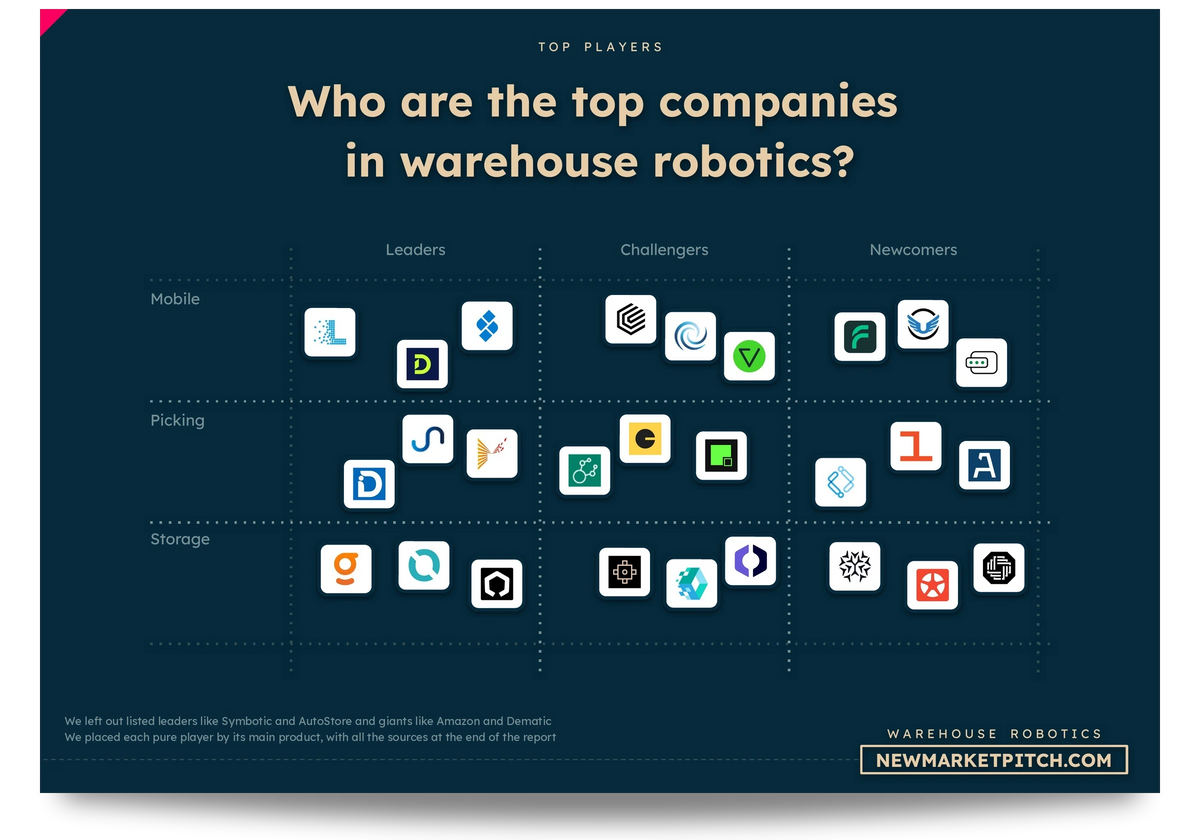
In our report covering the warehouse robotics market, we turn what is vague and complex into simple, useful visuals. Market maps like this one show you at a glance where every startup stands.
Top startups in the warehouse robotics market ranked by valuation
Here is the current ranking of the most valuable warehouse robotics startups. For each one you will also find our confidence level and the valuation basis we used.
If you want to go deeper into the warehouse robotics startup landscape, check our report covering the warehouse robotics market.
| # | Startup | Valuation | Confidence | Valuation basis | Last round | Total funding |
|---|---|---|---|---|---|---|
| Private startups | ||||||
| 1 | ExotecAutonomous warehouse storage and retrieval | $2.0Bas of Jan 2022 | Full | Announced private round valuation | $335MSeries D · Jan 2022 | $425Mvalued at 4.7× this |
| 2 | DexterityAI-powered robotic warehouse handling | $1.65Bas of Mar 2025 | Strong | Reported private round valuation | $105MEquity offering · May 2026 | $396Mvalued at 4.2× this |
| 3 | Hai RoboticsAutonomous case-handling warehouse robots | ~$1.56Bas of Mar 2026 | Strong | Reported private round valuation | $170MSeries D · Sep 2021 | $173M+valued at 9.0× this |
| 4 | Locus RoboticsAutonomous warehouse fulfillment mobile robots | $1.1B–$1.6Bas of Nov 2026 | Partial | Comparables-based estimate | $42MSeries G · Aug 2026 | $450Mvalued at 2.9× this |
| 5 | MytraThree-dimensional robotic material handling systems | $800M–$1.5Bas of Jan 2026 | Low | Estimated from last round | $120MSeries C · Jan 2026 | $170Mvalued at 6.4× this |
| 6 | Quicktron RoboticsIntelligent warehouse mobile robot systems | $850M–$1.4Bas of Nov 2026 | Partial | Comparables-based estimate | $100M+Series D · Sep 2024 | $229M+valued at 4.8× this |
| 7 | SereactAI-powered robotic picking and manipulation | $773M–$1.4Bas of Jul 2026 | Low | Estimated from last round | $6MSeries B extension · Jul 2026 | $148Mvalued at 7.1× this |
| 8 | Nimble RoboticsAI-powered autonomous fulfillment centers | $1.0Bas of Oct 2024 | Full | Announced private round valuation | $106MSeries C · Oct 2024 | $106Mvalued at 9.4× this |
| 9 | MujinRobotic picking and pallet handling systems | >$1.0Bas of Oct 2026 | Strong | Reported private round valuation | $133MSeries D+ · Dec 2025 | $237Mvalued at 4.2× this |
| 10 | DexoryAutonomous warehouse inventory intelligence | $667M–$1.2Bas of Oct 2025 | Low | Estimated from last round | $100MSeries C · Oct 2025 | $215M+valued at 4.3× this |
| 11 | Tutor IntelligenceAI robots for warehouse operations | $500M–$938Mas of Nov 2026 | Low | Estimated from last round | $75MSeries B · Nov 2026 | $109M+valued at 6.3× this |
| 12 | GreyOrangeAI-powered warehouse fulfillment orchestration | $350M–$750Mas of Nov 2026 | Partial | Comparables-based estimate | $135MSeries D · Dec 2023 | $385Mvalued at 1.3× this |
| 13 | VisionNav RoboticsAutonomous industrial forklifts and vehicles | >$500Mas of Apr 2022 | Full | Announced private round valuation | $70MSeries C+ · Apr 2022 | $150Mvalued at 3.3× this |
| 14 | Collaborative RoboticsCollaborative mobile manipulation robots | $350M–$650Mas of Nov 2026 | Partial | Comparables-based estimate | $100MSeries B · Apr 2024 | $140Mvalued at 3.4× this |
| 15 | Syrius RoboticsAutonomous warehouse picking and transport | $320M–$450Mas of Nov 2026 | Partial | Comparables-based estimate | UndisclosedSeries C · Jul 2023 | $20M+valued at 19.0× this |
| 16 | ForwardX RoboticsVision-guided autonomous warehouse robots | $250M–$550Mas of Nov 2026 | Partial | Comparables-based estimate | Undisclosed | |
| 17 | Gather AIAI-powered warehouse inventory intelligence | $267M–$500Mas of Feb 2026 | Low | Estimated from last round | $40MSeries B · Feb 2026 | $67Mvalued at 5.4× this |
| 18 | Pickle RobotAI-powered robotic truck unloading | $280M–$430Mas of Nov 2026 | Partial | Comparables-based estimate | $50MSeries B · Nov 2024 | $154Mvalued at 2.3× this |
| 19 | UltraRobotic warehouse packing and fulfillment | $250M–$417Mas of Oct 2026 | Low | Estimated from last round | $50MSeries A · Oct 2026 | $62Mvalued at 5.2× this |
| 20 | SeegridAutonomous material handling and forklifts | $220M–$400Mas of Nov 2026 | Partial | Comparables-based estimate | $25MSeries D extension · Oct 2025 | $75Mvalued at 4.0× this |
| 21 | Fulfil SolutionsAutomated grocery order fulfillment | $210M–$390Mas of Nov 2026 | Partial | Comparables-based estimate | $60MSeries B · Feb 2023 | $76M+valued at 3.7× this |
| 22 | SENADWarehouse sorting and logistics robots | $199M–$372Mas of Sep 2026 | Low | Estimated from last round | ~$30MSeries C · Sep 2026 | $102M+valued at 2.7× this |
| 23 | Plus One RoboticsAI-powered robotic parcel handling | $200M–$350Mas of Nov 2026 | Partial | Comparables-based estimate | $50MSeries C · Mar 2023 | $91Mvalued at 2.9× this |
| 24 | Third Wave AutomationAI-enabled autonomous warehouse forklifts | $180M–$320Mas of Nov 2026 | Partial | Comparables-based estimate | $27MSeries C · Oct 2024 | $82M+valued at 2.9× this |
| 25 | XYZ RoboticsRobotic palletizing and truck unloading | $160M–$300Mas of Nov 2026 | Partial | Comparables-based estimate | Undisclosed | |
| 26 | BrightpickAI-powered robotic order picking | $160M–$300Mas of Nov 2026 | Partial | Comparables-based estimate | $21MSeries B · Dec 2021 | $21Mvalued at 10.4× this |
| 27 | NomagicAI-driven robotic warehouse picking | $165M–$260Mas of Nov 2026 | Partial | Comparables-based estimate | $10MSeries B extension · Jan 2026 | $76Mvalued at 2.7× this |
| 28 | Rapyuta RoboticsCloud-connected autonomous warehouse robots | $140M–$260Mas of Nov 2026 | Partial | Comparables-based estimate | $51MSeries C · Apr 2022 | ~$104Mvalued at 1.8× this |
| 29 | RightHand RoboticsAI-driven robotic piece picking | $140M–$260Mas of Nov 2026 | Partial | Comparables-based estimate | $66MSeries C · Feb 2022 | $100M+valued at 1.9× this |
| 30 | Slip RoboticsAutonomous truck loading and unloading | $130M–$230Mas of Nov 2026 | Partial | Comparables-based estimate | $28MSeries B · Dec 2024 | $39M+valued at 4.5× this |
| 31 | VerityAutonomous drones for warehouse inventory | $135M–$220Mas of Nov 2026 | Partial | Comparables-based estimate | $11MSeries B extension · Jul 2023 | $64Mvalued at 2.7× this |
| 32 | Ambi RoboticsAI-powered parcel sorting robots | $110M–$230Mas of Nov 2026 | Partial | Comparables-based estimate | $32MSeries B · Oct 2022 | $64Mvalued at 2.5× this |
| 33 | inVia RoboticsRobotics-as-a-service warehouse picking automation | $100M–$220Mas of Nov 2026 | Partial | Comparables-based estimate | Undisclosed | |
| 34 | CovariantAI software for robotic picking | $75M–$250Mas of Nov 2026 | Partial | Comparables-based estimate | $75MSeries C extension · Apr 2023 | $222M+valued at 0.6× this |
| 35 | Corvus RoboticsAutonomous drone warehouse inventory scanning | $100M–$167Mas of Aug 2026 | Low | Estimated from last round | $20MSeries A · Aug 2026 | ~$28Mvalued at 4.7× this |
| 36 | Robust.AICarter mobile warehouse cart with Grace software | $100M–$167Mas of Apr 2023 | Low | Estimated from last round | $20MSeries A extension · Apr 2023 | $42M+valued at 3.0× this |
| 37 | Multiway RoboticsAutonomous forklifts and logistics robots | $93M–$175Mas of Apr 2025 | Low | Estimated from last round | $14M+Series B2 · Apr 2025 | $28M+valued at 4.6× this |
| 38 | OSAROAI vision for robotic picking | $75M–$140Mas of Nov 2026 | Partial | Comparables-based estimate | $30MSeries C · Aug 2021 | $59Mvalued at 1.7× this |
| 39 | Vecna RoboticsAutonomous forklifts and material transport | $85M–$110Mas of Nov 2026 | Partial | Comparables-based estimate | $31MSeries D / growth equity · Sep 2026 | $46Mvalued at 2.1× this |
| 40 | TwinnyAutonomous mobile warehouse transport robots | $70M–$132Mas of Sep 2026 | Low | Estimated from last round | ~$11MGrowth equity · Sep 2026 | $40Mvalued at 2.4× this |
| 41 | FilicsAutonomous robotic pallet transport | $74M–$124Mas of Jul 2025 | Low | Estimated from last round | $15MSeries A · Jul 2025 | $15M+valued at 6.5× this |
| 42 | SVT RoboticsSoftware connecting warehouse automation systems | $65M–$130Mas of Nov 2026 | Partial | Comparables-based estimate | $25MSeries A · Nov 2021 | $28Mvalued at 3.2× this |
| 43 | Yincheng IntelligentRobots for warehouse and factory logistics | $70M–$117Mas of Sep 2026 | Low | Estimated from last round | ~$14MSeries A · Sep 2026 | $14M+valued at 6.5× this |
| 44 | Contoro RoboticsAI-powered robotic truck unloading | $60M–$100Mas of Mar 2025 | Low | Estimated from last round | $12MSeries A · Mar 2025 | $18Mvalued at 4.3× this |
| 45 | Smart RoboticsAI-powered picking and palletizing robots | $58M–$97Mas of Apr 2026 | Low | Estimated from last round | ~$12MSeries A · Apr 2026 | $12M+valued at 6.5× this |
| 46 | Galam RoboticsAutonomous robots for warehouse material handling | $54M–$91Mas of Mar 2025 | Low | Estimated from last round | ~$11MSeries A · Mar 2025 | $11Mvalued at 6.5× this |
| 47 | CytronicRobotics-led third-party fulfillment service | $54M–$90Mas of Jul 2026 | Low | Estimated from last round | $14MSeed · Jul 2026 | $14Mvalued at 5.2× this |
| 48 | LexxPlussAutonomous material transport mobile robots | $49M–$82Mas of Mar 2023 | Low | Estimated from last round | UndisclosedUndisclosed stage · Jan 2026 | $9.9M+valued at 6.5× this |
| 49 | Anyware RoboticsMobile manipulators for warehouse handling | $48M–$80Mas of Mar 2025 | Low | Estimated from last round | UndisclosedCorporate strategic investment · Mar 2026 | $12M+valued at 5.2× this |
| 50 | UNIT AIModular robotic e-commerce fulfillment systems | $48M–$80Mas of Jul 2026 | Low | Estimated from last round | $12MSeed · Jul 2026 | $12Mvalued at 5.2× this |
| 51 | XpandAutomated compact retail fulfillment centers | $40M–$75Mas of Aug 2025 | Low | Estimated from last round | $6MGrowth equity · Aug 2025 | $31Mvalued at 1.8× this |
| 52 | XSQUARE TechnologiesAutonomous warehouse robots and fleet software | $39M–$66Mas of May 2024 | Low | Estimated from last round | $7.9MSeries A · May 2024 | $7.9Mvalued at 6.5× this |
| 53 | Unbox RoboticsRobotic parcel sorting and fulfillment | $35M–$58Mas of Dec 2021 | Low | Estimated from last round | $7MSeries A · Dec 2021 | $9Mvalued at 5.0× this |
| 54 | Destro AIWarehouse robot fleet orchestration software | $32M–$53Mas of Sep 2026 | Low | Estimated from last round | $8MSeed · Sep 2026 | $8Mvalued at 5.2× this |
| 55 | Reflex RoboticsWheeled dual arm humanoids for warehouses | $28M–$47Mas of Mar 2024 | Low | Estimated from last round | $7MSeed · Mar 2024 | $7Mvalued at 5.2× this |
| 56 | NavflexAutonomous robots for trailer loading | $28M–$46Mas of Sep 2024 | Low | Estimated from last round | $5.5MSeries A · Sep 2024 | $5.5Mvalued at 6.5× this |
| 57 | Milvus RoboticsAutonomous mobile robots for factories and warehouses | $28M–$46Mas of Jul 2025 | Low | Estimated from last round | $1MSeries A extension · Jul 2025 | $5.5Mvalued at 6.5× this |
| 58 | Anscer RoboticsAutonomous intralogistics mobile robot systems | $27M–$45Mas of May 2026 | Low | Estimated from last round | $5.4MSeries A · May 2026 | $7.4Mvalued at 4.7× this |
| 59 | Avatar RoboticsRemotely operated industrial humanoid robots | $26M–$43Mas of Aug 2026 | Low | Estimated from last round | $6.5MSeed · Aug 2026 | $6.5M+valued at 5.2× this |
| 60 | FloaticWarehouse picking robots and orchestration software | $15M–$25Mas of Jun 2024 | Low | Estimated from last round | $3.8MSeed · Jun 2024 | $3.8Mvalued at 5.2× this |
| 61 | NEOintralogisticsWarehouse automation robots offered as service | $14M–$23Mas of Jan 2026 | Low | Estimated from last round | ~$3.5MSeed · Jan 2026 | $3.5Mvalued at 5.2× this |
| 62 | UVIONIX InnovationsAutonomous drones for warehouse inventory checks | $14M–$23Mas of Feb 2025 | Low | Estimated from last round | $3.5MSeed · Feb 2025 | $3.5Mvalued at 5.2× this |
| 63 | InstockRobotic fulfillment storage as a service | $13M–$21Mas of Dec 2023 | Low | Estimated from last round | $3.2MSeed · Dec 2023 | $7.2Mvalued at 2.3× this |
| 64 | Deus RoboticsWarehouse robots and automation software | $12M–$20Mas of Dec 2024 | Low | Estimated from last round | $3MSeed · Dec 2024 | $3Mvalued at 5.2× this |
| 65 | Yueshi RoboticsAutonomous forklifts for cold storage warehouses | $11M–$19Mas of Mar 2024 | Low | Estimated from last round | $2.8M+Seed · Mar 2024 | $16M+valued at 0.9× this |
| 66 | CuebusLinear-motor automated warehouse storage | $10M–$19Mas of Feb 2024 | Low | Estimated from last round | UndisclosedSeries B extension · Dec 2024 | $1.5Mvalued at 9.1× this |
| 67 | PHINXT RoboticsAutonomous warehouse robot coordination software | $10M–$17Mas of Aug 2024 | Low | Estimated from last round | $2.6MSeed · Aug 2024 | $2.6Mvalued at 5.2× this |
| 68 | ULTIROBOTICSAutonomous robots for warehouse material handling | $7.3M–$12Mas of Jun 2026 | Low | Estimated from last round | $1.5M+Series A · Jun 2026 | $1.5M+valued at 6.5× this |
| 69 | Accio RoboticsWarehouse picking and sortation robots | $7.2M–$12Mas of Jan 2024 | Low | Estimated from last round | $1.8MSeed · Jan 2024 | $1.8Mvalued at 5.2× this |
| 70 | LogibotAutonomous mobile robots for warehouses | $6.2M–$10Mas of Sep 2026 | Low | Estimated from last round | $1.5MSeed · Sep 2026 | $1.5Mvalued at 5.2× this |
| 71 | ZS RoboticsAutomated pallet storage and warehouse robotics | $5M–$8.3Mas of Dec 2025 | Low | Estimated from last round | $1M+Series A · Dec 2025 | $1M+valued at 6.5× this |
| Listed in the last 5 years or acquired in the last 3 years · not ranked | ||||||
| Symbotic1AI-powered warehouse automation systems | $21.43Bas of Nov 2026 | Full | Public market cap | $452MIPO · Jun 2022 | $730Mvalued at 29.4× this | |
| Agility Robotics1Bipedal robots for warehouse automation | $2.0B–$2.4Bas of Nov 2026 | Full | Public market cap | ~$465MDe-SPAC (Churchill capital Corp XI), Nasdaq: AGLT · Nov 2026 | $811Mvalued at 2.7× this | |
| Geek+1Autonomous warehouse and logistics robots | $1.72Bas of Nov 2026 | Full | Public market cap | $383MIPO · Jul 2025 | $907M+valued at 1.9× this | |
No startups match this search.
- Total funding includes the primary proceeds of its IPO.

Our research about warehouse robots gets updated several times a month, so you always get the latest view of where things stand.
Is Exotec still the most valuable warehouse robotics startup?
Exotec is still the most valuable warehouse robotics startup, valued at $2.0B, ahead of Dexterity at a reported $1.65B.
We put the French company first among the warehouse robotics startups we track. Its valuation was announced with its January 2022 Series D+. Dexterity is second and Hai Robotics third, at a reported ~$1.56B. Locus Robotics now ranks fourth on our $1.1B–$1.6B estimate. Its 2022 reported price was close to the leader's, but a later round came without a published price. There is no runaway leader by private valuation.
Exotec has plenty of actual warehouse work behind that price. In October 2025, the company said Skypod robots were running at more than 200 customer sites worldwide. Its newer Skypod system can handle cases and individual items. Then, in October 2026, distributor First Supply said Exotec helped increase picking speed by 10x and enabled next-morning delivery for eligible orders.
Those are the kinds of customer results we want to see from a highly valued robotics company. They do not create a fresh equity price, though. Exotec's announced valuation still sets the bar for the private companies behind it.
Why does Locus Robotics now rank fourth in warehouse robotics valuations?
Locus Robotics ranks fourth among warehouse robotics startups because its last published price dates from 2022, so we now value it with our own $1.1B–$1.6B estimate.
Locus is the American company that sends mobile robots around fulfillment centers to help workers pick and move orders. We record $450M in equity raised, with a Series D+ in August 2026. Press reports put the company at about $2.0B in November 2022, but the August 2026 round came without a published price. A later round with no price turns the 2022 figure into history, so we compare Locus with similar companies instead. The resulting range sits entirely above $1B, which keeps Locus among the confirmed unicorns, but its midpoint falls behind Dexterity and Hai Robotics.
Locus has given customers a lot of work to count. In April 2025, it said its robots had completed 5 billion picks. By October 2025, the company reported 6 billion, with the latest billion completed in 24 weeks. That pace says far more about actual adoption than a robot demonstration.
The two companies also solve different problems. Exotec changes how goods are stored and brought to picking stations. Locus fits mobile robots into an existing order-picking operation. Neither has obviously replaced the other. The gap in our ranking reflects how fresh the price evidence is, not a verdict on how well Locus robots work.

In our market report about warehouse robots, we look at what the winners do differently, so you can learn from the best instead of guessing.
Can Dexterity really compete with the biggest warehouse robot startups?
Dexterity is already one of the highest-valued warehouse robotics startups, reportedly worth $1.65B as its trailer-loading robots move into larger customer operations.
The American company ranks second, with $396M in equity raised and an undisclosed-stage round in May 2026. Its robots have a tough job: picking up packages of different shapes and placing them inside trailers without slowing the loading line or creating safety problems.
FedEx offers the strongest public test. In July 2026, the carrier and Dexterity announced an expanded Mech deployment at FedEx's Hagerstown hub in Maryland. They had already spent years developing and testing the system. Dexterity's Foresight software helps decide how mixed packages should be placed inside trailers.
The expansion is a serious sign of customer demand. We still need repeated deployments across more sites to judge how big the business can become, but the valuation is grounded in a recognizable job for a major logistics operator. That puts Dexterity in a different position from a startup that has shown only an impressive prototype.
How many warehouse robotics startups are actually worth $1B?
Only 6 warehouse robotics startups have valuations firmly at $1B or higher, so a confirmed unicorn is still rare in this market.
We track 71 startups. The broader valuation grouping includes 9 in the $1B–$5B bracket, with 62 below $1B, but that grouping also includes ranges whose upper ends cross the line. Our stricter unicorn count requires the entire range to clear it. Mytra and Sereact can reach that level in their estimated ranges without being confirmed billion-dollar companies.
Nimble Robotics is a clearer case: it announced its unicorn valuation alongside an October 2024 funding round and a FedEx agreement. Mujin has a reported minimum above the threshold. Meanwhile, Exotec, Dexterity, Hai Robotics and Locus Robotics show how varied the leaders are, from storage to picking and package handling.
The market has produced a small group of very valuable private businesses. Most robotics startups are still priced well below them. The table makes the difference between a stated price and a wide range easier to see.
The table below shows the highest-ranked warehouse robotics startups and their valuation evidence.
| Startup | Valuation | Country |
|---|---|---|
| Exotec | $2.0B | France |
| Dexterity | $1.65B | United States |
| Hai Robotics | ~$1.56B | China |
| Locus Robotics | $1.1B–$1.6B | United States |
| Mytra | $800M–$1.5B | United States |
| Quicktron Robotics | $850M–$1.4B | China |
| Sereact | $773M–$1.4B | Germany |
| Nimble Robotics | $1.0B | United States |
| Mujin | >$1.0B | Japan |
A range reaching $1B at its upper end is not proof of a unicorn valuation.
Do American startups dominate warehouse robotics valuations?
American startups are the largest group in warehouse robotics, but the highest private valuation belongs to French company Exotec.
The United States has 35 of the startups we track, compared with 12 in China, 4 in Japan and 3 each in Germany and India. Locus Robotics, Dexterity and Nimble Robotics all sit near the top, but they sell different things. One moves orders with mobile robots, one handles mixed parcels, and one builds automated fulfillment operations.
Exotec demonstrates why the count of companies does not settle the contest. France has 2 businesses in our research, yet one is the valuation leader. In China, Hai Robotics and Quicktron Robotics compete in storage and mobile warehouse automation. Japan's Mujin is another strong name in robotic handling.
The products also travel well beyond their home countries. Exotec serves logistics operators in Europe and America; Quicktron describes warehouse projects with Maersk, Flash Express and international manufacturers. There are more American startups here, but a warehouse customer can buy serious automation from several countries.
The table below shows where the most represented warehouse robotics startups are based.
| Country | Startups |
|---|---|
| United States | 35 |
| China | 12 |
| Japan | 4 |
| Germany | 3 |
| India | 3 |
| France | 2 |
| South Korea | 2 |
| United Kingdom | 2 |

In our document detailing everything you need to know about warehouse robotics, you will always find fresh funding data, taken straight from our own verified funding database.
Is China's Hai Robotics close to the most valuable Western startups?
Hai Robotics is already a top warehouse robotics contender, reportedly valued at ~$1.56B and competing with the leading Western storage specialists.
The Chinese company builds systems that lift and move cases in dense warehouse storage. It ranks third among warehouse robotics startups. We record at least $173M of equity raised. Its valuation comes from press reporting in March 2026 rather than a company announcement, while its last recorded round dates from September 2021. Quicktron Robotics is another Chinese mobile-automation specialist with a high comparables-based estimate.
Hai Robotics said in December 2025 that more than 29,000 robots were operating or being deployed for over 1,200 customers worldwide. It also reported new manufacturing facilities in China and Malaysia and an expansion of the HaiPick Climb system. Those are the company's figures, but they show substantial reach beyond a small pilot program.
China also has different kinds of warehouse robot companies. VisionNav Robotics makes autonomous forklifts and has an announced value of >$500M. In July 2026, it described a project connecting robotic stackers, vertical lifts and control software at a cable manufacturer. We see Chinese companies competing for big projects across storage, mobile transport and forklifts. Whether Hai Robotics can turn its installed base into strong long-term earnings is a separate question.
Why is Mytra already worth so much in warehouse robotics?
Mytra has quickly become one of the most valuable warehouse robotics startups, with an $800M–$1.5B valuation range despite being founded only in 2022.
The American company builds a three-dimensional system that moves and stores materials on a flexible grid. We record $170M of equity raised and a Series C in January 2026. Mytra itself said that month it had raised more than $200M in total, a broader figure than the equity rounds we can confirm. Its valuation is our estimate from the size of that Series C, dated to the round, not a price announced by Mytra or its investors. We place it fifth because ranges are ordered on their geometric mean, although its wide range should be read alongside the stated prices of older companies.
Mytra's January announcement described contracts with a Fortune 100 food company and a Fortune 500 industrial distributor. It also said one installation was substantially bigger than its previous work. Those customer examples suggest the system can attract large buyers looking to change how materials move through their facilities.
There is still a big jump between winning a large project and installing the same system reliably across many warehouses. Exotec has a longer track record; Mytra is asking investors to believe its design can spread quickly. The customer contracts make that ambition credible, while the full valuation range leaves room for how much is still to come.

Learning from others' mistakes is the cheapest lesson there is. In our report covering the warehouse robotics market, we look at what broke startups before you, so you don't repeat it.
Is Sereact already a billion-dollar warehouse robotics startup?
Sereact could be worth more than $1B, but the German warehouse picking startup does not yet have a confirmed unicorn valuation.
We estimate Sereact at $773M–$1.4B from its Series B financing, rather than a single announced company price. It ranks seventh among the warehouse robotics startups we track, with $148M in equity raised, including a $110M Series B in April 2026 and a $6M extension of it in July 2026. The top of that range crosses the unicorn line; the bottom does not.
There is real work behind Sereact's case. In April 2026, the company said more than 200 systems were operating across Europe and its Cortex software had completed more than a billion production picks. Zalando joined its financing in July and backed its expansion plans. Picking unfamiliar products is difficult, especially when shapes, packaging and positions change from one order to the next.
Dexterity is tackling mixed parcels inside trailers, while Mujin builds robotic handling systems for pallets and items. Sereact's challenge is to repeat its picking performance for many customers without rebuilding the solution for each new warehouse. Its commercial record is encouraging; the question of a confirmed billion-dollar value remains open.
Is Nimble Robotics still a real warehouse robotics unicorn?
Nimble Robotics is a confirmed warehouse robotics unicorn, with a company-announced valuation of $1.0B from its October 2024 Series C.
The American company has raised $106M in recorded equity funding and ranks eighth. Mytra, Quicktron Robotics and Sereact sit just above it because valuation ranges are ordered on their midpoint, not on their low end. Nimble works differently from suppliers that simply install robots in someone else's building. It also runs automated fulfillment facilities, taking on the work of picking, packing and shipping customers' orders.
FedEx was named as a lead investor in the October 2024 funding announcement. The two companies also agreed to expand FedEx Fulfillment using Nimble's technology. That brought a major logistics customer into the story at the same time as the valuation was disclosed.
There is a catch to this model. Running fulfillment means dealing with staffing, building capacity, operating costs and customer service as well as robotic picking. A facility has to be busy and reliable enough to pay its way. Nimble's announced valuation is solid evidence of what investors priced, but profitability at scale will depend on what those facilities actually earn.

Your time is limited. In our research about warehouse robots, we put numbers on each part of the market, so you can see where it makes sense to focus.
Can Japan's Mujin challenge Exotec in warehouse robotics?
Mujin is a serious Japanese warehouse robotics contender, reportedly valued at >$1.0B, but it has not overtaken Exotec in our private-startup ranking.
Mujin is ninth among the startups we track, with $237M in equity funding and a Series D+ dated December 2025. It builds robotic systems for pallet handling, picking and unloading. Mujin's published valuation is a minimum, so it is ranked at its $1.0B floor, just behind Nimble Robotics, whose $1.0B was announced by the company itself.
The company has been working on physical handling tasks for years. In March 2023, it introduced TruckBot to unload trucks and containers. It has also developed robot control technology for palletizing and logistics operations. In December 2025, Mujin announced financing to support further international expansion.
Mujin and Dexterity both want to automate work that is still labor-intensive at many sites, even though their machines do it differently. Exotec has stronger visibility as a large storage-system installer. For Mujin to close the valuation gap, repeatable customer deployments and the economics of its robotic cells will matter far more than a new product video.
Why is warehouse robotics startup Dexory worth so much without picking boxes?
Dexory is one of the most valuable warehouse inventory robotics startups because customers will pay to know exactly what is on their shelves.
The British company builds tall autonomous robots that scan warehouse aisles and compare physical stock with digital records. We estimate it at $667M–$1.2B from the size of its October 2025 Series C, dated to that round. Dexory ranks tenth, with at least $215M raised. That Series C was $100M of equity within a $165M financing that also included debt, which we leave out. The range does not establish a confirmed unicorn price.
Missing pallets and incorrect stock records can delay orders, waste workers' time and cause repeated manual counting. Dexory can help find those problems without asking the customer to replace its whole storage system. In May 2026, Romark Logistics selected the company for warehouse inventory visibility at a facility in Pennsylvania.
Gather AI and Verity attack similar problems using airborne robots. Dexory uses a ground robot. The right choice depends on the layout of the warehouse, the racks and how often the operator needs fresh information. The high value placed on Dexory shows that inventory visibility can support a substantial robotics business, even without picking or moving customers' stock.
Are younger warehouse robotics startups catching the established leaders?
New warehouse robotics startups are reaching impressive valuations quickly, but Exotec and Dexterity still lead the private market.
Exotec was founded in 2015 and Dexterity in 2017. The younger businesses are making themselves noticed. Mytra was founded in 2022. Tutor Intelligence, founded in 2021, has an estimated $500M–$938M valuation range. Ultra, founded in 2024, has a $250M–$417M range estimated from its $50M Series A of October 2026.
Tutor uses a different path to getting robots into warehouses. In November 2026, Andreessen Horowitz said it had led Tutor's Series B. The investor described robots starting work with human teleoperation, then learning to handle more of the task themselves. Our Tutor Intelligence valuation is estimated from the size of that November 2026 round, dated to the round; neither the company nor its investors announced the range as a valuation.
That approach could help new robots start useful work before they can handle every awkward case independently. It also puts a lot of future progress into today's value. The established leaders have more deployment history, so we would not call the leadership contest over just because newer companies have reached high estimated prices.

In our market report about warehouse robots, we always try to gather several sources and make estimates that make sense, so you can work with solid numbers.
Can robotic truck loading create a billion-dollar startup?
Yes, robotic truck loading has already produced a billion-dollar warehouse robotics startup: Dexterity, while most dock-automation rivals are worth far less.
Dexterity builds robotic systems that place mixed parcels inside trailers. Pickle Robot focuses on unloading and has an estimated $280M–$430M value. Slip Robotics uses autonomous platforms for loading and unloading, with an estimated $130M–$230M range. Contoro Robotics is valued at an estimated $60M–$100M. The Pickle Robot and Slip Robotics ranges come from comparable companies, and the Contoro range from the size of its last round, not from a price announced by the startups or their investors.
In July 2026, FedEx expanded its work with Dexterity after testing its system in real hub operations. A month earlier, Ambi Robotics and Pickle Robot had announced a link between robotic unloading and robotic palletizing. The two announcements show why warehouse docks are difficult: unloading a parcel solves only part of the job if workers must then lift, sort or stack it.
The high end of this market belongs to companies that can keep robots working through messy, repetitive operations. Dexterity has a major customer expanding deployment. Pickle Robot and Ambi Robotics are working on joining separate robotic tasks. That gives us concrete results to compare, instead of treating every arm at a loading dock as the same business.
Can warehouse inventory drones become billion-dollar businesses?
Warehouse inventory drones have become valuable startups, but none of the drone specialists has a confirmed $1B valuation.
Gather AI has a $267M–$500M range estimated from its February 2026 Series B. We estimate Verity at $135M–$220M from comparable companies, while Corvus Robotics has a $100M–$167M range estimated from its August 2026 Series A. These systems fly through warehouse aisles, checking inventory locations and spotting gaps between what is physically present and what the warehouse software records.
Gather AI announced a February 2026 Series B led by Smith Point Capital and said it planned to use its physical AI platform for more than inventory checks. That is a potentially larger business, but the additional uses still need customer evidence. For now, frequent, automated stock counts are the clearest product customers can buy.
Dexory tackles the same inventory problem with a ground-based machine and carries a higher valuation range. A customer's decision depends on shelf height, flying restrictions, scanning accuracy and how the robot fits into daily operations. We would not assume the air or ground approach wins everywhere. The evidence shows that inventory robots can be valuable without replacing a complete warehouse automation system.

If you build or invest in the warehouse robotics market, you need to know which business models pay off now and which ones are fading. That's why our report covering it has a whole section on it.
Are high warehouse robotics valuations just a bet on AI software?
No, high warehouse robotics valuations depend on machines completing actual warehouse work, not AI software alone.
Exotec sells robotic storage systems. Locus Robotics gets mobile robots working alongside fulfillment teams. Dexterity uses AI to control machines handling irregular packages. Their software is valuable because it makes the hardware complete a job that customers already pay people or equipment to do.
The software-focused companies are worth watching too. GreyOrange, estimated at $350M–$750M from comparable businesses, links different robots and warehouse workflows through its GreyMatter platform. In April 2026, Dematic announced an agreement to offer that software to distribution and fulfillment operators. Sereact also puts AI at the center of robotic picking, but its customers still need physical machines that can handle the products on a shelf.
Pure AI claims are a weak reason to pay more for a warehouse robotics startup. We look for repeated customer use, installations that can be copied to other sites and robots that work safely under busy conditions. The software may help a business grow, but customers need the physical task completed.
Does raising more money make a warehouse robotics startup worth more?
Raising more equity does not automatically make a warehouse robotics startup worth more, even among companies with announced or reported prices.
We compare valuation with cumulative equity raised only for companies with a stated price and a complete funding total. Nimble Robotics stands at 9.4x and Exotec at 4.7x. Dexterity and Mujin are both at 4.2x. These are ratios of value to money raised, rather than revenue or profit multiples.
The spread is narrower than it looks at first. Nimble Robotics has the highest ratio in the comparison, at 9.4x, while VisionNav Robotics has the lowest, at 3.3x. That tells us how much value sits above recorded funding, but it says nothing directly about installation costs, repeat orders or profitability. A company can raise less and carry a high price, or raise more because robotics is expensive to develop and deploy.
Nimble has a FedEx relationship, and Exotec has a large installed base; both offer more useful customer evidence than a funding multiple alone. The table lets us compare the ratios consistently without pretending that the highest number automatically identifies the best business.
The table below shows selected valuation-to-equity-raised multiples, from highest to lowest.
| Startup | Multiple |
|---|---|
| Nimble Robotics | 9.4x |
| Exotec | 4.7x |
| Dexterity | 4.2x |
| Mujin | 4.2x |
| VisionNav Robotics | 3.3x |
These ratios compare valuation with recorded equity funding, not revenue or earnings.

In our report covering the warehouse robotics market, we don't want to repeat what boring consulting reports say. Instead, we show you the real and latest market signals that matter.
Are the most valuable warehouse robotics startups overpriced?
Some warehouse robotics valuations look ambitious, but the private market leaders have stronger customer evidence than the word "hype" suggests.
Exotec has an announced valuation and installations at many customer sites. Locus Robotics no longer has a current round price, but our estimate rests on a business with billions of completed picks. Dexterity's reported valuation comes alongside expanded testing and deployment with FedEx. Nimble Robotics announced its unicorn price with both a FedEx investment and a commercial agreement. We can see real businesses behind the leading names.
The less certain cases require more care. Mytra's range is our estimate from its last round, alongside a growing set of projects, while Quicktron Robotics has a comparables-based estimate. Tutor Intelligence is also an estimate from the size of its November 2026 Series B, dated to that round, rather than a company-announced price. Those ranges can be useful without pretending that someone bought the whole business at a single fixed valuation.
We have 6 valuations stated by a source, alongside 65 estimates. Big customers and working robots make several of these prices plausible. We would still want evidence of repeat deployments, costs and margins before calling any one of them cheap.
Can you trust warehouse robotics valuations from old funding rounds?
Old warehouse robotics valuations remain useful, but a price from years ago does not tell us what investors would pay for the company today.
Exotec's stated value comes from its January 2022 Series D+. Hai Robotics had its last recorded round in September 2021, and its valuation was reported by the press in March 2026. Dexterity and Sereact have more recent financing records, dated May 2026 and July 2026 respectively. Those dates matter because the companies may have grown or changed substantially in the meantime. Locus Robotics shows another case: its November 2022 price was followed by an August 2026 round with no published price, so we now show our own estimate instead.
Exotec launched a new Skypod generation in February 2025 and later reported additional installations. Hai Robotics said in December 2025 that it had expanded deployments and manufacturing capacity. Both are useful commercial updates. Neither tells us exactly how a new equity round would be priced today.
The same problem works in reverse: an old valuation is not automatically stale simply because a company has not needed fresh capital. We keep the dated financing value, then look separately at the company's products and customers. Readers should distinguish that historical price from a current estimate or a public share price.
Why isn't Symbotic the most valuable warehouse robotics startup?
Symbotic has a higher public-market value than any private warehouse robotics startup we track, but it is a listed company and appears separately.
We show Symbotic with a public market capitalization of $21.43B. Exotec remains first among the startups that meet our private-ranking definition. A public share price changes as investors trade every day, whereas many startup values come from a specific financing round. Putting the two into one numbered list would make the apparent comparison misleading.
Symbotic still tells us something important about demand. In an October 2026 filing with the U.S. Securities and Exchange Commission, it disclosed a new enterprise automation agreement with Walmart, covering additional equipment purchases and development spending across locations and years. A retailer of that size can turn warehouse automation into a very large business relationship.
Symbotic sells extensive automated warehouse systems. Exotec specializes in robotic storage and retrieval, while Locus Robotics brings mobile picking robots into fulfillment operations. These are different products and customer contracts. We therefore keep Symbotic visible as public-company context while leaving Exotec at the head of the private-startup comparison.

In our research about warehouse robots, we like to show you the big picture. We know your time is precious, so we make every page quick to read and packed with as much learning as possible per minute.
Why are Geek+ and Agility Robotics absent from the private warehouse robotics leaders?
Geek+ and Agility Robotics belong in any serious warehouse robotics discussion, but both are listed companies and sit outside our private-startup ranking.
Geek+ listed in Hong Kong in July 2025 and appears separately with a $1.72B public market capitalization. Agility Robotics began trading on Nasdaq in November 2026 through a merger with a listed acquisition company, not a venture round, and is listed separately at $2.0B–$2.4B. Both figures are public share-market values, rather than private funding-round prices.
Geek+ sells mobile robots used across warehouse storage and fulfillment. Its September 2025 updates described customer orders and adoption after the listing. Agility's Digit robots aim to take over physical tasks in warehouses and other workplaces, with a humanoid form that differs from traditional mobile warehouse robots.
Their absence from the numbered private list says nothing negative about their businesses. It simply prevents a public-market valuation from being treated as directly comparable with a startup's last funding round. Readers who want the whole industry should keep those listed businesses in view; readers comparing independent private startups should use the Exotec-led group.
So, which warehouse robotics startups are worth the most today?
Exotec is the number one warehouse robotics startup by valuation, with Dexterity close behind and Hai Robotics in third place.
Exotec leads on a stated private-round value and has substantial installation experience. Dexterity has built a high-value business around the difficult job of loading trailers, with FedEx expanding its deployment. Locus Robotics remains a confirmed unicorn on our estimate, after helping fulfillment teams complete billions of picks with mobile robots.
Hai Robotics provides a major Chinese challenger, while Mytra and Sereact show the value investors place on different warehouse designs and smarter picking. The confirmed unicorn group is still small. We also distinguish reported prices from estimated ranges, which should never be presented as equally certain.
The wider industry includes public companies such as Symbotic, Geek+ and Agility Robotics. Their share-market values tell a different story from private funding rounds. Among the 71 independent startups we track, Exotec remains the leader, without owning the entire warehouse automation market.
The table below shows what we found.
| Question | Answer |
|---|---|
| Has one private warehouse robotics leader pulled away? | No, Exotec leads Dexterity, but not by a wide margin. The top-two ratio is 1.2x in our comparison. That leaves little room to claim a runaway private leader. |
| Has warehouse robotics produced many confirmed unicorns? | No, confirmed unicorn valuations still belong to a small group. Only 6 startups clear that threshold under our definition. Most warehouse robot businesses are valued below the billion-dollar mark. |
| Does France really lead the global field? | Yes, French company Exotec holds the highest private valuation. Its stated price comes from a January 2022 Series D+. Customers across several countries have since used its systems. |
| Do American startups own most of the market? | Americans form the largest national group among the startups tracked. We count 35 companies based in the United States. The first place by valuation still belongs to France. |
| Are Chinese warehouse robots serious global competitors? | Yes, Hai Robotics belongs among the biggest private contenders. Its valuation is reportedly ~$1.56B in our research. Large international deployments make China impossible to overlook. |
| Can newer warehouse robot designs reach the top? | They can, and Mytra already belongs in the leading group. It was founded in 2022 and has major customer contracts. Broader installations will test how much that early value deserves. |
| Is smarter warehouse picking producing unicorn candidates? | Yes, Sereact has moved close to the billion-dollar threshold. Its valuation range is $773M–$1.4B after its Series B. The wide range still leaves its unicorn status unconfirmed. |
| Does a FedEx-backed startup have verified unicorn status? | Yes, Nimble Robotics announced a valuation alongside its FedEx partnership. That valuation was $1.0B in its October 2024 Series C. Operating profitable fulfillment centers is a separate challenge. |
| Can warehouse inventory tracking support valuable startups? | Yes, warehouse inventory is already a valuable specialist business. Gather AI carries an estimated $267M–$500M valuation range today. Buyers can benefit without replacing every picking or storage machine. |
| Does customer adoption settle every valuation question? | No, working robots do not make all prices equally certain. Our research contains 6 values stated by a source. Another 65 rely on estimates and deserve a different reading. |
| Does including listed companies change the valuation picture? | Yes, listed automation businesses can have much higher market capitalizations. Symbotic has a public-market value of $21.43B here. For that reason, it belongs outside the private-startup valuation contest. |

When you build or invest in the warehouse robotics market, you need clarity, not confusion. In our market report about warehouse robots, we always try to put numbers on and quantify whatever is usually vague and confusing.
Our methodology
Our data runs through November 14, 2026. We then reviewed this article and updated its answers on November 13, 2026, the date shown under the title. We define warehouse robotics as physical systems and dedicated software that automate work inside warehouses and fulfillment centers: mobile transport, picking, sorting, dense storage, automated forklifts, inventory drones and robotic fulfillment operations. We include companies on the boundary with industrial robotics when warehouse use is a principal product, rather than excluding every overlap. Every company in the main ranking is an independent startup under our definition: founded in 2000 or later, built to scale a new product or technology, funded privately and not long-established on public markets. Acquired or listed companies are shown apart.
Every startup in this ranking has raised equity funding, and each valuation comes with a confidence level that shows how it was obtained. A Full rating means the company announced the valuation itself, or several independent sources report the same figure. A Strong rating means a credible press report gives the valuation, or it follows directly from the terms of a funding round, such as the amount raised and the stake sold.
When no valuation has been disclosed, it is estimated. A Partial rating means the startup was compared with similar companies at the same stage, using indicators such as revenue, deal terms or recent transactions in the sector. A Low rating means the only reliable data point is the last equity round: the valuation is then derived from the amount raised and the share of the company that startups usually give up at that stage, which is why it is shown as a range and dated to that round.
Several safeguards keep these figures honest. Valuations that appear only in commercial databases, with no article or company statement behind them, are not used, and neither are share sales between existing shareholders, which often take place at a discount or a premium. Rounds older than five years are not used to estimate a valuation, debt and grants never count as equity, and companies whose claims are disputed are left out of the ranking. Startups that have since been acquired or have gone public are listed separately, valued at their acquisition price or market capitalization rather than at a past private round.
We order valuation ranges by the geometric mean of their low and high ends, so an optimistic upper end does not pull a company too high. Total funding counts equity only; debt, grants and post-IPO offerings are excluded, and a "+" total is a minimum because some rounds lack confirmed amounts. We count a round only when a company announcement, filing or press report confirms it, or when two recognized databases agree on the date and amount without an article; that latter evidence is low-confidence and never used for a company with more than $100M raised. A round found in just one database stays out of totals. We use company statements, filings and reliable journalism for valuations, never an unsourced database number. These company rankings cover each startup's financing history, rather than just the recent funding periods covered by our separate market trackers.
One reasonable objection is that a wide estimated range can appear above a lower stated valuation. That is deliberate, not a claim that the estimated number is better evidence. We order each range by its geometric mean so the optimistic high end does not dominate, and a Low estimate reflects the normal ownership sold in a financing of that stage and size, dated to the actual round. The confidence assessment lets readers place that estimate beside an announced or reported value without confusing the two. We keep public companies separate because a live market capitalization and a private financing value are different observations.
Key sources include Exotec's 2025 deployment history and customer base, Exotec's October 2026 First Supply deployment, Locus Robotics' operational picking milestone, FedEx's July 2026 expanded Dexterity deployment, Hai Robotics' deployment and manufacturing update, Mytra's January 2026 funding and deployment announcement, Sereact's July 2026 investment and deployment update, Nimble Robotics' announced valuation and FedEx agreement, Mujin's product and corporate announcements, Quicktron's customer deployment case studies, Dematic's April 2026 GreyOrange software agreement, VisionNav's warehouse automation case study, Tutor Intelligence Series B investor statement, Pickle Robot and Ambi Robotics inbound automation integration, Gather AI's February 2026 expansion announcement, Exotec's next-generation Skypod product announcement, Symbotic's October 2026 Walmart contract filing, Geek+ Hong Kong listing, Agility Robotics' Nasdaq listing announcement, Geek+ interim results and customer claims, and Dexory deployment at Romark Logistics in May 2026.

A good product starts with a real problem. In our document detailing everything you need to know about warehouse robotics, we show you the ones customers still live with.
Written by the New Market Pitch teamWe track new markets so founders and investors can move faster. About us