AI revenue cycle management: what’s funding like now?
Whether you're building or investing in the AI revenue cycle management market, our report covers everything you need to know: the players, the money, and what's coming next.
Summary
AI revenue cycle management funding has weakened considerably, especially for startups seeking their first investment. Over the latest 12 months, total funding fell 45% to $377 million, deal count declined from 28 to 23, and only 22 companies received financing. Yet the median round held steady at approximately $10 million.
The headline decline exaggerates the underlying slowdown. Excluding rounds above $50 million, funding fell just 19.7%, from $320 million to $257 million. Three large transactions accounted for 53.3% of previous-period capital, compared with just one round above $50 million in the latest period.
The biggest deterioration is at the beginning of the funding pipeline. First financings dropped from nine to four, and capital invested in those initial rounds fell 74.7%, from $39.45 million to $9.98 million. The median first financing also declined from $4 million to $2.6 million.
Existing venture-backed companies absorbed almost all available capital. Follow-on rounds remained unchanged at 19 transactions and represented 97.4% of current funding. However, their median size dropped from $21 million to $10 million, showing that continued investor support has come with smaller checks.
Denial management and appeals emerged as the clearest growth category. Funding increased from $11.2 million to $95.1 million, while the category's share of transactions climbed from 10.7% to 26.1%. The median financing rose from $4 million to $16.5 million.
Medical coding AI also gained ground in deal activity despite receiving less capital. Its deal share increased from 17.9% to 26.1%, putting it alongside denial management as the most frequently financed category. Patient access and eligibility, meanwhile, fell from eight transactions to three.
The market remains heavily early-stage. Seed and Series A represented more than three-quarters of current transactions, and the median funded company's age was just three years. What's changed is the number of young companies securing their first round, rather than a major shift toward mature businesses.
Funding has become more geographically diverse without becoming much less concentrated financially. North America's deal share declined from 96.4% to 78.3%, but the region still captured 91.8% of capital. Europe, Latin America and Asia-Pacific collectively received just $30.8 million.
Candid Health's $120 million Series D illustrates what can still attract a major investment. The company reported 190% annual contracted run-rate revenue growth and 180% net dollar retention. Arintra and Ambience Healthcare also reported substantial commercial adoption around their major financings, although the available data cannot establish a market-wide increase in investor requirements.
The central change is a narrower entry point into venture funding. AI revenue cycle management (RCM) businesses with existing investors continue to secure financing, denial management is expanding rapidly, and typical round sizes have not collapsed. But substantially fewer new companies are entering the funded startup population.

Written by the New Market Pitch teamWe track new markets so founders and investors can move faster. About us

In our report covering the AI revenue cycle management market, you will always find fresh funding data, taken straight from our own verified funding database.
All funding deals in the AI revenue cycle management market over the last 24 months
Below is the table listing all the deals. You can find our methodology at the end of this page.
If you want a deeper understanding of the market and its current dynamics, get our report covering the AI revenue cycle management market.
| Company | Category | Date | Stage | Deal size | What they do | Region | Lead investors | Country | Rank |
|---|---|---|---|---|---|---|---|---|---|
| GenHealth.ai | Patient Access & Eligibility AI | September 2026 | Series A | $16.5M | Deploys AI agents to automate healthcare-provider intake, eligibility checks, prior authorizations, billing and insurance denial workflows. | North America | Flare Capital Partners | United States | |
| Arintra | Medical Coding AI | August 2026 | Series B | $25M | Automates medical coding from clinical records and extends coded information into documentation improvement, denial prevention and reimbursement workflows. | North America | Define Ventures | United States | |
| Qodia GmbH | Charge Capture & Revenue Integrity | August 2026 | Seed | $1.4M | Uses AI to verify private medical invoices and translate clinical documentation into billable German GOÄ fee codes. | Europe | Not disclosed | Germany | |
| Procode AI | Medical Coding AI | July 2026 | Series A | $10M | Automates medical coding, claims preparation and revenue cycle management for private-practice surgical specialists. | North America | Health Velocity Capital | United States | |
| Candid Health | Claims Submission & Scrubbing | July 2026 | Series D+ | $120M | Provides an AI-powered revenue cycle platform automating medical claims, billing operations and reimbursement workflows for healthcare providers. | North America | Sixth Street Growth | United States | |
| Maia Medical Billing Corp. | Medical Coding AI | June 2026 | Seed | $1.2M | Provides AI-powered medical coding that analyzes clinical and surgical documentation to recommend reimbursement codes for orthopaedic practices. | North America | Not disclosed | United States | |
| Lassie | Payment Posting & Reconciliation | June 2026 | Series A | $35M | Deploys AI agents to automate insurance remittance processing, payment posting, reconciliation and claims follow-up for dental and medical practices. | North America | Andreessen Horowitz | United States | |
| Kubera Health | Payment Posting & Reconciliation | May 2026 | Seed | $6.5M | Uses AI to translate payer-provider contracts into payment rules and audit healthcare claims and reimbursements for discrepancies. | North America | Upfront Ventures | United States | |
| Anomaly Insights | Denial Management & Appeals | May 2026 | Unknown | $17M | Uses AI to identify insurer denials, underpayments and reimbursement discrepancies across healthcare-provider claims. | North America | Sound Ventures | United States | |
| Amperos Health | Denial Management & Appeals | April 2026 | Series A | $16M | Uses AI agents to automate healthcare insurance denials, payer follow-ups, appeals and unpaid-claim collections. | North America | Bessemer Venture Partners | United States | |
| Ethermed | Patient Access & Eligibility AI | April 2026 | Series A | $8.5M | Automates medical-necessity documentation, payer-rule interpretation and prior-authorization submissions using AI. | North America | Enfield Capital Partners; Blue Marlin Partners | United States | |
| Joyful Health | Denial Management & Appeals | April 2026 | Series A | $17M | Provides AI-powered claims intelligence, denial investigation and insurance revenue recovery for healthcare providers. | North America | CRV | United States | |
| Adonis | Denial Management & Appeals | March 2026 | Series C | $40M | Provides AI-driven revenue-cycle intelligence and agents that identify payment problems, resolve claims and denials, and improve provider collections. | North America | Quadrille Capital | United States | |
| Parallel | Medical Coding AI | March 2026 | Series A | $20M | Develops AI agents that automate hospital medical coding and optimize reimbursement using existing clinical and administrative systems. | Europe | Index Ventures | France | |
| Procode AI | Medical Coding AI | March 2026 | Seed | $4M | Provides AI-assisted medical coding, billing, denial management and reimbursement operations for private-practice surgeons. | North America | Story Ventures | United States | |
| Crosby Health | Denial Management & Appeals | February 2026 | Seed | $830K | Automates healthcare insurance-denial appeals using clinical AI to prepare supporting documentation and manage appeal submissions. | North America | Not disclosed | United States | |
| Rivio | Charge Capture & Revenue Integrity | February 2026 | Series A | $1M | Uses AI agents to audit hospital claims, correct billing inconsistencies, manage denials and improve insurer reimbursement. | Latin America | Not disclosed | Brazil | |
| Revena | Charge Capture & Revenue Integrity | January 2026 | Seed | $8M | Uses AI to interpret clinical records and payer contracts, generate hospital bills and claims, and recover revenue lost through billing omissions. | Latin America | Canary | Brazil | |
| Claim Health | Patient Access & Eligibility AI | January 2026 | Seed | $4.4M | Provides AI-powered revenue-cycle operations for post-acute care providers, automating referral intake, insurance eligibility, authorizations and billing workflows. | North America | Maverick Ventures | United States | |
| mutex Co., Ltd. (株式会社mutex) | Claims Submission & Scrubbing | December 2025 | Seed | ≈$383K | Develops Reze, an AI-powered platform that automates medical insurance claim preparation, verification and reimbursement-error detection for Japanese healthcare institutions. | Asia-Pacific | MTI Ltd. | Japan | |
| Ember AI | Denial Management & Appeals | November 2025 | Seed | $4.3M | Automates medical coding, payer-policy checks, denial prevention and appeals preparation for healthcare providers. | North America | Nexus Venture Partners | United States | |
| Olli Health | Medical Coding AI | November 2025 | Series A | $10M | Provides AI-powered medical coding, OASIS assessment review and documentation quality assurance to improve reimbursement for home-health agencies. | North America | Industry Ventures | United States | |
| Inbox Health | Patient Billing & Collections | September 2025 | Growth Equity | $10M | Automates medical patient billing, payment collection, billing communications, and AI-assisted patient financial support for healthcare providers and billing companies. | North America | Ten Coves Capital | United States | |
| Wisdom | Claims Submission & Scrubbing | August 2025 | Series A | $21M | Combines AI-powered automation with specialized billing services to manage dental insurance claims, accounts receivable, and payment collections. | North America | Permanent Capital Ventures | United States | |
| Stedi | Claims Submission & Scrubbing | August 2025 | Series B | $70M | Provides an AI-enabled healthcare clearinghouse and programmable infrastructure for insurance eligibility checks, claim submissions, claim-status tracking, and remittance transactions. | North America | Stripe; Addition | United States | |
| Arintra | Medical Coding AI | August 2025 | Series A | $21M | Automates medical coding from electronic health records using generative AI to help healthcare providers capture charges accurately and improve reimbursement. | North America | Peak XV Partners | United States | |
| Ambience Healthcare | Clinical Documentation & CDI | July 2025 | Series C | $243M | Provides AI-powered clinical documentation, medical coding, and clinical documentation integrity tools integrated into healthcare providers' workflows. | North America | Oak HC/FT; Andreessen Horowitz (a16z) | United States | |
| Charta Health | Charge Capture & Revenue Integrity | July 2025 | Series A | $22M | Uses AI to review clinical charts, identify missed billing opportunities, improve coding accuracy, and automate pre-bill revenue-integrity checks. | North America | Bain Capital Ventures | United States | |
| SuperDial | Patient Access & Eligibility AI | June 2025 | Series A | $12M | Provides healthcare voice AI agents that automate calls to insurers for benefits verification, prior authorization and claims follow-up. | North America | SignalFire | United States | |
| Amperos Health | Denial Management & Appeals | June 2025 | Seed | $4.2M | Develops AI billing agents that resolve denied insurance claims, automate payer follow-up and recover outstanding provider payments. | North America | Uncork Capital | United States | |
| Care Eco Corp (CareEco) | Charge Capture & Revenue Integrity | April 2025 | Unknown | $2.5M | Uses AI to analyze healthcare claims, identify underpayments and coding errors, and automate revenue recovery for providers. | North America | Not disclosed | United States | |
| Trek Health | Charge Capture & Revenue Integrity | April 2025 | Series A | $11M | Provides AI-powered payer-contract analysis, reimbursement benchmarking and underpayment intelligence to healthcare providers. | North America | Madrona | United States | |
| RISA Labs | Patient Access & Eligibility AI | April 2025 | Seed | $3.5M | Develops AI agents that automate insurance eligibility checks and prior authorization workflows for oncology providers. | North America | Binny Bansal | United States | |
| Youlify | Claims Submission & Scrubbing | April 2025 | Seed | $4.3M | Provides an AI-powered revenue-cycle platform that automates medical claims creation, coding, denial recovery and payment collection. | North America | Bonfire Ventures | United States | |
| Parallel | Medical Coding AI | April 2025 | Seed | $3.5M | Builds AI agents that automate medical coding by reading clinical documentation and entering billing codes into hospital software. | Europe | Frst | France | |
| RapidClaims | Medical Coding AI | April 2025 | Series A | $8M | Develops AI software for autonomous medical coding, clinical documentation improvement and claim-denial prevention. | North America | Accel | United States | |
| Sohar Health | Patient Access & Eligibility AI | March 2025 | Seed | $3.8M | Provides AI-powered insurance eligibility and verification-of-benefits software that helps healthcare providers prevent denials and accelerate reimbursement. | North America | Kindred Capital | United States | |
| Taxo | Patient Access & Eligibility AI | March 2025 | Seed | $5M | Develops healthcare-specific AI that automates insurance prior authorizations, medical billing and related administrative data-processing workflows. | North America | Y Combinator; General Catalyst; Character | United States | |
| Silna Health | Patient Access & Eligibility AI | March 2025 | Series A | $22M | Automates insurance eligibility verification, benefit checks, prior authorizations and ongoing coverage monitoring for healthcare providers using AI. | North America | Accel; Bain Capital Ventures | United States | |
| Camber | Claims Submission & Scrubbing | February 2025 | Series B | $30M | Provides AI-enabled insurance reimbursement software that automates medical claims processing and billing operations for specialty healthcare providers. | North America | Andreessen Horowitz | United States | |
| Charta Health | Charge Capture & Revenue Integrity | February 2025 | Seed | $8.1M | Automates pre-bill medical-chart reviews using AI to identify missed coding opportunities, prevent claim denials and improve revenue integrity. | North America | Bain Capital Ventures | United States | |
| Keebler Health | Medical Coding AI | February 2025 | Seed | $6M | Uses AI to review clinical records and identify risk-adjustment coding opportunities that improve reimbursement accuracy for value-based healthcare providers. | North America | Freestyle Capital | United States | |
| VoiceCare AI | Patient Access & Eligibility AI | February 2025 | Seed | $3.9M | Develops voice-based AI agents that automate insurance benefits verification, prior authorization and claims follow-up calls between healthcare providers and payers. | North America | Caduceus Capital Partners | United States | |
| Candid Health | Claims Submission & Scrubbing | February 2025 | Series C | $52.5M | Provides an AI-driven revenue-cycle platform that automates medical billing, insurance claims submission and reimbursement workflows for healthcare providers. | North America | Oak HC/FT | United States | |
| Red Sky Health | Denial Management & Appeals | January 2025 | Seed | $3M | Uses machine learning to identify errors in denied healthcare claims, recommend corrections and automate resubmission for reimbursement. | North America | Trevor Burgess | United States | |
| Anatomy Financial | Payment Posting & Reconciliation | December 2024 | Series A | $19M | Automates healthcare payment processing by digitizing insurance checks, converting explanations of benefits into electronic remittances, and reconciling payments. | North America | Canapi Ventures | United States | |
| Cofactor AI | Denial Management & Appeals | November 2024 | Seed | $4M | Uses healthcare-specific AI to analyze denied insurance claims and help hospitals prepare reimbursement appeals. | North America | Drive Capital | United States | |
| Janus Health Technologies, Inc. | Patient Access & Eligibility AI | October 2024 | Unknown | $2M | Provides AI-powered automation and operational intelligence for healthcare revenue-cycle workflows, including prior authorization, claims follow-up, and denial analysis. | North America | Not disclosed | United States | |
| Nym | Medical Coding AI | October 2024 | Growth Equity | $47M | Develops AI software that autonomously analyzes clinical charts and assigns medical billing codes for healthcare providers. | North America | PSG | United States | |
| Nirvana | Patient Access & Eligibility AI | September 2024 | Series A | $24.2M | Uses AI to automate patient insurance eligibility verification, benefits checks and healthcare cost estimates for providers. | North America | Northzone | United States | |
| Candid Health | Claims Submission & Scrubbing | September 2024 | Series B | $29M | Automates medical billing, claim preparation, submission and reimbursement workflows for healthcare providers. | North America | 8VC | United States |

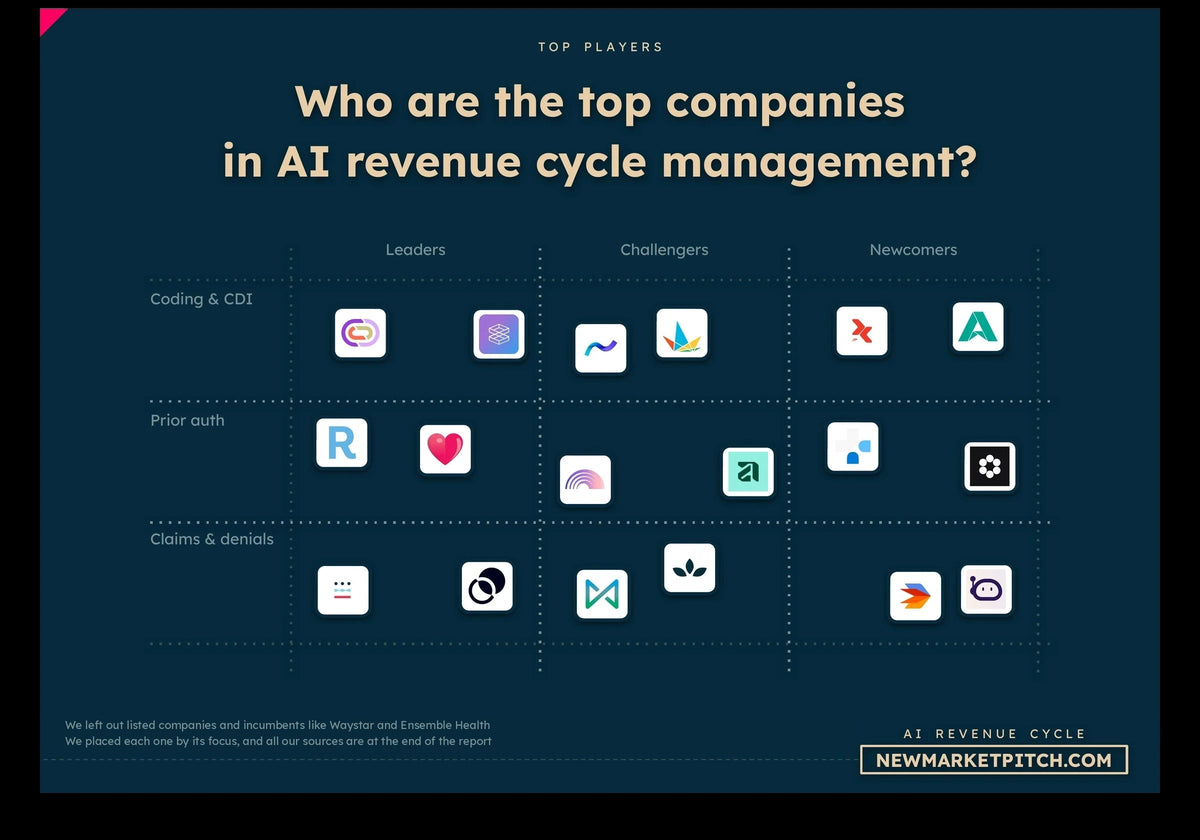
In our research about AI tools for medical billing, we turn what is vague and complex into simple, useful visuals. Market maps like this one show you at a glance where every startup stands.
Is the AI revenue cycle management market getting weaker?
The AI revenue cycle management (RCM) funding market is clearly weaker for startups trying to raise their first round, even though companies already backed by investors are still finding money.
Over the last 12 months, total funding fell 45%, from $685.5 million to $377 million. Deal count declined from 28 to 23, and the number of funded companies dropped from 26 to 22. Yet the median financing increased slightly, from $9.55 million to $10 million.
The biggest change came from first-time fundraising. Only four companies received their first financing, compared with nine in the previous period. Meanwhile, the number of follow-on rounds stayed exactly the same at 19.
The previous year also benefited from several unusually large investments, including Ambience Healthcare's $243 million Series C. Their disappearance explains much of the drop in total funding.
So the market has become harder for newcomers, while established startups still have access to capital. The problem is particularly visible at the beginning of the funding pipeline.
| Funding metric | Last 12 months | Previous 12 months | Change |
|---|---|---|---|
| Total funding | $377.0M | $685.5M | −45.0% |
| Funding deals | 23 | 28 | −17.9% |
| Funded companies | 22 | 26 | −15.4% |
| Median round | $10.0M | $9.55M | +4.7% |
| Average round | $16.39M | $24.48M | −33.0% |
| First financings | 4 | 9 | −55.6% |
| Follow-on financings | 19 | 19 | Unchanged |
| Largest round | $120M | $243M | −50.6% |
Did AI RCM funding really collapse, or did a few big deals disappear?
The apparent collapse in AI RCM funding is heavily influenced by unusually large rounds. Once we remove financings above $50 million, the decline shrinks from 45% to 19.7%.
The previous period included Ambience Healthcare's $243 million Series C, announced in July 2025, alongside two other rounds above $50 million. Those three deals represented 53.3% of all capital raised during the year.
By comparison, the latest 12-month period produced only one financing above $50 million: Candid Health's $120 million Series D.
Stedi complicates the comparison further. Its August 2025 announcement described a $70 million Series B package comprising $50 million in previously unannounced funding and $20 million in new capital. Our database records the full $70 million. Counting only the incremental $20 million would reduce previous-period funding by $50 million and make the headline decline approximately 40.7%, rather than 45%.
Even after excluding every round above $50 million, capital declined from approximately $320 million to $257 million. Underlying funding was therefore weaker, although nowhere near as dramatically as the headline suggests.
| Funding concentration | Last 12 months | Previous 12 months |
|---|---|---|
| Total capital | $377.0M | $685.5M |
| Excluding rounds above $50M | $257.0M | $320.0M |
| Excluding rounds above $100M | $257.0M | $442.5M |
| Largest round | $120M | $243M |
| Largest deal's capital share | 31.8% | 35.4% |
| Top three deals' capital share | 51.7% | 53.3% |
| Top five deals' capital share | 63.7% | 64.6% |
| Number of rounds above $50M | 1 | 3 |

Your time is limited. In our market report about AI tools for medical billing, we put numbers on each part of the market, so you can see where it makes sense to focus.
Are fewer AI RCM startups getting funded now?
Yes. AI RCM investors financed 22 companies during the latest 12 months, compared with 26 previously. That's four fewer funded businesses in an already relatively small market.
The decrease was most visible in North America, where transactions fell from 27 to 18. The drop was partly offset by more activity in Europe and the appearance of financings in Latin America and Asia-Pacific.
There was at least one AI RCM deal in every monthly window during the latest period, whereas the previous period had one month without any transactions.
Activity remained fairly continuous, but median monthly invested capital fell from $20.14 million to $12.12 million. Fewer substantial checks were being written.
The smaller companies that managed to secure funding did not necessarily receive less money, either. The overall median round remained around $10 million, despite the sharp decline in total capital.
Are investors abandoning new AI RCM startups?
New AI RCM startups are having a much harder time attracting their first investment, and the reduction is considerably worse than the overall funding slowdown.
We counted just four first financings during the latest year, compared with nine previously. Combined funding for these initial rounds dropped from $39.45 million to $9.98 million, a 74.7% decrease.
Their median size also declined from $4 million to $2.6 million. Fewer new companies managed to raise money, and those that did generally received smaller initial checks.
This happened while Seed and Series A rounds continued representing most transactions. A startup can be classified as Seed or Series A without being a first-time recipient of venture capital, which helps explain the apparent contradiction.
Investors appear particularly cautious about adding new companies to their portfolios. The figures tell us less about the total number of startups being created, since companies that never seek or secure institutional financing are outside this analysis.

In our document detailing everything you need to know about AI revenue cycle management, we always try to gather several sources and make estimates that make sense, so you can work with solid numbers.
Are established AI RCM companies taking nearly all the money?
Previously funded AI RCM companies now account for 97.4% of invested capital, but even their average funding situation has deteriorated.
Follow-on rounds brought in $367 million during the latest period, compared with $646 million previously. Despite the decline in capital, the number of follow-on transactions remained unchanged at 19.
Their median size dropped from $21 million to $10 million. Investors continued backing familiar companies, but the typical follow-on financing became considerably smaller.
Candid Health was the obvious exception, securing $120 million after reporting strong commercial growth.
Within-period repeat fundraising was also less common. Only one company completed multiple financings during the latest 12 months, compared with two in the preceding year.
We cannot tell whether companies are taking longer to raise again because previous-round dates are not consistently available across the full sample. But the preference for companies with an existing funding history is unmistakable.
| Financing measure | Last 12 months | Previous 12 months |
|---|---|---|
| First-financing deals | 4 | 9 |
| First-financing deal share | 17.4% | 32.1% |
| First-financing capital | $9.98M | $39.45M |
| First-financing capital share | 2.6% | 5.8% |
| Median first financing | $2.60M | $4.00M |
| Follow-on deals | 19 | 19 |
| Follow-on deal share | 82.6% | 67.9% |
| Follow-on capital | $367.02M | $646.03M |
| Follow-on capital share | 97.4% | 94.2% |
| Median follow-on round | $10.00M | $21.00M |
Which AI revenue cycle management categories are attracting more investors?
Denial management and appeals have become the strongest funding growth category in AI RCM, with medical coding also attracting a larger share of deals.
Denial management funding increased from $11.2 million to $95.1 million. Its share of transactions climbed from 10.7% to 26.1%, while its median round jumped from $4 million to $16.5 million.
Medical coding AI followed a different path. The category increased its deal share from 17.9% to 26.1%, although total funding declined from $85.5 million to $70.2 million. The median round still increased from $8 million to $10 million.
Meanwhile, patient access and eligibility AI lost momentum. Deals dropped from eight to three, even though median financing increased from approximately $4.43 million to $8.5 million.
Claims submission and scrubbing also went from six financings to two. However, the segment attracted almost 32% of total capital because of Candid Health's $120 million investment.
Payment posting and reconciliation had a smaller improvement, with deals increasing from one to two and capital rising from $19 million to $41.5 million.
Denial management stands out because more transactions, more capital and larger median checks all moved in the same direction.

Our report covering the AI revenue cycle management market gets updated several times a month, so you always get the latest view of where things stand.
Why are investors suddenly interested in denial management AI?
Denial management AI has attracted far more funding because the technology targets one of healthcare providers' most expensive administrative problems: getting paid for services they've already delivered.
When an insurer denies a claim, a provider may need to identify missing documentation, correct coding errors, investigate eligibility or submit an appeal. Every additional step consumes staff time and delays reimbursement.
Sixth Street highlighted this problem when explaining its investment in Candid Health. The investor cited survey evidence that nearly three-quarters of providers were experiencing rising claim denials, while more than 40% reported denial rates above 10%.
Software that helps providers prevent denials, identify mistakes or recover reimbursement can potentially demonstrate financial returns without requiring customers to change their entire clinical operation.
Companies are also moving beyond isolated coding tasks toward broader revenue assurance. Arintra, for instance, raised a $25 million Series B in August 2026 to expand its AI-powered revenue assurance platform. The company had already announced that its 2025 revenue grew eightfold, alongside a fivefold increase in monthly coding volume.
The funding shift is clear, although the data cannot establish how much of it is attributable to rising denial rates.
Is medical coding AI losing momentum?
Medical coding AI is holding up better than its declining funding total suggests. Investors are financing a larger share of coding companies, and the median round has increased.
The category's capital fell from $85.5 million to $70.2 million, but its share of all AI RCM deals rose to 26.1%. That makes coding one of the two most frequently financed categories in the current sample, alongside denial management.
Arintra reported eightfold revenue growth for 2025 and said its autonomous coding platform handled more than five times as much monthly coding volume as the year before. Its February 2026 announcement also claimed that customers had reduced coding costs by nearly one-third.
Ambience Healthcare has been working on a broader version of the same problem. Its software connects clinical documentation, diagnosis coding and clinical documentation integrity directly to the care process. In 2025, the company announced additional integrations with Epic and reported deployments covering more than 100 medical specialties.
The boundaries of medical coding AI are changing. Some companies sell coding automation directly, while others embed coding into wider clinical and financial workflows.

In our research about AI tools for medical billing, we look at what the winners do differently, so you can learn from the best instead of guessing.
Has AI RCM funding moved beyond the seed stage?
AI RCM funding is still overwhelmingly concentrated in Seed and Series A, and the latest figures show little evidence of a move toward later-stage financing.
Seed rounds accounted for approximately 39% of deals in both periods. Series A increased its share from 32.1% to 39.1%, although the actual number of Series A transactions stayed at nine.
Series B declined from three deals to one, while Series C went from two to one. One Series D+ financing appeared during the current period: Candid Health's $120 million round. Later-stage activity remained a relatively small part of the market.
We also calculated the approximate age of companies receiving funding. Median age increased only slightly, from 2.5 to three years. More surprisingly, the median age of follow-on recipients declined from four years to three.
The market remains focused on relatively young companies. The big difference is that fewer of those companies are securing their first financing.
Why did Candid Health manage to raise $120 million when everyone else was struggling?
Candid Health secured the largest AI RCM round of the year after reporting strong commercial growth and customer retention, making its $120 million financing an exception in a difficult market.
The Series D, announced in July 2026, was led by Sixth Street Growth, with participation from Oak HC/FT, 8VC and Y Combinator.
Candid reported 190% year-over-year growth in annual contracted run-rate revenue and 180% net dollar retention during 2025. It also said its valuation had tripled since its February 2025 Series C.
The company builds software that automates revenue cycle operations, including claims submission and billing workflows. Its approach combines a configurable rules engine with AI agents that handle tasks previously performed manually by billing teams.
Sixth Street explained that it was attracted to Candid's position inside essential healthcare workflows, its technical capabilities and its focus on measurable customer outcomes.
Candid had already raised a $52.5 million Series C in February 2025, making the latest round another major investment in a relatively short period.
Ambience Healthcare's previous-period $243 million financing offers a useful comparison. It too had evidence of adoption across major health systems. Large investors were already favoring companies with substantial customer deployments rather than treating AI capabilities alone as sufficient proof.

In our market report about AI tools for medical billing, we don't want to repeat what boring consulting reports say. Instead, we show you the real and latest market signals that matter.
Are AI RCM investors becoming more selective?
AI RCM investors appear to have become more selective about financing new companies, while continuing to support businesses they already know.
We identified 20 distinct disclosed lead-investor names in the latest period, compared with 27 previously. However, disclosure coverage also declined, so this should not be interpreted as a precise reduction in the active investor population.
Strategic participation was almost unchanged. Four current-period deals explicitly involved strategic investors, compared with five previously, representing 17.4% and 17.9% of transactions.
Recent examples include health-system-associated investors backing Arintra, Ethermed and Joyful Health, alongside MTI's participation in Japan-based mutex.
Arintra's $25 million Series B included the Yale New Haven Health Center for Health Care Innovation and Endeavor Health Ventures. Endeavor Health had also participated in the company's earlier financing and adopted its technology.
That investor-customer overlap is particularly relevant in healthcare, where implementing software across clinical and financial systems can be a substantial undertaking.
Still, the stronger change is in who receives funding, rather than the composition of the investor base itself. Corporate participation remained fairly stable, while first-time financing became much rarer.
Is AI RCM funding spreading beyond the United States?
AI RCM financing has become more geographically diverse, although North America still receives the overwhelming majority of investment.
North America's deal share fell from 96.4% to 78.3%, while its capital share declined from 99.5% to 91.8%.
Europe increased from one financing to two, with capital rising from $3.5 million to $21.4 million. Latin America appeared with two deals totaling $9 million, and Asia-Pacific recorded one $400,000 financing.
These amounts are still small compared with North America's $346.2 million in funding during the latest period.
The geographic expansion is more significant in the number of regions represented than in the distribution of money. U.S. reimbursement workflows remain central to many of the best-funded AI RCM businesses, including Candid Health, Ambience Healthcare and Arintra.
| Geography | Current deals | Previous deals | Current capital | Previous capital |
|---|---|---|---|---|
| North America | 18 | 27 | $346.2M | $682.0M |
| Europe | 2 | 1 | $21.4M | $3.5M |
| Latin America | 2 | 0 | $9.0M | $0 |
| Asia-Pacific | 1 | 0 | $0.4M | $0 |
| Total | 23 | 28 | $377.0M | $685.5M |

Learning from others' mistakes is the cheapest lesson there is. In our document detailing everything you need to know about AI revenue cycle management, we look at what broke startups before you, so you don't repeat it.
Do AI RCM startups need more traction to raise money now?
AI RCM startups with strong commercial traction can still attract very large rounds, but we cannot establish that investors have raised their requirements across the entire market.
Candid Health's $120 million financing is the clearest recent example, backed by reported revenue growth, strong customer retention and an increasing valuation.
Arintra offers another example at a smaller scale. Its August 2026 Series B followed a period of strong reported revenue growth, increasing coding volumes and broader adoption by health systems.
Ambience Healthcare was already demonstrating substantial deployment activity before its July 2025 financing. Cleveland Clinic announced a rollout of its platform in February 2025, while John Muir Health had reported enterprise adoption across multiple specialties.
These businesses had customers using their products at scale, but the evidence does not show that investors have become more demanding than they were a year earlier.
Company age offers little confirmation of such a shift. The median age of funded businesses increased by roughly six months, too modest a change to establish a meaningful difference in investment criteria.
The clearer finding is that fewer companies are receiving their first financing. Among the businesses securing the largest rounds, commercial adoption was already important in the previous period.
Are AI RCM companies raising money to build products or expand their businesses?
The largest AI RCM financings are increasingly associated with expanding commercial platforms, although product development remains an important part of how companies use the money.
Candid Health's July 2026 Series D was intended to scale its autonomous revenue cycle platform. The company's reported revenue growth suggests that expansion was a major priority.
Arintra's August 2026 Series B was similarly linked to growing its revenue assurance platform, expanding across health systems and developing automation capabilities throughout the revenue cycle.
Ambience Healthcare's $243 million Series C in the previous period had comparable ambitions. The company wanted to accelerate deployments across health systems while continuing to expand its clinical documentation and coding technology.
Enterprise deployment is a major part of the work. Winning a hospital or medical group is only the beginning; the software must also integrate with existing records, billing systems, coding requirements and staff workflows.
Ambience's deployment with Ardent Health and its integrations with Epic illustrate the scale of that effort.
However, the available deal records do not consistently divide proceeds into R&D, hiring, sales, acquisitions or international expansion. That prevents a reliable calculation of how the market's overall spending priorities have changed between the two years.

If you build or invest in the AI revenue cycle management market, you need to know which business models pay off now and which ones are fading. That's why our report covering it has a whole section on it.
What really changed over the last 12 months?
AI RCM funding became noticeably harder for new startups. Only four companies raised an initial financing, compared with nine previously, and the total amount invested in those rounds fell nearly 75%. This is the sharpest deterioration in the market.
The headline funding decline overstates the broader contraction. Total capital dropped 45%, but the contraction falls to 19.7% after excluding rounds above $50 million. Last year's exceptional financings, particularly Ambience Healthcare's $243 million Series C, explain much of the difference.
Existing companies kept raising, although their checks became smaller. Follow-on activity remained at 19 deals, but median financing declined from $21 million to $10 million. Previously funded companies captured 97.4% of invested capital.
Denial management became the standout category. Funding for denial management and appeals increased from $11.2 million to $95.1 million. Medical coding also gained deal share, while patient access and eligibility attracted substantially fewer transactions.
The market is still early-stage and overwhelmingly North American. Seed and Series A represented more than three-quarters of current transactions, while North America attracted over 90% of capital. Financing appeared in more regions, but the money remains highly concentrated.
The AI RCM funding market has become more selective, particularly for companies seeking their first investment. Established businesses continue attracting capital, and certain categories are growing rapidly. The biggest concern is the shrinking pipeline of newly financed startups.
Our methodology
Our analysis examines AI revenue cycle management startup funding across two consecutive, non-overlapping 12-month periods: September 9, 2025, through September 8, 2026, and September 9, 2024, through September 8, 2025. We reviewed 51 financing records, comprising 23 transactions in the latest period and 28 in the preceding year. All funding amounts are expressed in U.S. dollars.
We aggregated financing records from our database and examined changes in total capital, deal count, unique funded companies, median and average round sizes, funding stages, first financings, follow-on transactions, investor participation, categories and geography. Each separately dated financing was counted as one transaction, while companies raising multiple rounds were counted only once in the unique-company figures. We applied consistent market classifications across both periods and checked the selected records for duplicate transactions.
We separately tested how much large financings influenced the comparison. For each period, we recalculated funding after excluding rounds above $50 million and $100 million, then examined the concentration of capital among the largest transactions. The distinction is particularly important in a market with relatively few deals, where one exceptional financing can dominate the annual total. We also distinguished first-time funding recipients from companies raising follow-on capital, independently of their reported Seed, Series A or later-stage labels.
Financing amounts reflect disclosed transactions recorded in the database, including approximate currency conversions where applicable. We retained Stedi's announced $70 million Series B package while separately calculating the effect of recognizing only its $20 million in newly raised capital. Lead-investor analysis uses disclosed investor names rather than assuming complete syndicate coverage, and company age is estimated from recorded founding years.
We complemented the transaction analysis with first-hand company and investor announcements to examine revenue growth, customer adoption, platform expansion and commercial deployment. These examples help explain individual financing decisions without changing the aggregate transaction totals. Company-reported operating metrics are identified as such, and we distinguish directly observed funding changes from explanations that cannot be established across the full dataset.
Key financing sources include Sixth Street Growth's announcement of Candid Health's $120 million Series D, Sixth Street's investment rationale, Ambience Healthcare's $243 million Series C announcement, Stedi's Series B disclosure, and Arintra's $25 million Series B announcement.
For commercial performance and healthcare adoption, we also reviewed Arintra's reported revenue growth and coding performance, Cleveland Clinic's rollout of Ambience Healthcare, John Muir Health's enterprise deployment, and Ambience Healthcare's Epic integration announcement. These sources were used to assess specific investment and product developments, while the funding comparisons and category calculations remain based on our compiled financing dataset.

In our research about AI tools for medical billing, we like to show you the big picture. We know your time is precious, so we make every page quick to read and packed with as much learning as possible per minute.
Written by the New Market Pitch teamWe track new markets so founders and investors can move faster. About us