What are the top AI revenue cycle management startups by total funding raised?
Whether you're building or investing in the AI revenue cycle management market, our report covers everything you need to know: the players, the money, and what's coming next.
Summary
Cedar, AKASA and Candid Health are the top three AI revenue cycle management startups by total funding raised, with $326 million, $324 million and $218 million, respectively. Infinx follows with $187 million, ahead of CodaMetrix at $107 million.
The ten largest companies have raised a combined $1.553 billion. The top three account for 55.8% of that amount, while the top five represent 74.8%. Capital is heavily concentrated around a handful of businesses.
The leaders are pursuing different parts of healthcare's financial infrastructure. Cedar specializes in patient billing and financial engagement, Candid Health automates billing and claims, while AKASA addresses broader hospital revenue cycle operations.
Medical coding is another well-funded segment. CodaMetrix, Nym Health and Fathom have raised $107 million, $92 million and $61 million, respectively. Their products tackle one of the most labor-intensive stages of healthcare reimbursement, although several are now expanding into adjacent workflows.
Denial prevention and revenue recovery are attracting a new generation of specialized companies. Adonis, Anomaly, Charta Health and Amperos Health are developing tools to identify reimbursement problems, understand payer behavior and recover money that healthcare providers would otherwise lose.
Patient financial engagement remains a substantial investment category. Alongside Cedar, PayZen, Inbox Health and Collectly are tackling different parts of patient billing, payment financing and collections. Dental administration is emerging as a separate opportunity, led by Lassie, Wisdom and Zentist.
Recent financing activity shows that investors are still prepared to write large checks. Candid Health raised $120 million in July 2026 and AKASA $55.2 million the same month, while Adonis secured $40 million, Lassie $35 million and Arintra $25 million. Brellium also attracted $23 million in October 2026.
The market is moving beyond software that simply recommends coding corrections. Companies such as Parallel, Lassie and SuperDial are developing AI agents that can execute administrative tasks, communicate with insurers and work across existing healthcare systems.
The United States remains the main center of activity, although international companies are also competing, including Care.fi in India, Parallel in France, InsideDesk in Canada and Maverick Medical AI in Israel.
Investor interest comes from both traditional venture capital and healthcare specialists. Andreessen Horowitz, General Catalyst, NEA, 8VC, Bessemer Venture Partners and Sixth Street Growth are among the important financial backers, while CVS Health Ventures and Yale New Haven Health bring direct healthcare industry participation.
Funding alone will not determine which companies dominate. The strongest businesses will need to integrate with existing hospital and practice management systems, handle complicated insurance exceptions and demonstrate that their automation actually improves collections. Broad platforms have an opportunity to become essential infrastructure, while specialized startups can build valuable positions around individual workflows.

Written by the New Market Pitch teamWe track new markets so founders and investors can move faster. About us

In our report covering the AI revenue cycle management market, you will always find fresh funding data, taken straight from our own verified funding database.
Top startups in the AI revenue cycle management market ranked by total funding raised
Here is an updated table that ranks the top startups in the AI revenue cycle management market based on the total amount of funding they have raised to date.
The table also includes the total number of funding rounds, the date and size of the latest round, the financing type (e.g. Series A, equity financing), key investors, the startup’s current status (active, IPO, acquired, or shut down), and a confidence score based on the data collected.
If you need to dig deeper and get more detailed data, please check our report covering the AI revenue cycle management market.
| # | Startup | What They Do | Total Raised ($) | Total Rounds | Last Round Date | Last Round Amount ($) | Last Round Type | Key Investors | Current Stage | Confidence | Country |
|---|---|---|---|---|---|---|---|---|---|---|---|
| 1 | Cedar | Patient billing and financial engagement | $326M | 4 | March 2021 | $200M | Series D | Tiger Global, Andreessen Horowitz, Thrive Capital | Active | Full | United States |
| 2 | AKASA | AI automation for hospital revenue cycles | $323.7M | 5 | July 2026 | $55.2M | Series D-1 | Coatue Management | Active | Full | United States |
| 3 | Candid Health | Automated medical billing and claims | $217.7M | 5 | July 2026 | $120M | Series D | Sixth Street Growth, 8VC, Oak HC/FT | Active | Strong | United States |
| 4 | Infinx | AI-powered healthcare RCM solutions | $187M1 | 2 | May 2024 | ~$142M | Private Equity | KKR, Norwest Venture Partners | Active | Partial | United States |
| 5 | CodaMetrix | Autonomous AI medical coding | $107M | 3 | May 2025 | $12M | Series B-II | SignalFire, The Riverside Company | Active | Partial | United States |
| 6 | Adonis | AI-powered revenue cycle operations platform | $94M | 4 | March 2026 | $40M | Series C | Quadrille Capital, General Catalyst, Bling Capital | Active | Full | United States |
| 7 | Nym Health | Autonomous medical coding software | $92M | 4 | October 2024 | $47M | Growth Investment | PSG, GV, Addition | Active | Full | United States |
| 8 | Janus Health | AI-driven revenue cycle automation | $72.7M | 3 | October 2026 | $8.8M | Equity Extension | Enhanced Healthcare Partners | Active | Strong | United States |
| 9 | PayZen | AI-powered patient payment financing | $72M | 5 | August 2024 | $32M | Series B | NEA, Viola Ventures, 7wire Ventures | Active | Strong | United States |
| 10 | Fathom | Autonomous medical coding software | $61M2 | 5 | May 2026 | Undisclosed | Strategic Investment | CVS Health Ventures | Active | Partial | United States |
| 11 | Inbox Health | Patient billing communication automation | $56M | 9 | September 2025 | $10M | Growth Equity | Ten Coves Capital, Commerce Ventures, Connecticut Innovations | Active | Partial | United States |
| 12 | Arintra | Autonomous medical coding and revenue assurance | $51M | 5 | August 2026 | $25M | Series B | Define Ventures, Peak XV, Yale New Haven Health | Active | Partial | United States |
| 13 | Lassie | AI agents for dental administration | $47M | 2 | June 2026 | $35M | Series A | Andreessen Horowitz, Night Capital, Rahul Vohra | Active | Strong | United States |
| 14 | Brellium | AI clinical documentation and coding audits | $40M | 3 | October 2026 | $23M | Series B | First Round Capital, Left Lane Capital, Digital Health Venture Partners | Active | Partial | United States |
| 15 | Anomaly | AI payer intelligence and payment accuracy | $39M | 4 | May 2026 | $17M | Growth | Sound Ventures, Alumni Ventures, Link Ventures | Active | Partial | United States |
| 16 | Sift Healthcare | AI-powered healthcare payment intelligence | $39M | 6 | May 2024 | $20M | Series B | B Capital, Allos Ventures, First Trust Capital Partners | Active | Partial | United States |
| 17 | Collectly | Patient billing and payment engagement | $34.1M | 5 | July 2023 | $29M | Series A | Sapphire Ventures, Burst Capital, Cabra VC | Active | Strong | United States |
| 18 | Camber | Healthcare claims and billing automation | $30M+ | 3 | February 2025 | $30M | Series B | Andreessen Horowitz, Craft Ventures, ACME Capital | Active | Partial | United States |
| 19 | Charta Health | AI chart audits and revenue integrity | $30M | 2 | July 2025 | $22M | Series A | Bain Capital Ventures, Madrona, SV Angel | Active | Full | United States |
| 20 | Wisdom | AI-powered dental revenue cycle management | $28M | 2 | August 2025 | $21M | Series A | Permanent Capital Ventures, Aquiline Capital Partners, Juxtapose | Active | Strong | United States |
| 21 | Parallel | AI agents for hospital administration | $23.5M | 3 | March 2026 | $20M | Series A | Index Ventures, Frst, Y Combinator | Active | Strong | France |
| 22 | Outbound AI | Conversational AI for healthcare RCM | $23M | 2 | June 2023 | $16M | Seed | Madrona Venture Group, SpringRock Ventures, EPIC Ventures | Active | Strong | United States |
| 23 | Joyful Health | AI financial infrastructure for healthcare | $22M | 2 | April 2026 | $17M | Series A | CRV, XYZ Venture Capital, Designer Fund | Active | Strong | United States |
| 24 | Amperos Health | AI denial management and revenue recovery | $20M | 2 | April 2026 | $16M | Series A | Bessemer Venture Partners, Uncork Capital, Neo | Active | Full | United States |
| 25 | Zentist | AI-powered dental revenue cycle automation | $17M3 | 5 | April 2023 | Undisclosed | Venture | StartUp Health, Point Nine Capital, 500 Global | Active | Partial | United States |
| 26 | SuperDial | Voice AI for healthcare billing | $16M | 4 | June 2025 | $12M | Series A | SignalFire, Slow Ventures, BoxGroup | Active | Strong | United States |
| 27 | Procode AI | AI-powered surgical medical billing | $14M | 2 | July 2026 | $10M | Series A | Health Velocity Capital | Active | Full | United States |
| 28 | Trek Health | Healthcare payer data intelligence | $14M | 2 | May 2025 | $11M | Series A | Madrona Venture Group, Accrete Health Partners, LifeX Ventures | Active | Full | United States |
| 29 | InsideDesk | Dental revenue cycle automation | $13M | 4 | July 2026 | $13M | Growth Financing | Pender Ventures, Round13 Capital, Graphite Ventures | Active | Partial | Canada |
| 30 | RapidClaims | AI medical coding automation | $11M | 2 | April 2025 | $8M | Series A | Accel, Together Fund | Active | Strong | United States |
| 31 | Maverick Medical AI | Autonomous AI medical coding | $10M+ | 5 | August 2025 | Undisclosed | Corporate Minority Investment | Infinx | Active | Partial | Israel |
| 32 | Enter Health | Medical billing and revenue cycle services | $10M | 4 | April 2024 | $4M | Venture Financing | Mucker Capital | Active | Partial | United States |
| 33 | Care.fi | AI-powered hospital revenue cycle infrastructure | $5M | 1 | February 2026 | $5M | Series A | July Ventures, Peak XV, Accion Ventures | Active | Partial | India |
| 34 | XpertDox | AI-powered autonomous medical coding | $5M | 5 | January 2023 | $1M | Seed / Venture | Undisclosed | Active | Partial | United States |
| 35 | Claim Health | AI administration automation for home care | $5M | 2 | January 2026 | $4M | Seed | Maverick Ventures, Peak XV, Y Combinator | Active | Strong | United States |
| 36 | Ember AI | AI denial prevention and medical coding | $4M | 1 | November 2025 | $4M | Seed | Nexus Venture Partners, Y Combinator | Active | Partial | United States |
| 37 | Synaptec Health | Automated medical coding software | $4M | 2 | November 2023 | $4M | Seed | Citta Capital, Foothill Ventures | Active | Partial | United States |
| 38 | DayDream | Dental billing and insurance automation | $3M4 | 1 | March 2024 | $3M4 | Pre-Seed | AI Grant | Active | Low | United States |
| 39 | Veuu | AI healthcare payment automation | $580K | 1 | November 2020 | $580K | Seed | Undisclosed | Active | Low | United States |
| 40 | Cair Health | AI agents for medical claims workflows | $500K | 1 | September 2023 | $500K | Seed | Y Combinator | Active | Partial | United States |
| 41 | Substrate | AI agents for medical billing | $125K | 1 | August 2024 | $125K | Seed | Y Combinator | Active | Partial | United States |
- The 2024 round has conflicting reported values, which may affect the total.
- Minimum: several strategic and early investments have undisclosed amounts.
- The 2019 Series A is reported as both $8M and $14M.
- The reported pre-seed amount is not confirmed as equity.

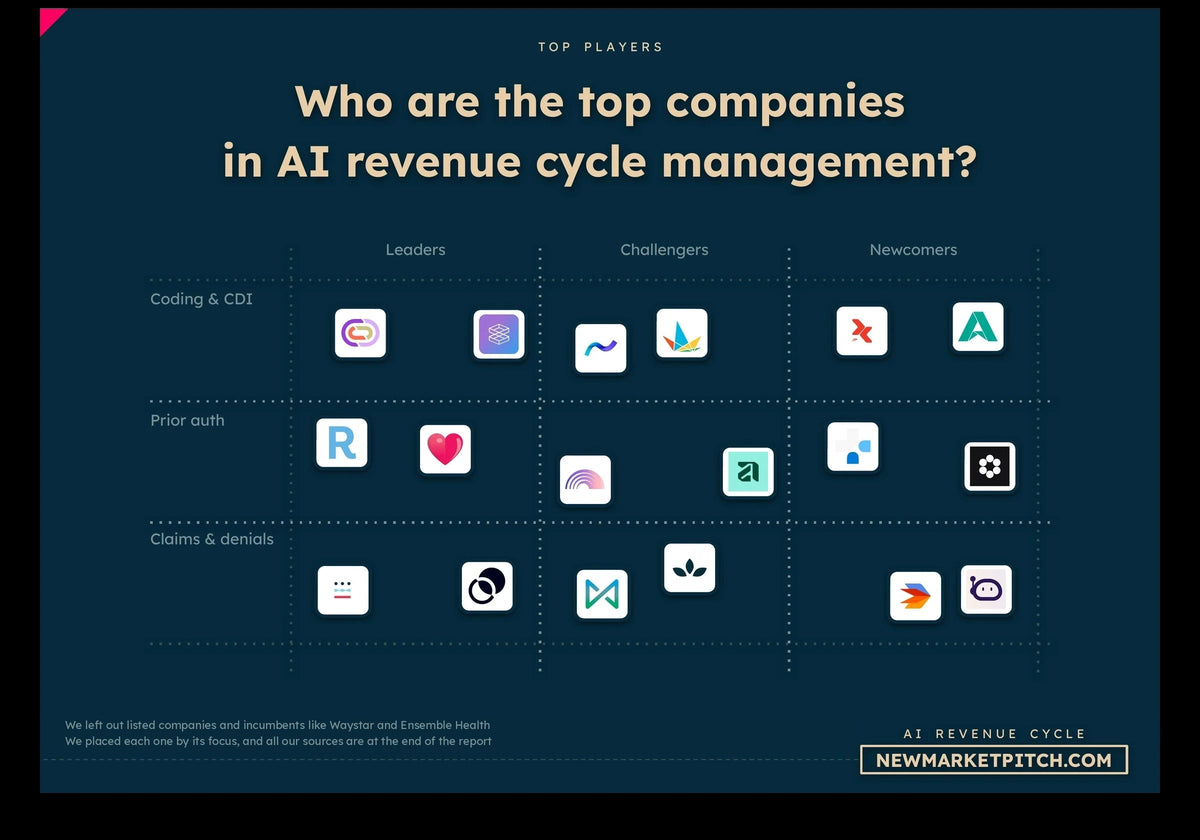
In our research about AI tools for medical billing, we turn what is vague and complex into simple, useful visuals. Market maps like this one show you at a glance where every startup stands.
Which AI revenue cycle management startups have raised the most money?
Cedar, AKASA and Candid Health are the three biggest-funded AI revenue cycle management startups, with $326 million, $324 million and $218 million raised respectively. Their combined $867 million represents 55.8% of the $1.553 billion raised by the ten highest-ranked companies.
The gap between the leaders and the rest of the market is considerable. Infinx follows with $187 million, while CodaMetrix, Adonis and Nym Health have raised between $92 million and $107 million. Below the top ten, cumulative funding drops to $56 million for Inbox Health and $51 million for Arintra.
Two distinct groups are emerging. The first consists of companies that have attracted substantial capital to build broader healthcare financial platforms. The second includes specialized businesses targeting medical coding, dental administration, patient payments and insurance claims. Both groups are attracting investment, although their funding histories differ considerably.
| Rank | Startup | Total raised |
|---|---|---|
| 1 | Cedar | $326M |
| 2 | AKASA | $324M |
| 3 | Candid Health | $218M |
| 4 | Infinx | $187M |
| 5 | CodaMetrix | $107M |
| 6 | Adonis | $94M |
| 7 | Nym Health | $92M |
| 8 | Janus Health | $73M |
| 9 | PayZen | $72M |
| 10 | Fathom | $61M |
Why are investors putting so much money into AI revenue cycle management?
Investors are paying serious attention to AI revenue cycle management because healthcare providers lose substantial time and money dealing with billing errors, insurance denials, incomplete documentation and delayed payments. These problems affect almost every stage of the financial relationship between providers, insurers and patients.
Different companies can address different parts of the same problem. Candid Health automates billing and claims, AKASA works across hospital revenue cycle operations, while Anomaly uses AI to understand payer behavior and payment accuracy.
Patient payments create another investment opportunity. Cedar, PayZen and Inbox Health are tackling the difficulty of collecting money from patients, communicating outstanding balances and making healthcare payments easier to manage.
There is also growing interest in automation that can prevent financial problems before claims are submitted. Charta Health focuses on chart audits and revenue integrity, while Arintra combines medical coding with revenue assurance.
The financial incentive is straightforward: healthcare providers want to collect more of the money they are owed while spending less on the administrative work required to obtain it. AI companies that can demonstrate measurable improvements in both areas have a compelling commercial proposition.

Your time is limited. In our market report about AI tools for medical billing, we put numbers on each part of the market, so you can see where it makes sense to focus.
Is Cedar still the biggest-funded AI revenue cycle management startup?
Yes. Cedar remains at the top of our AI revenue cycle management ranking with $326 million raised across four rounds. Its focus on patient billing and financial engagement gives it a different position from companies concentrating on autonomous medical coding or hospital claims processing.
Cedar's $200 million Series D in March 2021 was a particularly important financing event. Tiger Global led the round, with Andreessen Horowitz and Thrive Capital among the participating investors.
Cedar addresses a recurring problem for healthcare providers: patients increasingly have to manage their own medical expenses, understand complicated bills and arrange payments. Making these interactions easier can improve the patient experience while helping providers collect outstanding balances.
The company therefore represents an important part of the RCM market, even though its product positioning differs from the newer generation of AI-native claims and coding platforms.
Can Candid Health become a major competitor in healthcare billing software?
Candid Health has become one of the strongest-funded AI-native RCM companies, with $218 million raised across five rounds. Its $120 million Series D in July 2026, led by Sixth Street Growth with participation from Oak HC/FT and 8VC, demonstrates the scale of investor backing behind its approach.
Candid reported 190% year-over-year growth in annual contracted run-rate revenue in 2025 in connection with the financing announcement. That is an important commercial development because the company is attempting to automate the financial infrastructure that healthcare providers rely on to get paid.
The company's positioning also explains why it attracts comparisons with broader healthcare software platforms. Candid focuses on billing and claims workflows, allowing providers to automate processes that have traditionally required substantial administrative teams.
Its funding history is particularly impressive when compared with younger specialized competitors. Candid's $218 million cumulative total is more than twice CodaMetrix's $107 million and more than four times Amperos Health's $20 million.

In our document detailing everything you need to know about AI revenue cycle management, we always try to gather several sources and make estimates that make sense, so you can work with solid numbers.
Which AI medical coding startups have raised the most funding?
Medical coding is one of the best-funded areas within AI revenue cycle management. AKASA leads the broader hospital automation and coding group with $324 million raised, followed by CodaMetrix with $107 million, Nym Health with $92 million and Fathom with $61 million.
The next group includes Arintra with $51 million, RapidClaims with $11 million, Maverick Medical AI with $10 million, XpertDox with $5 million, Ember AI with $4 million and Synaptec Health with $4 million.
These companies approach coding from slightly different angles. AKASA works across hospital revenue cycle operations, while CodaMetrix, Nym Health and Fathom focus more directly on autonomous medical coding. Arintra combines coding automation with revenue assurance, and RapidClaims focuses on automating medical coding workflows.
Arintra's $25 million Series B in August 2026 is particularly notable. Define Ventures led the round, with participation from existing investors including Peak XV and Yale New Haven Health. The financing will help the company expand its revenue assurance platform beyond autonomous coding.
The difference between these companies will increasingly depend on how much of the financial workflow they can automate after assigning a medical code. Accurate coding is valuable, but providers also need systems that can identify documentation problems, reduce denials and improve reimbursement.
Is AI revenue cycle management moving beyond medical coding?
Yes. AI revenue cycle management is expanding into claims processing, documentation review, denial prevention, payment reconciliation and administrative execution. Medical coding remains an important entry point, but several companies are already targeting much wider workflows.
Candid Health is building automated billing and claims infrastructure, while Adonis focuses on AI-driven revenue cycle operations. Parallel develops AI agents for hospital administration, and Care.fi targets hospital revenue cycle infrastructure.
We can also see this expansion among companies that started with narrower applications. Arintra is extending autonomous medical coding into revenue assurance, while Charta Health combines clinical chart audits with documentation and revenue integrity.
This broader approach makes commercial sense because healthcare billing involves several connected tasks. A coding tool can identify the correct medical classification, but providers still need to check documentation, submit claims, handle insurer responses and collect payments.
The companies that can automate several of these steps have a chance to become more deeply embedded in healthcare organizations. That is where much of the current competition is heading.

Our report covering the AI revenue cycle management market gets updated several times a month, so you always get the latest view of where things stand.
Which AI RCM startups are trying to prevent medical billing denials?
Denial prevention and revenue recovery are attracting substantial investment because rejected claims directly affect how much money healthcare providers actually collect.
Several companies in our ranking are targeting this problem. Adonis has raised $94 million, Anomaly $39 million, Charta Health $30 million, Amperos Health $20 million and Ember AI $4 million. Arintra, with $51 million raised, also addresses revenue assurance through automated coding and documentation analysis.
Their products approach denials from different directions. Anomaly focuses on payer intelligence and payment accuracy, while Amperos Health automates denial management and revenue recovery. Charta Health reviews clinical documentation to identify problems before they affect billing.
Adonis is taking a broader approach through its AI revenue cycle operations platform. Its $40 million Series C in March 2026 was led by Quadrille Capital, with General Catalyst and Bling Capital participating. The company also reported more than fourfold revenue growth in 2025 and net revenue retention above 130%.
Amperos Health's $16 million Series A in April 2026, led by Bessemer Venture Partners, is another important example. The company said its technology had served more than 3,000 clinical locations and supported nearly $700 million in annual revenue recovery.
The opportunity is clear: providers want to identify reimbursement problems earlier, understand why insurers reject claims and recover money without having to increase their administrative headcount.
Which AI dental revenue cycle management startups have raised the most money?
Lassie is the biggest-funded dental-focused AI administration startup in our ranking, with $47 million raised. Wisdom follows with $28 million, Zentist with $17 million, InsideDesk with $13 million and DayDream with $3 million.
Lassie's $35 million Series A in June 2026, led by Andreessen Horowitz with participation from Night Capital and other investors, is particularly notable. Its AI agents automate administrative tasks in doctors' offices, starting with dental practices.
Wisdom takes a more direct approach to dental revenue cycle management. Its $21 million Series A in August 2025 was led by Permanent Capital Ventures, with Aquiline Capital Partners and Juxtapose participating.
InsideDesk focuses on dental revenue cycle automation, while Zentist works on dental billing and payment workflows. DayDream is another specialized company developing dental billing and insurance automation.
Dental practices offer an interesting market for AI automation because many administrative tasks are repeated across thousands of independent businesses. Insurance verification, claims submission, payment posting and patient billing create a substantial workload.
The challenge for these companies is integrating with the practice management systems already used by dentists and supporting the different insurance arrangements across practices. The companies that make those integrations work reliably could build valuable specialized businesses.

In our research about AI tools for medical billing, we look at what the winners do differently, so you can learn from the best instead of guessing.
Are AI patient billing startups still attracting serious investment?
Yes. Patient billing remains one of the most heavily funded parts of the AI revenue cycle management market. Cedar has raised $326 million, PayZen $72 million, Inbox Health $56 million and Collectly $34 million.
These businesses approach patient financial engagement from different angles. Cedar focuses on patient billing and financial engagement, PayZen offers AI-powered payment financing, Inbox Health automates billing communications, and Collectly helps providers manage patient payments.
PayZen's August 2024 Series B illustrates why financing structures matter. The company announced a $232 million financing package, consisting of $32 million in equity and a separate $200 million credit warehouse. We retain the $72 million cumulative equity funding total in our ranking rather than treating the credit facility as additional equity funding.
Inbox Health is another interesting example. Its September 2025 financing announcement described $20 million in new funding and brought its reported cumulative funding to $55 million. Our ranking lists $56 million.
The four companies demonstrate that patient financial engagement remains an important investment category, with different business models addressing the same underlying problem: making healthcare payments easier to understand, arrange and collect.
Who are the biggest investors in AI revenue cycle management startups?
The largest AI revenue cycle management companies have attracted a mixture of major venture capital firms, healthcare specialists and growth investors. Andreessen Horowitz, Tiger Global, General Catalyst, Coatue Management, NEA, 8VC and Sixth Street Growth are among the most visible names.
Andreessen Horowitz has backed Cedar, Camber and Lassie. General Catalyst appears among the investors in AKASA and Adonis, while 8VC has participated in Candid Health and Camber.
Other important investors include Thrive Capital, Oak HC/FT, Coatue Management, NEA, PSG, GV, Addition, Define Ventures, SignalFire, Bessemer Venture Partners and Quadrille Capital.
We also see strategic healthcare participation. CVS Health Ventures invested in Fathom, while Yale New Haven Health participated in Arintra's financing. These relationships are particularly interesting because healthcare organizations can bring operating knowledge and potential commercial connections alongside financial capital.
The investor landscape shows that healthcare RCM is attracting attention from both traditional venture capital and investors who understand the economics of healthcare delivery.

In our market report about AI tools for medical billing, we don't want to repeat what boring consulting reports say. Instead, we show you the real and latest market signals that matter.
What are the biggest recent AI revenue cycle management funding rounds?
Candid Health's $120 million Series D in July 2026 is the largest latest-round financing among the companies in our ranking. Several other companies have also attracted substantial investments through their most recent rounds.
AKASA raised $55.2 million in July 2026, Adonis $40 million in March 2026, Lassie $35 million in June 2026, Arintra $25 million in August 2026 and Brellium $23 million in October 2026.
Parallel secured $20 million in March 2026, Amperos Health raised $16 million in April 2026, Anomaly raised $17 million in May 2026 and Procode AI secured $10 million in July 2026.
| Startup | Latest round | Date | Amount |
|---|---|---|---|
| Candid Health | Series D | July 2026 | $120M |
| AKASA | Series D-1 | July 2026 | $55.2M |
| Adonis | Series C | March 2026 | $40M |
| Lassie | Series A | June 2026 | $35M |
| Arintra | Series B | August 2026 | $25M |
| Brellium | Series B | October 2026 | $23M |
| Parallel | Series A | March 2026 | $20M |
| Anomaly | Growth | May 2026 | $17M |
| Amperos Health | Series A | April 2026 | $16M |
| Procode AI | Series A | July 2026 | $10M |
Are AI revenue cycle management startups raising bigger Series A rounds?
Some are. Lassie's $35 million Series A in June 2026 and Parallel's $20 million Series A in March 2026 are particularly large commitments for companies at that financing stage.
Other examples include Amperos Health, which raised $16 million in April 2026, Procode AI with $10 million in July 2026 and Care.fi with $5 million in February 2026.
The contrast with more established businesses is interesting. Candid Health's $120 million Series D and Adonis's $40 million Series C represent larger growth investments, while these Series A financings show that investors are prepared to commit substantial capital before a company has completed several financing rounds.
We should also distinguish between round size and cumulative funding. Lassie has raised $47 million across two rounds, while Cedar has raised $326 million across four rounds. The former demonstrates substantial early investor backing, whereas the latter reflects a much longer funding history.

Learning from others' mistakes is the cheapest lesson there is. In our document detailing everything you need to know about AI revenue cycle management, we look at what broke startups before you, so you don't repeat it.
Are AI revenue cycle management companies actually building autonomous AI agents?
Yes. Autonomous AI agents are becoming an important product direction, particularly for companies trying to automate repetitive administrative work across existing healthcare systems.
Lassie has raised $47 million to develop AI agents for dental and medical administration. Parallel has raised $23.5 million for AI agents designed to automate hospital workflows, while SuperDial has raised $16 million to develop voice AI for healthcare billing.
Substrate, with $125,000 raised, is another company explicitly targeting AI agents for medical billing. Cair Health has raised $500,000 to develop agents for medical claims workflows.
Other companies pursue similar automation goals without necessarily marketing their products primarily as AI agents. Candid Health automates billing and claims, while Adonis coordinates revenue cycle operations and Arintra automates coding and revenue assurance.
The important question is how much work these systems can complete independently. An AI assistant that recommends a correction still requires a person to execute it. An agent that can identify a problem, update the relevant information and complete the next administrative step offers a much larger productivity opportunity.
Healthcare organizations will still need human oversight for unusual cases, clinical judgment and sensitive financial decisions. Even so, the ability to automate routine workflows across multiple systems could significantly change how revenue cycle teams operate.
Which AI revenue cycle management startups are focused on hospitals?
AKASA, Candid Health, CodaMetrix, Nym Health, Parallel and Care.fi are among the companies in our ranking with particularly strong hospital-oriented propositions.
AKASA has raised $324 million, Candid Health $218 million, CodaMetrix $107 million and Nym Health $92 million. Parallel has raised $23.5 million, while Care.fi has raised $5 million.
These businesses do not all sell the same product. AKASA addresses wider hospital revenue cycle operations, Candid automates billing and claims, and CodaMetrix and Nym Health concentrate on autonomous medical coding.
Parallel is developing AI agents that work across hospital administrative systems, while Care.fi focuses on revenue cycle infrastructure for hospitals.
Hospital deployments can be difficult because financial workflows connect to clinical records, insurance systems, billing platforms and internal administrative processes. A product must integrate reliably with these systems before it can become part of daily operations.
That complexity creates opportunities for both broad platforms and specialized vendors. A hospital may purchase a coding solution from one company and use another for claims automation or denial management.

If you build or invest in the AI revenue cycle management market, you need to know which business models pay off now and which ones are fading. That's why our report covering it has a whole section on it.
Which AI revenue cycle management startups are targeting smaller medical practices?
Several companies are building products for independent practices, dental offices and smaller healthcare organizations that cannot maintain the same administrative resources as large hospital systems.
Lassie has raised $47 million, Wisdom $28 million, Zentist $17 million, InsideDesk $13 million and DayDream $3 million, all targeting dental administration or related financial workflows.
Other relevant companies include SuperDial, with $16 million raised, Outbound AI with $23 million and Claim Health with $5 million. Their products address healthcare billing communications, conversational AI and administrative automation for home care.
The opportunity comes from the large number of smaller healthcare businesses that still depend on repetitive administrative work. Insurance verification, claims processing and payment follow-ups can consume a significant amount of staff time.
Selling to smaller organizations also creates a different commercial challenge. Software must be easy to implement, require limited technical support and deliver enough financial value to justify recurring subscription costs.
Which AI revenue cycle management startups are targeting insurance companies and payer data?
Anomaly and Trek Health are the clearest payer-intelligence specialists in our ranking, with $39 million and $14 million raised respectively.
Anomaly focuses on payer intelligence and payment accuracy, using AI to identify patterns in healthcare transactions and insurance reimbursement behavior. Its $17 million May 2026 financing was intended to expand its platform into managed care and payer intelligence.
Trek Health takes a related approach through healthcare payer data intelligence. Rather than concentrating exclusively on submitting claims, these businesses aim to help healthcare providers understand how insurers evaluate and reimburse medical services.
This is a valuable area because reimbursement rules and insurer behavior can vary significantly across contracts and medical specialties. Better information can help providers identify payment discrepancies, challenge incorrect decisions and prepare stronger claims.
Anomaly's strategy is particularly interesting because it addresses the relationship between providers and insurers from an information perspective. Its longer-term opportunity will depend on whether that intelligence can produce measurable improvements in reimbursement and contract negotiations.

In our research about AI tools for medical billing, we like to show you the big picture. We know your time is precious, so we make every page quick to read and packed with as much learning as possible per minute.
Are AI revenue cycle management startups becoming a global market?
The United States still dominates the funding landscape, but AI revenue cycle management development is also taking place in several other countries.
Care.fi is based in India, Parallel in France, InsideDesk in Canada and Maverick Medical AI in Israel. The other 37 companies in our ranking are based in the United States.
Parallel is the largest-funded international company, with $23.5 million raised. InsideDesk follows with $13 million, Maverick Medical AI with $10 million and Care.fi with $5 million.
The US concentration reflects the scale and complexity of American healthcare reimbursement. Companies targeting this market must deal with a fragmented insurance system, complicated coding requirements and large numbers of healthcare providers.
International companies can still build valuable businesses by developing technology for American healthcare customers or adapting automation to their own national healthcare systems. However, the software cannot always be transferred directly between countries because billing rules, payer structures and reimbursement requirements differ.
How concentrated is AI revenue cycle management funding among the biggest startups?
Funding is heavily concentrated among the largest companies. Cedar, AKASA and Candid Health have raised $867 million combined, representing approximately 55.8% of the $1.553 billion raised by the top ten.
The concentration increases when we include the next two companies. Infinx and CodaMetrix bring the cumulative funding of the top five to $1.161 billion, or approximately 74.8% of the top ten total.
| Funding group | Combined funding | Share of top ten |
|---|---|---|
| Top 3 | $867M | 55.8% |
| Top 5 | $1.161B | 74.8% |
| Top 7 | $1.347B | 86.8% |
| Top 10 | $1.553B | 100% |
The figures reveal how much capital has accumulated around a small number of businesses. The remaining companies have generally raised less, although several have still attracted meaningful investments.
Funding concentration should not be confused with market share. A company that has raised $200 million does not necessarily generate twice the revenue or serve twice as many customers as one that has raised $100 million. The figures simply show where investors have committed the most capital over time.

When you build or invest in the AI revenue cycle management market, you need clarity, not confusion. In our market report about AI tools for medical billing, we always try to put numbers on and quantify whatever is usually vague and confusing.
Can smaller AI revenue cycle management startups compete with companies that have raised more than $100 million?
Yes. Smaller startups can compete by solving a specific problem better than a broader platform, particularly when they develop strong integrations or expertise in a specialized medical workflow.
Amperos Health has raised $20 million for denial management and revenue recovery, while Procode AI has raised $14 million for surgical medical billing. RapidClaims has raised $11 million for medical coding automation, and Ember AI has raised $4 million for denial prevention and coding.
Other examples include Charta Health, with $30 million raised for chart audits and revenue integrity, and Trek Health, with $14 million raised for payer data intelligence.
These companies do not need to replace an entire hospital revenue cycle platform to become valuable. A product that reliably improves one expensive administrative process can establish a strong position within a healthcare organization.
The main risk is that larger platforms may expand into adjacent workflows. Smaller companies will need to keep improving their technology and demonstrate that their specialized products deliver results that customers cannot easily obtain elsewhere.
Which AI revenue cycle management startups have the strongest long-term potential?
Candid Health, AKASA, Adonis and Arintra stand out because their products address several important parts of the healthcare revenue cycle and have attracted substantial financing.
Candid Health has raised $218 million for automated billing and claims, while AKASA has raised $324 million for hospital revenue cycle automation. Adonis has raised $94 million for its AI-driven operations platform, and Arintra has raised $51 million for autonomous coding and revenue assurance.
Several more specialized businesses also deserve attention. Anomaly has raised $39 million to build payer intelligence, Lassie $47 million to automate dental administration and Amperos Health $20 million to address denials and revenue recovery.
The eventual winners will need more than strong fundraising histories. They must demonstrate that their software works reliably inside healthcare organizations, handles complicated exceptions and delivers financial improvements that justify the cost of implementation.
Our assessment is that broad RCM platforms have an advantage in the race to become essential healthcare financial infrastructure, while specialized companies have a credible opportunity to own individual workflows. The two models can coexist, although competition will intensify as larger platforms expand their product offerings.

A good product starts with a real problem. In our document detailing everything you need to know about AI revenue cycle management, we show you the ones customers still live with.
Our methodology
This analysis ranks startups in the AI revenue cycle management market by total funding raised. It covers companies developing AI-powered solutions for medical coding, billing, claims processing, denial management, revenue assurance, patient payments, dental administration and payer intelligence.
We compare cumulative company funding, individual financing rounds, announcement dates, round sizes and participating investors. The analysis also considers the different business models within the market, from broad hospital revenue cycle platforms to specialized tools for independent medical and dental practices.
We prioritize company announcements and investor disclosures for financing details, supplemented by reporting from healthcare and technology publications. Key sources include Cedar's Series D announcement, Sixth Street Growth's Candid Health financing announcement, CodaMetrix's Series B announcement, Nym Health's growth investment announcement, Adonis's Series C announcement, Arintra's funding announcements, Amperos Health's Series A announcement, PayZen's Series B announcement, Andreessen Horowitz's Lassie investment announcement and Axios's coverage of Brellium's October 2026 financing.
Additional industry reporting from Fierce Healthcare, Becker's Hospital Review and TechCrunch helps establish the commercial context, investor participation and development of the different RCM business models.

In our report covering the AI revenue cycle management market, we try to remove everything that could confuse you, especially if you're investing or building in this market.
Written by the New Market Pitch teamWe track new markets so founders and investors can move faster. About us