Who are the top AI revenue cycle startups hospitals buy?
Whether you're building or investing in the AI revenue cycle management market, our report covers everything you need to know: the players, the money, and what's coming next.
Summary
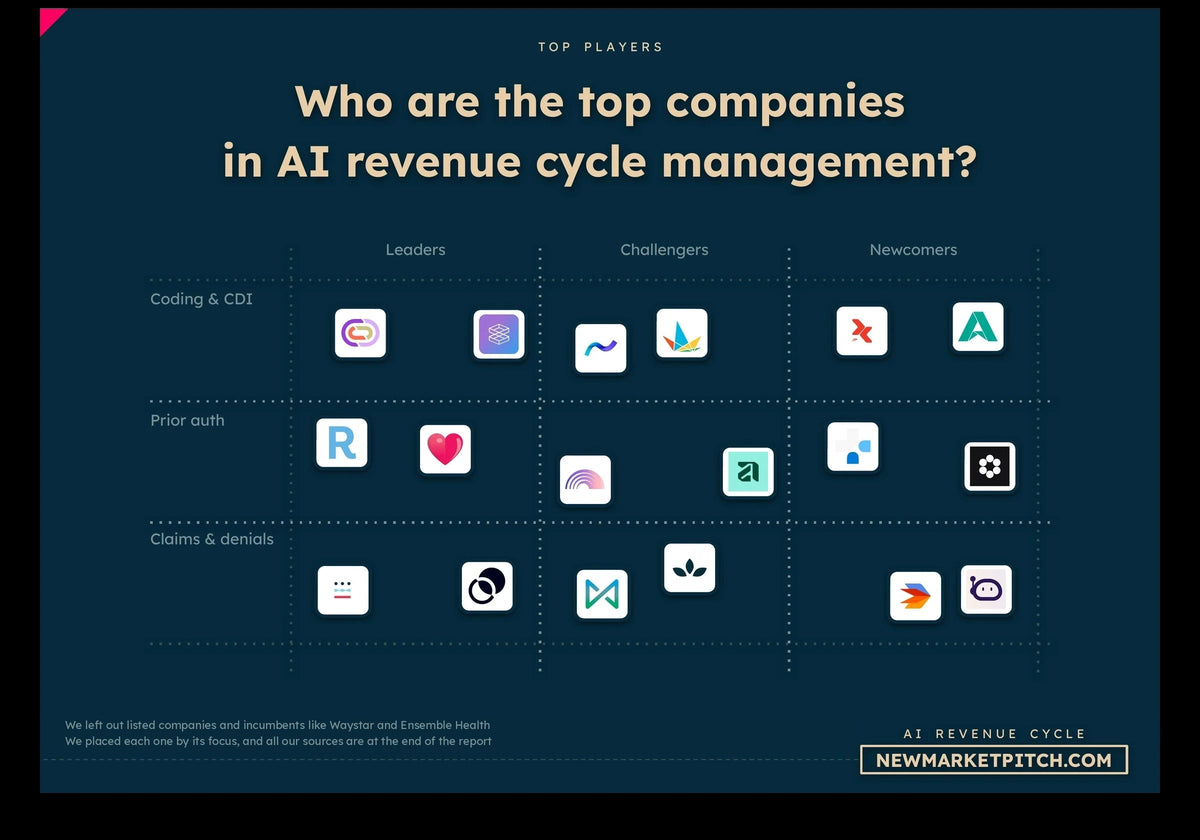
SmarterDx, CodaMetrix, and Nym are the top AI revenue cycle startups hospitals are buying, with SmarterDx leading in clinical revenue integrity, CodaMetrix in enterprise medical coding, and Nym standing out for emergency department coding. Fathom and AKASA are strong challengers, while Adonis and Infinx are competing in broader financial operations.
Hospital adoption has moved well beyond pilots. SmarterDx reports more than 85 health system customers across 300 hospital sites, while CodaMetrix's customers represent over 500 hospitals. These figures show substantial enterprise reach, although represented facilities are not necessarily equivalent to active deployments.
The strongest startups are winning by concentrating on expensive, specific problems rather than replacing hospital billing systems. Coding automation, documentation review, payment recovery, and denial management each have different buyers, performance measures, and competitive leaders.
SmarterDx has particularly compelling financial evidence. McLaren Health reported more than $11 million in annualized net new revenue after adopting its platform, while SmarterDx cites average realized incremental revenue of approximately $4.5 million per 10,000 DRG discharges.
CodaMetrix has the broadest disclosed enterprise coding footprint and won the inaugural 2026 Best in KLAS award for autonomous coding with a score of 90.7. Its scale is impressive, but maintaining implementation consistency and expanding specialty coverage remain important tests.
Nym's Inova deployment demonstrates how coding automation can improve several financial measures simultaneously. The hospital system reported $1.3 million in annual coding savings, a 48% smaller coding backlog, and a 50% reduction in emergency department revenue delayed in discharged-not-final-billed status.
Fathom offers strong evidence on coding automation quality, with Your Health reporting 95.5% automated coding and 98.3% accuracy. The catch is that results from a multi-site care provider do not establish equivalent performance in complicated inpatient hospital workflows.
Commercial momentum is emerging outside coding. Adonis reported more than fourfold revenue growth in 2025 and net revenue retention above 130%, suggesting that existing customers are expanding their use of its software. Infinx is pursuing scale through a combination of AI tools, operational services, and acquisitions.
There is no credible evidence yet of a large hospital operating its entire revenue cycle autonomously. Hospitals still need people to handle complex inpatient coding, documentation disputes, payer decisions, compliance, and exceptions that automated systems cannot reliably resolve.
Epic and Waystar remain major competitive threats because their software is already embedded in hospital financial workflows. Startups can win specialized contracts alongside these systems, but they will need to keep outperforming the AI features that established providers increasingly bundle into existing products.
Our assessment favors startups with several reinforcing forms of evidence: hospital adoption, independently assessed customer experience, measurable financial outcomes, and commercial expansion. SmarterDx and CodaMetrix have the clearest leadership claims today, but the market is likely to support several specialists rather than one winner across every revenue cycle function.

Written by the New Market Pitch teamWe track new markets so founders and investors can move faster. About us
Are hospitals really buying AI revenue cycle software?
Yes. Hospitals are already buying AI revenue cycle software at a meaningful scale, and the clearest proof comes from SmarterDx, CodaMetrix, and Nym, which have moved well beyond pilot projects.
SmarterDx reports working with more than 85 health systems across over 300 hospital sites. CodaMetrix says its customers represent more than 500 hospitals, while Nym reports serving more than 30 health systems and physician groups. These are company-reported figures, but they show that AI is already being used in real hospital billing operations.
Independent research backs up that picture. In August 2025, KLAS Research surveyed customers of CodaMetrix, Fathom, and Nym and found that autonomous coding was reducing manual work and speeding up billing. The same research identified functionality gaps and uneven implementation experiences.
Medical coding, clinical documentation, claims processing, and payment recovery all consume substantial staff time. AI vendors are increasingly able to connect their products to measurable financial outcomes, whether that means cutting coding expenses or collecting revenue that would otherwise be missed.
The market is still fragmented, though. Hospitals generally buy these products to fix particular problems within their existing revenue cycle operations. Very few are trying to replace their entire billing infrastructure with a single AI startup.
Which AI revenue cycle startups have the most hospital customers?
SmarterDx and CodaMetrix currently stand out for their publicly disclosed hospital footprints, while Nym, AKASA, and Fathom have strong evidence of adoption in more specific areas.
SmarterDx reports more than 85 health system customers and 300 hospital sites. CodaMetrix works with over 30 large health systems representing more than 500 hospitals, including nine institutions on the U.S. News & World Report Honor Roll. Nym's named customers include Inova, Geisinger, Ochsner, and Oregon Health & Science University.
The comparison needs some care. SmarterDx reports hospital sites using its technology, whereas CodaMetrix describes the overall hospital footprint represented by its health system partners. Those are different measures, and we cannot assume every facility within a customer network has deployed the same product.
AKASA has a significant enterprise relationship with Cleveland Clinic, while Fathom has strong customer feedback in independent KLAS research. Adonis and Infinx are also winning healthcare organizations, although their broader customer bases include physician groups and other provider businesses.
We rank SmarterDx and CodaMetrix highest for disclosed hospital-scale adoption, with Nym among the best-established coding specialists.
| Startup | Main focus | Public adoption evidence | Our assessment |
|---|---|---|---|
| SmarterDx | Clinical revenue integrity | 85+ health systems, 300+ hospital sites | Leading hospital adoption |
| CodaMetrix | Autonomous coding | 30+ health systems, 500+ hospitals represented | Leading enterprise coding footprint |
| Nym | Autonomous coding | 30+ health systems and physician groups | Established specialist |
| AKASA | Documentation and reimbursement accuracy | Cleveland Clinic partnership | Strong enterprise reference |
| Fathom | Autonomous coding | KLAS-reviewed customers and documented deployments | Strong coding competitor |
| Adonis | Revenue cycle orchestration | Rapid reported revenue growth and health system customers | Fast-growing challenger |
| Infinx | AI-enabled RCM operations | Academic medical center relationships and acquired customers | Broad operating presence |
| Rivet | Payer contracts and revenue analytics | Hundreds of healthcare organizations, mainly provider practices | Established adjacent specialist |

In our report covering the AI revenue cycle management market, we turn what is vague and complex into simple, useful visuals. Market maps like this one show you at a glance where every startup stands.
Is SmarterDx the top AI revenue integrity startup for hospitals?
SmarterDx is currently our strongest pick for hospital AI revenue integrity because it combines a large installed base with unusually concrete evidence of additional revenue collected.
The company's software reviews clinical records to identify diagnoses, documentation gaps, and reimbursement opportunities that hospital billing teams may have missed. It has analyzed more than 21 million clinically validated patient encounters.
SmarterDx reports average realized incremental annual revenue of approximately $4.5 million per 10,000 diagnosis-related-group discharges. At McLaren Health, CFO Dave Mazurkiewicz reported more than $11 million in annualized net new revenue after deploying the platform.
Those are substantial amounts for a hospital finance department. The McLaren result also goes beyond identifying possible reimbursement: the organization describes additional net revenue captured through its review process.
SmarterDx's customer list provides another useful indication of enterprise adoption. In addition to McLaren, its public references include the University of Arkansas for Medical Sciences, Novant Health, and other hospital operators.
The company also received a strategic investment from New Mountain Capital in April 2025, giving it additional resources to expand its products.
SmarterDx leads our ranking for hospitals trying to improve the accuracy and completeness of inpatient reimbursement. Its financial figures remain customer-reported case studies, however, and no hospital should assume it will automatically achieve the same results.
If you want more recent data on this point, please see our latest AI revenue cycle management market report.
Is CodaMetrix beating other AI medical coding startups?
CodaMetrix has the strongest overall case for leadership in enterprise autonomous coding, especially when we combine its hospital relationships, processing scale, and independent customer ratings.
The company originated from work at Mass General Brigham and has since expanded across major academic health systems. Its AI converts clinical documentation into medical codes, reducing the amount of routine coding work performed manually.
CodaMetrix reports processing more than 60 million outpatient visits annually. It also says its health system partners represent over $180 billion in net patient revenue, a measure of the organizations it serves rather than revenue earned by CodaMetrix itself.
In February 2026, the company won the inaugural Best in KLAS award for autonomous coding, scoring 90.7 in the published awards report. That's an important third-party endorsement in a market where most performance claims still come directly from vendors.
However, KLAS's August 2025 research also found that CodaMetrix customers wanted greater implementation consistency. The same study highlighted the need for broader specialty coverage across the autonomous coding industry.
CodaMetrix has a clear advantage in enterprise reach. Its next challenge is maintaining coding quality as customers use the software across more departments and increasingly complicated cases.

Our research about AI tools for medical billing gets updated several times a month, so you always get the latest view of where things stand.
Can Nym beat CodaMetrix in emergency department coding?
Nym is a particularly strong competitor in emergency department coding, where its work with Inova provides some of the most useful financial evidence in the market.
Inova operates a large Northern Virginia healthcare network handling more than 500,000 emergency department visits annually. Its coding operation faced staffing shortages, backlogs, and expensive reliance on overtime and contract coders.
After deploying Nym, Inova reported $1.3 million in annual coding cost savings, a 48% reduction in its coding backlog, and a 50% decrease in weekly emergency department revenue sitting in discharged-not-final-billed status. Average revenue per emergency department encounter also increased by more than 10%.
These improvements cover three separate problems: how much the hospital spends processing encounters, how quickly it prepares bills, and how completely it captures charges. That's considerably more convincing than an automation-rate claim alone.
Nym has also secured relationships with Geisinger, Ochsner, and Oregon Health & Science University, showing that Inova is far from its only enterprise customer.
KLAS's 2025 research found favorable customer feedback on Nym's support and implementations, although customers also wanted clearer product road maps and broader functionality.
For hospitals with high emergency department volumes, Nym belongs near the top of the shortlist. CodaMetrix still has the stronger disclosed enterprise footprint across specialties, so we would not call Nym the overall coding leader.
If you want more recent data on this point, please see our latest AI revenue cycle management market report.
Is Fathom catching up with CodaMetrix and Nym?
Fathom is already competitive on medical coding automation quality, although its total hospital footprint is less visible than CodaMetrix's.
The company's strongest recent customer example comes from Your Health, a senior-focused care organization operating across physician offices, patients' homes, assisted living communities, and other settings.
In March 2026, Your Health reported that Fathom was automatically coding 95.5% of encounters. Coding accuracy improved from 96.3% under the previous approach to 98.3% following implementation.
That two-percentage-point improvement may sound modest, but it represents roughly half as many inaccurate encounters relative to the previous error rate. Combined with a high automation rate, it suggests that Fathom can reduce manual workload without accepting lower coding quality.
Your Health also reported a two-day reduction in the time between claim submission and cash receipt, alongside improvements in diagnosis capture and risk adjustment reporting.
There is an important limitation: Your Health is a multi-site care provider rather than a large inpatient hospital system. Those results cannot simply be applied to complex surgical cases or academic hospital coding.
Fathom received a strategic investment from CVS Health Ventures in May 2026, adding a major healthcare investor. KLAS has also documented favorable customer experiences, including strong implementation support.
Fathom belongs alongside Nym and CodaMetrix in a serious coding evaluation. On publicly disclosed hospital distribution, CodaMetrix still leads.

In our market report about AI tools for medical billing, we look at what the winners do differently, so you can learn from the best instead of guessing.
Can AKASA challenge SmarterDx in hospital revenue integrity?
AKASA is a credible challenger to SmarterDx, particularly in clinical documentation and reimbursement accuracy, but its public evidence of hospital adoption is less extensive.
AKASA originally focused on automating administrative revenue cycle work before expanding toward generative AI tools that examine clinical records for coding and documentation opportunities.
Its relationship with Cleveland Clinic is especially relevant. The health system has worked with AKASA on improving mid-revenue-cycle operations, the part of hospital billing that connects clinical documentation, coding, and charge accuracy.
That is a demanding environment for AI software. Complex inpatient cases can involve lengthy medical records, changing diagnoses, multiple specialties, and reimbursement rules that differ between payers.
AKASA and SmarterDx are consequently moving into similar territory. Both analyze clinical information to help hospitals capture accurate reimbursement, although their products and implementation approaches differ.
SmarterDx currently has the stronger public commercial evidence, particularly its disclosed customer footprint and realized revenue case studies. AKASA has a major enterprise reference customer but has not published equally comparable deployment figures.
For now, SmarterDx leads our revenue integrity ranking. AKASA remains worth evaluating, especially for health systems interested in generative AI-assisted documentation workflows.
If you want more recent data on this point, please see our latest AI revenue cycle management market report.
Are Adonis and Infinx becoming serious AI revenue cycle competitors?
Adonis and Infinx are becoming important competitors in broader revenue cycle operations, with Adonis showing especially rapid software business growth and Infinx expanding through acquisitions and services.
Adonis helps healthcare organizations manage financial workflows across their existing systems. Its software identifies payment problems, connects revenue data, and automates administrative work.
In March 2026, Adonis announced a $40 million Series C, bringing total funding above $95 million. More revealingly, the company reported revenue growth exceeding fourfold during 2025 and net revenue retention above 130%.
Net retention above 130% means that, after accounting for expansion and lost revenue, existing customers collectively spent more than 30% above their previous level. That's a strong commercial indicator, although the company has not disclosed enough detail to measure its hospital-specific share of growth.
Infinx has taken another route. It combines AI software with operational revenue cycle services, covering areas such as patient access, prior authorization, billing, and coding.
Its acquisition of i3 Verticals' healthcare revenue cycle business in May 2025 expanded its customer relationships in academic medical centers and large provider groups. Infinx subsequently broadened its AI agent strategy through AWS-based infrastructure and workflow automation.
Adonis offers stronger evidence of fast-growing software revenue, while Infinx has a broader mix of technology, staff-supported services, and acquired customer relationships. Both are relevant to hospitals looking beyond a single coding or documentation product.

In our document detailing everything you need to know about AI revenue cycle management, you will always find fresh funding data, taken straight from our own verified funding database.
Which AI revenue cycle startups actually save hospitals money?
SmarterDx and Nym have some of the clearest disclosed financial outcomes among hospital-focused AI revenue cycle startups, while Fathom and Rivet provide useful evidence from other provider environments.
The distinction between different financial outcomes matters here. SmarterDx reports additional reimbursement captured from clinical records. Nym reduces coding expenses and billing backlogs. Fathom measures coding automation and accuracy. Rivet helps organizations recover denied or underpaid claims.
We should also separate actual collections from potential revenue opportunities. For example, an improvement in risk adjustment scoring can affect expected reimbursement without immediately producing the same amount of additional cash.
Rivet's customer examples show why payment recovery deserves attention. Resurgens Orthopaedics reported recovering more than $1.2 million in denied claims, while Boulder Centre for Orthopedics & Spine reported collecting $1.7 million in surgery prepayments. Both are provider examples rather than large hospital deployments.
These cases show that the tools can produce financial value. They do not allow a fair ranking of net returns, because vendor fees, implementation costs, and baseline operating expenses are rarely disclosed in comparable formats.
| Vendor and customer | Reported outcome | Financial effect |
|---|---|---|
| SmarterDx, McLaren Health | $11M+ annualized incremental net revenue | Additional reimbursement |
| SmarterDx, customer average | $4.5M per 10,000 annual DRG discharges | Revenue capture |
| Nym, Inova | $1.3M annual coding savings | Lower operating costs |
| Nym, Inova | 50% less weekly ED revenue delayed in DNFB | Faster billing |
| Fathom, Your Health | 95.5% coding automation | Less manual work |
| Fathom, Your Health | Accuracy increased from 96.3% to 98.3% | Fewer coding errors |
| Rivet, Resurgens Orthopaedics | $1.2M+ denied claims recovered | Cash recovery |
| Rivet, Boulder Centre | $1.7M in surgery prepayments | Earlier collections |
Can AI startups automate a hospital's entire revenue cycle?
No AI revenue cycle startup has publicly demonstrated fully autonomous end-to-end billing across a large hospital system, although several are expanding beyond the tasks they originally automated.
According to KLAS's August 2025 research, autonomous coding was most common in radiology and emergency departments. These specialties handle large encounter volumes, making it easier to automate recurring coding work and measure the financial benefits.
More complicated hospital cases create additional challenges. Inpatient reimbursement depends on the full clinical record, while prior authorization requires medical necessity information and payer-specific decisions. Denial appeals can involve reviewing clinical evidence and addressing insurer disputes.
The leading vendors reflect these differences. CodaMetrix and Nym concentrate on coding, SmarterDx examines clinical documentation and reimbursement, and Adonis automates workflows across billing systems.
Some companies are broadening their products. CodaMetrix introduced its CMX CARE platform for connected coding workflows. SmarterDx has added products supporting charge capture, denial management, and other revenue cycle processes.
These expansions make commercial sense. An existing hospital customer may be willing to purchase additional applications from a vendor it already trusts.
Still, broader product coverage doesn't mean a hospital can run its revenue cycle without substantial human oversight. The strongest deployments remain concentrated in well-defined areas.

Learning from others' mistakes is the cheapest lesson there is. In our report covering the AI revenue cycle management market, we look at what broke startups before you, so you don't repeat it.
Could Epic and Waystar beat the AI revenue cycle startups?
Epic, Waystar, and other established revenue cycle providers are serious threats to AI startups because hospitals already depend on their software and services for core financial operations.
Epic controls much of the workflow connecting electronic health records, clinical documentation, and hospital billing for its customers. Waystar operates across claims management, payment processing, denials, and other revenue cycle functions.
These existing relationships give established vendors an important advantage. Hospitals have already spent heavily on implementation, staff training, integrations, security reviews, and operational support.
A startup offering better automation still needs to fit into those systems. That adds integration costs and makes a hospital's purchasing decision more complicated than simply comparing model accuracy.
Yet startups have already shown that there is room for separate AI products. SmarterDx sells alongside existing hospital systems, while CodaMetrix and Nym automate coding tasks without requiring customers to replace their electronic health records.
The question is how long that advantage will last. If Epic, Waystar, or another incumbent can deliver similar functionality through software hospitals already use, standalone startups may face stronger pricing pressure.
Specialized AI vendors are winning because their products solve particular financial problems. Their longer-term advantage will depend on maintaining better results than the capabilities available inside established platforms.
Will hospitals choose one AI revenue cycle startup or several?
Hospitals are more likely to use several specialized AI revenue cycle vendors for now, because coding, documentation, denials, and payment recovery involve different work and different financial goals.
A hospital with an emergency department coding backlog might evaluate Nym or CodaMetrix. Another institution could choose SmarterDx because missing clinical documentation is affecting inpatient reimbursement. A provider struggling with payer underpayments may have more reason to examine Rivet or Adonis.
These buying decisions are also made by different teams. Coding managers care about accuracy and turnaround time. Clinical documentation teams need defensible diagnoses. Finance executives track revenue capture, cash collections, and operating expenses.
We can see this specialization in the customer evidence. CodaMetrix reports tens of millions of outpatient visits processed annually, Nym has demonstrated emergency department savings, and SmarterDx has built its business around identifying reimbursement opportunities in clinical records.
There is no reliable public dataset showing that hospitals spend more on autonomous coding than on all other AI revenue cycle applications combined. Vendor reports use different definitions of customers, contracts, and automation spending.
Successful specialists are already expanding into adjacent products. That may eventually reduce the number of vendors hospitals need, but current deployments still point toward a market with several different winners.

Your time is limited. In our research about AI tools for medical billing, we put numbers on each part of the market, so you can see where it makes sense to focus.
Which AI revenue cycle startup should a hospital choose?
SmarterDx is our leading choice for clinical revenue integrity, CodaMetrix for enterprise autonomous coding, and Nym for emergency department coding. Fathom, AKASA, Adonis, and Infinx deserve consideration depending on the hospital's needs.
The strongest choice changes substantially between a hospital trying to reduce its coding labor costs and one trying to recover reimbursement from incomplete documentation.
A large academic medical center evaluating coding automation should pay particular attention to CodaMetrix's enterprise relationships and KLAS performance. An emergency department handling several hundred thousand annual encounters has a compelling reason to examine Nym's Inova results.
SmarterDx becomes more attractive when the main financial problem is missed diagnoses and incomplete documentation. AKASA offers an alternative approach in that area, supported by its work with Cleveland Clinic.
Fathom has promising automation and accuracy results, although we would want to see comparable hospital-specific deployments before ranking it above CodaMetrix. Adonis and Infinx fit broader financial operations projects.
| Hospital priority | Startup to examine | Main reason |
|---|---|---|
| Inpatient revenue integrity | SmarterDx | Large hospital footprint and realized revenue cases |
| Enterprise medical coding | CodaMetrix | Broad health system presence and Best in KLAS award |
| Emergency department coding | Nym | Documented Inova savings and billing improvements |
| High coding automation rates | Fathom | Strong customer accuracy and automation results |
| AI-assisted documentation review | AKASA | Cleveland Clinic enterprise relationship |
| Revenue cycle orchestration | Adonis | Rapid software revenue growth and customer expansion |
| Broader RCM operations | Infinx | Technology, services, and academic medical center presence |
| Payer payment recovery | Rivet | Documented collections and underpayment use cases |
If you want more recent data on this point, please see our latest AI revenue cycle management market report.
Are AI revenue cycle startups building businesses hospitals will keep paying for?
Several AI revenue cycle startups have already built credible hospital businesses, but the strongest evidence of long-term value comes from repeated financial results and ongoing customer adoption.
SmarterDx and CodaMetrix have reached a level of enterprise distribution that would be difficult to explain through short pilots alone. Nym has demonstrated meaningful savings at a major health system. Fathom has documented high automation performance, and Adonis reports that existing customers are expanding their spending.
The weak point is financial transparency. Most of these businesses are privately held, and we lack comparable audited revenue, contract values, gross margins, customer churn, and acquisition costs.
There are also technical and regulatory risks. Coding errors can lead to payment disputes or compliance problems, and reimbursement rules change frequently. Hospitals need to verify that automation produces accurate, supportable claims rather than simply maximizing billed amounts.
KLAS's customer research makes another useful point: even satisfied autonomous coding customers still report gaps in specialty coverage and implementation. That gives successful vendors room to sell more products, but it also gives competitors opportunities to win dissatisfied customers.
Hospital AI revenue cycle software has become a real commercial category. Which startups will dominate it over the next several years is less settled, especially as established vendors build competing AI tools.

In our market report about AI tools for medical billing, we always try to gather several sources and make estimates that make sense, so you can work with solid numbers.
Who are the top AI revenue cycle startups hospitals buy today?
SmarterDx, CodaMetrix, and Nym are the strongest AI-native revenue cycle startups in our hospital-focused assessment, followed by Fathom and AKASA. Adonis and Infinx are important competitors when hospitals want broader financial workflow automation.
SmarterDx leads our revenue integrity ranking because it combines widespread hospital adoption with measurable additional reimbursement. CodaMetrix has the strongest enterprise coding position, backed by major health system relationships and its 2026 Best in KLAS award. Nym stands out for its documented emergency department performance.
Fathom is a serious coding challenger with strong automation results, while AKASA has a credible enterprise position through its Cleveland Clinic relationship. Adonis is particularly interesting for its rapid reported revenue growth, although its hospital-specific adoption is less transparent.
The leaders have become commercially established without one company taking control of every revenue cycle function. Hospitals are willing to pay for AI that improves coding accuracy, reduces administrative costs, or helps collect reimbursement they have already earned.
For now, SmarterDx and CodaMetrix have the clearest leadership claims in their respective specialties. The next competitive test will be whether these companies can broaden their products while keeping the financial results that persuaded hospitals to buy them in the first place.
If you want more recent data on this point, please see our latest AI revenue cycle management market report.
Our methodology
This analysis identifies the leading AI revenue cycle startups hospitals are actually buying, using commercial adoption and operational results rather than funding or publicity as the main criteria. We compare companies across hospital deployment scale, autonomous coding performance, clinical revenue integrity, financial outcomes, independent customer validation, competitive positioning, and evidence of continued expansion.
For each dimension, we collected recent evidence from hospital disclosures, provider case studies, company announcements, KLAS research, and product developments. We aggregated the relevant findings, assessed their consistency and comparability, and gave greater weight to companies supported by several independent or mutually reinforcing observations. Our conclusions reflect the combined evidence across these dimensions.
Hospital adoption was assessed using disclosed health system customers, hospital locations, named enterprise relationships, and production workflows. We distinguish hospitals actively using a product from the total number of facilities represented by a health system customer. Likewise, outpatient encounters processed annually and aggregate net patient revenue associated with partner organizations are treated as operational scale indicators, not as vendor revenue or verified hospital-wide deployment counts.
Financial performance was assessed through reported incremental reimbursement, coding cost savings, billing backlogs, collections, and coding accuracy. We separated realized or annualized financial outcomes from potential reimbursement opportunities and treated customer case studies as evidence of individual deployments rather than guaranteed results across all hospitals. We also considered the care setting, since outpatient coding results cannot automatically be extended to complex inpatient cases.
Independent validation was particularly important for autonomous coding. KLAS customer research informed our assessment of implementation quality, support, specialty coverage, and customer experience, while its 2026 Best in KLAS awards provided an additional comparative benchmark. Company-reported growth, customer footprints, funding, and automation performance were considered alongside this evidence, with greater weight assigned to results that could be connected to identifiable healthcare organizations.
We also evaluated whether specialized vendors could sustain their positions against incumbent hospital software platforms. This included the ability to integrate with existing workflows, extend products into adjacent revenue cycle functions, and defend performance advantages as established providers such as Epic and Waystar expand their AI capabilities.
Key sources include KLAS Research's 2025 autonomous coding study, the 2026 Best in KLAS awards, and CodaMetrix's KLAS vendor profile. These informed our assessment of independent customer experience, enterprise coding adoption, and competitive performance.
For hospital adoption and measurable revenue outcomes, we used SmarterDx's clinical intelligence platform disclosures, its hospital deployment figures, the McLaren Health case study, CodaMetrix's enterprise adoption and Best in KLAS announcement, Nym's Inova Health System case study, and Nym's disclosed customer reach.
Additional sources include Fathom's Your Health deployment results, its CVS Health Ventures investment announcement, AKASA's Cleveland Clinic partnership, Adonis's Series C and commercial growth disclosure, and Infinx's acquisition of i3 Verticals' healthcare RCM business.
For payment recovery and incumbent competition, we examined Rivet's Resurgens Orthopaedics case study, its Boulder Centre case study, Waystar's autonomous revenue cycle developments, and its August 2026 agentic AI announcement. We also reviewed SmarterDx's New Mountain Capital investment announcement for additional commercial context.
Our rankings prioritize demonstrated hospital adoption, measured financial and operational performance, and independently assessed customer experience. They distinguish established commercial deployments from announced capabilities and consider the differences between inpatient hospitals, outpatient departments, physician groups, and other healthcare providers.

If you build or invest in the AI revenue cycle management market, you need to know which business models pay off now and which ones are fading. That's why our report covering it has a whole section on it.
Written by the New Market Pitch teamWe track new markets so founders and investors can move faster. About us