AI revenue cycle management funding tracker (64 deals)
Whether you're building or investing in the AI revenue cycle management market, our report covers everything you need to know: the players, the money, and what's coming next.
Summary
AI revenue cycle management funding tracker (64 deals) shows a $1.42 billion market where a small group of healthcare AI platforms captures almost half the money. Across 53 funded companies, just five received $705.5 million, or 49.5% of all recorded capital.
The typical financing is much smaller than the headline suggests. The median round is $10 million, compared with a $22.25 million average. Forty of the 64 deals were below $20 million, while just six rounds of at least $50 million absorbed 46% of total funding.
Claims submission and medical coding are the two biggest investment categories, attracting $348.98 million and $318.8 million respectively. Together, they account for 46.9% of market funding. However, the medical coding total includes a $120 million AKASA transaction with weaker primary-source confirmation. Excluding it reduces coding funding to $198.8 million and overall market funding to $1.304 billion.
Funding concentration is especially striking in clinical documentation. Ambience Healthcare's $243 million Series C represents the entire recorded total for that category. Its financing shows what investors will pay for a broad hospital AI platform, but cannot establish what a typical clinical documentation startup raises.
Deal volume tells a different story from funding volume. Patient Access & Eligibility AI recorded 13 financings with an $8.5 million median, while Claims Submission attracted just ten deals with a $25 million median. Investors are backing plenty of specialized administrative tools, but writing much larger checks for businesses closer to the core claims infrastructure.
The early-stage market is active, with 24 Seed rounds and 20 Series A financings. Only seven deals reached Series C, Series D+ or Growth Equity. First-financing events represented 28.1% of transactions but captured just 6.3% of recorded capital, leaving most funding with companies that already had financing histories.
Repeat fundraising provides a useful distinction between emerging products and more established businesses. Candid Health raised $201.5 million across three rounds, while Adonis accumulated $71 million and Arintra $46 million across two each. Adonis also reported more than fourfold revenue growth in 2025, giving investors some commercial evidence beyond the funding announcements.
The market is overwhelmingly American. US-headquartered businesses received approximately $1.39 billion, or 97.6% of recorded funding. The complexity of American insurance claims, coding, eligibility and reimbursement creates a particularly valuable market for automation, while international financing remains small.
Healthcare-linked strategic investors participated in 11 of the 64 rounds. Those transactions had a $21 million median, compared with $9 million for rounds without a reported strategic investor. Hospital and healthcare investors are participating alongside traditional venture firms, especially in products that could become deeply embedded in provider operations.
The $1.42 billion figure should be understood as recorded qualifying private financing, with some transaction-specific qualifications. Removing AKASA's $120 million entry still leaves a $1.304 billion market. The broader pattern is clear: specialized AI revenue cycle management (RCM) startups can raise initial capital, but the largest investors are concentrating their money on companies capable of automating substantial parts of healthcare reimbursement.

Written by the New Market Pitch teamWe track new markets so founders and investors can move faster. About us

In our report covering the AI revenue cycle management market, you will always find fresh funding data, taken straight from our own verified funding database.
Our funding tracker covering the AI revenue cycle management market
Below is the table listing all the deals. You may find our methodology at the end of this page.
And, if you want to gain a deeper understanding of the market and its current dynamics, get our report covering the AI revenue cycle management market.
| Company | Category | Date | Stage | Deal size | What they do | Region | Lead investors | Country | Rank |
|---|---|---|---|---|---|---|---|---|---|
| GenHealth.ai | Patient Access & Eligibility AI | September 2026 | Series A | $16.5M | Deploys AI agents to automate healthcare-provider intake, eligibility checks, prior authorizations, billing and insurance denial workflows. | North America | Flare Capital Partners | United States | |
| Arintra | Medical Coding AI | August 2026 | Series B | $25M | Automates medical coding from clinical records and extends coded information into documentation improvement, denial prevention and reimbursement workflows. | North America | Define Ventures | United States | |
| Qodia GmbH | Charge Capture & Revenue Integrity | August 2026 | Seed | $1.4M | Uses AI to verify private medical invoices and translate clinical documentation into billable German GOÄ fee codes. | Europe | Not disclosed | Germany | |
| Procode AI | Medical Coding AI | July 2026 | Series A | $10M | Automates medical coding, claims preparation and revenue cycle management for private-practice surgical specialists. | North America | Health Velocity Capital | United States | |
| Candid Health | Claims Submission & Scrubbing | July 2026 | Series D+ | $120M | Provides an AI-powered revenue cycle platform automating medical claims, billing operations and reimbursement workflows for healthcare providers. | North America | Sixth Street Growth | United States | |
| Maia Medical Billing Corp. | Medical Coding AI | June 2026 | Seed | $1.2M | Provides AI-powered medical coding that analyzes clinical and surgical documentation to recommend reimbursement codes for orthopaedic practices. | North America | Not disclosed | United States | |
| Lassie | Payment Posting & Reconciliation | June 2026 | Series A | $35M | Deploys AI agents to automate insurance remittance processing, payment posting, reconciliation and claims follow-up for dental and medical practices. | North America | Andreessen Horowitz | United States | |
| Kubera Health | Payment Posting & Reconciliation | May 2026 | Seed | $6.5M | Uses AI to translate payer-provider contracts into payment rules and audit healthcare claims and reimbursements for discrepancies. | North America | Upfront Ventures | United States | |
| Anomaly Insights | Denial Management & Appeals | May 2026 | Unknown | $17M | Uses AI to identify insurer denials, underpayments and reimbursement discrepancies across healthcare-provider claims. | North America | Sound Ventures | United States | |
| Amperos Health | Denial Management & Appeals | April 2026 | Series A | $16M | Uses AI agents to automate healthcare insurance denials, payer follow-ups, appeals and unpaid-claim collections. | North America | Bessemer Venture Partners | United States | |
| Ethermed | Patient Access & Eligibility AI | April 2026 | Series A | $8.5M | Automates medical-necessity documentation, payer-rule interpretation and prior-authorization submissions using AI. | North America | Enfield Capital Partners; Blue Marlin Partners | United States | |
| Joyful Health | Denial Management & Appeals | April 2026 | Series A | $17M | Provides AI-powered claims intelligence, denial investigation and insurance revenue recovery for healthcare providers. | North America | CRV | United States | |
| Adonis | Denial Management & Appeals | March 2026 | Series C | $40M | Provides AI-driven revenue-cycle intelligence and agents that identify payment problems, resolve claims and denials, and improve provider collections. | North America | Quadrille Capital | United States | |
| Parallel | Medical Coding AI | March 2026 | Series A | $20M | Develops AI agents that automate hospital medical coding and optimize reimbursement using existing clinical and administrative systems. | Europe | Index Ventures | France | |
| Procode AI | Medical Coding AI | March 2026 | Seed | $4M | Provides AI-assisted medical coding, billing, denial management and reimbursement operations for private-practice surgeons. | North America | Story Ventures | United States | |
| Crosby Health | Denial Management & Appeals | February 2026 | Seed | $830K | Automates healthcare insurance-denial appeals using clinical AI to prepare supporting documentation and manage appeal submissions. | North America | Not disclosed | United States | |
| Rivio | Charge Capture & Revenue Integrity | February 2026 | Series A | $1M | Uses AI agents to audit hospital claims, correct billing inconsistencies, manage denials and improve insurer reimbursement. | Latin America | Not disclosed | Brazil | |
| Revena | Charge Capture & Revenue Integrity | January 2026 | Seed | $8M | Uses AI to interpret clinical records and payer contracts, generate hospital bills and claims, and recover revenue lost through billing omissions. | Latin America | Canary | Brazil | |
| Claim Health | Patient Access & Eligibility AI | January 2026 | Seed | $4.4M | Provides AI-powered revenue-cycle operations for post-acute care providers, automating referral intake, insurance eligibility, authorizations and billing workflows. | North America | Maverick Ventures | United States | |
| mutex Co., Ltd. (株式会社mutex) | Claims Submission & Scrubbing | December 2025 | Seed | ≈$383K | Develops Reze, an AI-powered platform that automates medical insurance claim preparation, verification and reimbursement-error detection for Japanese healthcare institutions. | Asia-Pacific | MTI Ltd. | Japan | |
| Ember AI | Denial Management & Appeals | November 2025 | Seed | $4.3M | Automates medical coding, payer-policy checks, denial prevention and appeals preparation for healthcare providers. | North America | Nexus Venture Partners | United States | |
| Olli Health | Medical Coding AI | November 2025 | Series A | $10M | Provides AI-powered medical coding, OASIS assessment review and documentation quality assurance to improve reimbursement for home-health agencies. | North America | Industry Ventures | United States | |
| Inbox Health | Patient Billing & Collections | September 2025 | Growth Equity | $10M | Automates medical patient billing, payment collection, billing communications, and AI-assisted patient financial support for healthcare providers and billing companies. | North America | Ten Coves Capital | United States | |
| Wisdom | Claims Submission & Scrubbing | August 2025 | Series A | $21M | Combines AI-powered automation with specialized billing services to manage dental insurance claims, accounts receivable, and payment collections. | North America | Permanent Capital Ventures | United States | |
| Stedi | Claims Submission & Scrubbing | August 2025 | Series B | $70M | Provides an AI-enabled healthcare clearinghouse and programmable infrastructure for insurance eligibility checks, claim submissions, claim-status tracking, and remittance transactions. | North America | Stripe; Addition | United States | |
| Arintra | Medical Coding AI | August 2025 | Series A | $21M | Automates medical coding from electronic health records using generative AI to help healthcare providers capture charges accurately and improve reimbursement. | North America | Peak XV Partners | United States | |
| Ambience Healthcare | Clinical Documentation & CDI | July 2025 | Series C | $243M | Provides AI-powered clinical documentation, medical coding, and clinical documentation integrity tools integrated into healthcare providers' workflows. | North America | Oak HC/FT; Andreessen Horowitz (a16z) | United States | |
| Charta Health | Charge Capture & Revenue Integrity | July 2025 | Series A | $22M | Uses AI to review clinical charts, identify missed billing opportunities, improve coding accuracy, and automate pre-bill revenue-integrity checks. | North America | Bain Capital Ventures | United States | |
| SuperDial | Patient Access & Eligibility AI | June 2025 | Series A | $12M | Provides healthcare voice AI agents that automate calls to insurers for benefits verification, prior authorization and claims follow-up. | North America | SignalFire | United States | |
| Amperos Health | Denial Management & Appeals | June 2025 | Seed | $4.2M | Develops AI billing agents that resolve denied insurance claims, automate payer follow-up and recover outstanding provider payments. | North America | Uncork Capital | United States | |
| Care Eco Corp (CareEco) | Charge Capture & Revenue Integrity | April 2025 | Unknown | $2.5M | Uses AI to analyze healthcare claims, identify underpayments and coding errors, and automate revenue recovery for providers. | North America | Not disclosed | United States | |
| Trek Health | Charge Capture & Revenue Integrity | April 2025 | Series A | $11M | Provides AI-powered payer-contract analysis, reimbursement benchmarking and underpayment intelligence to healthcare providers. | North America | Madrona | United States | |
| RISA Labs | Patient Access & Eligibility AI | April 2025 | Seed | $3.5M | Develops AI agents that automate insurance eligibility checks and prior authorization workflows for oncology providers. | North America | Binny Bansal | United States | |
| Youlify | Claims Submission & Scrubbing | April 2025 | Seed | $4.3M | Provides an AI-powered revenue-cycle platform that automates medical claims creation, coding, denial recovery and payment collection. | North America | Bonfire Ventures | United States | |
| Parallel | Medical Coding AI | April 2025 | Seed | $3.5M | Builds AI agents that automate medical coding by reading clinical documentation and entering billing codes into hospital software. | Europe | Frst | France | |
| RapidClaims | Medical Coding AI | April 2025 | Series A | $8M | Develops AI software for autonomous medical coding, clinical documentation improvement and claim-denial prevention. | North America | Accel | United States | |
| Sohar Health | Patient Access & Eligibility AI | March 2025 | Seed | $3.8M | Provides AI-powered insurance eligibility and verification-of-benefits software that helps healthcare providers prevent denials and accelerate reimbursement. | North America | Kindred Capital | United States | |
| Taxo | Patient Access & Eligibility AI | March 2025 | Seed | $5M | Develops healthcare-specific AI that automates insurance prior authorizations, medical billing and related administrative data-processing workflows. | North America | Y Combinator; General Catalyst; Character | United States | |
| Silna Health | Patient Access & Eligibility AI | March 2025 | Series A | $22M | Automates insurance eligibility verification, benefit checks, prior authorizations and ongoing coverage monitoring for healthcare providers using AI. | North America | Accel; Bain Capital Ventures | United States | |
| Camber | Claims Submission & Scrubbing | February 2025 | Series B | $30M | Provides AI-enabled insurance reimbursement software that automates medical claims processing and billing operations for specialty healthcare providers. | North America | Andreessen Horowitz | United States | |
| Charta Health | Charge Capture & Revenue Integrity | February 2025 | Seed | $8.1M | Automates pre-bill medical-chart reviews using AI to identify missed coding opportunities, prevent claim denials and improve revenue integrity. | North America | Bain Capital Ventures | United States | |
| Keebler Health | Medical Coding AI | February 2025 | Seed | $6M | Uses AI to review clinical records and identify risk-adjustment coding opportunities that improve reimbursement accuracy for value-based healthcare providers. | North America | Freestyle Capital | United States | |
| VoiceCare AI | Patient Access & Eligibility AI | February 2025 | Seed | $3.9M | Develops voice-based AI agents that automate insurance benefits verification, prior authorization and claims follow-up calls between healthcare providers and payers. | North America | Caduceus Capital Partners | United States | |
| Candid Health | Claims Submission & Scrubbing | February 2025 | Series C | $52.5M | Provides an AI-driven revenue-cycle platform that automates medical billing, insurance claims submission and reimbursement workflows for healthcare providers. | North America | Oak HC/FT | United States | |
| Red Sky Health | Denial Management & Appeals | January 2025 | Seed | $3M | Uses machine learning to identify errors in denied healthcare claims, recommend corrections and automate resubmission for reimbursement. | North America | Trevor Burgess | United States | |
| Anatomy Financial | Payment Posting & Reconciliation | December 2024 | Series A | $19M | Automates healthcare payment processing by digitizing insurance checks, converting explanations of benefits into electronic remittances, and reconciling payments. | North America | Canapi Ventures | United States | |
| Cofactor AI | Denial Management & Appeals | November 2024 | Seed | $4M | Uses healthcare-specific AI to analyze denied insurance claims and help hospitals prepare reimbursement appeals. | North America | Drive Capital | United States | |
| Janus Health Technologies, Inc. | Patient Access & Eligibility AI | October 2024 | Unknown | $2M | Provides AI-powered automation and operational intelligence for healthcare revenue-cycle workflows, including prior authorization, claims follow-up, and denial analysis. | North America | Not disclosed | United States | |
| Nym | Medical Coding AI | October 2024 | Growth Equity | $47M | Develops AI software that autonomously analyzes clinical charts and assigns medical billing codes for healthcare providers. | North America | PSG | United States | |
| Nirvana | Patient Access & Eligibility AI | September 2024 | Series A | $24.2M | Uses AI to automate patient insurance eligibility verification, benefits checks and healthcare cost estimates for providers. | North America | Northzone | United States | |
| Candid Health | Claims Submission & Scrubbing | September 2024 | Series B | $29M | Automates medical billing, claim preparation, submission and reimbursement workflows for healthcare providers. | North America | 8VC | United States | |
| PayZen | Patient Billing & Collections | August 2024 | Series B | $32M | Uses AI to create personalized medical-bill payment plans that help healthcare providers collect patient payments. | North America | NEA | United States | |
| Thoughtful AI | Claims Submission & Scrubbing | July 2024 | Series A | $20M | Provides AI agents that automate healthcare providers' insurance eligibility verification, claims processing and payment posting. | North America | Drive Capital | United States | |
| Adonis | Denial Management & Appeals | June 2024 | Series B | $31M | Provides AI-driven revenue-cycle intelligence to track claims, identify underpayments and automate reimbursement follow-up for healthcare providers. | North America | Point72 Private Investments | United States | |
| Zuub | Patient Access & Eligibility AI | June 2024 | Series A | $9M | Automates dental insurance eligibility verification, patient billing and related revenue-cycle workflows using AI. | North America | Vertical Venture Partners | United States | |
| Humata Health | Patient Access & Eligibility AI | June 2024 | Unknown | $25M | Uses AI to assemble medical-necessity documentation and automate prior authorization submissions and approval workflows for healthcare providers. | North America | Blue Venture Fund; LRVHealth | United States | |
| AKASA | Medical Coding AI | June 2024 | Series C | $120M | Develops AI-powered healthcare revenue-cycle automation, including medical coding and administrative billing workflows for providers. | North America | Not disclosed | United States | |
| Crosby Health | Denial Management & Appeals | May 2024 | Seed | $2.2M | Uses a clinical large language model to generate, submit and track medical claim-denial appeals for healthcare providers. | North America | Amplo Ventures | United States | |
| SmarterDx | Charge Capture & Revenue Integrity | May 2024 | Series B | $50M | Uses clinical AI to review hospital patient records, identify missing documentation and coding opportunities, and recover otherwise unrecognized reimbursement. | North America | Transformation Capital | United States | |
| Sift Healthcare | Denial Management & Appeals | May 2024 | Series B | $20M | Provides AI-powered payment intelligence to help healthcare providers prevent claim denials, accelerate reimbursement and improve collections. | North America | B Capital | United States | |
| CodaMetrix | Medical Coding AI | March 2024 | Series B | $40M | Provides autonomous AI medical coding software that translates clinical documentation into billing codes for healthcare providers. | North America | Transformation Capital | United States | |
| RapidClaims | Medical Coding AI | February 2024 | Seed | $3.1M | Develops AI software that automates medical coding, reviews clinical documentation and helps healthcare providers prevent claim denials. | North America | Together Fund | United States | |
| Anatomy Financial | Payment Posting & Reconciliation | February 2024 | Seed | $7.6M | Uses AI to convert healthcare insurance remittances into electronic records and automate payment posting and bank reconciliation. | North America | Lightspeed Venture Partners | United States | |
| AgentAI | Claims Submission & Scrubbing | February 2024 | Seed | $1.8M | Provides AI agents that automate medical billing, claims processing and healthcare revenue-cycle workflows. | North America | Oceans Ventures | United States |

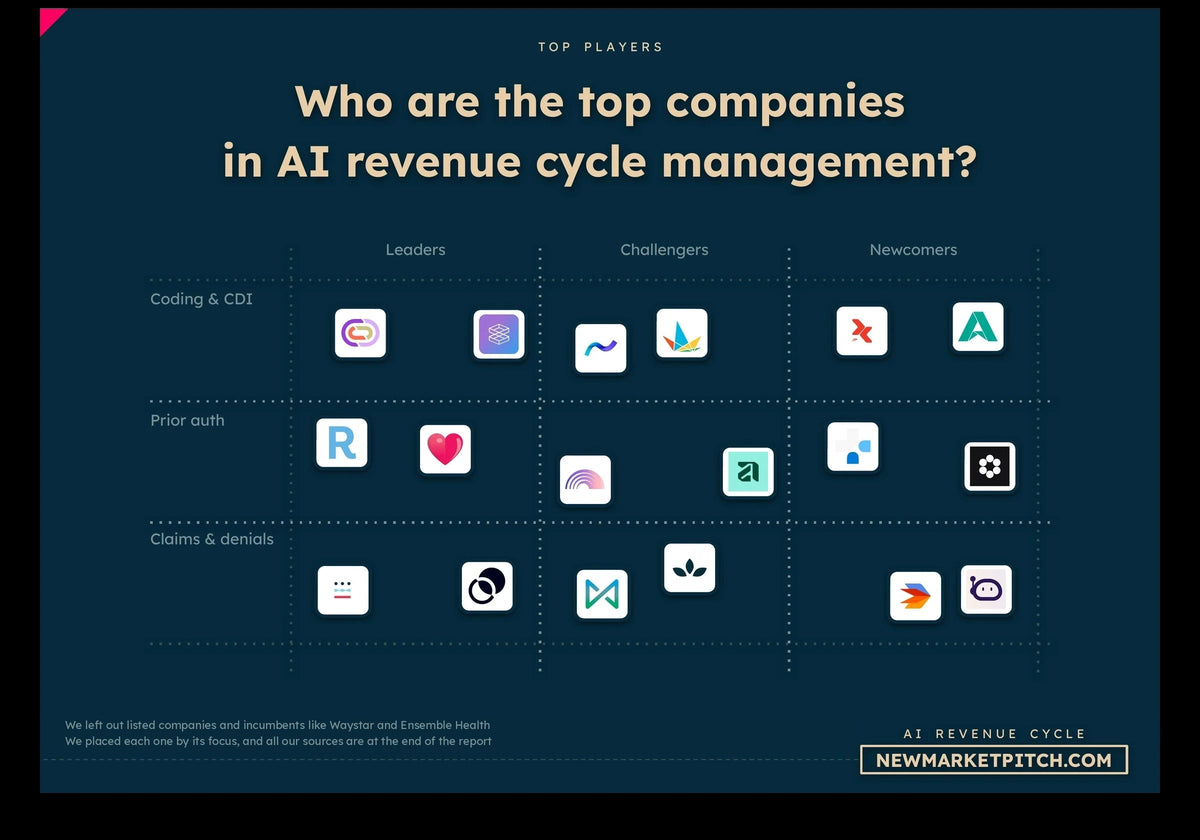
In our research about AI tools for medical billing, we turn what is vague and complex into simple, useful visuals. Market maps like this one show you at a glance where every startup stands.
Is AI revenue cycle management really a billion-dollar funding market?
AI revenue cycle management has attracted approximately $1.42 billion in private financing, but a remarkably small group of startups has collected most of that money.
We identified 64 funding rounds involving 53 companies between January 1, 2024 and September 8, 2026. The market covers AI software for medical coding, insurance claims, denial appeals, patient eligibility, payment reconciliation and clinical documentation.
Some companies are raising a few million dollars to automate a specific administrative task. Others are securing nine-figure rounds to build technology used across entire hospital systems.
Ambience Healthcare raised $243 million in a single Series C round. Candid Health accumulated $201.5 million across three financings, while AKASA has a recorded $120 million transaction. At the other end, 21 rounds were smaller than $5 million.
There is substantial money available for AI RCM, especially for companies that can become deeply integrated into healthcare operations. Getting access to the largest checks, however, remains difficult.
The category-level records add up to $1.42417 billion, while the stage-level records total $1.42418 billion, a $10,000 difference attributable to rounding. Both support the approximately $1.42 billion headline. Excluding the less firmly confirmed AKASA transaction would reduce the recorded market to approximately $1.304 billion.
How many AI RCM startups are getting funded, and who gets most of the money?
There are 53 funded AI revenue cycle management companies in our research, but five of them account for 49.5% of all capital raised.
Of those 53 businesses, 43 appear only once during the financing period. Nine raised twice, while Candid Health was the only company to complete three qualifying rounds.
Candid's progression is particularly interesting. It raised $29 million at Series B, followed by $52.5 million at Series C and $120 million at Series D+. Adonis completed two rounds totaling $71 million, and Arintra went from a $21 million Series A to a $25 million Series B.
At the top, Ambience Healthcare leads with $243 million, followed by Candid Health at $201.5 million and AKASA at $120 million. Adonis and Stedi complete the five largest funding recipients.
Those five companies raised a combined $705.5 million. Meanwhile, 17 of the 53 funded companies accumulated no more than $5 million each.
The contrast becomes clearer when we look at what these businesses are building. Stedi operates healthcare transaction infrastructure. Candid Health automates revenue-cycle workflows for providers. Ambience combines clinical documentation, coding and other hospital workflows within a broader AI platform.
Smaller startups are often tackling narrower problems. AgentAI focuses on billing automation, Zuub handles dental insurance and practice administration, and Crosby Health targets denial-related work.
A single appearance doesn't mean a company has never raised before or won't raise again. Our research captures transactions inside the defined period, including companies whose earlier financing histories began before it.
| Company | Funding rounds | Capital raised |
|---|---|---|
| Ambience Healthcare | 1 | $243.0M |
| Candid Health | 3 | $201.5M |
| AKASA | 1 | $120.0M |
| Adonis | 2 | $71.0M |
| Stedi | 1 | $70.0M |
| SmarterDx | 1 | $50.0M |
| Nym | 1 | $47.0M |
| Arintra | 2 | $46.0M |
| CodaMetrix | 1 | $40.0M |
| Lassie | 1 | $35.0M |
Amounts reflect qualifying financings during the study period, not necessarily lifetime funding. AKASA's $120 million transaction is retained in the main dataset but treated separately in the sensitivity analysis.

Your time is limited. In our market report about AI tools for medical billing, we put numbers on each part of the market, so you can see where it makes sense to focus.
How much money does a typical AI RCM startup raise?
A typical AI revenue cycle management funding round is around $10 million, far below the $22.25 million market average.
The difference comes from a handful of exceptionally large financings that push the average upward.
Nearly one-third of all rounds were smaller than $5 million. Another 19 transactions fell between $5 million and $20 million. Altogether, 40 of the 64 rounds were below $20 million.
AgentAI raised $1.8 million at Seed, Youlify secured $4.3 million, and RapidClaims completed a $3.1 million Seed round before returning for an $8 million Series A. These transactions are much closer to what a smaller AI RCM company actually raises.
The six rounds worth at least $50 million captured approximately $655.5 million, or 46% of the market's recorded capital. They represent fewer than one in ten transactions.
For founders, the more useful comparison is often the financing stage. The median Seed round is $3.93 million, compared with $16.75 million at Series A and $31 million at Series B.
Which AI RCM businesses are getting the biggest investments?
Claims Submission & Scrubbing receives the most AI RCM funding, with $348.98 million, closely followed by Medical Coding AI at $318.8 million.
Together, these two categories represent $667.78 million in financing, or 46.9% of the recorded market. They also have a reasonably broad company base, with eight businesses in Claims Submission and ten in Medical Coding.
Clinical Documentation & CDI ranks third at $243 million, although that figure comes entirely from Ambience Healthcare.
Other categories are receiving meaningful investment on a smaller scale. Denial Management & Appeals attracted $159.53 million, while Patient Access & Eligibility AI received $139.8 million.
The order changes considerably when we count transactions instead of dollars. Medical Coding leads with 14 deals, Patient Access follows with 13, and Denial Management has 12. Claims Submission has just ten.
| AI RCM category | Companies | Deals | Total funding | Median round |
|---|---|---|---|---|
| Claims Submission & Scrubbing | 8 | 10 | $348.98M | $25.0M |
| Medical Coding AI | 10 | 14 | $318.80M | $10.0M |
| Clinical Documentation & CDI | 1 | 1 | $243.00M | $243.0M |
| Denial Management & Appeals | 9 | 12 | $159.53M | $10.15M |
| Patient Access & Eligibility AI | 13 | 13 | $139.80M | $8.5M |
| Charge Capture & Revenue Integrity | 7 | 8 | $103.96M | $8.05M |
| Payment Posting & Reconciliation | 3 | 4 | $68.10M | $13.3M |
| Patient Billing & Collections | 2 | 2 | $42.00M | $21.0M |
The category totals sum to $1.42417 billion across 64 financings and 53 companies. Each company is assigned to one primary category, even when its products cover several revenue-cycle workflows.
The Medical Coding AI total includes AKASA's recorded $120 million transaction. Without it, coding funding falls to $198.8 million across 13 remaining financing records, although the category still contains multiple well-funded competitors.

In our document detailing everything you need to know about AI revenue cycle management, we always try to gather several sources and make estimates that make sense, so you can work with solid numbers.
Why are investors putting so much money into AI claims processing?
AI claims-processing companies are raising unusually large rounds because the biggest players are trying to run the infrastructure that healthcare providers depend on to get paid.
Claims Submission & Scrubbing has a $25 million median financing, compared with $10 million for the market overall.
Stedi provides a particularly revealing example. In August 2025, the company announced a $70 million Series B to expand its AI-enabled healthcare clearinghouse, with Stripe and Addition leading the financing.
Its announcement directly referenced the 2024 Change Healthcare cyberattack. The disruption exposed how heavily American healthcare transactions depended on a small number of established clearinghouses.
Stedi's business is built around a cloud-native alternative that lets healthcare software companies exchange claims and eligibility information through APIs.
Candid Health is another major beneficiary of investment in this area, with its technology addressing the submission and management of healthcare claims. At the smaller end, AgentAI and Youlify are using AI to automate billing workflows that otherwise require substantial manual work.
A startup that can become part of the infrastructure through which thousands of providers submit and manage claims has a very different growth opportunity from one selling a single productivity feature. Its technology also needs to handle high transaction volumes, complicated payer connections and demanding reliability requirements.
Why did Ambience Healthcare raise $243 million for clinical AI?
Ambience Healthcare attracted $243 million because investors were financing a much broader healthcare AI platform than a conventional clinical documentation tool.
The Series C, announced on July 29, 2025, was co-led by Oak HC/FT and Andreessen Horowitz. At the time, Ambience described technology covering clinical documentation, medical coding, clinical documentation integrity and workflows across more than 100 specialties.
In February 2026, Ambience announced an enterprise-wide rollout at Houston Methodist. The company reported an 80% utilization rate across specialties and a 40% reduction in documentation time. Those are company-reported results, but they provide a concrete example of the operational improvements Ambience is selling.
Its April 2026 roadmap went further, extending the platform across clinical workflows, revenue integrity, patient engagement, care orchestration and research. In August, Ambience introduced a partnership model involving dedicated teams working inside health systems and contracts linked to measurable outcomes.
Ambience is pursuing large institutional deployments, with the implementation, clinical integration and customer-support work that comes with them.
There is still an important limitation to our funding comparison: Ambience is the only company assigned to Clinical Documentation & CDI in our dataset. Its $243 million round tells us a great deal about investor confidence in Ambience's strategy, but very little about the typical funding size of other clinical documentation companies.

Our report covering the AI revenue cycle management market gets updated several times a month, so you always get the latest view of where things stand.
Why are so many startups trying to automate medical coding?
Medical Coding AI attracts more funding rounds than any other AI RCM category because it addresses a specific, expensive problem that hospitals and medical practices already understand.
We identified 14 rounds across ten companies, totaling $318.8 million in recorded financing.
Medical coding determines how documented services are translated into standardized billing codes. Inaccurate or incomplete coding can lead to delayed payments, denied claims, underpayments and more work for administrative teams.
Nym secured $47 million in growth equity for its autonomous medical-coding technology. CodaMetrix raised $40 million at Series B, while SmarterDx completed a $50 million Series B financing. Arintra has also become a significant funded competitor, accumulating $46 million across two rounds.
Arintra's August 2026 Series B announcement is particularly useful. The company raised $25 million led by Define Ventures to expand a platform combining AI-driven coding with revenue assurance. Its approach extends into identifying documentation problems and reimbursement opportunities.
One caveat affects the headline total. AKASA's recorded $120 million financing has weaker contemporaneous primary-source confirmation than several other major rounds. It represents 37.6% of the reported Medical Coding AI total.
Excluding AKASA would bring Medical Coding's capital total to $198.8 million and reduce its qualifying financing count from 14 to 13, across nine remaining companies. The market-wide total would fall from approximately $1.424 billion to $1.304 billion. Coding would still rank second by total funding, behind Claims Submission & Scrubbing.
That adjusted picture is still substantial. Multiple medical coding companies have independently secured financings in the tens of millions, even without relying on the AKASA entry.
Why is Patient Access AI getting lots of deals but smaller checks?
Patient Access & Eligibility AI has the broadest one-round company base in our research, with 13 businesses receiving 13 financings, but its median round is only $8.5 million.
The largest financing in this segment is $25 million. By comparison, the largest Claims Submission transaction reaches $120 million.
Patient Access software handles tasks such as verifying insurance coverage, collecting patient information and preparing administrative requirements before treatment or reimbursement.
Zuub illustrates why smaller specialized companies can find investors here. The dental automation provider raised $9 million at Series A in June 2024, led by Vertical Venture Partners. Its software automates insurance verification and related dental practice administration.
Silna Health secured $22 million at Series A, while Humata Health recorded a $25 million financing.
Regulatory changes may also support demand for certain products. Under the Centers for Medicare & Medicaid Services' 2024 interoperability and prior-authorization rule, affected payers became subject to several operational requirements beginning in 2026, with major API requirements generally following in 2027.
That creates additional reasons for healthcare organizations to improve authorization and information-exchange processes, although it does not guarantee business for every Patient Access startup.

In our research about AI tools for medical billing, we look at what the winners do differently, so you can learn from the best instead of guessing.
Are AI denial-management startups becoming serious businesses?
AI denial-management startups have already attracted $159.53 million across 12 rounds, putting the category among the more established areas of AI RCM financing.
The category includes nine companies, and its largest transaction accounts for approximately 25% of funding.
Adonis is the standout example. It raised $31 million in June 2024, followed by a $40 million Series C in March 2026.
The company's more recent announcement gives some evidence of commercial traction. Adonis reported that its revenue grew more than fourfold during 2025 and that net retention exceeded 130%. It also described plans to expand its intelligence, AI-agent and orchestration products.
Those figures are company-reported, but they suggest Adonis is selling beyond an initial experimental customer base.
Other funded companies, including Cofactor AI and Thoughtful AI, address related problems around denials, reimbursement and administrative workflows.
We have more evidence of investor interest than of profitability across the category. Still, repeat financing and Adonis's reported commercial growth make denial management one of the more convincing specialized AI RCM segments today.
How old are AI RCM startups when investors start writing big checks?
AI revenue cycle management startups typically raise funding about three years after being founded, while the companies securing the largest rounds tend to be considerably older.
The median age at financing is three years across the market. At Seed, the median is two years. It rises to three years at Series A, five at Series B and 5.5 at Series C.
Among financings above $50 million, median company age reaches six years. For rounds smaller than $5 million, it is two years.
AgentAI, founded in 2023, raised its $1.8 million Seed round in 2024. Youlify, founded in 2024, raised $4.3 million in 2025. More established businesses such as Candid Health have since moved into much larger expansion financings.
The population is quite young overall. Of the 52 companies with identifiable founding years, 32 were established between 2022 and 2025.
These figures describe how long companies had been operating when they raised, rather than a fixed timeline that every AI RCM startup can expect to follow.

In our market report about AI tools for medical billing, we don't want to repeat what boring consulting reports say. Instead, we show you the real and latest market signals that matter.
Why do hardly any AI RCM companies reach Series C, even as investors keep funding new startups?
AI revenue cycle management has an active early-stage funding market, but only a handful of companies are attracting the large follow-on rounds associated with Series C and beyond.
We counted 24 Seed rounds and 20 Series A rounds, compared with nine Series B rounds, four Series C rounds and one Series D+ financing. There were also two Growth Equity deals and four transactions without a confirmed stage.
The amounts involved increase sharply at each stage. The median Series A round is $16.75 million, rising to $31 million at Series B and $86.25 million at Series C.
At the same time, we identified 18 first-financing events worth $89.13 million, against 46 follow-on rounds worth approximately $1.335 billion.
First financings account for 28.1% of transactions but just 6.3% of capital. Their median size is $3.93 million, compared with $19.5 million for follow-on financing.
New entrants such as AgentAI and Youlify are securing initial capital, while businesses such as Adonis, Candid Health and Arintra are returning to investors for larger rounds.
Healthcare software faces practical difficulties that can slow scaling. Integrations with electronic health record systems, insurer connections, security requirements, procurement decisions and staff adoption can all complicate deployments.
We cannot determine from funding announcements how many startups failed to raise their next round. Some may still be too young, while others could be growing without additional financing.
Our first-financing classification also relies on identifiable previous funding history, so it should be considered an informed estimate rather than a complete record of every earlier investment.
| Funding stage | Deals | Capital raised | Median round |
|---|---|---|---|
| Seed | 24 | $94.95M | $3.93M |
| Series A | 20 | $323.20M | $16.75M |
| Series B | 9 | $327.00M | $31.00M |
| Series C | 4 | $455.50M | $86.25M |
| Series D+ | 1 | $120.00M | $120.00M |
| Growth Equity | 2 | $57.00M | $28.50M |
| Unknown | 4 | $46.53M | $9.74M |
The stage totals sum to $1.42418 billion. The $10,000 difference from the category total reflects rounding in the underlying records.
Which venture capital firms keep investing in AI RCM?
Bain Capital Ventures, Oak HC/FT, Transformation Capital and Andreessen Horowitz are among the few investors repeatedly leading AI revenue cycle management rounds.
Lead-investor information was available for 57 of the 64 deals. Within those financings, we identified 57 distinct named leads or co-leads, but only six investors appeared more than once.
Bain Capital Ventures recorded three lead appearances, the highest count.
Oak HC/FT led or co-led rounds totaling $295.5 million, including investments associated with Ambience Healthcare and Candid Health. Andreessen Horowitz also appeared in major healthcare AI financings, while Transformation Capital led transactions involving medical coding and revenue integrity.
Some firms have strong healthcare investment experience, while others are broader venture investors financing AI software and infrastructure.
The totals below represent rounds led or co-led, rather than the exact cash invested by each firm. A financing co-led by multiple firms can therefore appear in more than one investor's total.
| Lead investor | Deals led or co-led | Combined round value |
|---|---|---|
| Oak HC/FT | 2 | $295.5M |
| Andreessen Horowitz | 2 | At least $243.0M |
| Transformation Capital | 2 | $90.0M |
| Bain Capital Ventures | 3 | $52.1M |
| Accel | 2 | $30.0M |
| Drive Capital | 2 | $24.0M |
The Andreessen Horowitz figure is shown as a minimum because its confirmed co-lead of Ambience Healthcare's $243 million Series C already exceeds the $65 million combined value appearing in the original investor aggregation. That smaller figure cannot represent the full value of its co-led rounds if Ambience is included. The exact aggregate therefore requires reconciliation at the transaction level.

Learning from others' mistakes is the cheapest lesson there is. In our document detailing everything you need to know about AI revenue cycle management, we look at what broke startups before you, so you don't repeat it.
Are hospitals and healthcare companies investing in AI RCM themselves?
Healthcare-linked and other reported strategic investors participate in 17.2% of AI RCM funding rounds, and those transactions tend to be larger than the rest.
We identified 11 financings with at least one named strategic investor. Their median round was $21 million, compared with $9 million for transactions without a reported strategic participant.
Optum Ventures appeared in financing records for Ambience Healthcare and Humata Health. Endeavor Health Ventures invested in both Arintra rounds, while other named participants included Blue Venture Fund, Highmark Ventures and Yale New Haven Health's innovation organization.
Stripe's participation in Stedi is especially interesting because it reflects the connection between healthcare claims and broader financial transaction infrastructure.
These investors can bring something beyond money. A hospital-affiliated investment organization may understand procurement decisions, clinical deployment requirements or the administrative problems a startup is trying to solve.
Arintra's August 2026 funding announcement named both Endeavor Health Ventures and Yale New Haven Health's innovation organization among participating investors.
Not every investor labeled strategic necessarily has a direct commercial relationship with the startup, and larger rounds may naturally attract a wider range of investors.
Why is almost all AI revenue cycle management funding in the United States?
The United States dominates AI RCM fundraising because the largest funded companies are built around the unusually complex American healthcare reimbursement system.
US-headquartered businesses account for 58 of the 64 financing events and approximately $1.39 billion, representing 97.6% of the market's recorded capital.
American healthcare providers must navigate numerous insurers, coding systems, eligibility checks, claims submissions and reimbursement rules. Many of the problems targeted by AI RCM companies are especially costly in this environment.
That helps explain why businesses such as Candid Health, Stedi, Ambience and Adonis have attracted large American venture financings.
The international picture is much smaller.
France recorded $23.5 million across two rounds by Parallel. Brazil contributed two deals worth $9 million, Germany one worth approximately $1.39 million, and Japan one worth about $383,000.
None of these international transactions exceeded $50 million.
Healthcare administration also works differently across countries. A product designed for American insurance claims may need considerable adaptation in a system with different payment structures or reimbursement rules.
There are opportunities outside the United States, but our financing research shows that the largest private investments are concentrated in the American market.

If you build or invest in the AI revenue cycle management market, you need to know which business models pay off now and which ones are fading. That's why our report covering it has a whole section on it.
Is AI RCM fundraising really accelerating, or are a few giant rounds making it look that way?
AI RCM fundraising has been more consistent in deal count than in dollars, with individual large financings creating dramatic spikes.
Across the 32 completed months from January 2024 through August 2026, the median month contained two deals and approximately $24.94 million in funding.
April 2025 recorded six transactions, the highest monthly deal count, but only $32.78 million in capital. July 2025 produced $265 million from two transactions, largely because of Ambience Healthcare's $243 million Series C.
June 2024 reached approximately $185 million, including AKASA's recorded $120 million financing. Excluding AKASA would reduce that month's recorded total to approximately $65 million.
Monthly funding can therefore jump sharply even when very few additional companies are raising money.
The announcement date can also distort the picture. Stedi's August 2025 $70 million Series B combined a previously unannounced $50 million financing with $20 million of new capital.
Our recorded figures preserve the disclosed financing amounts, but the month in which a transaction was announced does not always correspond to when every dollar was newly committed.
The funding market has experienced several major financing events, although the available data does not establish a smooth month-by-month acceleration.
What is still missing from the AI RCM funding market?
AI revenue cycle management still lacks a broad group of repeatedly financed, mature businesses, especially outside the United States.
The absence becomes obvious when we move away from the largest announcements.
Only seven rounds fall under Series C, Series D+ or Growth Equity. Outside North America, there are no recorded financings above $50 million. And in Patient Billing & Collections, we identified just two companies attracting a combined $42 million.
Payment Posting & Reconciliation is another relatively small category, with four deals across three companies. Its $68.1 million in funding is meaningful but modest next to the claims and coding categories.
Clinical Documentation presents a different kind of gap. Despite Ambience Healthcare's exceptionally large financing, the category contains no other companies under our primary classification.
Product boundaries complicate these comparisons. Ambience operates across documentation and coding, Adonis works across several revenue-cycle functions, and other companies combine claims, denials and payments in their platforms.
We classify each company by its primary activity, which makes comparisons possible but can make adjacent categories appear more separate than they are commercially.
The clearest missing piece is a sizeable middle-to-late-stage company population. There are plenty of young startups building AI tools for healthcare administration and a few very heavily financed platforms. We have much less evidence of a broad group sitting between those two extremes.

In our research about AI tools for medical billing, we like to show you the big picture. We know your time is precious, so we make every page quick to read and packed with as much learning as possible per minute.
How reliable is the $1.42 billion AI RCM funding figure?
Our $1.42 billion funding estimate captures the recorded qualifying financings, but several important transactions require careful interpretation.
AKASA's $120 million entry is the largest source-verification concern. Funding databases record the transaction, but we could not establish the same level of contemporaneous company-announcement confirmation available for Ambience Healthcare or Adonis.
Excluding AKASA would reduce the total from $1.42417 billion to approximately $1.30417 billion. Medical Coding AI would fall from $318.8 million to $198.8 million, while the overall dataset would contain 63 remaining financings involving 52 companies.
Other complications involve how financing packages are structured. PayZen announced a $232 million package containing $200 million in credit capacity, leaving $32 million of equity in our analysis. Inbox Health's $20 million package included $10 million of debt, so we counted its $10 million equity component.
Stedi's combined financing disclosure creates a different issue around announcement timing, while a few smaller international transactions rely on approximate currency conversions.
We kept these distinctions visible rather than adjusting the numbers without evidence.
The market's broad financial picture is still clear. AI RCM has attracted substantial private investment, several companies have raised tens or hundreds of millions, and the majority of businesses operate at much smaller funding levels.
The greatest uncertainty lies in the precise size and timing of individual large transactions, not in the overall pattern of where investors are putting their money.
What should we actually take away from the funding data?
AI revenue cycle management is already a well-funded healthcare software market, but its $1.42 billion headline masks an enormous difference between the biggest platforms and ordinary startups. Most companies are raising relatively modest amounts, while a few businesses receive exceptionally large rounds.
The market has genuine breadth, with 53 funded companies covering claims, medical coding, denials, eligibility, payments and documentation. Yet only ten companies raised more than once during the period we studied. Repeat fundraising remains limited within the observed window.
Claims infrastructure and medical coding stand out as the strongest multi-company investment areas. Investors are particularly interested in software connected to essential reimbursement processes, where the financial value of automation can be tied to payments, denied claims, coding quality or administrative costs.
The step from early-stage startup to large-scale healthcare technology provider is currently the biggest dividing line. Seed and Series A financings are common, while Series C and later-stage rounds remain scarce. Companies that successfully reach the upper financing tiers can attract considerable capital.
Recent announcements from Adonis, Arintra and Ambience also show how the best-financed companies are broadening their products and pursuing larger health-system relationships. Ambience's enterprise deployment at Houston Methodist, Adonis's reported revenue growth and Arintra's expansion into revenue assurance provide more commercial context than funding announcements alone.
Strategic healthcare investors are involved, although traditional venture capital remains central to the financing market. Their participation suggests that hospitals, insurers and related organizations increasingly see AI automation as relevant to their operations.
Finally, the market remains overwhelmingly American. The complexity of US healthcare reimbursement creates a particularly strong opportunity for companies addressing claims, coding and administrative work.
Looking across the companies, financing stages and categories, we see a market where investors are willing to back specialized AI products, but reserve their largest commitments for businesses that can become deeply embedded in healthcare operations. Whether more of today's young startups can make that transition will be crucial to the next stage of AI RCM funding.

When you build or invest in the AI revenue cycle management market, you need clarity, not confusion. In our market report about AI tools for medical billing, we always try to put numbers on and quantify whatever is usually vague and confusing.
Sources and methodology
This analysis examines private fundraising in the AI revenue cycle management market between January 1, 2024 and September 8, 2026. We identified 64 qualifying financing events involving 53 distinct companies, representing approximately $1.424 billion in recorded capital. The objective is to understand where investors are putting money, how funding is distributed between companies and categories, and what financing sizes are realistic at different stages.
We compiled transaction records from the NewMarketPitch funding databases covering markets 1–50 and 51–200, using the database tabs to identify AI RCM companies, financing amounts, announcements, investors and stages. We cross-checked selected transactions against company announcements, investor communications, healthcare industry publications and official records. Each company was assigned one primary market category, covering medical coding, claims submission, denial management, patient access, revenue integrity, payment reconciliation, patient billing or closely related AI-driven workflows.
Our figures focus on qualifying private-company equity financings. We excluded identifiable debt, grants, credit facilities, public offerings and other nonqualifying instruments. Where financing packages combined equity with debt or credit capacity, we included only the identifiable equity component. Duplicate announcements were consolidated, while distinct financings were counted separately. Financing stages, founding years, lead investors and strategic investor participation were classified from available transaction-level information.
We calculated total funding, company and deal counts, median and average financing sizes, stage-level distributions, category-level funding, repeat financings, investor participation, geographic concentration and company age at financing. The $1.424 billion headline includes AKASA's recorded $120 million transaction; an exclusion sensitivity case reduces the market total to approximately $1.304 billion and Medical Coding AI funding to $198.8 million. The calculations describe qualifying transactions within the study period rather than companies' complete lifetime financing histories.
Financing announcement dates were used for historical comparisons, with transaction structures reviewed where a single announcement combined previously unannounced and newly committed capital. Commercial performance figures mentioned in the analysis, including utilization, revenue growth and retention, are attributed to the companies reporting them rather than treated as independently audited results.
Company financing and operating sources include Ambience Healthcare's $243 million Series C announcement, Ambience's Houston Methodist rollout, Ambience's platform roadmap, Ambience's health-system partnership model, Stedi's Series B announcement, Adonis's $40 million Series C, Adonis's 2024 financing announcement, Arintra's $25 million Series B, Zuub's Series A, AgentAI's Seed financing and Youlify's Seed financing.
Regulatory context comes from the Centers for Medicare & Medicaid Services, including the 2024 Interoperability and Prior Authorization Final Rule, its implementation overview, the federal interoperability milestones and the April 2026 proposed rule concerning electronic prior authorization for drugs.

A good product starts with a real problem. In our document detailing everything you need to know about AI revenue cycle management, we show you the ones customers still live with.
Written by the New Market Pitch teamWe track new markets so founders and investors can move faster. About us