What are the funding trends in AI revenue cycle management?
Whether you're building or investing in the AI revenue cycle management market, our report covers everything you need to know: the players, the money, and what's coming next.
Summary
AI revenue cycle management funding is down 37.1% in 2026, but the underlying market is holding up better than the headline suggests. Investment below $50 million per round has grown 19.3%, while funding has shifted toward previously backed companies, denial management and medical coding.
Between January 1 and September 8, 2026, AI revenue cycle management startups raised $352.3 million across 19 deals, compared with $560.2 million across 22 deals in the equivalent 2025 period. The number of funded companies declined from 21 to 18.
Much of the apparent contraction comes from three exceptional 2025 rounds. Ambience Healthcare, Stedi and Candid Health accounted for 65.2% of last year's comparable-period funding. Without financings above $50 million, capital invested actually increased from $194.7 million to $232.3 million.
The typical financing has become larger despite the decline in total funding. Median round size increased from $8 million to $10 million, and the market has already matched the entire 2024 calendar year's deal count of 19 transactions.
The clearest weakness is the disappearance of first-time financings. Only three deals in 2026 were classified as first financings, compared with eight in 2025. Follow-on transactions now account for 84.2% of activity, up from 63.6%.
Seed funding is feeling that pressure more than Series A. Seed deals fell from ten to seven, while Series A transactions increased from seven to eight. Investors are still financing early-stage companies, but increasingly those with an existing funding history.
Denial management is the standout category. Funding increased from $7.2 million across two transactions to $90.8 million across five. Adonis, Joyful Health, Amperos Health and Anomaly Insights account for most of that activity, reflecting growing investment in software that helps providers recover denied or underpaid claims.
Medical coding is also attracting more capital, rising from $38.5 million to $60.2 million. Arintra, Parallel and Procode AI illustrate how investors are financing both AI software platforms and businesses applying automation to existing medical billing operations.
Claims submission has gone in the opposite direction. The category recorded only one 2026 financing, although it was substantial: Candid Health's $120 million Series D. Clinical documentation recorded no qualifying transaction after Ambience Healthcare's $243 million financing dominated the 2025 comparison.
Funding concentration has eased at the top. The three largest 2026 rounds account for 55.3% of capital, down from 65.2% in 2025. Yet fewer new companies are getting funded, so the apparent diversification among large rounds comes alongside greater selectivity toward new entrants.
The central question for the remainder of 2026 is whether investors will finance another wave of new revenue cycle management companies. The market is still producing substantial rounds and demonstrable commercial traction, but most of the momentum is coming from businesses that have already secured backing.

Written by the New Market Pitch teamWe track new markets so founders and investors can move faster. About us

In our report covering the AI revenue cycle management market, you will always find fresh funding data, taken straight from our own verified funding database.
All funding deals in the AI revenue cycle management market over the last years
Below is the table listing all the deals. You can find our methodology at the end of this page.
If you want a deeper understanding of the market and its current dynamics, get our report covering the AI revenue cycle management market.
| Company | Category | Date | Stage | Deal size | What they do | Region | Lead investors | Country | Rank |
|---|---|---|---|---|---|---|---|---|---|
| GenHealth.ai | Patient Access & Eligibility AI | September 2026 | Series A | $16.5M | Deploys AI agents to automate healthcare-provider intake, eligibility checks, prior authorizations, billing and insurance denial workflows. | North America | Flare Capital Partners | United States | |
| Arintra | Medical Coding AI | August 2026 | Series B | $25M | Automates medical coding from clinical records and extends coded information into documentation improvement, denial prevention and reimbursement workflows. | North America | Define Ventures | United States | |
| Qodia GmbH | Charge Capture & Revenue Integrity | August 2026 | Seed | $1.4M | Uses AI to verify private medical invoices and translate clinical documentation into billable German GOÄ fee codes. | Europe | Not disclosed | Germany | |
| Procode AI | Medical Coding AI | July 2026 | Series A | $10M | Automates medical coding, claims preparation and revenue cycle management for private-practice surgical specialists. | North America | Health Velocity Capital | United States | |
| Candid Health | Claims Submission & Scrubbing | July 2026 | Series D+ | $120M | Provides an AI-powered revenue cycle platform automating medical claims, billing operations and reimbursement workflows for healthcare providers. | North America | Sixth Street Growth | United States | |
| Maia Medical Billing Corp. | Medical Coding AI | June 2026 | Seed | $1.2M | Provides AI-powered medical coding that analyzes clinical and surgical documentation to recommend reimbursement codes for orthopaedic practices. | North America | Not disclosed | United States | |
| Lassie | Payment Posting & Reconciliation | June 2026 | Series A | $35M | Deploys AI agents to automate insurance remittance processing, payment posting, reconciliation and claims follow-up for dental and medical practices. | North America | Andreessen Horowitz | United States | |
| Kubera Health | Payment Posting & Reconciliation | May 2026 | Seed | $6.5M | Uses AI to translate payer-provider contracts into payment rules and audit healthcare claims and reimbursements for discrepancies. | North America | Upfront Ventures | United States | |
| Anomaly Insights | Denial Management & Appeals | May 2026 | Unknown | $17M | Uses AI to identify insurer denials, underpayments and reimbursement discrepancies across healthcare-provider claims. | North America | Sound Ventures | United States | |
| Amperos Health | Denial Management & Appeals | April 2026 | Series A | $16M | Uses AI agents to automate healthcare insurance denials, payer follow-ups, appeals and unpaid-claim collections. | North America | Bessemer Venture Partners | United States | |
| Ethermed | Patient Access & Eligibility AI | April 2026 | Series A | $8.5M | Automates medical-necessity documentation, payer-rule interpretation and prior-authorization submissions using AI. | North America | Enfield Capital Partners; Blue Marlin Partners | United States | |
| Joyful Health | Denial Management & Appeals | April 2026 | Series A | $17M | Provides AI-powered claims intelligence, denial investigation and insurance revenue recovery for healthcare providers. | North America | CRV | United States | |
| Adonis | Denial Management & Appeals | March 2026 | Series C | $40M | Provides AI-driven revenue-cycle intelligence and agents that identify payment problems, resolve claims and denials, and improve provider collections. | North America | Quadrille Capital | United States | |
| Parallel | Medical Coding AI | March 2026 | Series A | $20M | Develops AI agents that automate hospital medical coding and optimize reimbursement using existing clinical and administrative systems. | Europe | Index Ventures | France | |
| Procode AI | Medical Coding AI | March 2026 | Seed | $4M | Provides AI-assisted medical coding, billing, denial management and reimbursement operations for private-practice surgeons. | North America | Story Ventures | United States | |
| Crosby Health | Denial Management & Appeals | February 2026 | Seed | $830K | Automates healthcare insurance-denial appeals using clinical AI to prepare supporting documentation and manage appeal submissions. | North America | Not disclosed | United States | |
| Rivio | Charge Capture & Revenue Integrity | February 2026 | Series A | $1M | Uses AI agents to audit hospital claims, correct billing inconsistencies, manage denials and improve insurer reimbursement. | Latin America | Not disclosed | Brazil | |
| Revena | Charge Capture & Revenue Integrity | January 2026 | Seed | $8M | Uses AI to interpret clinical records and payer contracts, generate hospital bills and claims, and recover revenue lost through billing omissions. | Latin America | Canary | Brazil | |
| Claim Health | Patient Access & Eligibility AI | January 2026 | Seed | $4.4M | Provides AI-powered revenue-cycle operations for post-acute care providers, automating referral intake, insurance eligibility, authorizations and billing workflows. | North America | Maverick Ventures | United States | |
| mutex Co., Ltd. (株式会社mutex) | Claims Submission & Scrubbing | December 2025 | Seed | ≈$383K | Develops Reze, an AI-powered platform that automates medical insurance claim preparation, verification and reimbursement-error detection for Japanese healthcare institutions. | Asia-Pacific | MTI Ltd. | Japan | |
| Ember AI | Denial Management & Appeals | November 2025 | Seed | $4.3M | Automates medical coding, payer-policy checks, denial prevention and appeals preparation for healthcare providers. | North America | Nexus Venture Partners | United States | |
| Olli Health | Medical Coding AI | November 2025 | Series A | $10M | Provides AI-powered medical coding, OASIS assessment review and documentation quality assurance to improve reimbursement for home-health agencies. | North America | Industry Ventures | United States | |
| Inbox Health | Patient Billing & Collections | September 2025 | Growth Equity | $10M | Automates medical patient billing, payment collection, billing communications, and AI-assisted patient financial support for healthcare providers and billing companies. | North America | Ten Coves Capital | United States | |
| Wisdom | Claims Submission & Scrubbing | August 2025 | Series A | $21M | Combines AI-powered automation with specialized billing services to manage dental insurance claims, accounts receivable, and payment collections. | North America | Permanent Capital Ventures | United States | |
| Stedi | Claims Submission & Scrubbing | August 2025 | Series B | $70M | Provides an AI-enabled healthcare clearinghouse and programmable infrastructure for insurance eligibility checks, claim submissions, claim-status tracking, and remittance transactions. | North America | Stripe; Addition | United States | |
| Arintra | Medical Coding AI | August 2025 | Series A | $21M | Automates medical coding from electronic health records using generative AI to help healthcare providers capture charges accurately and improve reimbursement. | North America | Peak XV Partners | United States | |
| Ambience Healthcare | Clinical Documentation & CDI | July 2025 | Series C | $243M | Provides AI-powered clinical documentation, medical coding, and clinical documentation integrity tools integrated into healthcare providers' workflows. | North America | Oak HC/FT; Andreessen Horowitz (a16z) | United States | |
| Charta Health | Charge Capture & Revenue Integrity | July 2025 | Series A | $22M | Uses AI to review clinical charts, identify missed billing opportunities, improve coding accuracy, and automate pre-bill revenue-integrity checks. | North America | Bain Capital Ventures | United States | |
| SuperDial | Patient Access & Eligibility AI | June 2025 | Series A | $12M | Provides healthcare voice AI agents that automate calls to insurers for benefits verification, prior authorization and claims follow-up. | North America | SignalFire | United States | |
| Amperos Health | Denial Management & Appeals | June 2025 | Seed | $4.2M | Develops AI billing agents that resolve denied insurance claims, automate payer follow-up and recover outstanding provider payments. | North America | Uncork Capital | United States | |
| Care Eco Corp (CareEco) | Charge Capture & Revenue Integrity | April 2025 | Unknown | $2.5M | Uses AI to analyze healthcare claims, identify underpayments and coding errors, and automate revenue recovery for providers. | North America | Not disclosed | United States | |
| Trek Health | Charge Capture & Revenue Integrity | April 2025 | Series A | $11M | Provides AI-powered payer-contract analysis, reimbursement benchmarking and underpayment intelligence to healthcare providers. | North America | Madrona | United States | |
| RISA Labs | Patient Access & Eligibility AI | April 2025 | Seed | $3.5M | Develops AI agents that automate insurance eligibility checks and prior authorization workflows for oncology providers. | North America | Binny Bansal | United States | |
| Youlify | Claims Submission & Scrubbing | April 2025 | Seed | $4.3M | Provides an AI-powered revenue-cycle platform that automates medical claims creation, coding, denial recovery and payment collection. | North America | Bonfire Ventures | United States | |
| Parallel | Medical Coding AI | April 2025 | Seed | $3.5M | Builds AI agents that automate medical coding by reading clinical documentation and entering billing codes into hospital software. | Europe | Frst | France | |
| RapidClaims | Medical Coding AI | April 2025 | Series A | $8M | Develops AI software for autonomous medical coding, clinical documentation improvement and claim-denial prevention. | North America | Accel | United States | |
| Sohar Health | Patient Access & Eligibility AI | March 2025 | Seed | $3.8M | Provides AI-powered insurance eligibility and verification-of-benefits software that helps healthcare providers prevent denials and accelerate reimbursement. | North America | Kindred Capital | United States | |
| Taxo | Patient Access & Eligibility AI | March 2025 | Seed | $5M | Develops healthcare-specific AI that automates insurance prior authorizations, medical billing and related administrative data-processing workflows. | North America | Y Combinator; General Catalyst; Character | United States | |
| Silna Health | Patient Access & Eligibility AI | March 2025 | Series A | $22M | Automates insurance eligibility verification, benefit checks, prior authorizations and ongoing coverage monitoring for healthcare providers using AI. | North America | Accel; Bain Capital Ventures | United States | |
| Camber | Claims Submission & Scrubbing | February 2025 | Series B | $30M | Provides AI-enabled insurance reimbursement software that automates medical claims processing and billing operations for specialty healthcare providers. | North America | Andreessen Horowitz | United States | |
| Charta Health | Charge Capture & Revenue Integrity | February 2025 | Seed | $8.1M | Automates pre-bill medical-chart reviews using AI to identify missed coding opportunities, prevent claim denials and improve revenue integrity. | North America | Bain Capital Ventures | United States | |
| Keebler Health | Medical Coding AI | February 2025 | Seed | $6M | Uses AI to review clinical records and identify risk-adjustment coding opportunities that improve reimbursement accuracy for value-based healthcare providers. | North America | Freestyle Capital | United States | |
| VoiceCare AI | Patient Access & Eligibility AI | February 2025 | Seed | $3.9M | Develops voice-based AI agents that automate insurance benefits verification, prior authorization and claims follow-up calls between healthcare providers and payers. | North America | Caduceus Capital Partners | United States | |
| Candid Health | Claims Submission & Scrubbing | February 2025 | Series C | $52.5M | Provides an AI-driven revenue-cycle platform that automates medical billing, insurance claims submission and reimbursement workflows for healthcare providers. | North America | Oak HC/FT | United States | |
| Red Sky Health | Denial Management & Appeals | January 2025 | Seed | $3M | Uses machine learning to identify errors in denied healthcare claims, recommend corrections and automate resubmission for reimbursement. | North America | Trevor Burgess | United States | |
| Anatomy Financial | Payment Posting & Reconciliation | December 2024 | Series A | $19M | Automates healthcare payment processing by digitizing insurance checks, converting explanations of benefits into electronic remittances, and reconciling payments. | North America | Canapi Ventures | United States | |
| Cofactor AI | Denial Management & Appeals | November 2024 | Seed | $4M | Uses healthcare-specific AI to analyze denied insurance claims and help hospitals prepare reimbursement appeals. | North America | Drive Capital | United States | |
| Janus Health Technologies, Inc. | Patient Access & Eligibility AI | October 2024 | Unknown | $2M | Provides AI-powered automation and operational intelligence for healthcare revenue-cycle workflows, including prior authorization, claims follow-up, and denial analysis. | North America | Not disclosed | United States | |
| Nym | Medical Coding AI | October 2024 | Growth Equity | $47M | Develops AI software that autonomously analyzes clinical charts and assigns medical billing codes for healthcare providers. | North America | PSG | United States | |
| Nirvana | Patient Access & Eligibility AI | September 2024 | Series A | $24.2M | Uses AI to automate patient insurance eligibility verification, benefits checks and healthcare cost estimates for providers. | North America | Northzone | United States | |
| Candid Health | Claims Submission & Scrubbing | September 2024 | Series B | $29M | Automates medical billing, claim preparation, submission and reimbursement workflows for healthcare providers. | North America | 8VC | United States | |
| PayZen | Patient Billing & Collections | August 2024 | Series B | $32M | Uses AI to create personalized medical-bill payment plans that help healthcare providers collect patient payments. | North America | NEA | United States | |
| Thoughtful AI | Claims Submission & Scrubbing | July 2024 | Series A | $20M | Provides AI agents that automate healthcare providers' insurance eligibility verification, claims processing and payment posting. | North America | Drive Capital | United States | |
| Adonis | Denial Management & Appeals | June 2024 | Series B | $31M | Provides AI-driven revenue-cycle intelligence to track claims, identify underpayments and automate reimbursement follow-up for healthcare providers. | North America | Point72 Private Investments | United States | |
| Zuub | Patient Access & Eligibility AI | June 2024 | Series A | $9M | Automates dental insurance eligibility verification, patient billing and related revenue-cycle workflows using AI. | North America | Vertical Venture Partners | United States | |
| Humata Health | Patient Access & Eligibility AI | June 2024 | Unknown | $25M | Uses AI to assemble medical-necessity documentation and automate prior authorization submissions and approval workflows for healthcare providers. | North America | Blue Venture Fund; LRVHealth | United States | |
| AKASA | Medical Coding AI | June 2024 | Series C | $120M | Develops AI-powered healthcare revenue-cycle automation, including medical coding and administrative billing workflows for providers. | North America | Not disclosed | United States | |
| Crosby Health | Denial Management & Appeals | May 2024 | Seed | $2.2M | Uses a clinical large language model to generate, submit and track medical claim-denial appeals for healthcare providers. | North America | Amplo Ventures | United States | |
| SmarterDx | Charge Capture & Revenue Integrity | May 2024 | Series B | $50M | Uses clinical AI to review hospital patient records, identify missing documentation and coding opportunities, and recover otherwise unrecognized reimbursement. | North America | Transformation Capital | United States | |
| Sift Healthcare | Denial Management & Appeals | May 2024 | Series B | $20M | Provides AI-powered payment intelligence to help healthcare providers prevent claim denials, accelerate reimbursement and improve collections. | North America | B Capital | United States | |
| CodaMetrix | Medical Coding AI | March 2024 | Series B | $40M | Provides autonomous AI medical coding software that translates clinical documentation into billing codes for healthcare providers. | North America | Transformation Capital | United States | |
| RapidClaims | Medical Coding AI | February 2024 | Seed | $3.1M | Develops AI software that automates medical coding, reviews clinical documentation and helps healthcare providers prevent claim denials. | North America | Together Fund | United States | |
| Anatomy Financial | Payment Posting & Reconciliation | February 2024 | Seed | $7.6M | Uses AI to convert healthcare insurance remittances into electronic records and automate payment posting and bank reconciliation. | North America | Lightspeed Venture Partners | United States | |
| AgentAI | Claims Submission & Scrubbing | February 2024 | Seed | $1.8M | Provides AI agents that automate medical billing, claims processing and healthcare revenue-cycle workflows. | North America | Oceans Ventures | United States |

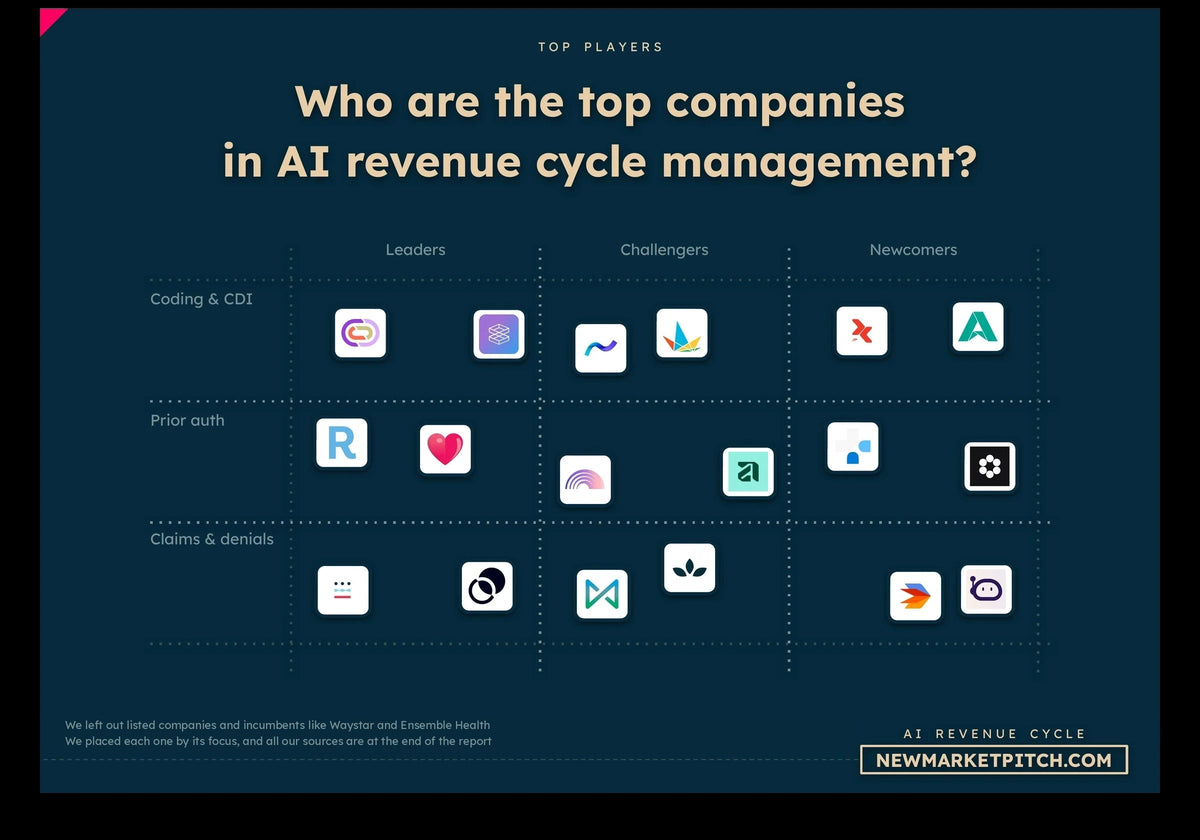
In our research about AI tools for medical billing, we turn what is vague and complex into simple, useful visuals. Market maps like this one show you at a glance where every startup stands.
Is AI revenue cycle management funding falling in 2026?
AI revenue cycle management funding is down 37.1% in 2026, but investors are still putting more money into smaller and mid-sized rounds than they did last year.
We counted $352.3 million across 19 funding rounds between January 1 and September 8, compared with $560.2 million across 22 deals during the same period in 2025. The number of funded companies also declined, from 21 to 18.
The headline looks worse because 2025 had some unusually large rounds. Ambience Healthcare raised $243 million, Stedi announced $70 million, and Candid Health secured $52.5 million. Those three transactions represented 65.2% of all funding during the period.
Meanwhile, the median round increased from $8 million to $10 million in 2026. Once we exclude financings exceeding $50 million, investment actually rose 19.3%.
The comparison with 2024 is also useful. Back then, the market attracted $361.7 million across just 13 deals. Capital raised this year is almost identical, but the number of transactions is 46.2% higher. There are more companies raising meaningful amounts than two years ago, even though the market has cooled since 2025.
| Funding metric | 2026 YTD | 2025 YTD | 2024 YTD |
|---|---|---|---|
| Total capital | $352.3M | $560.2M | $361.7M |
| Funding deals | 19 | 22 | 13 |
| Unique funded companies | 18 | 21 | 13 |
| Median round | $10.0M | $8.0M | $20.0M |
| Average round | $18.5M | $25.5M | $27.8M |
| Largest financing | $120M | $243M | $120M |
| Capital excluding rounds over $50M | $232.3M | $194.7M | $241.7M |
| Capital excluding rounds over $100M | $232.3M | $317.2M | $241.7M |
| Top-three capital concentration | 55.3% | 65.2% | 58.1% |
Would AI revenue cycle management funding still be down without the biggest rounds?
Without rounds above $50 million, AI revenue cycle management funding is actually growing. That changes how we should read this year's decline.
The market attracted $232.3 million below that threshold, up from $194.7 million in 2025. Several meaningful financings contributed: Adonis raised $40 million, Lassie secured $35 million, Arintra raised $25 million, and Parallel obtained $20 million.
In 2025, just three transactions accounted for $365.5 million. Ambience Healthcare's $243 million Series C was especially influential, representing 43.4% of the year's comparable-period funding.
There's another detail worth considering. Stedi's August 2025 announcement combined $50 million raised previously with $20 million in new capital. The company explicitly disclosed that structure. Our announcement-date methodology counts the published $70 million headline, but the money was not necessarily all raised during that period.
Removing Stedi's entire announcement would reduce 2025's total to $490.2 million and narrow the reported 2026 decline to 28.1%.
The picture changes again when excluding only rounds above $100 million: funding is still down 26.8%. Stedi's $70 million and Candid Health's $52.5 million remain in that comparison.
So the decline is real, but its severity depends heavily on how we treat the biggest deals. Below $50 million, investors are deploying more capital than last year.

Your time is limited. In our market report about AI tools for medical billing, we put numbers on each part of the market, so you can see where it makes sense to focus.
Are fewer AI revenue cycle management startups getting funded?
Yes. Fewer AI revenue cycle management companies are raising capital in 2026, even though the typical financing has become larger.
Our research identified 18 funded companies, compared with 21 during the equivalent period in 2025. Deal volume fell from 22 to 19, while the median financing increased 25%.
The bigger concern is how few new companies are entering the funded startup population.
Only three 2026 deals were classified as first financings, compared with eight in 2025 and five in 2024. Follow-on rounds now represent 84.2% of activity, up from 63.6% last year.
The contrast is clear among recent fundraises. Adonis secured a $40 million Series C, Arintra raised a $25 million Series B, and Candid Health obtained a $120 million Series D. At earlier stages, Parallel, Amperos Health and Procode AI also received follow-on financing.
Companies with previous investors and financing histories are taking a larger share of the available opportunities. Startups raising their first institutional capital appear to be having a harder time.
The first-financing figures rely on publicly traceable funding histories, rather than a complete record of every company's private investments.
Are seed-stage AI revenue cycle management startups being squeezed out?
Seed-stage AI revenue cycle management startups are facing a tougher funding environment, while Series A activity is holding up much better.
Seed deals dropped from ten in 2025 to seven in 2026, and total Seed capital declined from $45.3 million to $26.3 million. The median Seed round stayed close to $4 million, suggesting the main change is the number of financings rather than their typical size.
Series A looks healthier. The number of deals increased from seven to eight, while funding rose from $117 million to $124 million.
Parallel's $20 million Series A is a good example. The company had raised $3.5 million in seed funding the previous year and was already deploying AI agents in hospitals. Amperos Health followed its $4.2 million Seed with a $16 million Series A, while Procode AI raised $4 million in March and another $10 million in July.
These are companies progressing through successive financing rounds rather than entirely new startups appearing for the first time.
Across all stages, Seed and Series A still represent 78.9% of transactions, virtually unchanged from 77.3% in 2025. The market remains heavily early-stage, but there are fewer newly financed businesses within that group.
| Financing activity | 2026 YTD | 2025 YTD | 2024 YTD |
|---|---|---|---|
| Total funding deals | 19 | 22 | 13 |
| First financings | 3 | 8 | 5 |
| Follow-on financings | 16 | 14 | 8 |
| First-financing share | 15.8% | 36.4% | 38.5% |
| Follow-on share | 84.2% | 63.6% | 61.5% |
| Seed deals | 7 | 10 | 4 |
| Series A deals | 8 | 7 | 2 |
| Series B and later deals | 3 | 4 | 6 |
| Seed + Series A share | 78.9% | 77.3% | 46.2% |

In our document detailing everything you need to know about AI revenue cycle management, we always try to gather several sources and make estimates that make sense, so you can work with solid numbers.
Why is denial management suddenly attracting so much AI funding?
Denial management is the fastest-growing part of the AI revenue cycle management funding market in our 2026 comparison, with investors backing several companies rather than just one standout startup.
We identified five denial-management financings totaling $90.8 million, compared with only two rounds worth $7.2 million during the same period in 2025. Its share of total market capital jumped from 1.3% to 25.8%.
Adonis raised $40 million in March, Joyful Health secured $17 million in April, Amperos Health raised $16 million that same month, and Anomaly Insights obtained $17 million in May.
These companies tackle slightly different parts of the problem. Adonis works on reimbursement performance and payment exceptions, Amperos automates denied-claim recovery, while Anomaly Insights helps providers identify reimbursement issues and analyze payer contracts.
Amperos offers one of the clearest examples of why investors are interested. In its April 2026 Series A announcement, the company reported serving more than 3,000 clinical locations and helping recover nearly $700 million annually across more than 500,000 claims.
Hospitals and medical practices lose money when insurers deny claims, underpay providers or delay reimbursement. Software that can recover some of that money offers a result customers can measure.
Bessemer Venture Partners, which led Amperos's financing, estimated in its April 2026 investment analysis that U.S. healthcare providers lose more than $260 billion annually to insurance denials.
It's a powerful pitch: help providers recover revenue they have already earned, and measure the results in dollars.
Is medical coding AI becoming another funding hotspot?
Medical coding AI is attracting more investment in 2026, with five financing events collectively raising $60.2 million, up from $38.5 million across four deals last year.
Arintra secured $25 million in August, Parallel raised $20 million in March, and Procode AI completed two transactions totaling $14 million. Maia Medical Billing also obtained $1.2 million in June.
These startups are taking different approaches.
Arintra builds AI systems for coding and revenue assurance inside health systems. Parallel initially focused on medical coding but is expanding into other administrative work at hospitals. Procode AI combines coding technology with the acquisition of established medical billing businesses, particularly those serving surgical specialists.
The funding is supporting both software platforms and companies using AI to transform existing billing operations.
Parallel provides a concrete sign of adoption. When announcing its Series A, the company said its agents were already deployed across several dozen public and private hospitals.
Procode AI offers a different example. Its July financing was intended partly to fund additional acquisitions, allowing the company to expand beyond plastic surgery and dermatology into other surgical specialties.
Medical coding attracted $163.1 million in the comparable 2024 period, including a recorded $120 million Series C for AKASA. That unusually large financing makes the earlier comparison less representative of the category's typical activity.
Compared with 2025, the category is strengthening through several meaningful financings rather than one giant transaction.

Our report covering the AI revenue cycle management market gets updated several times a month, so you always get the latest view of where things stand.
Is claims automation losing investors to denial management?
Claims automation is seeing much narrower funding activity in 2026, while denial management has become a more popular destination for venture capital.
Claims submission and scrubbing attracted only one recorded financing this year: Candid Health's $120 million Series D. In the equivalent 2025 period, five financings raised a combined $177.8 million.
Candid Health is still a major success story. Sixth Street Growth led its July financing, and the company reported 190% year-over-year growth in annual contracted run-rate revenue and 180% net dollar retention during 2025.
Those company-reported operating metrics help explain why a growth investor would commit nine figures.
But the category's broader financing activity has weakened. In 2025, capital also reached Stedi, Camber, Wisdom and Youlify.
The shift toward denial management is interesting because both categories deal with the same underlying reimbursement system. Claims automation tries to improve how claims are prepared and submitted. Denial management focuses on what happens when claims are rejected or payments fall short.
Investors are finding more companies to back on the recovery side of the process. Claims automation still has a major funded player in Candid, but it isn't producing anything close to the same breadth of funding activity.
Which AI revenue cycle management categories are getting the most money now?
Denial management and medical coding are gaining investor attention, while claims submission, patient access and charge capture have become less active compared with 2025.
Denial management increased from two to five deals. Medical coding rose from four to five, with higher total funding and a stronger median round.
Payment posting and reconciliation also appeared as a meaningful funding category, attracting $41.5 million across two deals after recording none during the equivalent 2025 period.
Lassie's $35 million Series A drove most of that increase, while Kubera Health raised $6.5 million to build technology connecting payer contracts with payment operations and reconciliation.
On the weaker side, patient access and eligibility fell from six deals to three. Charge capture and revenue integrity declined from $43.6 million to $10.4 million, despite recording three financings.
Clinical documentation and CDI had no qualifying 2026 transaction in the database. Its 2025 total was entirely driven by Ambience Healthcare's $243 million Series C, making that comparison particularly sensitive to a single fundraising event.
The strongest funding activity is clustering around reimbursement recovery, coding and payment reconciliation.
| Category | 2026 deals | 2026 capital | 2025 deals | 2025 capital |
|---|---|---|---|---|
| Denial Management & Appeals | 5 | $90.83M | 2 | $7.20M |
| Medical Coding AI | 5 | $60.20M | 4 | $38.50M |
| Claims Submission & Scrubbing | 1 | $120.00M | 5 | $177.80M |
| Patient Access & Eligibility AI | 3 | $29.40M | 6 | $50.15M |
| Payment Posting & Reconciliation | 2 | $41.50M | 0 | $0 |
| Charge Capture & Revenue Integrity | 3 | $10.39M | 4 | $43.58M |
| Clinical Documentation & CDI | 0 | $0 | 1 | $243.00M |
| Total market | 19 | $352.32M | 22 | $560.23M |

In our research about AI tools for medical billing, we look at what the winners do differently, so you can learn from the best instead of guessing.
Why are investors backing AI that helps hospitals recover payments?
Investors are putting more money into AI reimbursement recovery because these products can show customers exactly how much money they help collect.
Hospitals and medical practices already spend heavily on revenue cycle management, but much of the work still involves checking claims, appealing denials, reviewing contracts and following up with insurers.
Adonis, Amperos Health and Joyful Health are developing products that automate different parts of this process. Arintra works further upstream, helping providers improve coding and identify revenue they might otherwise miss.
One useful indicator comes from Adonis. When announcing its $40 million Series C in March 2026, the company reported more than fourfold revenue growth during 2025 and net revenue retention above 130%.
Amperos has emphasized recovered claims revenue, while Arintra's August financing was positioned around expanding an AI-driven revenue assurance platform.
A hospital CFO can assess reimbursement automation through money recovered, staff time saved and changes in payment performance.
We cannot establish from deal announcements alone that these companies have better margins or retention than every other revenue-cycle category. What we can see is that several are attracting substantial funding while reporting measurable commercial results.
Is AI prior authorization still attracting funding?
AI prior authorization continues to attract venture funding in 2026, although the broader patient access and eligibility category is raising less money than last year.
The category received $29.4 million across three financings, compared with $50.2 million across six deals during the same period in 2025.
GenHealth.ai raised $16.5 million in September, Ethermed secured $8.5 million in April, and Claim Health obtained $4.4 million in January.
GenHealth.ai develops agents that handle healthcare back-office tasks including eligibility, prior authorization, billing and denials. Ethermed focuses on prior-authorization workflows, while Claim Health works on referral intake and admissions.
The regulatory environment gives these products a potentially important tailwind.
Under the Centers for Medicare & Medicaid Services' interoperability and prior-authorization final rule, certain health plans must adopt standardized APIs for electronic prior authorization, generally beginning in January 2027. Other operational requirements began taking effect in 2026.
That creates more reasons for healthcare organizations to modernize how authorization information moves between insurers, providers and software systems.
For now, though, the financing numbers have not followed that potential demand upward. Investors backed fewer companies in the category, and it is too early to call this a new funding boom.

In our market report about AI tools for medical billing, we don't want to repeat what boring consulting reports say. Instead, we show you the real and latest market signals that matter.
Which AI revenue cycle management startups are getting the biggest checks?
Candid Health, Adonis and Lassie received the largest AI revenue cycle management funding rounds in 2026, showing that investors are still willing to make major commitments to selected companies.
Candid Health leads with $120 million, followed by Adonis at $40 million and Lassie at $35 million.
Arintra's $25 million Series B and Parallel's $20 million Series A come next, followed by denial-management specialists Joyful Health and Anomaly Insights, each with $17 million.
The mix covers claims automation, denial recovery, medical coding, payment administration and hospital workflows. Investors are backing several approaches to automating the revenue cycle.
Candid is the clearest growth-stage example. Sixth Street Growth led its Series D, alongside existing backers including Oak HC/FT, 8VC and Y Combinator.
Lassie shows that large early-stage checks are still possible. Andreessen Horowitz led its $35 million Series A for software automating healthcare-practice administration, starting with dental operations.
Together, the three largest transactions account for $195 million, or 55.3% of the year's funding.
| Company | Round | Funding | Main category |
|---|---|---|---|
| Candid Health | Series D | $120M | Claims submission |
| Adonis | Series C | $40M | Denial management |
| Lassie | Series A | $35M | Payment reconciliation |
| Arintra | Series B | $25M | Medical coding |
| Parallel | Series A | $20M | Medical coding |
| Joyful Health | Series A | $17M | Denial management |
| Anomaly Insights | Undisclosed stage | $17M | Denial management |
| GenHealth.ai | Series A | $16.5M | Patient access |
| Amperos Health | Series A | $16M | Denial management |
| Procode AI | Series A | $10M | Medical coding |
Are the same venture capital firms dominating AI revenue cycle management?
AI revenue cycle management funding is spread across several venture and growth investors, with no single firm consistently leading the largest deals.
Sixth Street Growth led Candid Health's $120 million Series D, Quadrille Capital led Adonis's $40 million Series C, and Andreessen Horowitz led Lassie's $35 million Series A.
Elsewhere, Define Ventures backed Arintra, Index Ventures led Parallel, Bessemer Venture Partners financed Amperos Health, and Health Velocity Capital led Procode AI's July round.
The investors are financing businesses at very different stages.
Sixth Street is backing an established company with substantial reported commercial growth. Index Ventures is helping Parallel expand deployments of hospital AI agents. Health Velocity Capital is financing Procode's combination of AI software and acquisitions of established billing businesses.
Strategic investors are involved too. Arintra's Series B included Yale New Haven Health's Center for Health Care Innovation and Endeavor Health Ventures. Ethermed's financing included Healthliant Ventures.
Only 15 of the 19 transactions disclosed identifiable lead or co-lead investors in 2026, compared with 21 of 22 in 2025. That limits any firm conclusions about changing investor leadership, and strategic participation remains uneven.
The investor base nevertheless includes both generalist technology investors and firms with direct healthcare industry expertise.

Learning from others' mistakes is the cheapest lesson there is. In our document detailing everything you need to know about AI revenue cycle management, we look at what broke startups before you, so you don't repeat it.
Is AI revenue cycle management funding becoming too concentrated?
AI revenue cycle management funding is less concentrated in its biggest rounds than it was in 2025, even though fewer startups are receiving capital.
The largest deal accounts for 34.1% of the current total, compared with 43.4% last year. The top three rounds represent 55.3%, down from 65.2%, while the top five account for 68.1%, down from 74.5%.
Part of the explanation is simply the absence of another Ambience-sized financing. In 2025, that $243 million Series C dominated the market.
This year's largest rounds are distributed among Candid Health, Adonis, Lassie, Arintra and Parallel.
But funding has not become easier to obtain. The number of distinct companies raising capital has declined, and the first-financing share has fallen sharply.
Investors are spreading the largest checks across a somewhat wider group of established businesses while financing fewer new entrants. That could leave the market with several well-funded leaders and a thinner pipeline of newly financed competitors.
Could 2026 still become a strong year for AI revenue cycle management fundraising?
AI revenue cycle management could still finish 2026 with substantial funding activity, although matching the exceptional capital raised in 2025 would require more large transactions.
By September 8, the market had accumulated $352.3 million across 19 deals.
For context, the entire 2025 calendar year recorded $584.9 million across 26 deals, while full-year 2024 reached $487 million across 19 transactions.
The current year has already matched 2024's complete annual deal count. It has also reached 60.2% of full-year 2025 capital and 72.4% of full-year 2024 capital.
That's a respectable level of activity, especially considering the decline from last year's unusually large rounds.
One major financing could materially change the annual total, however, and fundraising is rarely distributed evenly throughout the year.
The more revealing developments will be whether first financings recover and whether denial-management and coding startups continue raising capital across several different companies.

If you build or invest in the AI revenue cycle management market, you need to know which business models pay off now and which ones are fading. That's why our report covering it has a whole section on it.
What is actually changing in AI revenue cycle management funding?
AI revenue cycle management funding is becoming more selective in 2026, with money increasingly going to previously backed companies and startups tackling specific reimbursement problems.
The headline funding decline of 37.1% is partly explained by unusually large 2025 financings. Outside rounds above $50 million, capital deployment is stronger this year.
The more important weakness is the decline in new-company funding. First financings fell from eight to three, while follow-on transactions now make up more than four-fifths of the market. Seed activity has also slowed, even though Series A investment remains relatively healthy.
Denial management has emerged as the clearest winner. Its financing growth is supported by several companies, including Adonis, Joyful Health, Amperos Health and Anomaly Insights. Medical coding is also attracting more attention, with Arintra, Parallel and Procode AI receiving meaningful capital.
Meanwhile, claims automation has become much more dependent on Candid Health, and clinical documentation has yet to produce another financing comparable to Ambience Healthcare's large 2025 round.
Investors appear particularly interested in products that help providers collect money, reduce reimbursement errors and automate expensive administrative work. Company announcements from Adonis, Amperos and Candid also provide some evidence of commercial traction behind this interest.
The next important development will be whether the market starts financing more new startups again. For now, much of the money is going to companies that have already secured backing and can point to concrete progress.
Our methodology
This analysis examines funding trends in the AI revenue cycle management market across three directly comparable periods: January 1 to September 8, 2026; January 1 to September 8, 2025; and January 1 to September 8, 2024. We also use full-calendar-year 2024 and 2025 figures when examining how the current year's fundraising compares with previous annual totals.
We compiled and reviewed 64 market-matched funding records covering companies whose core products address AI-driven healthcare revenue cycle management. The market includes medical coding, claims submission, denial management, patient access, reimbursement analytics, payment reconciliation, clinical documentation and related administrative workflows. We assessed market eligibility according to each company's activities at the time of financing, rather than including healthcare AI startups indiscriminately.
We focused on disclosed private-company equity financings of at least $300,000. Debt facilities, loans, grants, public offerings and identifiable non-equity components were excluded. Funding amounts were attributed to their public announcement dates, and independently identifiable transactions were counted separately. We reviewed company names, financing extensions and repeated announcements to reduce duplicate counting.
Stedi's August 2025 announcement is treated according to this announcement-date approach. Its published $70 million financing figure included $50 million previously raised and $20 million in new funding. We retained the announced amount in the dataset and separately calculated its effect on the year-over-year comparison.
For each period, we aggregated disclosed funding amounts, deal counts, unique funded companies, round sizes, financing stages and category-level capital. We calculated medians, averages, first-financing and follow-on shares, and concentration among the largest transactions. We also recalculated investment totals after excluding rounds above $50 million and $100 million to distinguish broad funding activity from the influence of exceptional transactions.
First-financing classifications were based on documented company funding histories. Category comparisons use each transaction's principal revenue cycle management activity, preventing the same round from being counted across multiple categories. Company-reported revenue growth, deployment figures and reimbursement outcomes were used as supporting commercial context rather than substitutes for disclosed investment amounts.
Our research combines company and investor announcements, established funding databases, healthcare industry publications and regulatory information. Primary funding sources include Sixth Street Growth on Candid Health's $120 million Series D, Ambience Healthcare's Series C announcement, Stedi's Series B disclosure, Adonis's Series C announcement, and Arintra's Series B announcement.
Additional company and investor sources include Amperos Health, Parallel, Index Ventures, Procode AI, Kubera Health and GenHealth.ai. For reimbursement-recovery market context, we used Bessemer Venture Partners' analysis of healthcare denials.
Regulatory context comes from the Centers for Medicare & Medicaid Services, including its Interoperability and Prior Authorization Final Rule and electronic prior authorization guidance. We used these materials to assess the operating environment for prior-authorization startups, while keeping regulatory developments separate from recorded venture capital activity.
The resulting comparisons measure publicly disclosed fundraising activity within the specified periods. Capital totals, transaction counts and category changes come from the compiled funding dataset; reported operating metrics and regulatory developments provide additional context for interpreting those funding trends.

In our research about AI tools for medical billing, we like to show you the big picture. We know your time is precious, so we make every page quick to read and packed with as much learning as possible per minute.
Written by the New Market Pitch teamWe track new markets so founders and investors can move faster. About us