Is AI revenue cycle a big market or a US billing quirk?
Whether you're building or investing in the AI revenue cycle management market, our report covers everything you need to know: the players, the money, and what's coming next.
Summary
AI revenue cycle management has the makings of a multibillion-dollar US software market, but its unusually large opportunity comes from America’s complicated medical billing system. The industry is commercially credible; its current pure-play AI revenue still cannot be measured reliably.
Broad US revenue cycle management is estimated at $172.2 billion in 2024 and $190.4 billion in 2025. Those figures include software and services, not just AI, so treating them as an AI addressable market would wildly overstate what vendors can sell.
The biggest source of demand is fragmentation: hospitals must reconcile different insurers, negotiated contracts, medical codes and authorization rules. This makes the US a particularly lucrative market and a poor template for sizing the rest of the world.
CAQH estimates that electronic transactions already avoided $258 billion in administrative costs in 2024, with another $21 billion in potential annual savings from further transaction automation. Neither amount is AI vendor revenue.
The best automation economics are in denials, coding, appeals and other messy exceptions. Straightforward eligibility checks are already digitized, leaving less value for another layer of automation.
Candid Health reported 190% growth in annual contracted run-rate revenue and 180% net dollar retention; Adonis reported more than fourfold revenue growth in 2025. Customer expansion is real, although neither company provides a clean measure of industrywide AI billing revenue.
Waystar generated $1.099 billion of revenue in 2025 and acquired Iodine Software for $1.25 billion. This proves that revenue cycle technology can scale, but only part of Waystar’s business is AI, and incumbents may capture much of the upside.
Illustrative AI software revenue scenarios span $2 billion, $8 billion and $18 billion annually, depending on the addressable spending pool and the share vendors capture. These are modeled possibilities, not measured market sizes or forecasts.
The market carries a built-in contradiction: insurers deploying more automation can create more work for hospitals, while regulation and better interoperability could eliminate some of that work altogether.
Beyond the US, coding, documentation and payment accuracy should travel better than tools designed around American denials. The durable winners will reduce billing friction, not simply make existing bureaucracy faster.

Written by the New Market Pitch teamWe track new markets so founders and investors can move faster. About us
Why are investors suddenly pouring money into AI revenue cycle startups?
AI revenue cycle management is attracting serious investment because American healthcare providers spend heavily on getting paid, and new AI software can now handle some of that work.
Revenue cycle management, or RCM, covers the financial work between a patient booking an appointment and a healthcare provider collecting payment. It includes insurance checks, medical coding, claim submission, denial management, appeals and patient billing.
Investment in the category has picked up. Candid Health raised $120 million in July 2026, following a $52.5 million round in February 2025. Adonis raised $40 million in March 2026, taking its total funding above $95 million. Waystar completed its $1.25 billion acquisition of Iodine Software in October 2025, bringing AI-powered clinical documentation tools into its healthcare payments platform.
These companies are approaching the problem differently. Candid wants to automate billing from beginning to end. Adonis focuses on improving revenue operations using AI and financial data. Waystar is adding AI to an established payments platform already serving large healthcare organizations.
The commercial appeal is straightforward. Hospitals already pay employees, outsourcing companies and software vendors to manage these processes. AI startups are entering an existing budget rather than inventing a new one.
But there is a catch. Much of that budget exists because American medical billing is exceptionally complicated. The question is how much of today's spending AI companies can capture, and whether the opportunity survives outside the US.
How big is the US revenue cycle management market today?
The US revenue cycle management market is worth well over $100 billion under broad industry estimates, but the actual AI software market is much smaller.
Grand View Research estimated the US RCM market at $172.2 billion in 2024 and projected $190.4 billion for 2025, implying growth of roughly 10.5%. Its forecast extends to $308.2 billion by 2030.
Those are broad market estimates covering revenue cycle software and services, not measured spending on AI billing agents. Other research firms use narrower definitions and arrive at substantially different totals.
Reported company revenue gives us a firmer anchor. Waystar generated $1.099 billion in 2025 from healthcare payments software. R1 RCM, meanwhile, operates a large business built around managing revenue cycle work for hospitals and health systems, including labor-intensive services. Providers also run sizable internal billing teams.
That creates three different spending pools: all resources devoted to revenue collection, payments to external RCM vendors, and the portion that AI software could eventually replace or improve.
Confusing them produces inflated market estimates. A hospital's billing payroll may be an opportunity for automation, but eliminating $1 million of labor does not automatically create $1 million of software revenue.
For now, the broad US RCM industry is clearly huge. There is no equally reliable consolidated figure showing how much revenue pure-play AI RCM vendors generate.
| Market measure | Latest figure | What it tells us |
|---|---|---|
| US healthcare spending, 2024 | $5.3T | Scale of the healthcare system |
| US hospital expenditure, 2024 | $1.635T | Hospital services spending |
| US physician and clinical services, 2024 | $1.110T | Physician and clinical spending |
| Broad US RCM market, 2024 | $172.2B | Grand View Research estimate |
| Broad US RCM market, 2025 | $190.4B | Grand View Research projection |
| Broad US RCM market, 2030 | $308.2B | Long-term industry forecast |
| Waystar revenue, 2025 | $1.099B | Reported healthcare payments software revenue |
| Pure-play AI RCM revenue | Not reliably aggregated | The market still needing measurement |

Your time is limited. In our report covering the AI revenue cycle management market, we put numbers on each part of the market, so you can see where it makes sense to focus.
Why is medical billing so much more complicated in the US?
American healthcare billing is unusually complicated because providers must deal with numerous insurers, reimbursement contracts, authorization rules and patient payment obligations.
According to CMS, private health insurance accounted for $1.645 trillion in US healthcare spending in 2024. Medicare accounted for $1.118 trillion, Medicaid for $932 billion, and out-of-pocket payments for another $557 billion.
These payment sources have different rules. A hospital may receive different prices for the same procedure depending on the patient's insurer, network, coverage and negotiated contract.
Before getting paid, providers often have to confirm eligibility, document medical necessity, submit appropriate codes and establish that the treatment satisfies the insurer's requirements. A mistake can delay or reduce payment, even when the medical care was delivered correctly.
The burden shows up in industry surveys. Experian Health's 2025 State of Claims report found that 68% of responding providers considered submitting clean claims more difficult than the previous year. Another 54% reported increasing claim errors.
Many other countries have insurance claims and medical coding, but fewer combine the same degree of fragmented commercial insurance with complex provider-specific reimbursement arrangements.
That gives US RCM vendors an unusually large domestic opportunity. It also means the American market is a poor starting point for estimating global demand.
How much money is wasted on healthcare billing?
US healthcare administration offers billions of dollars in potential savings, although the often-quoted figures are much broader than what AI revenue cycle vendors can realistically earn.
The 2025 CAQH Index, released in February 2026, estimated that electronic transactions and better data exchange helped US healthcare avoid $258 billion in administrative costs during 2024.
That figure was 17% higher than the previous year's estimated cost avoidance. CAQH also identified approximately $21 billion in additional annual savings that could come from fully automating manual and partly manual transactions.
The research drew on more than 600 provider organizations and health plans representing 63% of insured lives.
The $258 billion represents estimated costs already avoided through electronic processes. The remaining $21 billion is an estimate of possible further savings within the administrative transactions CAQH tracks.
Neither figure measures AI software revenue.
After decades of digitization, US healthcare still has a sizable pool of repetitive administrative work. CAQH reported that more than 50% of health plans and 25% of provider organizations were already using AI tools in administrative workflows.
Automation is therefore an established trend, with AI becoming a more common part of it. New vendors must show they can do better than existing electronic systems, especially when those systems already process straightforward transactions at low cost.

In our research about AI tools for medical billing, we always try to gather several sources and make estimates that make sense, so you can work with solid numbers.
Are insurance claim denials making the AI revenue cycle market bigger?
Insurance claim denials are making AI revenue cycle software more attractive because providers face repeated administrative work and delayed payments when claims are rejected.
Experian Health's 2025 survey of 250 revenue cycle professionals found that 41% of respondents were dealing with denial rates of at least 10%. The company has tracked growing denial problems across successive editions of its survey since 2022.
Those findings describe the surveyed organizations rather than a nationally weighted denial rate, but the operational problem is substantial.
Consider a provider submitting one million claims annually. At a hypothetical initial denial rate of 10%, that means 100,000 claims need attention. Preventing 20% of those denials would remove 20,000 problematic cases.
The benefit can be bigger than the labor saved. Some denied claims are eventually paid after additional work, while others lead to reduced collections or write-offs. A successful automation system can potentially reduce processing costs, accelerate payment and recover money that would otherwise be lost.
Adonis uses AI and revenue data to identify reimbursement problems and automate parts of the response. AKASA has developed AI systems for revenue cycle tasks. Waystar offers denial management and prevention capabilities within its broader platform.
Two types of products are emerging. Some help providers challenge denials more efficiently. Others aim to submit cleaner claims so the denial never happens.
The second approach can remove more work from the system, although it depends heavily on having accurate clinical, insurance and payer-policy information.
If you want more recent data on this point, please see our latest AI revenue cycle management market report.
Which AI billing tasks are actually worth automating?
AI billing automation is most valuable in medical coding, denial prevention, appeals and complicated payment exceptions, where a single avoided mistake can save substantial work or protect reimbursement.
Not all revenue cycle tasks offer the same economics.
Basic eligibility transactions and claim-status inquiries are often already handled electronically. Automating one more straightforward transaction may save very little.
Complex denials are different. Employees may need to review medical records, find missing documentation, interpret payer requirements and prepare an appeal. The process can involve several systems and repeated communication.
Medical coding presents another opportunity. AI can review clinical documentation, suggest codes and identify inconsistencies, although the output still requires suitable controls to prevent inaccurate billing.
These differences also affect employment. An AI system that prepares an appeal may reduce the time an employee spends on the case without eliminating the need for review. More autonomous workflows could eventually reduce staffing requirements, but current adoption surveys do not establish large industrywide workforce reductions.
The strongest measure of progress is operational: how many claims are processed per employee, how often humans intervene, and how much it costs to collect each dollar.
| Workflow | AI opportunity | Main economic benefit |
|---|---|---|
| Patient registration | Detect missing information | Fewer downstream errors |
| Insurance eligibility | Resolve coverage exceptions | Less manual checking |
| Prior authorization | Assemble documentation and requests | Faster processing |
| Clinical documentation | Identify missing clinical details | More accurate reimbursement |
| Medical coding | Suggest and verify codes | Higher coding productivity |
| Claim submission | Detect errors before submission | Fewer rejected claims |
| Denial prevention | Predict and correct denial causes | Less rework |
| Appeals | Prepare evidence and draft responses | Lower administrative cost |
| Payment reconciliation | Match payments against expected amounts | Fewer missed discrepancies |
| Patient collections | Automate billing communication | Lower collection costs |

In our market report about AI tools for medical billing, we don't want to repeat what boring consulting reports say. Instead, we show you the real and latest market signals that matter.
Are AI revenue cycle startups actually growing fast?
Several AI revenue cycle startups are growing very quickly, and their customer expansion figures provide stronger evidence of demand than their fundraising announcements alone.
Candid Health reported 190% year-over-year growth in annual contracted run-rate revenue for 2025 when announcing its July 2026 financing. It also reported 180% net dollar retention.
Adonis reported more than fourfold revenue growth during 2025 and net retention above 130%, according to its March 2026 fundraising announcement.
Those retention figures deserve attention. Net retention above 100% means revenue or contracted value from an existing customer group increased overall, even after accounting for reductions and cancellations, under the companies' respective reporting definitions.
Candid's 180% figure suggests customers substantially expanded their commitments after adopting its platform. Adonis also appears to be growing within existing accounts rather than relying exclusively on newly acquired customers.
But the companies have not disclosed enough financial detail to establish their absolute contribution to the market.
A business growing 190% from $5 million generates a very different amount of revenue from one growing at the same rate from $100 million. Contracted run-rate revenue also differs from revenue already recognized.
These products are finding customers willing to increase spending. The remaining uncertainty concerns the industry's absolute size, profitability and ability to sustain such growth as the customer base matures.
Is Waystar proof that AI revenue cycle can become a billion-dollar business?
Waystar proves that healthcare payments software can generate more than $1 billion annually with strong margins, although only part of its business comes from AI.
According to its February 2026 financial results, Waystar generated $1.099 billion in revenue during 2025, up 16.5% from $943.5 million in 2024.
Adjusted EBITDA reached $462.1 million, equivalent to a 42% margin. Revenue was also up from $791 million in 2023, meaning the company grew approximately 39% over two years.
Subscription revenue increased 22% in 2025 to $558.4 million. Volume-based revenue grew 11% to $534.8 million.
Nearly two-thirds of the company's $155.7 million annual revenue increase came from subscriptions. That included approximately $30 million from the acquired Iodine business.
Waystar also reported 1,391 customers generating more than $100,000 each in trailing-12-month revenue, up 16%, alongside 112% net revenue retention.
The business has scale, recurring customer relationships and profitable growth.
However, Waystar built its business over many years through payments software, transaction processing, acquisitions and other services. AI is now an important part of its strategy, but attributing the full $1.1 billion to AI would exaggerate the size of the emerging category.
Waystar is strongest as evidence that healthcare providers will support large, established software businesses around getting paid.

In our document detailing everything you need to know about AI revenue cycle management, we like to show you the big picture. We know your time is precious, so we make every page quick to read and packed with as much learning as possible per minute.
Could Waystar and other incumbents crush AI billing startups?
Established revenue cycle companies could capture a large share of the AI opportunity because they already have the customers, financial data and integrations that new startups need to build.
Waystar's acquisition of Iodine Software is a particularly revealing example.
The $1.25 billion transaction, completed in October 2025, connected Waystar's healthcare payments platform with clinical documentation intelligence. Iodine brought relationships with more than 1,000 hospitals and health systems, and Waystar said the acquisition expanded its addressable market by more than 15%.
The strategic value comes from linking clinical documentation with downstream reimbursement. A system that understands both sides can identify missing information before a claim is submitted.
Private equity is pursuing a similar approach. New Mountain Capital backed the creation of Smarter Technologies, combining Access Healthcare, SmarterDx and Thoughtful.ai to bring together outsourced revenue operations, clinical revenue intelligence and automation.
Buyers and investors increasingly favor systems spanning multiple stages of the revenue cycle.
That puts pressure on startups selling one isolated feature. A tool that drafts appeals may work extremely well, but a hospital could prefer an existing vendor that integrates appeals with claim submission, payment reconciliation and reporting.
The challengers still have room to win through better automation and faster deployment. Yet we should expect some of the financial benefits of AI to appear inside established RCM businesses rather than exclusively in new AI companies.
If you want more recent data on this point, please see our latest AI revenue cycle management market report.
How big could the AI revenue cycle software market actually become?
AI revenue cycle software could plausibly become a multibillion-dollar annual market in the US, but published evidence still does not support a precise industrywide revenue estimate.
Spending scenarios offer a better test than applying a percentage to the entire healthcare economy.
Suppose the annual spending pool that AI software could meaningfully replace or improve eventually reaches $20 billion, $40 billion or $60 billion. These are hypothetical addressable pools, not observed market measurements.
If vendors capture 10%, 20% or 30% of those pools as software revenue, the resulting market ranges from $2 billion to $18 billion annually.
The important variable is how much value vendors can retain.
A hospital may save $1 million by replacing manual work, yet pay only $200,000 for the automation software. The remaining $800,000 stays with the hospital before accounting for implementation and oversight.
Competitive pressure could lower software prices further as AI models become cheaper.
The scenarios nevertheless show that a sizeable US AI RCM industry can emerge without automating every billing function. A few billion dollars of annual vendor revenue would represent a small fraction of the country's administrative spending.
We view the lower and middle outcomes as plausible long-term possibilities. The $18 billion outcome would require much broader adoption, a large genuinely addressable spending pool and unusually strong vendor monetization.
| Illustrative scenario | Conservative | Central | Expansive |
|---|---|---|---|
| Addressable annual spending | $20B | $40B | $60B |
| Share captured as vendor revenue | 10% | 20% | 30% |
| Implied annual AI software revenue | $2B | $8B | $18B |
| Share of US healthcare spending | 0.04% | 0.15% | 0.34% |
| Requires broad adoption | Yes | Yes | Yes |
| Current measured market size | No | No | No |
| Main limitation | Narrow adoption | Execution and pricing | Aggressive assumptions |

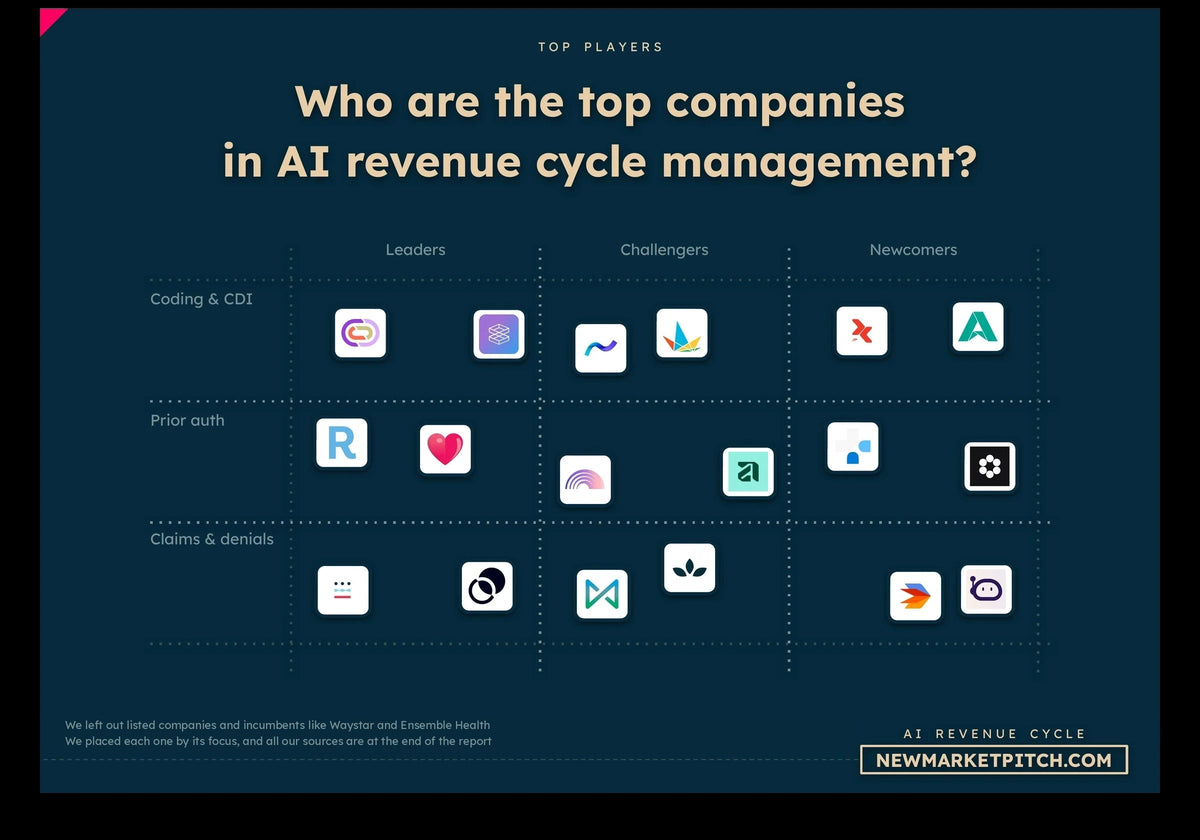
In our report covering the AI revenue cycle management market, we turn what is vague and complex into simple, useful visuals. Market maps like this one show you at a glance where every startup stands.
Could simpler insurance rules destroy part of the AI billing market?
Simpler insurance rules could reduce demand for some AI billing products, especially those built around navigating unnecessary payer complexity.
CMS is already pushing insurers toward faster and more standardized administration.
Under its interoperability and prior authorization rule, specified payers must respond to urgent authorization requests within 72 hours and standard requests within seven calendar days, subject to the rule's scope and exceptions. Key requirements began in 2026, with API-related requirements following in 2027.
Affected insurers must also provide specific reasons for certain authorization denials.
These reforms could make it easier to submit requests, exchange information and understand why an authorization was rejected.
They will not eliminate medical coding, payment reconciliation or all reimbursement disputes. But they could reduce the demand for products that mainly transfer information between disconnected portals.
The 2025 CAQH Index already shows the larger historical pattern: electronic transactions have removed enormous amounts of administrative effort, and further savings remain possible.
AI vendors face the same dynamic. When software removes a billing problem permanently, the customer may no longer need to pay as much to manage that problem.
The long-term opportunity looks stronger in accurate documentation, coding and payment verification than in automating avoidable bureaucracy.
If you want more recent data on this point, please see our latest AI revenue cycle management market report.
Is AI revenue cycle management a real opportunity outside the US?
AI revenue cycle management has international potential, particularly in medical coding and payment administration, but the US insurance-billing opportunity is difficult to reproduce abroad.
England's NHS offers a useful contrast.
NHS England's payment arrangements include blended and other contractual mechanisms that differ sharply from American private-insurance reimbursement. Hospitals still need clinical coding, activity reporting and financial administration, but they generally do not face the same network of competing commercial insurance contracts.
Countries with social insurance, private insurers or mixed public-private systems may have more claims-related work, yet their reimbursement rules still differ from those of the US.
Some AI capabilities should travel well. Clinical documentation review, coding assistance, invoice processing and payment reconciliation solve problems found across healthcare systems.
Other products are much more American. Software designed around US insurer denials, specific procedure codes, negotiated commercial reimbursement and payer authorization rules may require substantial redevelopment.
That limits the usefulness of a global estimate built by multiplying US billing expenses by international healthcare spending.
Still, international expansion is not essential for building a large company. CMS recorded approximately $2.74 trillion in US hospital and physician-service expenditure in 2024 alone.
For illustration, a software business serving 2,000 healthcare organizations at an average annual contract value of $250,000 would generate $500 million in revenue. At $500,000 per customer, that becomes $1 billion.
Those are hypothetical contracts, but Waystar's actual revenue shows that a major domestic healthcare payments software business is achievable.

Our research about AI tools for medical billing gets updated several times a month, so you always get the latest view of where things stand.
Will AI billing software become much cheaper as models improve?
Basic AI billing features will probably become cheaper, putting pressure on startups that sell little beyond document extraction, coding suggestions or appeal drafting.
General-purpose AI models can already read records, summarize documents, identify inconsistencies and generate structured responses. Improvements in model quality and inference costs should make those capabilities more accessible to software developers.
The harder part is getting the software to work reliably across hospital systems, payer requirements and real financial transactions.
A product must connect to electronic health records, apply the right billing rules, preserve audit trails, protect patient information and handle cases the model cannot resolve safely.
Errors can be expensive. An inaccurate code may trigger a denial, incorrect reimbursement or compliance problems. An appeal prepared using incomplete clinical evidence can create additional work.
This gives companies with established integrations and large collections of payment data a meaningful advantage. It also explains why newer vendors increasingly emphasize end-to-end automation rather than single AI features.
Pricing will matter. Some products charge subscriptions, others use transaction-based fees, and revenue recovery tools may link compensation to financial outcomes.
As automation costs fall, hospitals should capture some of the savings through lower software prices. Vendors that can demonstrate reliable performance across complete workflows will be better positioned to protect margins.
If you want more recent data on this point, please see our latest AI revenue cycle management market report.
Could insurer AI make medical billing even more complicated?
AI could make US medical billing more complicated if insurers become better at checking and rejecting claims while providers respond with increasingly automated appeals.
Health plans already use automated systems for claims processing, utilization management, fraud detection and payment integrity.
Healthcare providers deploy revenue cycle tools to comply with payer rules, find reimbursement errors and contest denials.
If both sides become more sophisticated, the outcome could go in either direction. Better data and standardized processing could reduce mistakes. More aggressive automated scrutiny could create additional disputes and administrative work.
Experian Health's 2025 survey provides evidence that denial problems were widespread, but it does not establish that newer insurer AI caused them.
To determine that, we would need to compare denial rates, overturned decisions and appeal costs before and after specific AI deployments across insurers.
There is a commercial paradox here. A more complicated billing environment can create more demand for AI revenue cycle software, even if the extra spending does little to improve care.
A vendor might therefore grow by helping providers deal with administrative problems that the healthcare system would ultimately be better off eliminating.
That distinction is essential when assessing whether growth in AI billing represents genuine productivity gains.

In our market report about AI tools for medical billing, you will always find fresh funding data, taken straight from our own verified funding database.
Is AI revenue cycle a big market or just a US billing quirk?
AI revenue cycle management is a big, commercially credible market, but its unusually attractive economics depend heavily on the complexity of US healthcare billing.
The commercial evidence supports a narrower conclusion than the headline market figures.
The existing RCM industry is enormous under broad market definitions. Waystar's billion-dollar revenue base shows that hospitals will support major payments software platforms. Candid Health and Adonis are reporting rapid growth and strong expansion among existing customers, while established companies are spending heavily to acquire AI capabilities.
There is also substantial remaining administrative work. CAQH's estimate of $21 billion in potential further transaction-automation savings shows that even decades of digitization have left room for improvement.
Yet those figures cannot be combined into a single AI market size. Administrative savings, outsourced billing expenditure, contracted software revenue and actual AI vendor sales measure different things.
We believe several billion dollars in annual US AI RCM software revenue is a plausible outcome as adoption expands. A precise current figure remains unverified, and estimates above $10 billion require stronger assumptions about how much spending vendors can capture.
The international opportunity will be more selective. Coding, documentation and payment accuracy have broad applications, while products built around American insurance denials and reimbursement rules face a much smaller market elsewhere.
The biggest long-term risk is also unusually clear. Healthcare providers want to spend less on administration. If AI and regulation succeed in simplifying billing, some of the work currently creating demand for software will disappear.
That favors companies helping hospitals code accurately, document care properly and collect legitimate payments with fewer interventions. Businesses built mainly around managing unnecessary complexity have a less certain future.
So the answer is partly both: AI revenue cycle is large enough to support major software companies, and the US billing system is the main reason the opportunity looks so big. The best businesses will make money by reducing that complexity rather than depending on it forever.
If you want more recent data on this point, please see our latest AI revenue cycle management market report.
Our methodology
This analysis asks whether AI revenue cycle management is a durable software opportunity or mainly a consequence of US healthcare billing complexity. We separate broad RCM expenditure from observable vendor revenue, projected automation savings and hypothetical AI software sales, rather than adding unlike figures together.
We assessed eight dimensions: market boundaries, demonstrated demand, administrative inefficiency, workflow economics, competition, revenue potential, international transferability and durability. For each, we collected recent evidence, compared it across sources, tested what it actually measured and then combined the results into a more reliable view of the market.
Our market anchors include US health expenditure and payer mix from CMS, estimates from Grand View Research, transaction-efficiency findings from CAQH and claims research from Experian Health. Company disclosures from Candid Health, Adonis and Waystar help test whether customers are actually adopting and expanding spending on relevant products.
We evaluated incumbents alongside AI-first challengers, using Waystar’s financial reporting and Iodine acquisition and New Mountain Capital’s formation of Smarter Technologies. We also reviewed CMS prior-authorization changes and the NHS England payment framework to assess where today’s billing complexity may shrink and which capabilities could carry abroad.
The $2 billion, $8 billion and $18 billion revenue scenarios apply assumed software-capture rates to hypothetical addressable spending pools. They show how monetization changes the outcome; they are not observations of current AI RCM revenue. We did not extrapolate US billing costs to the rest of the world.
Key sources: CMS national health expenditure data, Grand View Research on US RCM, CAQH Index, Experian Health’s State of Claims, Candid Health’s financing announcement, Adonis’s financing announcement, Waystar FY2025 results, Waystar on Iodine, New Mountain Capital on Smarter Technologies, CMS prior authorization rule, and NHS England’s payment scheme.

In our document detailing everything you need to know about AI revenue cycle management, we look at what the winners do differently, so you can learn from the best instead of guessing.
Written by the New Market Pitch teamWe track new markets so founders and investors can move faster. About us