Is % of collections the best AI billing business model?
Whether you're building or investing in the AI revenue cycle management market, our report covers everything you need to know: the players, the money, and what's coming next.
Summary
Percentage of collections is one of the best AI billing business models for companies replacing entire medical billing operations, but it is not the best model for every AI billing product. For broader healthcare AI platforms, hybrid pricing offers a more durable combination of recurring revenue, usage-based fees, and performance incentives.
The attraction is substantial contract value. A medical practice collecting $10 million annually can generate $300,000 to $500,000 in vendor revenue at a 3% to 5% fee. Those economics become especially attractive when AI reduces the labor required to handle claims, denials, payments, and collections.
There's a catch in comparing collections fees with software subscriptions. A 5% contract might generate $250,000 annually from a practice collecting $5 million, versus $30,000 for a $2,500 monthly subscription. But the first vendor may be replacing an entire billing department, while the second sells software the customer operates itself.
Automation could radically improve revenue cycle management (RCM) margins, although published savings benchmarks are often misunderstood. The CAQH Index shows electronic claim-status inquiries cost 74% less than manual ones, but those savings measure administrative digitization, not the additional impact of generative AI.
AI billing companies are making measurable operational progress. Candid Health reports touchless processing above 95% for its defined claims workflow, while an AKASA deployment at Methodist Health System saved more than 5,000 staff hours. Neither result proves an entire revenue-cycle operation can run without people.
Percentage pricing has an incentive problem. Vendors earn more when a practice collects more, even when that growth comes from additional patients, higher reimbursement rates, or acquisitions rather than better billing. This becomes harder to defend as automation reduces the cost of processing individual claims.
Growth can also make percentage contracts expensive. A practice expanding from $5 million to $20 million in collections sees its annual fee rise from $250,000 to $1 million at an unchanged 5% rate, even if the underlying processing workload grows much more slowly.
The market is enormous, but total healthcare spending is a misleading addressable-market figure. US hospital and physician spending reached approximately $2.74 trillion in 2024, implying a theoretical $27.4 billion fee pool at 1%. Actual opportunities depend on eligible collections, existing billing costs, and which services vendors can replace.
Alternative models already work at considerable scale. Waystar generated $1.099 billion in 2025 revenue and a 42% adjusted EBITDA margin through subscription and volume-based services. More than 99% of its revenue came from subscriptions or highly predictable transaction volumes, showing that collections commissions are not necessary for recurring healthcare payments revenue.
The strongest pricing model follows the work being delivered. Full-service RCM can justify a share of collections; routine claims processing fits per-claim or per-transaction fees; denial recovery suits performance-based payments; and software platforms benefit from recurring subscriptions.
Our conclusion favors hybrid pricing for the strongest long-term AI billing platforms: a recurring software fee, usage charges for processing, and performance fees for verified additional recoveries. Percentage pricing may deliver bigger early contracts, but lasting profitability will depend on automation costs, measurable customer value, and contracts that remain reasonable as providers grow.

Written by the New Market Pitch teamWe track new markets so founders and investors can move faster. About us
Why are AI medical billing startups so interested in percentage-of-collections pricing?
Percentage-of-collections pricing is especially attractive for AI medical billing startups because it lets them earn a share of healthcare payments while using automation to reduce the cost of processing those payments.
A medical practice collecting $10 million annually generates $500,000 in vendor revenue at a 5% fee. That's an unusually large contract for a software company serving a single healthcare customer, particularly if much of the billing work can be automated.
The model existed long before generative AI. Traditional revenue cycle management (RCM) companies such as R1 RCM and athenahealth built substantial businesses around collecting an agreed percentage of providers' revenue. AI companies are now going after the labor-intensive work that made those fees necessary in the first place.
There's one complication: traditional RCM contracts often cover almost everything between treating a patient and receiving payment. An AI startup that only automates claim submission is selling something much narrower. Whether percentage pricing is attractive depends heavily on how much of that work the vendor actually takes over.
What are healthcare providers actually paying for with a percentage-of-collections contract?
A percentage-of-collections contract can cover the entire medical billing operation or just selected services, and that difference can completely change whether the price is reasonable.
R1 RCM's 2023 annual report described a model in which some operating fees were calculated using an agreed cost-to-collect percentage applied to defined patient collections, alongside contractual adjustments and operating expense arrangements.
A full-service contract may include medical coding, claim submission, denial management, payment posting, patient billing, collections, and the employees needed to perform those tasks. A narrower AI product might handle only two or three of them.
Even the definition of collections varies. Contracts may include insurance payments, patient payments, or revenue from specific facilities. Refunds, historical receivables, and some reimbursement categories can be excluded.
For a practice collecting $10 million, a 5% fee means $500,000 annually. That's potentially reasonable for replacing a billing department and much harder to justify for automating a single administrative task.

A good product starts with a real problem. In our report covering the AI revenue cycle management market, we show you the ones customers still live with.
Is charging 5% of collections more profitable than selling a subscription?
A 5% collections fee can generate far more revenue per healthcare customer than a software subscription, although higher revenue doesn't necessarily mean higher profit.
Tebra, for example, has publicly marketed monthly subscription packages for medical practices. Its software model offers a very different way of monetizing billing and practice-management technology compared with traditional percentage-based outsourcing.
Consider a hypothetical practice collecting $5 million annually. We can calculate what several possible contracts would generate for the vendor. These are illustrative pricing scenarios rather than actual offers from the companies mentioned.
| Billing model | Pricing assumption | Annual vendor revenue |
|---|---|---|
| Collections-based | 3% of collections | $150,000 |
| Collections-based | 4% of collections | $200,000 |
| Collections-based | 5% of collections | $250,000 |
| Collections-based | 6% of collections | $300,000 |
| Fixed subscription | $799/month | $9,588 |
| Fixed subscription | $2,500/month | $30,000 |
| Per-claim | $2 on 20,000 claims | $40,000 |
| Per-claim | $5 on 20,000 claims | $100,000 |
| Hybrid | $5,000/month + 1% | $110,000 |
The difference is enormous. A 5% fee generates more than eight times the revenue of a $2,500 monthly subscription in this example.
But the comparison only works as a revenue illustration. A full-service billing vendor might need employees, compliance specialists, integrations, and continuous customer support, while a subscription provider could be selling software that the practice operates itself.
If you want more recent data on this point, please see our latest AI revenue cycle management market report.
Will medical practices really pay AI billing companies 3% to 7% of collections?
Medical practices already pay several percentage points of revenue for outsourced billing, so AI providers can sell within an established pricing market. Getting those same fees for software alone is much less certain.
Traditional billing providers frequently advertise percentage-based rates, with the actual fee varying by specialty, claims volume, complexity, and the responsibilities being outsourced. Higher rates often reflect more difficult billing work or smaller practices with less volume.
An important reference is athenahealth's published estimate that medical practices typically spend approximately 3% to 4% of their revenue on collections-related costs. That isn't a universal industry rate, but it helps explain the economics that vendors must compete against.
A practice currently spending 4% on billing has a strong reason to consider an automated service charging 3% if the service can handle comparable work. Paying an additional 3% for AI software on top of its existing billing expenses is a different proposition.
We're therefore looking at two separate markets: AI companies replacing existing RCM spending and software vendors trying to sell additional tools to organizations that still operate their own billing departments.

If you build or invest in the AI revenue cycle management market, you need to know which business models pay off now and which ones are fading. That's why our report covering it has a whole section on it.
Can AI make percentage-of-collections billing dramatically more profitable?
AI can make collections-based billing substantially more profitable by cutting manual processing costs, and existing administrative automation benchmarks show just how large those savings can be.
The 2024 CAQH Index estimates that processing a claim-status inquiry manually costs $13.80, compared with $3.64 electronically. Eligibility verification costs fall from $8.57 to $2.00, while claim submission drops from $6.33 to $3.05.
Those represent estimated savings of 74%, 77%, and 52%, respectively. They measure electronic administrative transactions rather than the incremental effect of generative AI, but they establish how expensive manual processes are.
The potential margin improvement becomes clearer with a simple calculation. An AI billing vendor generating $500,000 annually from one customer would earn a gross margin of 80% if its direct delivery costs were $100,000. If the vendor still needed $300,000 in labor, infrastructure, and support, its gross margin would fall to 40%.
Traditional RCM providers often carry substantial labor costs. AI-native companies may eventually deliver comparable services with much smaller teams, although we still need better financial disclosures to know how often that is happening.
Are AI billing companies actually replacing human billing teams yet?
AI medical billing companies are already automating substantial amounts of work, but the publicly available evidence doesn't yet show widespread elimination of entire revenue-cycle teams.
Candid Health has advertised a touchless claim rate above 95%, meaning that, under its definition, more than 95% of claims were submitted and finalized without human intervention. The company has also reported a 97% payer net collection rate. Both are company-reported performance figures.
AKASA provides a different example. Its case study with Methodist Health System describes more than 56,000 accounts processed over eight months, over 5,000 hours of work saved, and 71.3% of accounts removed from staff queues. The deployment covered a health system with four hospitals and 33 clinics.
These results are impressive but measure different activities. Candid's claim metric concerns a defined claims workflow, while AKASA's study focuses on automating account-status work.
Billing still includes difficult appeals, coding exceptions, payer disputes, patient collections, and payment reconciliation. Companies are making real progress on specific workflows, but a high touchless-claim percentage doesn't mean an entire billing operation runs without people.

Learning from others' mistakes is the cheapest lesson there is. In our market report about AI tools for medical billing, we look at what broke startups before you, so you don't repeat it.
Is the healthcare billing market big enough to make percentage-based AI companies huge?
The US healthcare billing market is easily large enough to support multibillion-dollar AI companies, although the amount AI vendors can realistically capture is much smaller than total healthcare spending.
According to CMS, American hospitals accounted for approximately $1.635 trillion in healthcare spending in 2024, while physician and clinical services represented another $1.110 trillion. Combined, that's about $2.74 trillion.
If vendors charged 1% against an equivalent payment base, the resulting annual fee pool would reach approximately $27.4 billion. At 3%, it would exceed $82 billion.
These calculations illustrate the scale rather than measure an addressable market. Healthcare expenditures aren't identical to eligible collections, and hospitals already use internal teams, software platforms, and outsourcing contracts.
Waystar offers a more tangible measure of the commercial opportunity. The healthcare payments software company generated $1.099 billion in revenue in 2025, up 16.5% from the previous year, without relying on a universal percentage-of-collections fee.
We don't need to assume that AI will capture a large fraction of medical payments for this to become an enormous software category. Replacing even part of today's administrative spending could support several large businesses.
Can AI billing companies earn more money without charging a percentage of collections?
Subscription and transaction-based billing companies can generate highly recurring revenue, and Waystar's recent financial results offer strong evidence.
According to its 2025 annual report, more than 99% of Waystar's revenue came from subscriptions or highly predictable transaction volumes. Its net revenue retention reached 112%, meaning existing customers, in aggregate, were spending 12% more after accounting for expansion, contraction, and departures.
Waystar generated $558.4 million in subscription revenue and $534.8 million in volume-based revenue during 2025. Subscriptions grew 22% from the previous year, compared with 11% for volume-based services.
Subscription revenue was growing roughly twice as fast, even though both models benefited from the same broader demand for healthcare payment technology.
The company also reported 1,391 customers generating more than $100,000 each in annual revenue, up 16% year over year.
These figures make it difficult to argue that collections-based commissions are necessary for recurring healthcare billing revenue. Customers will keep paying for valuable infrastructure, regardless of whether the invoice is tied directly to their medical collections.

When you build or invest in the AI revenue cycle management market, you need clarity, not confusion. In our document detailing everything you need to know about AI revenue cycle management, we always try to put numbers on and quantify whatever is usually vague and confusing.
Do AI billing vendors automatically benefit when their customers collect more money?
Percentage-based AI billing companies earn more when healthcare providers collect more, even when the additional payments have little to do with better billing performance.
Suppose a practice collects $10 million annually and pays a 5% fee. The billing vendor earns $500,000. If collections rise 10%, vendor revenue climbs to $550,000.
That $50,000 increase could reflect better denial management, but it could just as easily come from more patient visits, higher reimbursement rates, or the acquisition of another practice.
This creates an incentive problem. The vendor receives more money even when the healthcare provider generated the growth independently.
The same issue becomes more pronounced with high-value procedures. Two claims may require similar processing work while producing very different payments. A percentage fee automatically charges more for the larger claim.
For companies taking responsibility for the entire revenue cycle, that arrangement may still make sense. For vendors selling narrowly defined automation, it's a weakness that customers can eventually challenge.
If you want more recent data on this point, please see our latest AI revenue cycle management market report.
Could percentage-of-collections contracts become too expensive as medical practices grow?
Percentage-of-collections pricing can become a bad deal for successful healthcare practices when vendor fees rise much faster than the actual work required.
Imagine a practice growing from $5 million to $20 million in annual collections. At a fixed 5% rate, the billing bill rises from $250,000 to $1 million.
If the practice also processes four times as many claims, the vendor has more work to do. But if much of the growth comes from higher reimbursement per procedure or a change in treatment mix, the workload might increase far less than the fee.
The practice now has a strong incentive to renegotiate, demand volume discounts, or consider software charged by provider, claim, or transaction.
There's another practical consequence: large healthcare organizations usually have more resources to compare vendors and negotiate contracts. They may be less willing than small practices to accept an unchanged percentage as their revenue grows.
Percentage pricing can be especially attractive during the early years of a customer relationship, but long-term revenue per customer may not keep rising at the same rate as medical collections.

In our report covering the AI revenue cycle management market, we look at what the winners do differently, so you can learn from the best instead of guessing.
Is charging a percentage of recovered revenue better than taking a cut of everything?
For AI companies specializing in denial recovery or underpaid claims, charging a percentage of additional money recovered is often easier to justify than taking a share of all collections.
Consider a healthcare provider with $10 million in eligible receivables that historically collects $9.5 million. An AI system helps raise collections to $9.8 million, generating an additional $300,000.
A 20% performance fee on that improvement produces $60,000 in vendor revenue. By contrast, a 5% fee on all $9.8 million collected would generate $490,000.
The first contract has a clearer link to the financial improvement delivered. That's particularly useful for vendors handling old unpaid claims, appeals, and underpayment recovery.
The difficult part is proving how much of the improvement came from the AI system. Payer reimbursement changes, claim age, case mix, and payment timing can all influence results.
A performance contract therefore needs a well-defined baseline, eligible claim categories, and rules for attributing recovered payments. Without those controls, providers and vendors can end up disagreeing about what the software actually earned.
Could per-claim pricing beat percentage-of-collections billing?
Per-claim pricing is a serious threat to percentage-based AI billing because claim-processing costs are often more closely related to transaction volume than payment size.
A system handling two claims with similar documentation and payer rules may perform roughly the same amount of work even if one claim pays $200 and another pays $2,000.
At a 5% collections fee, the vendor receives $10 for the first claim and $100 for the second. At $2 per processed claim, it receives $2 for either.
The CAQH administrative benchmarks reinforce the importance of transaction economics. Electronic claim submission costs an estimated $3.05 per transaction, compared with $6.33 manually. These figures aren't commercial prices for AI billing software, but they show why standardized processing can become much cheaper.
As automation improves, routine claim submission and eligibility verification are likely to face stronger price competition. Providers can compare the cost of individual transactions across suppliers without needing to evaluate an entire outsourced billing operation.
Percentage pricing should remain harder to displace for vendors managing complex collections, appeals, and full operational responsibility.
If you want more recent data on this point, please see our latest AI revenue cycle management market report.

Your time is limited. In our research about AI tools for medical billing, we put numbers on each part of the market, so you can see where it makes sense to focus.
Can subscription-based AI billing software be more profitable than percentage-based RCM?
Subscription-based healthcare billing software can be highly profitable, and Waystar shows that selling recurring software and transaction services can produce strong margins at scale.
In its February 2026 financial results, Waystar reported $1.099 billion in annual revenue, $462.1 million in adjusted EBITDA, and $112.1 million in net income. Its adjusted EBITDA margin reached 42%.
Revenue had grown from $791 million in 2023 to $943.5 million in 2024 and $1.099 billion in 2025, an increase of approximately 39% over two years.
The company also generated $310 million in operating cash flow during 2025. Its financial performance demonstrates that healthcare payment software can combine recurring revenue with substantial operating profits.
Waystar's profitability reflects both subscription and volume-based services, and the company doesn't separately report the margin earned by each pricing model. Its results also don't establish that AI-native startups will achieve comparable margins.
Still, a billion-dollar company with a 42% adjusted EBITDA margin provides strong evidence that taking a percentage of medical collections isn't the only attractive way to monetize healthcare billing.
Can AI billing startups undercut traditional RCM companies and still make money?
AI-native billing companies have a credible opportunity to charge less than traditional RCM providers while earning attractive margins, provided they automate enough work to avoid rebuilding the same labor-heavy operation.
Traditional providers such as R1 RCM have handled large portions of customers' revenue-cycle operations, sometimes taking responsibility for personnel and third-party services. These contracts are difficult to replace because the provider manages workflows that directly affect healthcare organizations' cash flow.
AI companies are approaching the problem differently. Candid Health focuses on automating claims and billing operations, while AKASA has demonstrated productivity gains in administrative revenue-cycle work. Waystar is embedding AI into its established healthcare payments infrastructure.
Their products and responsibilities differ, but together they illustrate three routes into the market: replacing complete billing operations, automating selected tasks, or selling AI through an existing platform.
The clearest opportunity for an AI-native provider is replacing a traditional 5% billing arrangement with a cheaper service that delivers comparable collections.
A startup charging 3% on $10 million in annual collections would still generate $300,000 from that customer while potentially saving the healthcare provider $200,000 annually. Whether the startup can make that contract profitable depends on its actual delivery costs.

In our market report about AI tools for medical billing, we always try to gather several sources and make estimates that make sense, so you can work with solid numbers.
Will AI eventually force medical billing fees below 3%?
AI should put growing pressure on routine medical billing fees, but there isn't enough evidence to claim that the industry is already moving toward a universal rate below 3%.
The cost reductions seen in electronic administrative transactions show that significant savings are possible. More recent AI deployments suggest that additional manual work can be removed from claims processing and account management.
However, billing vendors still carry integration, compliance, customer support, and exception-handling costs. Healthcare providers also face meaningful disruption when switching systems, particularly if a vendor is responsible for collecting millions of dollars in payments.
The competitive pressure will probably appear unevenly. Standardized tasks such as eligibility checks, claim submission, and payment posting are easier to compare and price per transaction. Difficult appeals, unusual coding cases, and complex payer disputes remain harder to automate.
Waystar's 2025 growth also shows that established healthcare payment platforms continue to attract customer spending even as AI improves.
We expect the largest fee reductions where AI makes processing predictable and highly automated. Full-service RCM pricing should move more slowly because the vendor still assumes responsibility for the broader billing operation.
If you want more recent data on this point, please see our latest AI revenue cycle management market report.
Which AI billing pricing model makes the most sense today?
The best AI billing pricing model depends primarily on whether the vendor is selling software, completing individual transactions, recovering unpaid revenue, or taking over the customer's entire billing operation.
Our comparison favors collections-based pricing for full-service RCM, per-claim pricing for standardized workflows, and performance fees for clearly measurable recoveries. For broader software platforms, subscriptions and hybrid contracts offer more flexibility.
| Billing model | Biggest advantage | Main problem | Best suited for |
|---|---|---|---|
| % of total collections | High recurring contract value | Fees can outgrow workload | Full-service RCM |
| % of incremental collections | Payment tied to improvement | Hard to measure attribution | Revenue optimization |
| Flat subscription | Predictable recurring revenue | Heavy users may cost more | Billing software |
| Per claim | Tracks processing volume | Price competition | Claims automation |
| Per transaction | Clear unit economics | Lower revenue per task | Eligibility and payments |
| Per provider | Simple budgeting | Weak link to usage | Small practices |
| Per recovered dollar | Clear customer ROI | Recovery disputes | Denial management |
| Hybrid base + variable fee | Combines predictable and variable revenue | More complex contracts | Integrated AI RCM |

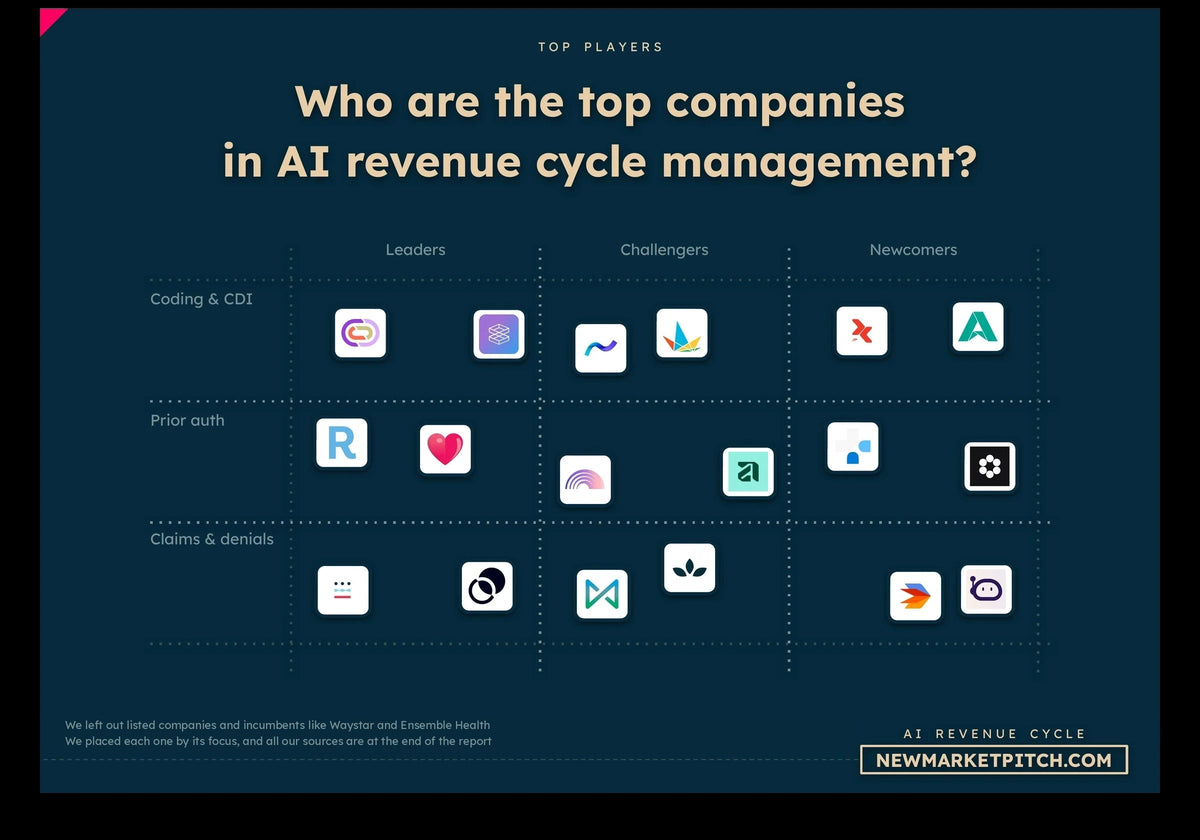
In our document detailing everything you need to know about AI revenue cycle management, we turn what is vague and complex into simple, useful visuals. Market maps like this one show you at a glance where every startup stands.
Is percentage of collections the best AI billing business model?
Partly true. Percentage of collections is one of the most attractive business models for AI companies replacing complete medical billing operations, but the evidence favors hybrid pricing for broader healthcare AI platforms.
The attraction is obvious: a single practice collecting $10 million annually can generate $300,000 to $500,000 in vendor revenue at a 3% to 5% fee. If AI significantly reduces the labor required to deliver that service, the potential margins are substantial.
Yet collections-based pricing has two weaknesses. Vendors earn more when customers collect more, even without improving billing performance, and providers may eventually question fees that rise much faster than processing costs.
The financial evidence also shows that alternative models already work at scale. Waystar generated $1.099 billion in 2025 revenue and a 42% adjusted EBITDA margin through a combination of subscriptions and volume-based services. Meanwhile, AI automation deployments are demonstrating that specific billing tasks can be handled with considerably less manual work.
For an AI company taking over the whole revenue cycle, percentage pricing remains a strong choice. For software that automates claims, eligibility, or payment processing, per-transaction fees and subscriptions are easier to defend. For denial recovery, charging against verified additional collections creates a clearer link to results.
We therefore favor a hybrid structure for the strongest long-term AI billing platforms: recurring fees for the core software, usage-based charges for routine processing, and performance fees where the vendor can prove it recovered additional revenue.
Percentage-of-collections pricing may generate the largest early contracts, but it won't automatically produce the most profitable or durable AI billing businesses. Those will be the companies that can automate expensive work, keep customers collecting efficiently, and charge fees that remain reasonable as both sides grow.
If you want more recent data on this point, please see our latest AI revenue cycle management market report.
Our methodology
This analysis examines whether percentage-of-collections pricing is the best commercial model for AI medical billing companies. We compare it with subscriptions, per-claim and per-transaction fees, performance-based recovery payments, and hybrid contracts. Our assessment focuses on vendor revenue, delivery costs, customer incentives, automation potential, and long-term profitability.
We organized the research around several questions: what providers actually purchase under a collections-based contract, how much they pay, which billing activities can be automated, and how each pricing model behaves as a customer grows. For each dimension, we gathered recent financial disclosures, pricing documentation, administrative cost benchmarks, and operational deployment results, then assessed their implications across competing models.
We distinguish full-service revenue cycle management from software that automates individual administrative tasks. Collections-based contracts can include employees, coding, denials, patient payments, and broader operational responsibilities. Comparing their fees directly with software subscriptions would overstate the economic advantage of percentage pricing unless those differences are accounted for.
The financial scenarios use standardized assumptions to isolate pricing effects. Examples involving $5 million or $10 million in annual collections, fees between 3% and 6%, and fixed or transaction-based charges are illustrative calculations, not vendor quotations. We also examine cases where collections increase without a corresponding rise in processing workload, because vendor revenue growth is not necessarily evidence of greater customer value.
For automation economics, we use the 2024 CAQH Index to compare manual and electronic administrative transaction costs. These benchmarks establish the potential savings from digitization but should not be interpreted as savings independently attributable to generative AI. We assess company-reported deployments separately, including Candid Health's touchless-claim metrics and AKASA's Methodist Health System case study, without treating workflow automation as proof of complete labor replacement.
For demonstrated commercial performance, we use Waystar's 2025 financial disclosures to examine recurring revenue, transaction-based monetization, customer retention, margins, and cash generation. We evaluate its combined business model rather than attributing its profitability to subscriptions alone. Historical R1 RCM and athenahealth filings help establish how percentage-based revenue-cycle contracts work, while CMS national healthcare expenditure data provides context for the potential market scale. We distinguish that spending base from the narrower pool of collections actually available to billing vendors.
Our final assessment combines these findings across customer size, transaction volume, service scope, and automation maturity. The strongest conclusions come from comparing observable economics rather than assuming that the pricing model generating the highest revenue will also produce the best margins. We give particular weight to whether fees remain defensible as automation improves and healthcare providers grow.
Key sources include: R1 RCM's 2023 Form 10-K for cost-to-collect contract structures; athenahealth's historical Form 10-K and collections guidance for established billing economics; Tebra's pricing documentation for subscription-based alternatives; the 2024 CAQH Index for administrative transaction costs; Candid Health's RCM performance disclosures and AKASA's Methodist Health System case study for automation results; CMS National Health Expenditure Data for healthcare spending; and Waystar's 2025 Form 10-K together with its full-year financial results for revenue composition, retention, profitability, and cash flow.

Our report covering the AI revenue cycle management market gets updated several times a month, so you always get the latest view of where things stand.
Written by the New Market Pitch teamWe track new markets so founders and investors can move faster. About us