What are the most valuable AI revenue cycle management startups?
Whether you're building or investing in the AI revenue cycle management market, our report covers everything you need to know: the players, the money, and what's coming next.
Summary
Cedar is the most valuable AI revenue cycle management startup, valued at $1.2 billion to $2.2 billion, followed by Candid Health at $900 million to $1.4 billion and AKASA at $900 million to $1 billion. These three companies lead a market increasingly focused on automating healthcare billing, insurance claims, medical coding, and payment collection.
Only Cedar sits entirely above the $1 billion valuation threshold. Candid Health and AKASA are close, while Infinx, CodaMetrix, and Fathom form the next group of highly valued companies. Billion-dollar valuations remain concentrated among a few businesses despite growing investor interest across the sector.
Candid Health has some of the strongest recent growth figures. After raising $120 million in July 2026, it reported 190% year-over-year growth in annual contracted run-rate revenue and 180% net dollar retention during 2025. Its approach to autonomous insurance billing is gaining commercial traction.
Cedar's leadership comes with a historical complication. The company was valued above $3 billion in 2021, considerably higher than its current range. Patient payment technology remains valuable, but the extraordinary premiums attached to digital healthcare businesses during the previous venture boom have faded.
AKASA is taking a different route by automating complex inpatient coding and clinical documentation. Its reported inpatient processing volume grew almost sixfold over the preceding year, and its customers collectively account for roughly 10% of US inpatient discharges. That gives it access to some of healthcare's largest and most complicated billing environments.
Autonomous medical coding is already delivering measurable results. Fathom reported a 95.5% encounter-level automation rate and 98.3% coding accuracy at Your Health, while CodaMetrix, Arintra, and Nym Health are competing for similar hospital and medical practice workflows. The opportunity is substantial, although specialty coverage still varies.
Insurance denials are another major investment driver. The 2026 HFMA–Guidehouse survey found that 88% of healthcare finance leaders ranked payer challenges among their biggest concerns, while 69% prioritized revenue cycle technology investment. Software that prevents rejected claims can improve cash flow as well as reduce administrative work.
Adoption is progressing, but pilots still outnumber large-scale deployments. An HFMA survey in February 2026 found that 27% of respondents were deploying AI across multiple revenue cycle functions, compared with 53% conducting selected pilots. Many healthcare organizations are still deciding which workflows can safely operate with limited human intervention.
Smaller specialists are finding opportunities in denial management, dental billing, conversational AI, and revenue intelligence. Adonis reported more than fourfold revenue growth in 2025, while companies such as Lassie, Wisdom, SuperDial, and Amperos Health are building businesses around narrower but expensive administrative problems.
The long-term valuation winners will be determined by measurable financial results: fewer billing errors, faster reimbursements, lower collection costs, and recurring revenue that grows faster than staffing requirements. AI agents may make individual administrative tasks cheaper, but companies embedded in complete reimbursement workflows are better positioned to defend their pricing and customer relationships.

Written by the New Market Pitch teamWe track new markets so founders and investors can move faster. About us

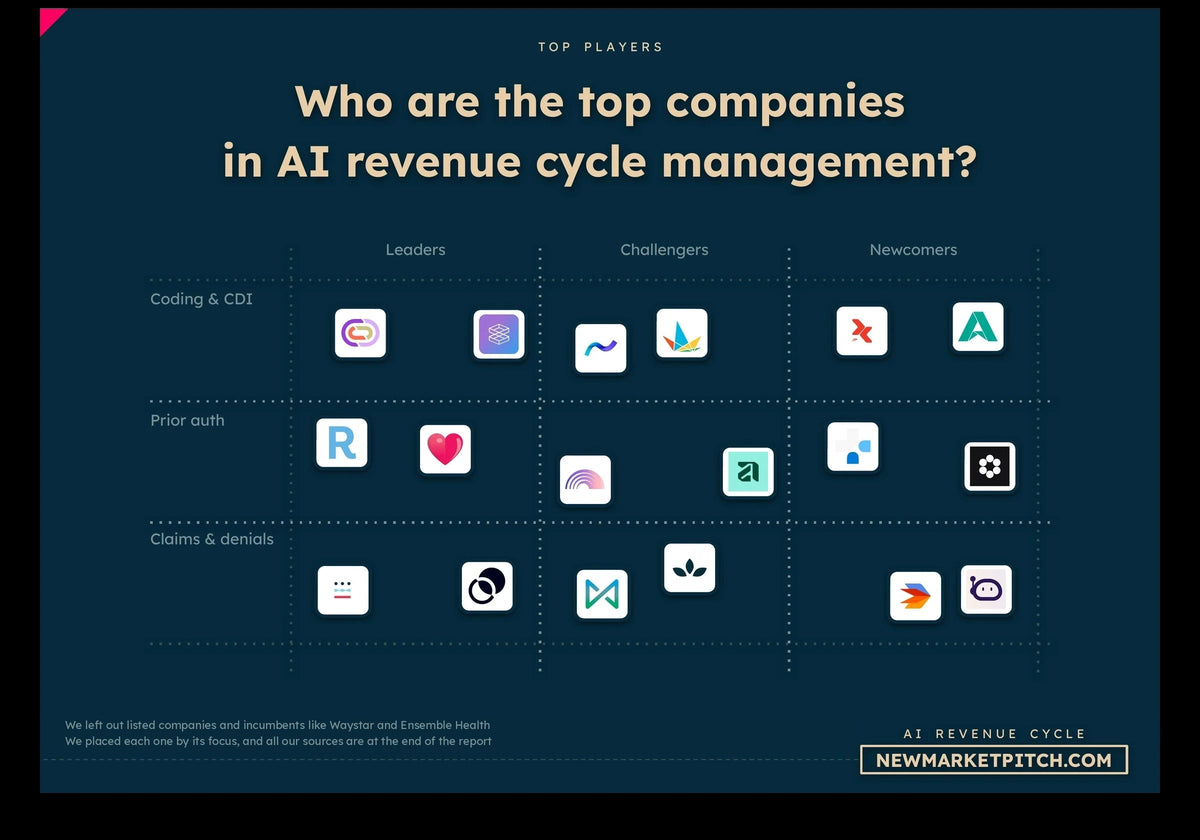
In our report covering the AI revenue cycle management market, we turn what is vague and complex into simple, useful visuals. Market maps like this one show you at a glance where every startup stands.
Top startups in the AI revenue cycle management market ranked by valuation
Here is an updated table that ranks the top startups in the AI revenue cycle management market based on their latest reported or estimated valuations.
If you need to dig deeper and get more detailed data, please check our report covering the AI revenue cycle management market.
| # | Startup Name | What They Do | Current Valuation ($) | Valuation Confidence Level | Valuation Type | Evidence Status | Total Funding ($) | Funding Confidence Level | Country |
|---|---|---|---|---|---|---|---|---|---|
| 1 | Cedar | Patient billing and payment automation | $1.2B–$2.2B | Low Confidence | Comparables-Based Estimate | Estimated | $326M+ | Partial Confidence | United States |
| 2 | Candid Health | Autonomous healthcare billing and claims | $900M–$1.4B | Partial Confidence | Implied Valuation from Raise | Implied | $217.7M | Partial Confidence | United States |
| 3 | AKASA | AI-powered healthcare revenue cycle automation | $900M–$1.0B | Strong Confidence | Implied Valuation from Raise | Estimated | $323.7M | Partial Confidence | United States |
| 4 | Infinx | Healthcare revenue cycle outsourcing and automation | $550M–$850M | Partial Confidence | Comparables-Based Estimate | Estimated | Undisclosed | - | United States |
| 5 | CodaMetrix | Autonomous medical coding for hospitals | $350M–$480M | Partial Confidence | Comparables-Based Estimate | Estimated | $107M | Strong Confidence | United States |
| 6 | Fathom | AI-powered autonomous medical coding | $280M–$450M | Partial Confidence | Comparables-Based Estimate | Estimated | $61M | Partial Confidence | United States |
| 7 | Adonis | AI revenue intelligence and orchestration | $310M–$350M | Strong Confidence | Implied Valuation from Raise | Estimated | $94M | Strong Confidence | United States |
| 8 | Lassie | AI agents for dental administration | $220M–$290M | Partial Confidence | Comparables-Based Estimate | Estimated | $47M | - | United States |
| 9 | Arintra | Autonomous coding and revenue assurance | $167M–$313M | Strong Confidence | Implied Valuation from Raise | Implied | $51M | Partial Confidence | United States |
| 10 | Janus Health | Revenue cycle operational intelligence | $190M–$290M | Partial Confidence | Comparables-Based Estimate | Estimated | $72.7M | - | United States |
| 11 | Brellium | AI clinical chart auditing platform | $153M–$288M | Partial Confidence | Implied Valuation from Raise | Implied | $39.7M+ | - | United States |
| 12 | Camber | Automated billing for specialty practices | $180M–$260M | Partial Confidence | Comparables-Based Estimate | Estimated | $30M+ | - | United States |
| 13 | PayZen | Patient financing and payment collections | $170M–$250M | Partial Confidence | Comparables-Based Estimate | Estimated | $72M | Strong Confidence | United States |
| 14 | Nym Health | Autonomous AI medical coding software | $130M–$210M | Partial Confidence | Comparables-Based Estimate | Estimated | $92M | Partial Confidence | United States |
| 15 | Collectly | Automated patient billing and collections | $120M–$210M | Low Confidence | Comparables-Based Estimate | Estimated | $34.1M | Partial Confidence | United States |
| 16 | Anomaly | AI-powered insurance payer intelligence | $113M–$213M | Partial Confidence | Implied Valuation from Raise | Implied | $39M | Partial Confidence | United States |
| 17 | Charta Health | AI clinical chart review automation | $120M–$180M | Partial Confidence | Comparables-Based Estimate | Estimated | $30M+ | - | United States |
| 18 | Inbox Health | Automated patient billing and collections | $105M–$175M | Partial Confidence | Comparables-Based Estimate | Estimated | $38M+ | Partial Confidence | United States |
| 19 | Wisdom | AI-powered dental revenue cycle management | $115M–$155M | Partial Confidence | Implied Valuation from Raise | Implied | $28M | - | United States |
| 20 | Parallel | AI agents for hospital administration | $105M–$145M | Strong Confidence | Implied Valuation from Raise | Implied | $23.5M | - | France |
| 21 | Joyful Health | AI-powered claims recovery and prevention | $95M–$140M | Strong Confidence | Implied Valuation from Raise | Implied | $22M | - | United States |
| 22 | Sift Healthcare | Healthcare payment analytics | $85M–$145M | Partial Confidence | Comparables-Based Estimate | Estimated | $40M+ | Partial Confidence | United States |
| 23 | Amperos Health | AI insurance denial management automation | $80M–$133M | Strong Confidence | Implied Valuation from Raise | Implied | $20M | Full Confidence | United States |
| 24 | SuperDial | AI voice agents for insurers | $55M–$85M | Partial Confidence | Implied Valuation from Raise | Implied | $17M1 | - | United States |
| 25 | Zentist | AI-powered dental revenue cycle automation | $45M–$85M | Partial Confidence | Comparables-Based Estimate | Estimated | $19.8M | - | United States |
| 26 | InsideDesk | AI-powered dental claims automation | $50M–$76M | Strong Confidence | Implied Valuation from Raise | Estimated | $14.6M | - | Canada |
| 27 | Outbound AI | Conversational AI for healthcare administration | $40M–$75M | Partial Confidence | Comparables-Based Estimate | Estimated | $23M | - | United States |
| 28 | Procode AI | AI-powered surgical billing and coding | $45M–$65M | Strong Confidence | Implied Valuation from Raise | Implied | $14M | - | United States |
| 29 | Trek Health | AI-powered payer contract optimization | $43M–$67M | Partial Confidence | Comparables-Based Estimate | Estimated | $13.7M | - | United States |
| 30 | Maverick Medical AI | Real-time autonomous medical coding | $30M–$55M | Partial Confidence | Comparables-Based Estimate | Estimated | $10M+ | - | Israel |
| 31 | RapidClaims | AI-powered medical coding and claims | $32M–$52M | Partial Confidence | Implied Valuation from Raise | Implied | $11M | Strong Confidence | United States |
| 32 | Ember AI | AI revenue integrity and compliance | $25M–$45M | Partial Confidence | Comparables-Based Estimate | Estimated | $4.3M+ | - | United States |
| 33 | Care.fi | AI healthcare claims and financing | $25M–$42M | Partial Confidence | Implied Valuation from Raise | Implied | $10M2 | - | India |
| 34 | Enter Health | Automated medical billing and collections | $15M–$35M | Low Confidence | Proxy-Based Estimate | Estimated | $9.9M | - | United States |
| 35 | Claim Health | AI revenue automation for post-acute care | $18M–$29M | Strong Confidence | Implied Valuation from Raise | Implied | $4.9M | - | United States |
| 36 | Synaptec Health | Automated AI medical coding platform | $14M–$26M | Low Confidence | Proxy-Based Estimate | Estimated | $4.21M | - | United States |
| 37 | Cair Health | AI agents for insurance claims | $10M–$25M | Low Confidence | Proxy-Based Estimate | Estimated | $0.5M+ | - | United States |
| 38 | Substrate | AI agents for medical billing | $8M–$22M | Low Confidence | Proxy-Based Estimate | Estimated | Undisclosed | - | United States |
| 39 | XpertDox | Autonomous AI medical coding software | $8M–$22M | Low Confidence | Comparables-Based Estimate | Estimated | ~$4.7M | - | United States |
| 40 | DayDream | Automated dental billing and insurance | $8M–$20M | Low Confidence | Proxy-Based Estimate | Estimated | $2.5M | - | United States |
| 41 | Veuu | AI medical claims and payments | $5M–$15M | Low Confidence | Proxy-Based Estimate | Estimated | Undisclosed | - | United States |
| 42 | Cofactor AI | AI-powered healthcare revenue management | $5M–$10M | Partial Confidence | Implied Valuation from Raise | Implied | ~$1.5M | - | United States |
- Excludes $3M of venture debt from the reported $20M.
- Equity only; excludes $3M of debt in the latest $8M round.

Our research about AI tools for medical billing gets updated several times a month, so you always get the latest view of where things stand.
Why are AI revenue cycle management startups attracting so much investment?
AI revenue cycle management startups are attracting substantial investment because healthcare providers are moving from isolated automation experiments toward software that can handle entire billing workflows. The opportunity is unusually large: healthcare organizations must convert clinical services into insurance claims, resolve payment disputes, collect patient balances, and manage increasingly complicated reimbursement rules.
The financial pressure is measurable. The 2026 HFMA–Guidehouse Revenue Cycle Management Trends survey found that 88% of healthcare finance leaders ranked payer challenges among their three biggest concerns. Meanwhile, 69% ranked revenue cycle technology among their leading investment priorities.
The financing environment reflects that demand. Candid Health raised $52.5 million in February 2025 and another $120 million in July 2026. Adonis secured a $40 million Series C in March 2026 after reporting more than fourfold revenue growth during 2025.
Investors are financing several different opportunities: reducing administrative labor, collecting more money, accelerating reimbursements, and replacing legacy billing infrastructure. Companies that accomplish several of these functions together have a much larger expansion opportunity than those automating a single repetitive task.
The attraction is straightforward. Healthcare organizations already spend heavily on revenue cycle administration, and even relatively small improvements in reimbursement or operating efficiency can be worth millions of dollars to a large health system.
Which AI revenue cycle management startups are worth the most?
Cedar, Candid Health, and AKASA occupy the three highest positions in our AI revenue cycle management valuation ranking, but they represent substantially different approaches to healthcare financial automation.
Cedar leads at $1.2 billion to $2.2 billion. Its business centers on patient billing, financial engagement, and payment collection. Candid Health follows at $900 million to $1.4 billion, concentrating on automating insurance billing and claims workflows. AKASA ranks third at $900 million to $1 billion, with technology spanning healthcare revenue cycle automation, medical coding, and clinical documentation.
Infinx follows at $550 million to $850 million, combining revenue cycle services with automation. CodaMetrix, at $350 million to $480 million, and Fathom, at $280 million to $450 million, represent the increasingly important autonomous medical coding segment.
The composition of this leading group is revealing. Healthcare financial technology is developing across several distinct markets. Patient payments, autonomous billing infrastructure, managed revenue cycle operations, and coding automation all attract substantial capital, although their revenue models, deployment costs, and long-term margins differ significantly.
The highest valuations generally belong to companies that can become deeply integrated into healthcare financial operations rather than functioning as optional productivity tools.

In our market report about AI tools for medical billing, we look at what the winners do differently, so you can learn from the best instead of guessing.
How many AI revenue cycle management startups are unicorns?
Cedar is the clearest billion-dollar company in our ranking, while Candid Health and AKASA sit at or near the unicorn threshold.
Cedar's $1.2 billion to $2.2 billion range places it comfortably above $1 billion. Candid Health's $900 million to $1.4 billion range crosses that threshold, while AKASA's $900 million to $1 billion range reaches it at the upper end.
That gives us one company firmly above $1 billion and two additional companies whose valuation ranges touch or cross the threshold.
Among the next group, Infinx at $550 million to $850 million, CodaMetrix at $350 million to $480 million, and Fathom at $280 million to $450 million remain below $1 billion throughout their respective ranges.
The market is still relatively concentrated at the top. Healthcare revenue cycle automation has become an established venture investment category, but most companies operate at valuations well below those of the three leaders.
That leaves considerable room for new unicorns, particularly among businesses that can expand from one administrative function into a much broader healthcare financial platform.
Is Cedar still the most valuable AI revenue cycle management startup?
Cedar remains the highest-ranked AI revenue cycle management startup at $1.2 billion to $2.2 billion, although its valuation history shows how dramatically the market has changed.
In March 2021, Cedar announced financing that valued the company above $3 billion. That was a period of exceptionally strong investor appetite for digital healthcare businesses, when rapid growth often commanded much higher revenue multiples.
The company subsequently acquired OODA Health to expand its capabilities around healthcare payments and billing. But in July 2022, Cedar reduced its workforce by approximately 24%, according to Becker's Hospital Review. Management linked the restructuring to market conditions and organizational changes following the acquisition.
Its current valuation range is considerably below that 2021 benchmark. The difference reflects a tougher environment for patient-facing financial technology and a market that now places greater emphasis on operating efficiency.
Cedar also faces a different challenge from companies focused on insurance claims. It must improve patient payment experiences and collections while maintaining relationships with large healthcare systems.
There is still a substantial business opportunity here. Patients face confusing bills, complicated insurance explanations, and fragmented payment experiences. Healthcare organizations want to improve collections without making those experiences worse.
Cedar's leading position is credible, but it doesn't necessarily make Cedar the fastest-growing company in the market. Its valuation reflects a different product category and a longer commercial history than several of its AI-native competitors.

In our document detailing everything you need to know about AI revenue cycle management, you will always find fresh funding data, taken straight from our own verified funding database.
Is Candid Health catching up with Cedar?
Candid Health is catching up with Cedar in commercial scale and investor attention, although its $900 million to $1.4 billion valuation range remains below Cedar's position in our ranking.
The strongest recent development came in July 2026, when Candid raised $120 million in a Series D led by Sixth Street Growth. The company reported that its valuation had tripled since its February 2025 Series C.
Its operating figures were equally impressive. Candid reported 190% year-over-year growth in annual contracted run-rate revenue and 180% net dollar retention during 2025. The company also reported serving more than 200 healthcare organizations across the United States.
A 180% net dollar retention rate means that contracted revenue from an existing customer group increased substantially after accounting for expansion and contraction. That's particularly encouraging for a company trying to become a central part of healthcare billing infrastructure.
Candid is pursuing the difficult task of making insurance billing increasingly autonomous rather than simply improving existing manual workflows.
That approach could become highly profitable as claims volumes expand. Software that processes more claims without requiring equivalent growth in administrative staffing has a potentially attractive economic model.
Of course, insurance billing is messy. Payer-specific requirements, integrations, exceptions, and constant reimbursement rule changes make it harder to automate than many other back-office processes.
For now, Cedar remains higher in the valuation ranking, while Candid has particularly strong recent evidence of accelerated commercial adoption.
Why is AKASA valued so highly?
AKASA's $900 million to $1 billion valuation reflects its ambition to automate some of the most complicated administrative work performed by large American healthcare systems.
The company has moved beyond basic repetitive billing tasks toward clinical documentation and inpatient coding, where mistakes can affect reimbursement amounts, compliance, and the accuracy of clinical records.
In October 2026, AKASA announced an autonomous platform covering inpatient medical coding and clinical documentation integrity. It also reported that inpatient volume processed through its technology had increased almost sixfold over the preceding year.
The company stated that its customers collectively represented more than $180 billion in annual net patient revenue and approximately 10% of US inpatient discharges.
These figures describe the financial scale and activity of AKASA's customers rather than AKASA's own revenue. Still, they show how deeply the company has entered the large-hospital market.
Inpatient documentation is particularly difficult to automate. Claims can depend on diagnoses, procedures, severity, and detailed supporting clinical evidence. Missing or incorrect information can result in lower reimbursement or compliance problems.
AKASA is betting that automating these complex workflows will save hospitals money while improving the financial accuracy of their operations.
Its valuation will ultimately depend on whether growing processing volumes translate into recurring software revenue, reliable clinical accuracy, and manageable implementation costs.

Learning from others' mistakes is the cheapest lesson there is. In our report covering the AI revenue cycle management market, we look at what broke startups before you, so you don't repeat it.
Which AI medical coding startups have the highest valuations?
CodaMetrix, Fathom, Arintra, and Nym Health are among the most highly valued specialists in autonomous medical coding, a segment where AI is already producing measurable operational results.
CodaMetrix is valued at $350 million to $480 million, followed by Fathom at $280 million to $450 million. Arintra stands at $167 million to $313 million, while Nym Health is valued at $130 million to $210 million.
These companies address a persistent healthcare bottleneck: translating clinical documentation into standardized diagnosis and procedure codes used for reimbursement.
One of the clearest commercial results came from Fathom. In March 2026, the company reported that Your Health, a senior-focused healthcare organization, achieved a 95.5% encounter-level autonomous coding rate and 98.3% coding accuracy after deploying its platform.
Those figures are impressive, especially because coding accuracy improved from 96.3% before implementation. But performance will vary between healthcare organizations, specialties, and coding workflows.
KLAS Research's August 2025 autonomous coding assessment offered a broader perspective. It found promising efficiency and accuracy improvements among customers of Fathom, Nym Health, and CodaMetrix, while identifying functionality gaps and demand for wider specialty coverage.
Autonomous coding is commercially useful today. The next challenge is expanding from the workflows that are relatively straightforward to automate into more complex hospital departments.
| Startup | Current valuation | Total funding | Primary specialization |
|---|---|---|---|
| CodaMetrix | $350M–$480M | $107M | Hospital medical coding |
| Fathom | $280M–$450M | $61M | Autonomous clinical coding |
| Arintra | $167M–$313M | $51M | Coding and revenue assurance |
| Nym Health | $130M–$210M | $92M | Autonomous medical coding |
| XpertDox | $8M–$22M | ~$4.7M | AI medical coding |
| RapidClaims | $32M–$52M | $11M | Medical coding and claims |
| Maverick Medical AI | $30M–$55M | $10M+ | Real-time medical coding |
Can AI completely replace human medical coders?
AI can already handle much of the routine coding workload in selected healthcare settings, but completely eliminating human coding oversight across hospitals is not realistic with today's technology.
Fathom's reported 95.5% encounter-level automation at Your Health shows that extremely high automation rates are achievable in production.
The result still leaves approximately 4.5% of encounters outside the autonomous completion measure. More importantly, performance at one healthcare organization does not automatically translate to every specialty, payer arrangement, or clinical documentation workflow.
KLAS Research's 2025 findings showed autonomous coding adoption concentrated in radiology and emergency departments, with customers requesting broader capabilities.
Hospitals differ enormously in clinical complexity, existing software systems, coding requirements, and tolerance for automated decision-making.
A straightforward radiology encounter is very different from an inpatient stay involving multiple diagnoses, procedures, complications, and documentation changes.
Human coders will likely spend less time processing straightforward records and more time handling exceptions, audits, ambiguous documentation, and complex cases.
The economic opportunity is therefore to increase the volume of accurate claims handled per employee while reducing reimbursement errors and compliance risks.
That could change the coding profession considerably, even without eliminating the need for experienced specialists.

Your time is limited. In our research about AI tools for medical billing, we put numbers on each part of the market, so you can see where it makes sense to focus.
Why are AI claims and denial management startups becoming more valuable?
AI claims and denial management companies are attracting investment because rejected claims directly affect healthcare providers' cash flow, and recovering unpaid reimbursements has become increasingly expensive.
The 2026 HFMA–Guidehouse survey found that 88% of participating healthcare finance leaders ranked payer challenges among their biggest concerns.
Several startups are approaching the problem from different directions.
Adonis, valued at $310 million to $350 million, focuses on revenue cycle intelligence and orchestration. Janus Health, at $190 million to $290 million, emphasizes operational intelligence. Anomaly, at $113 million to $213 million, concentrates on insurance payer intelligence, while Amperos Health, at $80 million to $133 million, addresses denial management automation.
Joyful Health and Trek Health work on related financial problems through claims recovery and payer contract optimization.
There is a big economic difference between preventing a denial and processing it more efficiently after it occurs.
A system that catches incorrect eligibility information before submission may avoid the entire appeals process. A system that automatically prepares appeals can reduce administrative work, but the provider still depends on the insurer's decision.
For hospitals, the most valuable software will generally combine fewer initial denials, faster reimbursement, higher net collections, and lower administrative costs.
Simply generating more appeals letters doesn't solve the underlying financial problem.
Are AI revenue cycle management companies growing faster than traditional billing providers?
Some AI revenue cycle management startups are growing exceptionally quickly, although their growth rates are difficult to compare directly with those of much larger traditional billing companies.
Candid Health's reported 190% year-over-year growth in annual contracted run-rate revenue in 2025 and Adonis's more than fourfold revenue growth during the same year are particularly notable.
Both companies also disclosed figures beyond fundraising. Candid reported 180% net dollar retention, while Adonis reported net retention above 130% alongside its March 2026 financing.
Those figures suggest that existing customers are expanding their spending, rather than all growth depending on winning new accounts.
Still, a company growing from $5 million to $20 million in annual revenue has a very different challenge from a mature provider trying to grow from $500 million to $600 million.
The distinction also involves operating models. Traditional revenue cycle companies frequently rely on substantial human workforces and managed service contracts. AI-first providers aim to process increasing volumes without proportionate increases in staffing.
Infinx illustrates how the categories overlap. Its business combines revenue cycle services with automation rather than fitting a purely software-based model.
The real competitive test is whether AI-native companies can keep expanding revenue while maintaining attractive margins as their customers and workflows become more complicated.
Fast growth is encouraging. Sustained growth without a matching increase in service costs would be much more powerful.

In our market report about AI tools for medical billing, we always try to gather several sources and make estimates that make sense, so you can work with solid numbers.
Are hospitals actually adopting AI revenue cycle management software at scale?
Hospitals are adopting AI revenue cycle management software, but large-scale autonomous operation remains less common than the volume of startup investment might suggest.
HFMA's April 2026 Revenue Cycle of the Future report, based on a February survey of 95 healthcare finance professionals, found that 27% were deploying AI at scale across multiple revenue cycle functions.
Another 53% were conducting pilots in selected areas.
Together, those groups represented 80% of respondents, but only about one-third of that AI-active group had reached scaled deployment across multiple functions.
That's a meaningful gap. A pilot can demonstrate that software works on a particular task without proving it can handle a hospital's complete operational requirements.
The same report showed that respondents expected substantial changes in workforce roles, particularly in coding, documentation, denial management, and revenue cycle leadership.
KLAS Research's 2025 findings reinforce the distinction between operational promise and implementation maturity. Autonomous coding customers reported real benefits, alongside requests for broader functionality and improvements in deployment.
Healthcare organizations also have unusually high reliability requirements. Billing failures can interrupt cash flow, while coding mistakes can create reimbursement disputes and compliance risks.
The market is moving into production, but AI has not yet become the default operating system for healthcare reimbursement.
| Adoption or market indicator | Reported result | Source |
|---|---|---|
| AI deployed at scale across multiple functions | 27% | HFMA, February 2026 |
| AI pilots in selected functions | 53% | HFMA, February 2026 |
| Remaining respondents outside those two groups | 20% | Calculated from HFMA survey |
| Healthcare finance respondents | 95 | HFMA, February 2026 |
| Payer relations and denials identified as a major stressor | 88% | HFMA–Guidehouse, 2026 |
| Revenue cycle technology identified as an investment priority | 69% | HFMA–Guidehouse, 2026 |
| Providers outsourcing all or part of revenue cycle operations | 69% | HFMA–Guidehouse, 2026 |
| Respondents using automation and AI to speed up manual processes | 41% | HFMA–Guidehouse, 2026 |
Which AI revenue cycle management startups have raised the most funding?
Cedar, AKASA, and Candid Health have attracted some of the largest cumulative funding amounts in our AI revenue cycle management ranking, showing how capital-intensive the race to build healthcare financial infrastructure has become.
Cedar has raised at least $326 million, AKASA approximately $324 million, and Candid Health approximately $218 million. These amounts are substantially larger than the totals reported for most younger companies in the sector.
CodaMetrix has secured $107 million, Adonis $94 million, Nym Health $92 million, and Janus Health over $72 million. PayZen reports $72 million, while Fathom has raised $61 million.
Funding becomes more interesting when compared with valuations.
AKASA's approximately $324 million in funding is substantial relative to its $900 million to $1 billion valuation. Candid Health has raised less capital but occupies a similar valuation range.
Meanwhile, Adonis has raised considerably less than either company and has reported unusually strong recent revenue growth.
That doesn't automatically make Adonis more capital-efficient. The companies were founded at different times, sell different products, and may have very different cumulative spending.
Total fundraising is a poor substitute for commercial performance. Revenue growth, customer retention, gross margins, and the amount of work a platform can automate tell us much more about the strength of the underlying business.

If you build or invest in the AI revenue cycle management market, you need to know which business models pay off now and which ones are fading. That's why our report covering it has a whole section on it.
What types of AI revenue cycle management startups attract the highest valuations?
Broad revenue cycle platforms generally occupy the highest valuation positions, while specialized coding, claims intelligence, and patient payment businesses form substantial but smaller groups.
Cedar's valuation reflects a platform centered on patient financial engagement and payments. Candid Health's position is tied to autonomous billing infrastructure. AKASA's valuation reflects automation spanning complex hospital revenue cycle workflows.
At a smaller scale, companies specializing in particular tasks can still attract significant capital.
CodaMetrix and Fathom focus on coding, Adonis on revenue orchestration, and PayZen on patient financing and collections.
The advantage of a broader platform is the potential to generate revenue from several administrative functions within the same healthcare organization.
A coding specialist might charge for processing clinical records. An end-to-end platform may participate in claims preparation, submission, monitoring, reconciliation, and exception management.
That creates opportunities to expand customer contracts without needing to acquire an entirely new customer for every additional product.
However, broader coverage also creates engineering, integration, and support costs. Running several interconnected reimbursement workflows reliably is much harder than automating one well-defined task.
Investors are paying particularly high valuations for companies that could become core financial infrastructure, but specialized vendors can still build attractive businesses by dominating difficult, high-value workflows.
Are dental AI revenue cycle management startups becoming a major category?
Dental AI revenue cycle management is emerging as a distinct startup category, although its valuation scale remains smaller than that of the leading platforms serving hospitals and broader medical practices.
Lassie is valued at $220 million to $290 million, placing it among the more valuable specialized companies. Wisdom follows at $115 million to $155 million, while SuperDial, Zentist, InsideDesk, and DayDream address related dental billing and insurance processes.
Dental practices face many of the same administrative problems as larger healthcare providers: insurance verification, claims processing, reimbursement follow-up, and patient collections.
The operating environment is quite different, though. A dental billing platform may need to support smaller organizations with fewer administrative employees and tighter software budgets.
That makes automation attractive. A small office can benefit significantly when repetitive insurance calls, claim checks, and payment follow-ups are handled automatically.
The challenge is distribution. Selling software to thousands of independent practices requires a different commercial approach from signing a few large hospital systems.
Dental specialists also need to work with practice management software, dental insurers, and the particular coding and reimbursement processes used in dentistry.
These companies may ultimately generate attractive recurring revenue without reaching the valuations of broader hospital-focused platforms.
For now, the sector's leading dental valuations show that investors consider the opportunity large enough to support dedicated companies rather than treating dental billing as a minor feature of general healthcare software.

In our report covering the AI revenue cycle management market, we don't want to repeat what boring consulting reports say. Instead, we show you the real and latest market signals that matter.
Can AI revenue cycle management startups compete with established healthcare technology companies?
AI revenue cycle management startups can compete with established healthcare technology companies in specific workflows, but replacing an entire hospital billing infrastructure is considerably harder than automating individual tasks.
Healthcare revenue cycles depend on electronic health records, insurance clearinghouses, payer connections, payment systems, and complex contractual arrangements.
An AI company can improve one part of that process without owning every system involved.
CodaMetrix and Fathom can automate coding workflows, while Adonis can deliver intelligence and orchestration across revenue cycle activities. Candid Health is pursuing a broader billing infrastructure opportunity.
The importance of underlying infrastructure became particularly clear during the February 2024 Change Healthcare cyberattack.
The American Hospital Association reported that 94% of hospitals responding to its March 2024 survey experienced financial effects, while 83% reported cash-flow impacts. The incident demonstrated how deeply healthcare reimbursement depends on established transaction networks.
It also exposed the importance of operational resilience, system redundancy, and reliable integrations.
For many startups, the immediate opportunity is to become indispensable within existing healthcare infrastructure. They can improve the processes that hospitals already use without requiring a complete replacement of their billing systems.
Some may eventually replace larger parts of that infrastructure. But doing so requires dependable transactions, regulatory compliance, trusted customer relationships, and consistent performance across payer systems.
Better AI models alone won't be enough.
Are AI revenue cycle management valuations justified by real cost savings?
AI revenue cycle management valuations have a credible economic foundation, but projected administrative savings should be separated from improvements that healthcare providers actually achieve.
Candid Health's February 2025 financing announcement referenced McKinsey research suggesting that improvements in claims submission could reduce associated administrative costs by up to 18%.
HFMA's 2026 Revenue Cycle of the Future report also discussed McKinsey estimates suggesting that more advanced AI-driven revenue cycles could eventually reduce cost to collect by 30% to 60%.
Those figures describe potential savings under particular assumptions. They do not mean every hospital adopting AI will achieve similar results.
Consider a healthcare organization collecting $500 million annually and spending 3% of collections on revenue cycle administration.
Its annual revenue cycle cost would be $15 million. Reducing that expense by 20% would generate $3 million in gross annual savings before software fees, implementation expenses, and any necessary human oversight.
Improving collections creates another potential benefit. A relatively small increase in successfully reimbursed claims can be financially meaningful even without reducing staffing.
There is also a cash-flow advantage when claims are paid faster. Healthcare organizations can reduce the amount of money tied up in outstanding receivables, potentially improving liquidity and lowering financing needs.
The most valuable platforms will be able to document these improvements through measurable operating results.
A high software subscription price can be perfectly reasonable when the hospital saves several times that amount. Without consistent financial benefits, even impressive automation technology becomes difficult to justify.

In our research about AI tools for medical billing, we like to show you the big picture. We know your time is precious, so we make every page quick to read and packed with as much learning as possible per minute.
Could AI agents make revenue cycle management software much cheaper?
AI agents could substantially reduce the cost of completing individual revenue cycle tasks, but healthcare revenue cycle software itself may remain expensive.
Automating a phone call, extracting information from a medical record, or drafting an insurance appeal may require relatively little computing expenditure.
The full cost of reliable healthcare automation includes software integration, security, monitoring, payer-specific rules, exception handling, quality assurance, and ongoing product development.
That helps explain the variety of business models emerging across the market.
SuperDial and Outbound AI focus on conversational automation. Parallel and Substrate target broader administrative tasks using AI agents. Joyful Health concentrates on claims recovery, while Charta Health and Brellium work on clinical chart review and auditing.
As general AI models improve, some task-level capabilities will become easier for competitors to reproduce.
A company whose main advantage is generating a competent insurance-related conversation could face stronger pricing pressure than one embedded in a provider's complete reimbursement workflow.
The more durable advantages are likely to involve integrations, operational feedback, payer-specific expertise, and verified reimbursement outcomes.
There is another important difference: the cost of performing an automated task and the value of the result are rarely the same.
Generating an insurance appeal might cost very little in computing terms, but recovering a large unpaid claim can be worth thousands of dollars to the healthcare organization.
AI should make individual administrative actions cheaper while increasing the competitive importance of workflow ownership and reliable execution.
Why are some AI revenue cycle management startups worth less than $100 million?
AI revenue cycle management startups below $100 million in valuation are generally operating at earlier stages, addressing narrower workflows, or facing greater uncertainty around commercial scale.
SuperDial's $55 million to $85 million valuation reflects its focus on automated communications with insurers. Zentist, at $45 million to $85 million, concentrates on dental revenue cycle management, while Outbound AI, at $40 million to $75 million, develops conversational healthcare administration technology.
Other companies address more specialized opportunities. Procode AI focuses on surgical billing and coding, Trek Health on payer contract optimization, and Ember AI on revenue integrity.
Further down the ranking, Enter Health, Synaptec Health, Cair Health, Substrate, XpertDox, DayDream, Veuu, and Cofactor AI occupy smaller valuation ranges.
A relatively low valuation does not automatically indicate weak technology. It can reflect limited fundraising history, a smaller customer base, narrow product scope, or an early commercial stage.
There is also a difference between a young company that has raised relatively little capital and an older business that has already invested heavily in product development and sales.
For younger startups, valuation often depends on the expectation that successful initial deployments will lead to larger customer contracts and additional workflows.
Some of these businesses could eventually expand beyond their original specialization. A company that starts by automating insurance phone calls, for example, might move into eligibility verification, claims follow-up, or broader payer communications.
Whether that expansion succeeds will depend on repeatable customer deployments and commercial execution, not just improvements in the underlying AI technology.

When you build or invest in the AI revenue cycle management market, you need clarity, not confusion. In our market report about AI tools for medical billing, we always try to put numbers on and quantify whatever is usually vague and confusing.
Can smaller AI revenue cycle management startups eventually become unicorns?
Smaller AI revenue cycle management startups can reach billion-dollar valuations, but most will need to move beyond successful niche automation and establish a much larger recurring revenue business.
Several companies illustrate different potential routes.
Adonis can expand its revenue cycle orchestration capabilities across more healthcare organizations. Arintra can broaden medical coding and revenue assurance coverage. Janus Health can extend operational intelligence into additional revenue cycle functions.
In dental administration, Lassie and Wisdom could expand from individual administrative tasks toward more comprehensive practice automation.
For earlier-stage companies such as Amperos Health, RapidClaims, Procode AI, and Claim Health, the challenge is establishing repeatable deployments and expanding contract value without proportionate increases in implementation costs.
A useful financial test is the relationship between valuation and recurring revenue.
At a valuation of $1 billion, a company trading at 10 times annual recurring revenue would need approximately $100 million in ARR. At 15 times ARR, it would need roughly $66.7 million.
These are illustrative multiples rather than actual pricing multiples for the companies discussed here. Investor pricing also depends on growth rates, gross margins, retention, profitability, and market conditions.
Building a $100 million recurring revenue business in healthcare administration is possible, but it requires substantial commercial scale.
A narrow automation company may need to win thousands of customers. A platform selling to large hospital systems could potentially reach the same revenue through fewer, much larger contracts.
The path to becoming a unicorn depends on sustained software revenue growth and customer value, not simply on processing more claims or demonstrating an effective AI model.
What could cause AI revenue cycle management startup valuations to fall?
AI revenue cycle management valuations could decline if automation becomes a low-margin commodity, deployments fail to produce measurable returns, or customer growth slows before companies establish durable profitability.
Three risks stand out.
First, the underlying AI capabilities may become easier to reproduce. If several vendors can automate the same coding or claims task with comparable accuracy, competition may shift toward price and distribution.
Second, healthcare integration remains expensive. Hospitals cannot tolerate frequent billing errors or interrupted reimbursements, so vendors must invest heavily in reliability, security, and implementation support.
Third, high growth expectations can reverse quickly. Cedar's historical valuation above $3 billion in 2021, followed by a current range of $1.2 billion to $2.2 billion, illustrates how sensitive private healthcare technology valuations can be to changing market conditions.
The risks also differ between business models.
Medical coding vendors must maintain accuracy and extend specialty coverage. Denial management companies must demonstrate improvements in reimbursement outcomes. Patient payment businesses need to increase collections without introducing excessive financing or operating costs.
Candid Health and Adonis have reported encouraging growth and retention figures, but rapid expansion can become expensive when every additional customer requires substantial implementation work.
One warning sign would be customer spending growth that depends on increasingly expensive services, custom development, or manual intervention.
Another would be declining renewal rates as hospitals consolidate their technology vendors or decide that similar functionality is available inside existing healthcare software.
Companies that consistently deliver financial value at attractive software margins will be better positioned to withstand valuation pressure.

A good product starts with a real problem. In our document detailing everything you need to know about AI revenue cycle management, we show you the ones customers still live with.
Are AI revenue cycle management startups worth their current valuations?
AI revenue cycle management startups have a credible foundation for substantial valuations, but the market favors companies that can demonstrate real operational and financial results.
Candid Health has reported rapid contracted revenue growth and expanding customer relationships. Adonis has demonstrated strong revenue growth and retention. AKASA has reported a nearly sixfold increase in inpatient processing volume, while Fathom has published production results showing high automation rates in a defined healthcare setting.
Those developments are more convincing than fundraising announcements alone.
At the same time, HFMA's 2026 survey found that only 27% of respondents were deploying AI at scale across multiple revenue cycle functions, compared with 53% still running selected pilots.
Commercial adoption is advancing, but hospitals are still working through integration, reliability, compliance, and workforce challenges.
The largest valuations currently favor companies addressing broad financial workflows or difficult, high-value administrative functions. Cedar remains highest in our ranking, followed by Candid Health and AKASA.
Specialized coding, revenue intelligence, claims automation, and dental billing companies represent additional opportunities at smaller valuations.
Not every successful AI billing startup needs to become a complete revenue cycle platform. Specialists can build profitable businesses by solving expensive problems that existing healthcare technology handles poorly.
But the highest valuations require a larger opportunity: substantial administrative work eliminated, measurable improvements in collections, and recurring revenue growth that doesn't require proportionately more human labor.
That's the difference between an impressive automation product and a financially valuable healthcare infrastructure business.
The leading startups are beginning to demonstrate those capabilities. The eventual winners will be determined by their operating performance, not their fundraising totals or headline valuations.
Our methodology
This analysis ranks startups in the AI revenue cycle management market by company valuation as of November 2026. We cover businesses developing AI-powered medical billing, autonomous coding, claims processing, denial management, revenue intelligence, patient payments, and related healthcare financial administration software.
Valuation ranges combine announced financing benchmarks, company disclosures, and comparisons with similar private healthcare technology businesses. A valuation established during a financing round is different from a current market estimate, so the ranges should be read as approximate company values rather than guaranteed transaction prices. Funding figures refer to reported cumulative capital raised and are separate from company valuations.
We evaluate the market using fundraising activity, reported revenue growth, customer retention, deployment scale, automation performance, and the economics of healthcare reimbursement workflows. The analysis distinguishes contracted revenue from realized revenue, customer financial activity from vendor revenue, and operational automation rates from direct cost savings.
For market adoption and industry economics, we use the 2026 HFMA–Guidehouse Revenue Cycle Management Trends survey and HFMA's April 2026 Revenue Cycle of the Future report. For autonomous medical coding, we use KLAS Research's August 2025 assessment and reported customer deployment results. Company financing announcements and operational disclosures inform individual startup comparisons.
A company can appear in this ranking even when its total funding is undisclosed: its position depends on its valuation, not on the capital it has raised.
Key sources include: Guidehouse and HFMA's 2026 Revenue Cycle Management Trends report, HFMA's Revenue Cycle of the Future report, KLAS Research's Autonomous Coding 2025 assessment, Sixth Street Growth on Candid Health's July 2026 financing, AKASA's October 2026 autonomous coding announcement, Adonis's March 2026 Series C announcement, Your Health's autonomous coding deployment results, Becker's Hospital Review on Cedar's restructuring and historical valuation, and the American Hospital Association's Change Healthcare cyberattack survey.
Written by the New Market Pitch teamWe track new markets so founders and investors can move faster. About us