Which AI revenue cycle management startups earn the most?
Whether you're building or investing in the AI revenue cycle management market, our report covers everything you need to know: the players, the money, and what's coming next.
Summary
Ensemble Health Partners ranks first among AI revenue cycle management startups, with $600M in FY2020 revenue. Access Healthcare follows with INR 32.9B in FY2025 Indian-entity revenue, while IKS Health ranks third with INR 31.9B in FY2026 consolidated revenue.
The largest businesses in this market are mostly established healthcare billing and outsourcing operators that have added automation and AI. Their financial advantage comes from years of relationships with hospitals, large operational teams and contracts covering multiple parts of the revenue cycle.
The ranking needs some care because the financial figures aren't perfectly comparable. Ensemble's revenue dates from 2020, while several Indian operators report more recent figures for their local entities rather than their entire global businesses.
SmarterDx stands out among younger AI-focused companies, with approximately $150M in reported revenue as of August 2026. That puts it well ahead of most AI-native billing startups with publicly identifiable financial figures, even as its ownership structure continues to change.
Tebra exceeds $200M in reported revenue run-rate, while Commure and Abridge have estimated ARR around $105M and $100M, respectively. All three sell broader healthcare technology products, so their financial scale cannot be attributed entirely to AI revenue cycle management.
Candid Health is one of the clearest fast-growth examples, reporting 190% year-over-year growth in annual contracted run-rate revenue and 180% net dollar retention. Those figures suggest strong expansion among existing customers, although Candid has not disclosed a comparable annual revenue total.
AI coding companies are achieving much wider adoption than their financial disclosures suggest. AKASA's customers represent approximately 10% of U.S. inpatient discharges, Fathom has coded more than 63M encounters, and Arintra processes over $5B in annual client claim value.
Patient billing is another substantial opportunity. Cedar has processed more than $13.6B in cumulative patient payments, while Collectly and Inbox Health have reached thousands of healthcare facilities and practices. These volumes show commercial reach, but the money processed belongs to healthcare providers rather than the technology companies.
The biggest opportunity for AI-native startups is to expand from one workflow into several. A company that starts with coding or denial management can potentially add documentation, claim validation, payment processing and other services without having to win an entirely new customer relationship.
Traditional outsourcing and AI software will likely coexist for years. The established operators already have the revenue, while companies such as SmarterDx, Candid Health, AKASA and Fathom are showing how quickly automated products can gain ground inside hospital financial operations.

Written by the New Market Pitch teamWe track new markets so founders and investors can move faster. About us

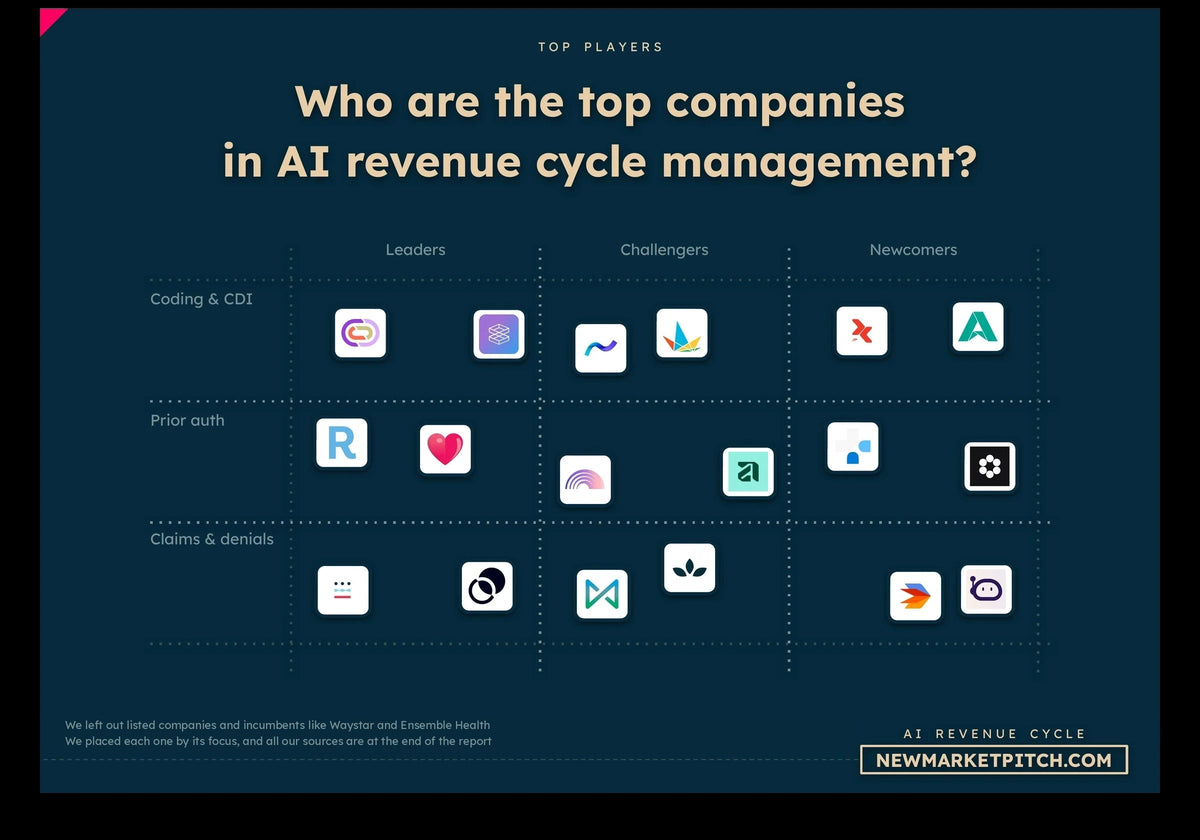
In our report covering the AI revenue cycle management market, we turn what is vague and complex into simple, useful visuals. Market maps like this one show you at a glance where every startup stands.
The ranking of top startups in the AI revenue cycle management market by revenue
Below is a table ranking the startups of this market by their current revenue scale. You can find our methodology at the end of this page.
If you want a deeper understanding of the market and its current dynamics, get our report on the AI revenue cycle management market.
| Ranking | Company | Latest Metric | Metric Type | Freshness | Disclosed When | Source Quality | Confidence | Segment | Why This Ranking | Local Metric | Country |
|---|---|---|---|---|---|---|---|---|---|---|---|
| 1 | Ensemble Health Partners | $600M | Annual Revenue | Historical · 70mo | Oct 2021 | Filed / Audited | Low | End-to-End RCM | Audited consolidated revenue confirms scale, but the figure is nearly six years old; current managed provider revenue is not company revenue. | us | |
| 2 | Access Healthcare | ~$390M | Fiscal-Year Revenue | Aging · 19mo | Filed / Audited | Medium | End-to-End RCM | The filed Indian operating entity provides substantial actual revenue but not clearly global consolidated sales; combined into Smarter Technologies in 2025. | INR 32.9B | us | |
| 3 | IKS Health | ~$363M | Fiscal-Year Revenue | Fresh · 7mo | May 13, 2026 | Filed / Audited | High | End-to-End RCM | Recent consolidated filing is more comparable than Indian subsidiaries above and below, but covers broader care-enablement services. | INR 31.9B | in |
| 4 | Omega Healthcare | ~$276M | Fiscal-Year Revenue | Aging · 19mo | Filed / Audited | Medium | RCM Outsourcing and AI | Material filed revenue reflects its Indian entity rather than a confirmed global consolidation, so direct comparison with IKS is limited. | INR 23.3B | us | |
| 5 | GeBBS Healthcare Solutions | ~$233M | Fiscal-Year Revenue | Aging · 19mo | Filed / Audited | Medium | RCM Outsourcing and AI | Recent filed revenue establishes substantial operational scale, but covers the Indian entity rather than the whole global group. | INR 19.7B | us | |
| 6 | Tebra | >$200M | Revenue Run-Rate | Fresh · 10mo | Dec 22, 2025 | Company Disclosed | Medium | Practice Management and RCM | CEO-reported scale is newer than several older accounting figures, but the description is not audited realized revenue. Broad practice operations and clinical software are included. | us | |
| 7 | SmarterDx | ~$150M | Annual Revenue | Very Fresh · 2mo | Aug 5, 2026 | Credible Reported | Medium | AI Revenue Integrity | Current deal-sourced company revenue is more timely than several older filings, but not formally reported and its corporate separation remains fluid. | us | |
| 8 | CorroHealth | ~$148M | Fiscal-Year Revenue | Aging · 19mo | Filed / Audited | Medium | RCM Outsourcing and AI | The Indian legal entity reports genuine sales but does not establish global consolidated revenue; the group also includes acquired legacy operations. | INR 12.5B | us | |
| 9 | AGS Health | ~$143M | Fiscal-Year Revenue | Aging · 19mo | Filed / Audited | Medium | RCM Outsourcing and AI | Filed Indian operating-company results offer real revenue evidence, but are not necessarily the global group total. | INR 12.1B | us | |
| 10 | Commure | ~$105M | ARR | Historical · 31mo | Nov 26, 2024 | Third-Party Estimate | Low | End-to-End RCM | The historical ARR estimate captures broader clinical and administrative products; 2026 expansion does not verify an updated sales figure. | us | |
| 11 | Abridge | ~$100M | ARR | Fresh · 17mo | Jul 22, 2025 | Third-Party Estimate | Low | AI Documentation and Coding | Material estimated recurring revenue includes AI clinical documentation, not only medical coding and billing workflows. | us | |
| 12 | Ambience Healthcare | ~$30M | ARR | Fresh · 17mo | Jul 22, 2025 | Third-Party Estimate | Low | AI Documentation and Coding | Estimated ARR supports a meaningful software business, but blends documentation and reimbursement products and is not audited. | us | |
| 13 | Cair Health | >$1M | ARR | Undated | Company Disclosed | Medium | AI Claims Automation | Founder-backed ARR is direct evidence of monetization but the exact measurement date is unstated and the number is a lower bound. | us | ||
| 14 | Ember | >$1M | ARR | Undated | Company Disclosed | Medium | End-to-End RCM | Commercial hiring evidence describes several million in ARR without a precise figure or operating month; minimum bound is conservative. | us | ||
| 15 | Plena Health | >$1M | Bookings | Undated | Company Disclosed | Low | AI Practice and Collections | Contracted ARR is a commitment, not necessarily live recurring revenue; the company also automates non-billing clinic workflows. | us | ||
| 16 | LunaBill | $764K | Bookings | Fresh · 10mo | Company Disclosed | Medium | AI Claims Follow-Up | Contracted annual value is explicit, but only $428K was live at the time; it therefore follows businesses with realized ARR. | us | ||
| 17 | Cedar | >$13.6B patient payments processed | Other Scale Signal | Very Fresh · 2mo | Aug 2026 | Company Disclosed | Low | AI Patient Billing and Payments | Large payment throughput supports operational scale, not company revenue, so it ranks below businesses with defensible sales figures. | us | |
| 18 | Adonis | >100M claims | Transactions | Aging · 22mo | Jan 2025 | Company Disclosed | Low | AI Denials and Claims Analytics | A completed-year claim count establishes platform adoption but gives no take rate or direct evidence of annual revenue. | us | |
| 19 | Fathom | >63M encounters | Transactions | Undated | Company Disclosed | Low | Autonomous Medical Coding | Coded encounter counts are material activity, but do not specify revenue, pricing, or the measurement period. | us | ||
| 20 | Arintra | >$5B annual claim value processed | Other Scale Signal | Very Fresh · 2mo | Aug 2026 | Company Disclosed | Low | Autonomous Medical Coding | Current annual claim value is a strong activity proxy, but represents provider claims rather than Arintra revenue. | us | |
| 21 | Candid Health | ~$7B annual claim volume | Other Scale Signal | Very Fresh · 3mo | Jul 22, 2026 | Credible Reported | Low | AI Claims Automation | Rapid 190% contracted run-rate growth is not an absolute revenue figure; the $7B claim volume belongs to customers. | us | |
| 22 | AKASA | ~10% of U.S. inpatient discharges | Other Scale Signal | Very Fresh · 0mo | Oct 2, 2026 | Company Disclosed | Low | Autonomous Medical Coding | The broad hospital footprint is highly current but measures customers served rather than sales generated. | us | |
| 23 | CodaMetrix | ~12% of U.S. hospital patient revenue represented | Other Scale Signal | Fresh · 16mo | Jun 23, 2025 | Company Disclosed | Low | Autonomous Medical Coding | Significant health-system market reach is documented, but the $180B represents customer revenue, not CodaMetrix revenue. | us | |
| 24 | Collectly | >3,000 facilities | Locations | Fresh · 7mo | Mar 26, 2026 | Company Disclosed | Low | AI Patient Billing and Payments | Documented facility penetration indicates commercialization, but patient payments processed are not provider-software revenue. | us | |
| 25 | Inbox Health | ~4,000 practices | Locations | Very Fresh · 5mo | May 2026 | Company Disclosed | Low | AI Patient Billing and Payments | Current practice count demonstrates substantial distribution; no comparable recognized revenue or ARR is public. | us | |
| 26 | Nym | >400 facilities | Locations | Very Fresh · 1mo | Sep 18, 2026 | Company Disclosed | Low | Autonomous Medical Coding | Fresh hospital deployment count is a concrete AI coding signal, but contracts and revenue per site remain undisclosed. | us | |
| 27 | Sift Healthcare | 88 health systems | Locations | Undated | Company Disclosed | Low | AI Denials and Claims Analytics | Deployed systems signal enterprise adoption but without contract sizes, live revenue, or an as-of date. | us | ||
| 28 | FinThrive | >3,800 providers | Users | Very Fresh · 5mo | Company Disclosed | Low | RCM Software and Services | Extensive deployed provider base demonstrates reach, but no recent company-wide AI RCM revenue is public. | us | ||
| 29 | Anomaly | >20 health systems | Locations | Undated | Third-Party Estimate | Low | AI Denials and Claims Analytics | Named adoption scale is weaker than verified subscription sales; payer rule counts do not measure company revenue. | us | ||
| 30 | Procode AI | >350 providers | Users | Fresh · 7mo | Mar 4, 2026 | Credible Reported | Low | Autonomous Medical Coding | Acquired traditional billing clients provide a tangible distribution base but do not isolate software revenue. | us | |
| 31 | Flow | >$400M annual client collections | Other Scale Signal | Undated | Company Disclosed | Low | End-to-End RCM | Client collections indicate a functioning AI-assisted RCM service, but belong to providers, not Flow itself. | us | ||
| NR | Thoughtful AI | Not disclosed | Other Scale Signal | Undated | Company Disclosed | Low | AI Claims Automation | Standalone sales are unavailable after consolidation into Smarter Technologies; combined company revenue guidance cannot be allocated. | us |

Our research about AI tools for medical billing gets updated several times a month, so you always get the latest view of where things stand.
Why are AI revenue cycle management startups getting so much attention?
AI revenue cycle management startups are attracting much more attention because hospitals are dealing with rising claim denials, administrative costs and staffing pressures, while AI is becoming capable of handling increasingly complicated billing tasks.
The 2026 Guidehouse and HFMA Revenue Cycle Management Trends report provides a particularly useful indication of the problem. The percentage of surveyed providers reporting final denial rates above 5% nearly doubled, rising from 12% in the previous survey to 20%. Guidehouse also found that 88% of executives considered payer challenges one of their three biggest revenue cycle concerns.
Hospitals are already responding. The same survey found that 78% of respondents were using automation and AI to speed up manual revenue cycle processes, while 69% were outsourcing all or part of their revenue cycle operations.
There is a substantial financial opportunity behind this adoption. The 2024 CAQH Index, published in 2025, estimated that the healthcare industry could save another $20B annually by automating administrative transactions.
Companies such as SmarterDx, which identifies missed reimbursement opportunities, Candid Health, which automates claims workflows, and AKASA, which automates coding and documentation, are targeting different parts of this spending.
The appeal is pretty straightforward: hospitals want to collect more of what they are owed while spending less money on the administrative work required to get paid.
Which AI revenue cycle management startups make the most money?
Ensemble Health Partners ranks first, followed by Access Healthcare and IKS Health, with the top of the AI revenue cycle management startup ranking dominated by companies combining software, automation and outsourced services.
The difference in scale is substantial. Ensemble's $600M figure comes from FY2020, while Access Healthcare's INR 32.9B and IKS Health's INR 31.9B reflect much more recent financial periods. The latter two figures also have different reporting boundaries: Access Healthcare's number relates to its Indian operating entity, whereas IKS Health's is consolidated revenue.
Tebra and SmarterDx are particularly interesting further down the ranking. Tebra has a reported revenue run-rate above $200M, while SmarterDx generated approximately $150M in reported company revenue as of August 2026.
Commure and Abridge also have nine-figure recurring-revenue estimates, although their businesses cover broader clinical and healthcare technology products.
Here are the twelve highest-ranked startups and their selected financial disclosures.
| Rank | Startup | Revenue figure | Metric | Period |
|---|---|---|---|---|
| 1 | Ensemble Health Partners | $600M | Annual revenue | FY2020 |
| 2 | Access Healthcare | INR 32.9B | Fiscal-year revenue, Indian entity | FY2025 |
| 3 | IKS Health | INR 31.9B | Consolidated fiscal-year revenue | FY2026 |
| 4 | Omega Healthcare | INR 23.3B | Fiscal-year revenue, Indian entity | FY2025 |
| 5 | GeBBS Healthcare Solutions | INR 19.7B | Fiscal-year revenue, Indian entity | FY2025 |
| 6 | Tebra | >$200M | Revenue run-rate | As of Dec 2025 |
| 7 | SmarterDx | ~$150M | Annual revenue | As of Aug 2026 |
| 8 | CorroHealth | INR 12.5B | Fiscal-year revenue, Indian entity | FY2025 |
| 9 | AGS Health | INR 12.1B | Fiscal-year revenue, Indian entity | FY2025 |
| 10 | Commure | ~$105M | ARR | As of Mar 2024 |
| 11 | Abridge | ~$100M | ARR | As of May 2025 |
| 12 | Ambience Healthcare | ~$30M | ARR | As of May 2025 |

In our market report about AI tools for medical billing, we look at what the winners do differently, so you can learn from the best instead of guessing.
How much revenue does Ensemble Health Partners make?
Ensemble Health Partners ranks first with $600M in FY2020 revenue, according to its financial disclosures in its 2021 SEC registration statement.
The filing also reported $100.7M in net income and $210.3M in adjusted EBITDA for that year. Calculated against the $600M revenue figure, those amounts represent margins of approximately 16.8% and 35.1%, respectively.
Its business model explains the scale. Ensemble provides comprehensive revenue cycle services to healthcare organizations, covering activities such as billing, collections, coding and financial operations.
The same filing reported approximately $19B in net patient revenue under management at the end of 2020, compared with approximately $4B at the end of 2017. That represents an increase of roughly 4.75 times in three years.
Ensemble's business is quite different from that of a younger AI billing vendor. It earns money from broad operational relationships with healthcare providers, while a specialist software company might charge a subscription fee for automating just one part of those operations.
The $600M remains a historical FY2020 figure. It should not be mistaken for Ensemble's current annual revenue.
Is Access Healthcare bigger than IKS Health?
Access Healthcare ranks ahead of IKS Health in our startup ranking, with INR 32.9B in FY2025 Indian-entity revenue compared with IKS Health's INR 31.9B in FY2026 consolidated revenue.
The difference is approximately INR 1B, but the two figures aren't directly comparable. Access Healthcare's number comes from its Indian operating entity, while IKS Health's financial results cover its consolidated business.
IKS Health's FY2026 results, released in May 2026, reported 20% year-over-year revenue growth. Its consolidated figure therefore offers a more recent picture of the company's overall financial performance.
The corporate strategies are also different. Access Healthcare became part of Smarter Technologies in 2025, combining its RCM operations with specialized AI businesses. IKS Health completed its acquisition of TruBridge in July 2026, expanding its healthcare technology offering and reach among rural and community hospitals.
Both are major technology-enabled RCM operators. Access Healthcare retains second place in our ranking, but its Indian-entity revenue cannot establish that the company is larger globally than IKS Health.

In our document detailing everything you need to know about AI revenue cycle management, you will always find fresh funding data, taken straight from our own verified funding database.
How much do Omega Healthcare, GeBBS, CorroHealth and AGS Health make?
Omega Healthcare, GeBBS Healthcare Solutions, CorroHealth and AGS Health all report substantial Indian-entity revenue, with selected FY2025 figures ranging from INR 12.1B to INR 23.3B.
Omega ranks fourth with INR 23.3B, followed by GeBBS at INR 19.7B. CorroHealth ranks eighth with INR 12.5B, while AGS Health ranks ninth with INR 12.1B.
Together, these four businesses represent INR 67.6B in reported FY2025 revenue across their respective Indian operating entities. This is our calculation from the four disclosed amounts, rather than consolidated global group revenue.
The figures help explain why traditional RCM outsourcing businesses remain so financially important. They have large operational teams, established relationships with healthcare providers and recurring demand for billing, coding and administrative services.
Their technology strategies increasingly include automation and AI, allowing them to improve the productivity of existing operations and expand the range of services offered to customers.
There is one important geographical limitation: the Indian-entity figures do not establish the total revenue of each company's global group.
Does Tebra really make more than $200M from AI medical billing?
Tebra has a reported business scale above $200M, but that figure covers a much broader healthcare software and services platform than AI medical billing alone.
In an interview with the Orange County Business Journal published in December 2025, CEO Dan Rodrigues said the business was worth more than $200M in revenue terms and described it as highly profitable. Our ranking uses the reported revenue run-rate above $200M.
Tebra serves independent medical practices through electronic health records, practice management, billing, payments, patient engagement and marketing tools.
The company sells several products into the same customer relationship. An independent practice can use Tebra for scheduling, clinical records, billing and patient communications rather than buying separate systems for every function.
That broader business explains its sixth-place position. There is no basis for attributing the entire $200M-plus figure to AI billing products.

Learning from others' mistakes is the cheapest lesson there is. In our report covering the AI revenue cycle management market, we look at what broke startups before you, so you don't repeat it.
How much revenue does SmarterDx make, and what happened to the company?
SmarterDx has approximately $150M in reported company revenue, making it one of the largest financially established AI-focused revenue integrity businesses in the ranking.
Axios reported the figure in August 2026, noting that SmarterDx had grown from approximately $50M in revenue when New Mountain Capital acquired it the previous year.
SmarterDx uses clinical AI to examine hospital records and identify documentation gaps or missed reimbursement opportunities. Its product is particularly relevant to revenue integrity, where an incomplete or inaccurate medical record can affect the amount a hospital legitimately collects.
The company's ownership history has become more complicated. In May 2025, SmarterDx was combined with Access Healthcare and Thoughtful AI to form Smarter Technologies. Axios subsequently reported that Datavant planned to fold SmarterDx into its business following a debt recapitalization.
The planned Datavant integration should be distinguished from a confirmed completed acquisition. The approximately $150M figure remains the selected company revenue disclosure in our ranking, rather than revenue attributed to the broader Datavant business.
Is Commure a $100M AI revenue cycle management company?
Commure reached an estimated $105M in ARR as of March 2024, although its recurring revenue comes from a broader healthcare technology platform that includes RCM.
The estimate comes from Sacra's November 2024 analysis following Commure's combination with Athelas.
Commure has expanded through healthcare software, administrative automation, remote patient monitoring and revenue cycle products. This gives it several ways to generate recurring revenue from healthcare providers.
The Athelas combination was particularly important because it expanded Commure's exposure to billing and administrative workflows. Subsequent acquisitions also broadened its clinical documentation and healthcare software capabilities.
The selected $105M ARR figure is historical, and it cannot be attributed entirely to AI claims processing or billing.
Commure's tenth-place position reflects the scale of a wider healthcare technology business with significant RCM exposure.

Your time is limited. In our research about AI tools for medical billing, we put numbers on each part of the market, so you can see where it makes sense to focus.
Does Abridge make more money than Ambience Healthcare?
Abridge ranks ahead of Ambience Healthcare, with estimated ARR of approximately $100M compared with Ambience's approximately $30M, based on estimates for May 2025.
Both figures come from Sacra's comparison of AI clinical documentation companies published in July 2025. Using the same reference period and metric, Abridge's estimated ARR was roughly 3.3 times Ambience's.
Abridge focuses on AI-generated clinical documentation from conversations between doctors and patients. Its technology turns those conversations into structured medical records that can support downstream coding and billing.
Ambience Healthcare also began with clinical documentation and expanded into products that support coding and reimbursement workflows.
These companies are relevant to RCM because accurate clinical documentation influences how medical services are coded and ultimately reimbursed. Their commercial activity therefore extends into the revenue cycle even when documentation remains their main product.
Neither ARR estimate represents revenue earned exclusively from billing or claims automation.
Which AI revenue cycle management startups have reached $100M in revenue?
Eleven companies in our ranking have selected financial figures at or above the $100M level, although some figures represent recurring revenue or run-rate rather than completed-year sales.
The group comprises Ensemble Health Partners, Access Healthcare, IKS Health, Omega Healthcare, GeBBS Healthcare Solutions, Tebra, SmarterDx, CorroHealth, AGS Health, Commure and Abridge.
The differences between their figures are substantial. Ensemble's $600M is historical recognized revenue, while Access Healthcare, IKS Health, Omega Healthcare, GeBBS, CorroHealth and AGS Health have fiscal-year revenue figures.
Tebra's figure is a revenue run-rate, and Commure and Abridge are represented by estimated ARR.
A company with $100M ARR has reached an important recurring-revenue milestone, but it has not necessarily recognized $100M in sales over the preceding twelve months.
There are already quite a few nine-figure businesses in AI-enabled RCM. The uncertainty lies in how comparable their figures really are, especially when the reporting periods and business boundaries differ.

In our market report about AI tools for medical billing, we always try to gather several sources and make estimates that make sense, so you can work with solid numbers.
Are smaller AI billing startups already making millions?
Cair Health and Ember have disclosed ARR above $1M, while Plena Health and LunaBill have reported meaningful contractual bookings.
Cair Health ranks thirteenth with more than $1M ARR, supported by its company recruiting materials. Ember ranks fourteenth with more than $1M ARR, with recruiting information referring to its first several million in recurring revenue.
Plena Health ranks fifteenth with more than $1M in committed ARR. Our ranking classifies this as bookings because contractual commitments are not necessarily live recurring revenue.
LunaBill ranks sixteenth with $764K in contracted ARR as of 2025, of which $428K was reported as live.
LunaBill's live amount represents approximately 56% of its contracted figure. That's a useful illustration of the gap between signing a customer and actually activating the associated recurring revenue.
These businesses are still considerably smaller than the established RCM operators, but their disclosures show that newer AI-focused billing products are already attracting paying customers and securing commercial commitments.
Which AI medical coding startups have the widest reach?
AI medical coding companies are gaining meaningful adoption in hospitals, with Fathom, Arintra, AKASA, CodaMetrix and Nym reporting substantial operational footprints.
Fathom ranks nineteenth with more than 63M coded encounters. Its platform automates medical coding across multiple specialties and provider sites.
Arintra ranks twentieth with more than $5B in annual client claim value processed. This represents the value of healthcare claims handled for customers, rather than revenue earned by Arintra.
AKASA ranks twenty-second, with customers representing approximately 10% of U.S. inpatient discharges as of October 2026. Its October platform launch expanded autonomous AI into inpatient coding and clinical documentation integrity. The company also reported that inpatient volume processed had grown almost sixfold over the preceding year.
CodaMetrix ranks twenty-third, with customers representing approximately 12% of U.S. hospital patient revenue as of June 2025. Nym ranks twenty-sixth, with deployments across more than 400 facilities as of September 2026.
The strongest adoption is emerging around coding, documentation and reimbursement accuracy, where AI can process large amounts of clinical information and reduce the time needed to prepare claims.

If you build or invest in the AI revenue cycle management market, you need to know which business models pay off now and which ones are fading. That's why our report covering it has a whole section on it.
Are AI claims automation startups growing fast enough to challenge established RCM businesses?
Adonis and Candid Health have demonstrated substantial claims-related adoption, with Candid reporting particularly rapid growth in contracted recurring revenue.
Adonis ranks eighteenth and reported processing more than 100M claims during 2024. Its platform uses AI and machine learning to identify changes in payer behavior, billing issues and opportunities to improve revenue recovery.
Candid Health ranks twenty-first and reported 190% year-over-year growth in annual contracted run-rate revenue in July 2026. It also reported 180% year-over-year net dollar retention in 2025.
The latter figure is particularly interesting because it suggests that existing customers are expanding their spending, rather than growth coming entirely from new customer acquisition.
Candid also reported approximately $7B in annual claim volume as of July 2026. This indicates substantial processing activity, although the amount belongs to the claims handled for healthcare providers, not Candid's own revenue.
Both companies are building around the financial consequences of incorrect claims, denied payments and inefficient billing operations. Candid's growth figures are especially strong evidence that AI-native RCM products can gain commercial traction with healthcare providers.
How big are AI patient billing startups such as Cedar, Collectly and Inbox Health?
Cedar, Collectly and Inbox Health have built substantial patient financial operations, although their disclosures measure payment volume, healthcare facilities and practice customers rather than comparable company revenue.
Cedar ranks seventeenth with more than $13.6B in cumulative patient payments processed since 2017, according to its August 2026 announcement. The company also reported more than 63 million patients served.
Collectly ranks twenty-fourth with more than 3,000 facilities as of March 2026. Its acquisition of Pledge Health expanded the platform into upstream financial workflows, including coverage verification, cost estimates and financial clearance.
Inbox Health ranks twenty-fifth with approximately 4,000 practices supported as of May 2026, according to an interview with its CEO published by Healthcare Brew.
These companies address a part of RCM that can easily be overlooked when discussions focus exclusively on insurance claims: collecting money directly from patients.
Patient balances, payment plans, billing questions and financial assistance create substantial administrative work for healthcare providers. AI can help automate communication and payment processes while making it easier for patients to understand and resolve their bills.
| Overall rank | Startup | Reported commercial scale | Measurement period |
|---|---|---|---|
| 17 | Cedar | >$13.6B payments processed | Cumulative since 2017, through Aug 2026 |
| 18 | Adonis | >100M claims | 2024 |
| 19 | Fathom | >63M encounters | Cumulative, period unspecified |
| 20 | Arintra | >$5B annual claim value processed | As of Aug 2026 |
| 21 | Candid Health | ~$7B annual claim volume | As of Jul 2026 |
| 22 | AKASA | ~10% of U.S. inpatient discharges represented | As of Oct 2026 |
| 23 | CodaMetrix | ~12% of U.S. hospital patient revenue represented | As of Jun 2025 |
| 24 | Collectly | >3,000 facilities | As of Mar 2026 |
| 25 | Inbox Health | ~4,000 practices | As of May 2026 |

In our report covering the AI revenue cycle management market, we don't want to repeat what boring consulting reports say. Instead, we show you the real and latest market signals that matter.
Are AI revenue cycle management startups winning hospitals or smaller clinics?
AI revenue cycle management startups are finding customers across both large hospital systems and smaller healthcare practices, with the product and sales model differing considerably between the two groups.
The hospital-focused opportunity is visible in the adoption reported by AKASA and CodaMetrix, whose customers represent significant portions of U.S. inpatient discharges and hospital patient revenue.
Smaller and more specialized providers are also adopting AI-enabled RCM products. Nym ranks twenty-sixth with more than 400 facilities, while Sift Healthcare ranks twenty-seventh with deployments across 88 health systems.
FinThrive ranks twenty-eighth with more than 3,800 providers, based on its May 2026 customer disclosure. Anomaly ranks twenty-ninth with more than 20 health systems, while Procode AI ranks thirtieth with more than 350 providers following the launch of its AI-powered billing business.
Flow ranks thirty-first, reporting more than $400M in annual client collections managed.
The figures show that adoption is spreading across different types of healthcare organizations. Large hospitals offer bigger contracts and more complex integration opportunities, while independent practices and specialist providers offer a broader market of smaller customer relationships.
Can AI revenue cycle management software really work without human coders?
AI medical coding is becoming increasingly autonomous, but the public evidence still points to automation of specific workflows rather than the removal of every human role from the entire revenue cycle.
AKASA's October 2026 platform launch is one of the clearest examples. The company says its technology can complete inpatient coding in less than 90 seconds after discharge, compared with the 30 to 60 minutes typically required by a human coder.
The company also reported third-party blinded evaluations in which its AI matched or exceeded human coder performance on selected accuracy measures.
Fathom has built a large autonomous coding operation, while Arintra is expanding its platform across inpatient, outpatient, emergency and ambulatory settings.
CodaMetrix is taking a broader approach to contextual coding, using information from the patient's clinical journey to support coding accuracy across different workflows.
These developments are significant, but hospitals still have to deal with unusual cases, incomplete records, payer-specific rules, compliance requirements and exceptions requiring human judgment.
The immediate opportunity is to cut repetitive manual work and allow coding teams to focus on cases where clinical interpretation or additional review is genuinely needed.

In our research about AI tools for medical billing, we like to show you the big picture. We know your time is precious, so we make every page quick to read and packed with as much learning as possible per minute.
Are AI revenue cycle startups replacing traditional outsourcing companies?
AI revenue cycle startups are putting pressure on manual billing operations, but traditional RCM outsourcing remains a major part of how hospitals manage their finances.
The 2026 Guidehouse report found that 69% of surveyed providers outsourced all or part of their revenue cycle. Among the specific outsourced activities, 67% used external providers for accounts receivable follow-up and collections, while 50% outsourced coding.
That is a large existing market for technology-enabled service providers.
Ensemble Health Partners, Access Healthcare, IKS Health, Omega Healthcare and GeBBS Healthcare Solutions all demonstrate how large the outsourcing model has become. CorroHealth and AGS Health also have substantial reported Indian-entity revenue.
AI is changing the economics of these services. Automated coding, claim validation and denial management can reduce the amount of repetitive work performed by employees and potentially improve the economics of contracts.
For established outsourcing operators, the opportunity is to use AI to deliver more work with fewer manual steps. For AI-native software companies, the challenge is to convince hospitals to replace or modify workflows that are already deeply embedded in their operations.
Both models will probably coexist for some time. But the amount of human labor needed to deliver RCM services is clearly starting to change.
Are AI revenue cycle management acquisitions creating bigger competitors?
Acquisitions are bringing together specialized AI products, established billing operations and existing healthcare customer relationships, creating broader competitors across the revenue cycle.
Access Healthcare joined Smarter Technologies in 2025 alongside SmarterDx and Thoughtful AI. The combination brought large-scale RCM services together with clinical revenue intelligence and AI workflow automation.
SmarterDx subsequently became the subject of reported plans for integration into Datavant following a debt recapitalization. Its corporate structure has therefore continued to evolve.
IKS Health completed its acquisition of TruBridge in July 2026, expanding its technology offering for rural and community hospitals. TruBridge is an established business and is not included as a startup in our ranking.
Collectly also completed its acquisition of Pledge Health in March 2026, adding financial clearance and pre-service automation to its patient billing platform.
Companies are trying to cover more steps of the revenue cycle through integrated products and services. That gives them more opportunities to sell additional software and automation to existing healthcare customers.
Thoughtful AI deserves a separate mention. Following its combination into Smarter Technologies, no standalone revenue figure is available that can be allocated reliably to the company. The broader group's revenue cannot be presented as Thoughtful AI's individual revenue, so it remains without a revenue rank.

When you build or invest in the AI revenue cycle management market, you need clarity, not confusion. In our market report about AI tools for medical billing, we always try to put numbers on and quantify whatever is usually vague and confusing.
How do AI revenue cycle startups compare with Waystar and eClinicalWorks?
The largest AI revenue cycle startups remain smaller than some established healthcare software businesses, although the latter are deliberately excluded from our startup ranking.
Waystar reported $1.1B in FY2025 revenue in its February 2026 financial results. eClinicalWorks reported $900M in actual 2024 company revenue across its broader electronic health records and practice-management business.
Both figures offer useful context for the scale of established healthcare technology companies.
Ensemble Health Partners' $600M FY2020 revenue remains the first-ranked startup figure, while the newer financial disclosures from Access Healthcare and IKS Health demonstrate that technology-enabled RCM operators can also generate several hundred million dollars in annual revenue.
Newer AI companies still have plenty of room to expand. They can start with individual workflows such as clinical coding, denial management or patient collections, then add products as healthcare providers become more comfortable with automation.
Which AI revenue cycle management startups have the strongest growth potential?
SmarterDx, Candid Health, AKASA and Fathom have some of the clearest evidence of commercial traction among newer AI-focused businesses, although their growth prospects are supported by different kinds of evidence.
SmarterDx already has approximately $150M in reported revenue, giving it a meaningful financial base. Candid Health's 190% contracted run-rate growth and 180% net dollar retention demonstrate rapid commercial expansion.
AKASA has reported almost sixfold growth in inpatient volume processed over a year, alongside adoption representing approximately 10% of U.S. inpatient discharges.
Fathom has more than 63M encounters coded, while Arintra processes more than $5B in annual claim value for its customers.
These businesses are targeting workflows with direct financial consequences for hospitals. Better coding, more accurate claims and faster reimbursement can improve provider cash collection and reduce administrative costs.
The strongest future competitors will probably be those that can turn a successful individual product into a broader relationship with healthcare providers. Expanding from coding into documentation, claims validation, denials and payment workflows creates more opportunities to generate recurring revenue.
The market has already produced companies with substantial commercial scale. The next test is how many AI-native specialists can turn operational adoption into the kind of recurring financial performance already achieved by the largest technology-enabled RCM operators.

A good product starts with a real problem. In our document detailing everything you need to know about AI revenue cycle management, we show you the ones customers still live with.
Which AI revenue cycle management startups earn the most?
Ensemble Health Partners ranks first with $600M in FY2020 revenue, followed by Access Healthcare with INR 32.9B in FY2025 Indian-entity revenue and IKS Health with INR 31.9B in FY2026 consolidated revenue.
Omega Healthcare and GeBBS Healthcare Solutions complete the top five. Tebra ranks sixth, and SmarterDx ranks seventh with approximately $150M in reported company revenue.
The largest financial businesses in AI revenue cycle management still rely heavily on broad RCM operations, outsourcing and established provider relationships. The younger AI-native companies are making progress through more specialized products, particularly in coding, claims automation and revenue integrity.
For now, SmarterDx is one of the clearest examples of a newer AI-focused business reaching substantial revenue scale. Candid Health, AKASA and Fathom have demonstrated strong adoption, although their public commercial indicators cannot yet be translated into comparable annual revenue.
Ensemble Health Partners therefore remains first in our assessment, with the important caveat that its selected revenue figure is historical. The next stage of competition will depend on which AI-focused companies turn their growing hospital deployments into large, recurring and measurable revenue streams.
Our methodology
This analysis ranks AI revenue cycle management startups by their strongest identifiable financial and commercial-scale figures. We examined companies involved in medical billing, coding, clinical documentation, revenue integrity, claims automation, denial management and patient payments, including both AI-native software developers and established technology-enabled RCM operators.
We applied a consistent startup definition: companies founded in 2000 or later that have never been publicly listed or were first listed within the past five years, and that operate independently rather than as divisions of established groups. Companies acquired within the past three years remain eligible and are identified with their acquirers. Established businesses such as Waystar and eClinicalWorks are used for context but excluded from the startup ranking.
We reviewed public financial disclosures and commercial evidence from the preceding ten years, prioritizing annual revenue, fiscal-year revenue and trailing twelve-month revenue where available. We also considered ARR, revenue run-rates, quarterly revenue, bookings and operational adoption indicators. Each metric retains its original meaning, and we do not convert claims processed, customer counts, payment volumes or contracted business into estimated company revenue.
Reporting boundaries are especially important in this market. Ensemble Health Partners' selected $600M figure comes from FY2020, while Access Healthcare, Omega Healthcare, GeBBS, CorroHealth and AGS Health are represented by Indian-entity financial figures. IKS Health reports consolidated revenue. We also distinguish the broad healthcare technology revenue of Tebra, Commure, Abridge and Ambience Healthcare from revenue attributable specifically to AI billing products.
Our ranking prioritizes metric relevance, source quality and freshness, while retaining material limitations when comparing different financial periods, geographic entities and business models. Companies whose strongest evidence concerns contracted revenue, facility adoption, claim value or processing volume are kept separate from those with recognized revenue figures. We do not treat these operational measures as interchangeable with company sales.
Key financial sources include Ensemble Health Partners' SEC registration statement, IKS Health's investor relations disclosures, GeBBS Healthcare Solutions' financial filings, the Orange County Business Journal's interview with Tebra's CEO, Axios on SmarterDx's revenue and corporate developments, Sacra's Commure ARR estimate, and Sacra's Abridge and Ambience Healthcare comparison.
For market conditions and commercial adoption, we used the 2026 Guidehouse and HFMA Revenue Cycle Management Trends report, CAQH's administrative automation estimates, Fierce Healthcare on Candid Health's growth, AKASA's autonomous coding announcement, Cedar's payment-processing disclosures, Adonis' claims-processing announcement, Arintra's claim-value disclosure, and CodaMetrix's hospital adoption figures.
Additional company and transaction information comes from Access Healthcare's Smarter Technologies announcement, Collectly's Pledge Health acquisition announcement, Healthcare Brew's Inbox Health interview, Nym's facility adoption disclosure, Sift Healthcare, Flow, and Fierce Healthcare on Procode AI. These sources were used to assess commercial activity, acquisition developments and company positioning without assigning unsupported revenue estimates.

In our report covering the AI revenue cycle management market, we try to remove everything that could confuse you, especially if you're investing or building in this market.
Written by the New Market Pitch teamWe track new markets so founders and investors can move faster. About us