What are the top AI voice agent startups by revenue today?
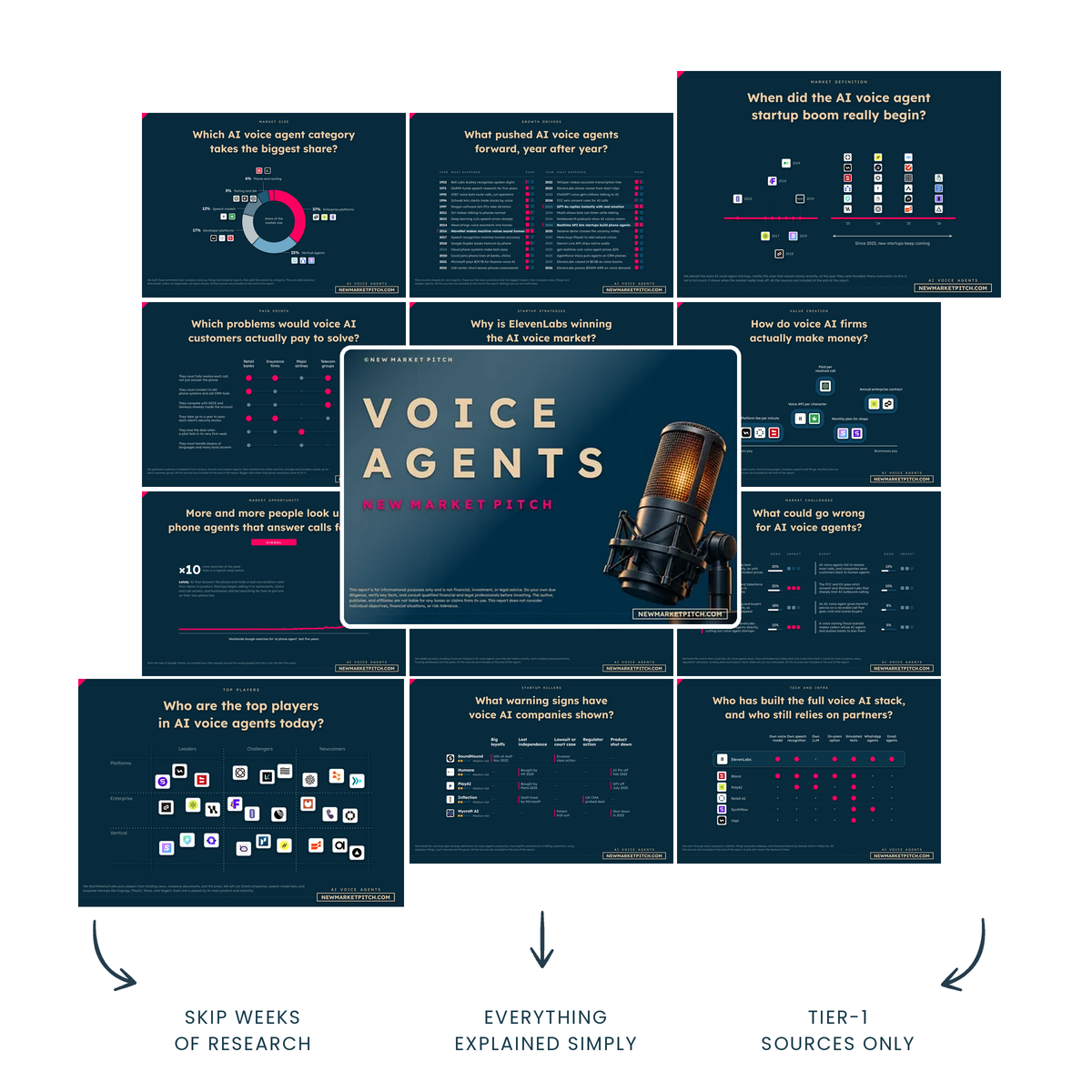
Whether you're building or investing in the AI voice agent market, our report covers everything you need to know: the players, the money, and what's coming next.
Summary
ElevenLabs leads the AI voice agent startup ranking with $600M in annual recurring revenue (ARR) as of September 2026. Fin follows at more than $400M, ahead of Dialpad, Aircall and Talkdesk, although their revenue figures cover different periods and are not equally reliable.
The revenue leaders are mostly broader software businesses. ElevenLabs sells speech and audio tools, Fin spans customer service, and Dialpad and Aircall built large communications businesses before expanding into autonomous agents.
Among more focused voice-agent platforms, Retell AI has reached an $80M annualized run-rate, Omilia exceeds $60M ARR, and Parloa has passed $50M ARR. These numbers offer a clearer look at demand for automated conversations.
Seventeen companies in our ranking have contemporary annual revenue figures, ARR or annualized run-rates around $100M or higher. But full-company revenue should not be confused with money earned specifically from voice agents.
Aircall ranks ahead of Talkdesk even though Talkdesk has a higher headline figure: Aircall disclosed $250M ARR in October 2026, while Talkdesk's roughly $279M is an external estimate. Source quality affects the ranking.
Growth has been rapid. ElevenLabs moved from $350M ARR at the end of 2025 to $600M by September 2026; Sierra doubled from $100M to $200M ARR in roughly six months; Retell doubled its annualized revenue in ten months.
Usage is scaling as well. Retell handles more than 100 million calls per month, while Hi Auto processes more than 100 million drive-through orders annually. Neither figure can be read as revenue without pricing and billing details.
Industry-specific products are gaining ground. EliseAI exceeds $200M ARR across housing and healthcare, Podium's AI-agent business exceeds $150M ARR, and smaller specialists target healthcare scheduling, restaurants and dealership calls.
Profitability varies sharply. Retell reported being profitable at a $40M revenue run-rate, while PolyAI recorded about £18M in annual turnover and roughly £43M in pre-tax losses. Fast adoption does not guarantee attractive economics.
Cheaper speech technology will make simple voice agents easier to replicate. The strongest businesses may be those that own customer relationships, connect deeply with existing workflows, and can prove that calls were resolved rather than merely answered.

Written by the New Market Pitch teamWe track new markets so founders and investors can move faster. About us

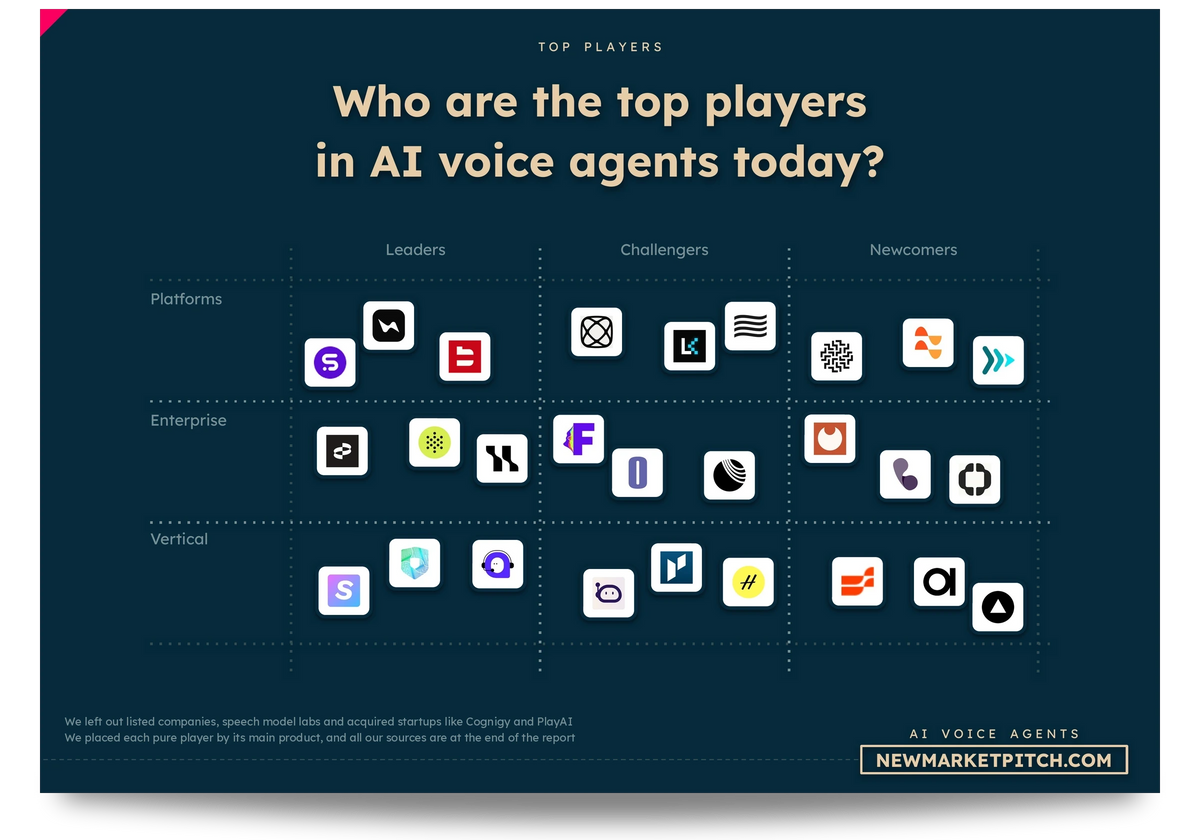
In our report covering the AI voice agent market, we turn what is vague and complex into simple, useful visuals. Market maps like this one show you at a glance where every startup stands.
The ranking of top startups in the AI voice agents market by revenue
Below is a table ranking the startups of this market by their current revenue scale. You can find our methodology at the end of this page.
If you want a deeper understanding of the market and its current dynamics, get our report on the AI voice agents market.
| Ranking | Company | Latest Metric | Metric Type | Freshness | Disclosed When | Source Quality | Confidence | Segment | Why This Ranking | Local Metric | Country |
|---|---|---|---|---|---|---|---|---|---|---|---|
| 1 | ElevenLabs | $600M | ARR | Very Fresh · 1mo | Sep 24, 2026 | Company Disclosed | Medium | Voice Agent Platforms | Largest recent directly disclosed ARR among newer voice-platform specialists, but includes speech generation and music rather than voice-agent sales alone. | us | |
| 2 | Fin | >$400M | ARR | Very Fresh · 4mo | Jun 15, 2026 | Credible Reported | Medium | Enterprise Voice Agents | Large current ARR makes the business a major benchmark below ElevenLabs, but includes the broader messaging and service-agent suite; Salesforce acquired it in September 2026. | us | |
| 3 | Dialpad | >$300M | ARR | Aging · 24mo | Oct 15, 2024 | Company Disclosed | Medium | Enterprise Voice Agents | Material company-wide ARR is stronger than modelled estimates but is two years old and includes cloud calling and human-assist products. | us | |
| 4 | Aircall | $250M | ARR | Very Fresh · 0mo | Oct 29, 2026 | Company Disclosed | Medium | Enterprise Voice Agents | Extremely current direct ARR merits precedence over uncertain higher private-company estimates; the number covers all business calling, not just voice agents. | fr | |
| 5 | Talkdesk | ~$279M | ARR | Very Fresh · 3mo | Jul 2026 | Third-Party Estimate | Low | Enterprise Voice Agents | Estimated company ARR could exceed Aircall but is ranked lower because its methodology is less transparent and includes a broad CX platform. | us | |
| 6 | Uniphore | >$200M | ARR | Fresh · 11mo | Nov 2025 | Company Disclosed | Medium | Enterprise Voice Agents | Founder-confirmed ARR exceeds the next two $200M operators, although it includes enterprise AI infrastructure beyond voice conversations. | us | |
| 7 | EliseAI | >$200M | ARR | Very Fresh · 4mo | Jun 10, 2026 | Company Disclosed | Medium | Vertical Voice Agents | Recent direct ARR places it alongside Sierra, but revenue spans housing and healthcare workflow automation as well as phone conversations. | us | |
| 8 | Sierra | $200M | ARR | Very Fresh · 5mo | Aug 31, 2026 | Company Disclosed | Medium | Enterprise Voice Agents | Current company-confirmed ARR supports a high rank; the omnichannel service suite is broader than spoken interactions alone. | us | |
| 9 | SoundHound AI | $169M | Fiscal-Year Revenue | Fresh · 10mo | Mar 2026 | Filed / Audited | Medium | Enterprise Voice Agents | Recognized public-company revenue carries more weight than nearby estimated ARR, although it includes voice AI, restaurant solutions and acquired operations. | us | |
| 10 | Podium | >$150M | ARR | Very Fresh · 0mo | Oct 22, 2026 | Company Disclosed | Medium | Vertical Voice Agents | AI-specific ARR is more relevant than broad company sales, but includes messaging and other agent workflows as well as spoken calls. | us | |
| 11 | Crescendo | >$100M | ARR | Very Fresh · 4mo | Jun 19, 2026 | Company Disclosed | Medium | Hybrid Voice Agent Services | Recent founder ARR outweighs older figures near this size, but the hybrid human-and-AI delivery model is less comparable to software-only agents. | us | |
| 12 | Cresta | >$100M | ARR | Very Fresh · 6mo | Apr 30, 2026 | Company Disclosed | Medium | Enterprise Voice Agents | Recent first-party ARR is more defensible than similarly sized external estimates; includes human-agent assistance as well as autonomous voice agents. | us | |
| 13 | Capacity | >$100M | ARR | Very Fresh · 4mo | Jun 18, 2026 | Company Disclosed | Medium | Enterprise Voice Agents | Direct contemporary ARR gives a strong revenue floor, but automation across many channels and acquired products dilutes voice-only comparability. | us | |
| 14 | CallRail | >$100M | ARR | Aging · 22mo | Dec 18, 2024 | Company Disclosed | Low | Vertical Voice Agents | The company has large established subscription scale, but this 2024 ARR predates its autonomous Voice Assist expansion and is not product-specific. | us | |
| 15 | Kore.ai | $100M | ARR | Historical · 33mo | Jan 2024 | Credible Reported | Low | Enterprise Voice Agents | An older company-scale ARR disclosure is more meaningful than an unsupported fresh user count, but rapid subsequent platform expansion makes it Historical. | us | |
| 16 | Decagon | ~$100M | Revenue Run-Rate | Very Fresh · 3mo | Jul 2026 | Third-Party Estimate | Low | Enterprise Voice Agents | Current estimated run-rate could match the leaders immediately above, but independent modelling receives less weight than founder-disclosed ARR. | us | |
| 17 | Deepgram | ~$100M | Revenue Run-Rate | Very Fresh · 2mo | Aug 2026 | Third-Party Estimate | Low | Voice Agent Infrastructure | Recent scale estimate is substantial but much of the platform consists of speech recognition and synthesis APIs, not autonomous agents. | us | |
| 18 | Retell AI | $80M | Revenue Run-Rate | Very Fresh · 1mo | Sep 2026 | Company Disclosed | Medium | Voice Agent Platforms | Directly disclosed annualized voice-agent revenue is stronger than nearby estimated run-rates, although it is not recognized annual revenue. | us | |
| 19 | Wonderful | ~$70M | Revenue Run-Rate | Very Fresh · 2mo | Aug 2026 | Third-Party Estimate | Low | Enterprise Voice Agents | Estimated fresh revenue suggests meaningful scale, but third-party provenance and voice-plus-chat scope put it below confirmed $100M businesses. | il | |
| 20 | Omilia | >$60M | ARR | Very Fresh · 2mo | Aug 6, 2026 | Company Disclosed | Medium | Enterprise Voice Agents | Current founder-confirmed voice-automation ARR is stronger than nearby estimates; it remains ARR rather than recognized sales. | gr | |
| 21 | Ringover | >$50M | ARR | Fresh · 8mo | Feb 10, 2026 | Company Disclosed | Medium | Enterprise Voice Agents | Current disclosed ARR is a clear lower bound, but includes conventional cloud telephony and conversation-assist features alongside AIRO voice agents. | fr | |
| 22 | Parloa | >$50M | ARR | Fresh · 10mo | Dec 18, 2025 | Company Disclosed | Medium | Voice Agent Platforms | Confirmed enterprise ARR ranks near Ringover; the more focused agent platform improves relevance but reported value is a lower bound. | de | |
| 23 | Birdeye | >$100M | ARR | Historical · 40mo | Jun 27, 2023 | Company Disclosed | Low | Vertical Voice Agents | Historical reputation-software ARR precedes its 2026 Myna voice-agent launch; the old number cannot be treated as present voice-agent revenue. | us | |
| 24 | [24]7.ai | $300M | Annual Revenue | Historical · 82mo | 2019 | Company Disclosed | Low | Hybrid Voice Agent Services | The old large revenue figure reflects a mixed human service and automation business; its seven-year age precludes ranking it alongside current $300M ARR operators. | us | |
| 25 | ASAPP | ~$40M | Segment Revenue | Fresh · 10mo | 2026 | Third-Party Estimate | Low | Enterprise Voice Agents | Indicative agent-market sales are a partial estimated perimeter, so this is less reliable than the directly disclosed ARR above. | us | |
| 26 | Cognigy | ~$37M | Annual Revenue | Aging · 22mo | Dec 19, 2024 | Third-Party Estimate | Low | Voice Agent Platforms | Older estimated 2024 revenue predates the 2025 NICE acquisition, reducing confidence in how much standalone scale remains. | de | |
| 27 | Toku | $34.8M | Fiscal-Year Revenue | Fresh · 10mo | Mar 2, 2026 | Filed / Audited | Medium | Enterprise Voice Agents | Reported annual revenue is more defensible than neighbouring private estimates and the company listed in 2026, though the figure includes telecom and non-agent CX. | sg | |
| 28 | Yellow.ai | >$34M | Fiscal-Year Revenue | Fresh · 7mo | Aug 3, 2026 | Company Disclosed | Medium | Enterprise Voice Agents | Newer company-reported actual revenue is close to Toku, but unaudited and mixes voice with chat; its announced SPAC is not treated as a completed listing. | us | |
| 29 | Assort Health | >$30M | Revenue Run-Rate | Very Fresh · 4mo | Jun 24, 2026 | Third-Party Estimate | Low | Vertical Voice Agents | Focused phone automation and a recent estimate make it relevant, but the figure is modelled rather than disclosed by the company. | us | |
| 30 | PolyAI | ~$24.1M | Fiscal-Year Revenue | Fresh · 9mo | Jun 7, 2026 | Filed / Audited | High | Voice Agent Platforms | Audited UK group turnover is unusually strong pure-play voice-agent evidence and deserves preference over similar-sized estimated run-rates. | ~£18M | gb |
| 31 | Skit.ai | ~$22.4M | Annual Revenue | Aging · 22mo | Oct 2024 | Third-Party Estimate | Low | Vertical Voice Agents | Estimated 2024 revenue is less fresh and less verifiable than PolyAI filings; voice debt-collection specialization limits its sector breadth. | us | |
| 32 | Fish Audio | $21M | ARR | Very Fresh · 3mo | Jul 28, 2026 | Company Disclosed | Medium | Voice Agent Infrastructure | Direct ARR is timely but materially includes speech synthesis and voice-cloning products alongside its voice-agent platform. | us | |
| 33 | Smith.ai | $20M | Annual Revenue | Historical · 34mo | 2023 | Company Disclosed | Low | Hybrid Voice Agent Services | Historical sales include live human receptionists; the lack of newer revenue reduces ranking weight relative to recent specialist ARR. | us | |
| 34 | fonio.ai | $17.5M | ARR | Very Fresh · 0mo | Oct 20, 2026 | Company Disclosed | Medium | Voice Agent Platforms | A current and founder-sourced ARR figure outweighs some higher but stale estimates, with a focused AI phone-agent product. | at | |
| 35 | Regal.ai | ~$17.8M | Annual Revenue | Fresh · 10mo | 2025 | Third-Party Estimate | Low | Enterprise Voice Agents | Indicative 2025 sales are similar to fonio.ai, but lack the transparency of the October 2026 founder-confirmed ARR. | us | |
| 36 | Voiceflow | ~$9.9M | Annual Revenue | Fresh · 10mo | Jun 2025 | Third-Party Estimate | Low | Voice Agent Platforms | Developer-platform revenue is estimated, covers chat as well as voice, and is ranked below directly disclosed specialized ARR. | us | |
| 37 | Vapi | ~$8M | Annual Revenue | Fresh · 18mo | Oct 7, 2026 | Third-Party Estimate | Low | Voice Agent Infrastructure | The older estimated revenue is weak evidence of current scale despite billions of subsequently processed calls; it is not inflated from transaction volumes. | us | |
| 38 | Slang.ai | ~$5.9M | Annual Revenue | Fresh · 10mo | Sep 2025 | Third-Party Estimate | Low | Vertical Voice Agents | Restaurant phone-agent specialist has a modest outside estimate; later deployments do not support manufacturing a higher revenue number. | us | |
| 39 | Phonely | ~$5M | Annual Revenue | Aging · 28mo | Jun 2024 | Third-Party Estimate | Low | Voice Agent Platforms | Old weakly sourced estimate is retained rather than converting customer revenue generated by its agents into the vendor revenue. | us | |
| 40 | Bland AI | ~$3.8M | Annual Revenue | Aging · 28mo | Jun 2024 | Third-Party Estimate | Low | Voice Agent Platforms | Old estimated sales are almost certainly less informative than recent call scale but no verified newer revenue amount supersedes them. | us | |
| 41 | AIVO Asia | $2.4M | ARR | Very Fresh · 6mo | Company Disclosed | Low | Voice Agent Platforms | Self-reported business ARR is unverified by independent reporting and shared across separate voice and messaging products. | sg | ||
| 42 | Bolna | $175K | Monthly Revenue | Very Fresh · 3mo | Jul 2026 | Company Disclosed | Medium | Voice Agent Platforms | A recent real monthly sales figure is meaningful but cannot be compared directly with the annual figures above without an unwarranted annualization. | in | |
| 43 | telli | ~$1.9M | Annual Revenue | Fresh · 10mo | Sep 2025 | Third-Party Estimate | Low | Voice Agent Platforms | Modest estimated 2025 sales are less reliable than Bolna founder-reported monthly revenue; no stronger public revenue disclosed. | de | |
| 44 | Thoughtly | ~$1.2M | Annual Revenue | Fresh · 10mo | Nov 2025 | Third-Party Estimate | Low | Voice Agent Platforms | Low-end modelled sales are a weak ranking basis; product category fit is stronger than financial visibility. | us | |
| 45 | CallFluent AI | ~$1.1M | Annual Revenue | Fresh · 10mo | Jun 2025 | Third-Party Estimate | Low | Voice Agent Platforms | Early-stage revenue estimate lacks a company-issued confirmation and therefore ranks below stronger founder-supported evidence. | us | |
| 46 | Synthflow AI | ~$1.1M | Annual Revenue | Fresh · 10mo | Sep 2025 | Third-Party Estimate | Low | Voice Agent Platforms | Estimate appears stale relative to subsequently announced call traffic; no invented conversion from calls to fees is used. | de | |
| 47 | JustCall | ~$1M | ARR | Fresh · 10mo | 2025 | Credible Reported | Low | Enterprise Voice Agents | Only the AI voice-agent offering is measured here, not SaaS Labs consolidated sales, making the perimeter narrower than the companies above. | us | |
| 48 | HappyRobot | >150 enterprise customers | Other Scale Signal | Very Fresh · 2mo | Aug 4, 2026 | Company Disclosed | Low | Vertical Voice Agents | Meaningful customer adoption signals scale in logistics, but without an exact public financial figure it does not outrank disclosed revenue. | us | |
| 49 | Hi Auto | >100M orders/year | Transactions | Fresh · 10mo | Dec 16, 2025 | Company Disclosed | Low | Vertical Voice Agents | Huge order-throughput signal measures customer transactions rather than fees earned by the restaurant AI-ordering vendor. | il | |
| 50 | Replicant | >1B automated minutes | Other Scale Signal | Fresh · 8mo | Feb 5, 2026 | Company Disclosed | Low | Enterprise Voice Agents | Cumulative automated minutes establish significant deployment but cannot be treated as annual revenue or even current-month call volume. | us | |
| 51 | ConverseNow | >2M conversations/month | Other Scale Signal | Undated | Company Disclosed | Low | Vertical Voice Agents | Monthly AI order-taking conversations support substantial live usage, but source timing and financial conversion remain unclear. | us | ||
| 52 | Numa | >1,300 dealerships | Locations | Very Fresh · 6mo | Apr 2026 | Credible Reported | Low | Vertical Voice Agents | Operational dealership footprint provides a customer-scale proxy without establishing whether each location is a paying account. | us | |
| 53 | CloudTalk | >5,500 businesses | Other Scale Signal | Undated | Company Disclosed | Low | Enterprise Voice Agents | Broad installed cloud-calling base is not voice-agent specific and gives no defensible indication of current AI agent revenue. | sk | ||
| 54 | Ada | >550 deployed agents | Other Scale Signal | Fresh · 7mo | Mar 3, 2026 | Company Disclosed | Low | Enterprise Voice Agents | Hundreds of deployed agents and a fast-growing voice business signal adoption, but the company discloses no comparable dollar figure. | ca | |
| 55 | Observe.AI | >350 enterprise customers | Other Scale Signal | Very Fresh · 3mo | Jul 2026 | Company Disclosed | Low | Enterprise Voice Agents | Large contact-center deployment base includes agent-assist products; customer counts cannot substitute for voice-agent revenue. | us | |
| 56 | Cartesia | >50K customers | Other Scale Signal | Fresh · 7mo | Mar 2026 | Credible Reported | Low | Voice Agent Infrastructure | Large voice API adoption is largely speech technology, and an account count does not establish paid voice-agent business scale. | us | |
| 57 | Hyro | >650M automated minutes | Other Scale Signal | Undated | Company Disclosed | Low | Vertical Voice Agents | Automated minutes show considerable healthcare usage, but the metric is cumulative and not a substitute for revenue. | us | ||
| NR | LiveKit | Not disclosed | Other Scale Signal | Undated | Company Disclosed | Low | Voice Agent Infrastructure | A key agent operating platform, but no verified public monetary or commercial-count disclosure permits a meaningful numerical placement. | us |

Our research about AI voice agents gets updated several times a month, so you always get the latest view of where things stand.
Why are AI voice agent startups making so much money now?
AI voice agent startups are now generating hundreds of millions of dollars because businesses have started using AI to handle real customer calls, sales inquiries, appointments and support requests.
The clearest evidence is the number of companies reaching major revenue milestones. ElevenLabs reported $600M ARR in September 2026, Retell AI doubled its annualized revenue from $40M to $80M in ten months, and Parloa surpassed $50M ARR in December 2025. Cresta crossed $100M ARR in April 2026, while Podium's AI-agent business reached more than $150M ARR in October.
The growth also shows up in actual usage. Retell AI reported processing more than 100 million monthly calls by September 2026, up from approximately 30 million earlier in the year. Podium said it had deployed more than 20,000 AI agents by October 2026, helping customers generate more than $13B in revenue. That last figure represents revenue generated by Podium's customers, rather than Podium's own sales.
Businesses are paying for systems that can answer phones, schedule appointments, qualify leads and update customer records. For companies handling thousands of repetitive calls every day, even automating part of that workload can change their operating costs.
Which AI voice agent startups make the most revenue today?
ElevenLabs is currently the highest-ranked AI voice agent startup with $600M ARR, followed by Fin at more than $400M, Dialpad at more than $300M, Aircall at $250M and Talkdesk at approximately $279M in estimated ARR.
Our ranking covers 57 startups with revenue figures or other meaningful commercial-scale indicators, plus LiveKit, whose revenue remains undisclosed. The first 47 positions have financial measures, while positions 48–57 rely on customer counts, deployment volumes or other operating indicators that cannot be directly compared with revenue.
One important detail: many of the largest companies sell much more than autonomous voice agents. ElevenLabs develops speech and audio technology, Dialpad and Aircall have established cloud-calling businesses, and Fin provides customer-service software across several channels.
That distinction becomes clearer further down the ranking. Retell AI reports an $80M annualized run-rate from a more specialized voice-agent business, while Omilia and Parloa have reported more than $60M and $50M ARR, respectively.
The table preserves the original ranking order and each company's reported financial measure. Older revenue, estimated ARR and annualized run-rates are identified rather than presented as equivalent sales.
| Rank | Startup | Revenue or commercial scale | Metric and period |
|---|---|---|---|
| 1 | ElevenLabs | $600M | ARR, Sep 2026 |
| 2 | Fin | >$400M | ARR, Jun 2026 |
| 3 | Dialpad | >$300M | ARR, Oct 2024 |
| 4 | Aircall | $250M | ARR, Oct 2026 |
| 5 | Talkdesk | ~$279M | Estimated ARR, Jul 2026 |
| 6 | Uniphore | >$200M | ARR, Nov 2025 |
| 7 | EliseAI | >$200M | ARR, Jun 2026 |
| 8 | Sierra | $200M | ARR, May 2026 |
| 9 | SoundHound AI | $169M | FY2025 revenue |
| 10 | Podium | >$150M | AI-agent ARR, Oct 2026 |
| 11 | Crescendo | >$100M | ARR, Jun 2026 |
| 12 | Cresta | >$100M | ARR, Apr 2026 |
| 13 | Capacity | >$100M | ARR, Jun 2026 |
| 14 | CallRail | >$100M | ARR, Dec 2024 |
| 15 | Kore.ai | $100M | ARR, Jan 2024 |
| 16 | Decagon | ~$100M | Estimated run-rate, Jul 2026 |
| 17 | Deepgram | ~$100M | Estimated run-rate, Aug 2026 |
| 18 | Retell AI | $80M | Run-rate, Sep 2026 |
| 19 | Wonderful | ~$70M | Estimated run-rate, Aug 2026 |
| 20 | Omilia | >$60M | ARR, Aug 2026 |
| 21 | Ringover | >$50M | ARR, Feb 2026 |
| 22 | Parloa | >$50M | ARR, Dec 2025 |
| 23 | Birdeye | >$100M | ARR, Jun 2023 |
| 24 | [24]7.ai | $300M | Annual revenue, 2019 |
| 25 | ASAPP | ~$40M | Estimated segment revenue, 2025 |
| 26 | Cognigy | ~$37M | Estimated annual revenue, 2024 |
| 27 | Toku | $34.8M | FY2025 revenue |
| 28 | Yellow.ai | >$34M | FY2026 revenue, unaudited |
| 29 | Assort Health | >$30M | Estimated run-rate, Jun 2026 |
| 30 | PolyAI | ~£18M | FY2026 revenue, ended Jan 2026 |
| 31 | Skit.ai | ~$22.4M | Estimated annual revenue, 2024 |
| 32 | Fish Audio | $21M | ARR, Jul 2026 |
| 33 | Smith.ai | $20M | Annual revenue, 2023 |
| 34 | fonio.ai | $17.5M | ARR, Oct 2026 |
| 35 | Regal.ai | ~$17.8M | Estimated annual revenue, 2025 |
| 36 | Voiceflow | ~$9.9M | Estimated annual revenue, 2025 |
| 37 | Vapi | ~$8M | Estimated annual revenue, Apr 2025 |
| 38 | Slang.ai | ~$5.9M | Estimated annual revenue, 2025 |
| 39 | Phonely | ~$5M | Estimated annual revenue, Jun 2024 |
| 40 | Bland AI | ~$3.8M | Estimated annual revenue, Jun 2024 |
| 41 | AIVO Asia | $2.4M | ARR, Apr 2026 |
| 42 | Bolna | $175K | Monthly revenue, Jul 2026 |
| 43 | telli | ~$1.9M | Estimated annual revenue, 2025 |
| 44 | Thoughtly | ~$1.2M | Estimated annual revenue, 2025 |
| 45 | CallFluent AI | ~$1.1M | Estimated annual revenue, 2025 |
| 46 | Synthflow AI | ~$1.1M | Estimated annual revenue, 2025 |
| 47 | JustCall | ~$1M | AI-agent ARR, 2025 |
| 48 | HappyRobot | >150 enterprise customers | Aug 2026 |
| 49 | Hi Auto | >100M orders/year | Dec 2025 |
| 50 | Replicant | >1B automated minutes | Cumulative through Feb 2026 |
| 51 | ConverseNow | >2M conversations/month | 2026 |
| 52 | Numa | >1,300 dealerships | Apr 2026 |
| 53 | CloudTalk | >5,500 businesses | 2026 |
| 54 | Ada | >550 deployed agents | Mar 2026 |
| 55 | Observe.AI | >350 enterprise customers | Jul 2026 |
| 56 | Cartesia | >50K customers | Mar 2026 |
| 57 | Hyro | >650M automated minutes | Cumulative, undated |
LiveKit remains unranked because no comparable public revenue figure is available.

In our market report about AI voice agents, we look at what the winners do differently, so you can learn from the best instead of guessing.
Is ElevenLabs really the biggest AI voice agent startup?
ElevenLabs ranks first with $600M ARR as of September 2026, although a large part of its business comes from AI speech and audio products beyond autonomous phone agents.
The company's recent growth has been extraordinary. ElevenLabs finished 2025 at $350M ARR, crossed $500M during the first four months of 2026 and reached $600M by September. That represents approximately 71% growth from the end of 2025 in less than nine months.
In a September 2026 interview with TechCrunch, CEO Mati Staniszewski said more than 55% of ElevenLabs' business came from traditional enterprise customers. Applying that share to the company's ARR implies more than $330M associated with enterprise customers, although the company has not disclosed how much comes specifically from voice agents.
Its broader portfolio explains the scale. ElevenLabs sells text-to-speech, voice cloning, dubbing, conversational AI and creative audio tools. In September 2026, it also announced a licensing and product-development agreement with Universal Music Group, showing that its ambitions extend well beyond customer-service calls.
The $600M figure is therefore company-wide ARR. Among startups more tightly focused on autonomous phone conversations, Retell AI and Parloa provide a more direct picture of the voice-agent business itself.
How much revenue does Fin, formerly Intercom, make?
Fin ranks second among AI voice agent startups, with more than $400M ARR as of June 2026, although that revenue includes the wider customer-service business formerly known as Intercom.
Fin's software covers customer messaging, support operations and AI agents across several channels. Voice is part of the offering, but there is no public breakdown showing how much of the $400M-plus ARR comes specifically from telephone automation.
Salesforce announced its agreement to acquire Fin for approximately $3.6B in June 2026 and completed the transaction in September. At completion, Salesforce described a customer base exceeding 30,000 companies and positioned Fin alongside its broader AI customer-service products.
At the reported ARR threshold, the acquisition price represents less than nine times annual recurring revenue. That is an indicative transaction-price comparison rather than a multiple based on voice-only revenue.
The acquisition is also important for the wider market. Salesforce now owns an established AI customer-service business with considerable recurring sales, rather than having to build every capability internally.
Fin keeps its second position because the acquisition is recent. Cognigy, acquired by NICE in 2025, also remains ranked at number 26, based on approximately $37M in estimated 2024 revenue. Both illustrate how established software groups are buying younger conversational AI companies to strengthen their products.

In our document detailing everything you need to know about AI voice agent, you will always find fresh funding data, taken straight from our own verified funding database.
Is Dialpad bigger than Aircall and Talkdesk?
Dialpad ranks third with more than $300M ARR, ahead of Aircall in fourth place with $250M ARR and Talkdesk in fifth with approximately $279M in estimated ARR.
The financial disclosures differ quite substantially. Dialpad announced its milestone in October 2024, making its revenue figure older than those of its two competitors. It also includes business calling, communications software and AI-assisted products.
Aircall's October 2026 announcement provides a much fresher reference. The company reported $250M ARR and more than 24,000 customers. It had also acquired Vogent in May 2026 and Piper AI in June, expanding its AI voice-agent capabilities through acquisitions.
Talkdesk's approximately $279M ARR comes from Northmetric's external estimate rather than an equivalent company disclosure. The estimated amount is higher than Aircall's reported figure, but the evidence is weaker.
Which AI voice agent startups have crossed $100 million in revenue?
Seventeen AI voice agent startups have contemporary annual revenue, ARR or annualized run-rate figures around $100M or higher, led by ElevenLabs, Fin and Dialpad.
The next companies in that group are Aircall, Talkdesk, Uniphore, EliseAI, Sierra, SoundHound AI, Podium, Crescendo, Cresta, Capacity, CallRail, Kore.ai, Decagon and Deepgram.
But there is an important accounting distinction. SoundHound AI reported $169M in recognized FY2025 revenue through its SEC filing, whereas ElevenLabs reported $600M ARR and Decagon's approximately $100M annualized run-rate comes from Sacra's estimate.
Two further startups have large historical figures: Birdeye reported more than $100M ARR in June 2023, while [24]7.ai reported $300M in annual revenue for 2019. Neither amount establishes the company's present-day voice-agent sales.
There are now many businesses connected to voice automation operating at nine-figure financial scales, though their figures cannot simply be added together: they cover different periods, products and sometimes overlapping parts of the same technology stack.

Learning from others' mistakes is the cheapest lesson there is. In our report covering the AI voice agent market, we look at what broke startups before you, so you don't repeat it.
Which AI voice agent startups are growing fastest right now?
Retell AI, ElevenLabs, Sierra and Podium have shown some of the clearest recent revenue acceleration among AI voice agent startups, although they started from very different sizes.
Retell AI doubled annualized revenue from $40M in November 2025 to $80M in September 2026. ElevenLabs grew from $350M ARR at the end of 2025 to $600M by September 2026, an increase of roughly 71%.
Sierra offers another strong comparison. Founded in 2023, the company reached $200M ARR by May 2026 after nine quarters of commercial development. It was already at $100M ARR in November 2025, implying a doubling in roughly six months.
Podium's October 2026 announcement revealed how much faster its AI products are growing than its original software business did. Its AI-agent business reached more than $150M ARR in two and a half years, while the original business took eight years to reach the same milestone. That is more than three times faster when measured by the time needed to hit $150M.
EliseAI reported five consecutive years of approximately 100% annual growth when it crossed $200M ARR in June 2026. Capacity's historical expansion, from $5M to more than $100M ARR in 3.5 years, shows that exceptional growth has also occurred in broader automation platforms.
| Startup | Earlier milestone | Latest ranking figure | Change |
|---|---|---|---|
| ElevenLabs | $350M ARR, end-2025 | $600M ARR, Sep 2026 | ~71% |
| Fin | No comparable earlier figure | >$400M ARR, Jun 2026 | Not established |
| Dialpad | No comparable earlier figure | >$300M ARR, Oct 2024 | Not established |
| Aircall | No comparable earlier figure | $250M ARR, Oct 2026 | Not established |
| Talkdesk | No comparable earlier figure | ~$279M estimated ARR, Jul 2026 | Not established |
| Uniphore | No comparable earlier figure | >$200M ARR, Nov 2025 | Not established |
| EliseAI | ~$150M ARR, end-2025 | >$200M ARR, Jun 2026 | >33% |
| Sierra | $100M ARR, Nov 2025 | $200M ARR, May 2026 | 100% |
| Podium | $100M AI ARR, Jan 2026 | >$150M AI ARR, Oct 2026 | >50% |
| Retell AI | $40M run-rate, Nov 2025 | $80M run-rate, Sep 2026 | 100% |
How much money is EliseAI making from housing and healthcare?
EliseAI currently generates more than $200M ARR across housing and healthcare automation, making it the seventh-ranked AI voice agent startup.
The company's original business focused on multifamily housing. Its software answers leasing inquiries, communicates with residents, manages maintenance requests and automates administrative tasks. It later expanded into healthcare, particularly patient scheduling and front-office workflows.
According to EliseAI's June 2026 announcement, it serves more than 600 property owners and operators and reaches roughly one in six US apartments through its housing products.
The growth trajectory is especially notable. Sacra estimated approximately $37M ARR at the end of 2023, $75M at the end of 2024 and $150M at the end of 2025. The company's subsequent disclosure above $200M confirms that its revenue continued rising rapidly.
EliseAI has become large by solving fairly specific operational problems in two industries. Housing operators need agents that understand leasing and resident workflows, while medical practices need scheduling and patient communications linked to existing systems.
The company does not report how its ARR divides between housing, healthcare, telephone conversations and other automated interactions.

Your time is limited. In our research about AI voice agents, we put numbers on each part of the market, so you can see where it makes sense to focus.
Is SoundHound AI making real revenue from voice AI?
SoundHound AI has a substantial revenue-generating business, reporting $169M in FY2025 sales, and ranks ninth among AI voice agent startups.
Its financial evidence is unusually strong for this market. The company's SEC 10-K reports recognized annual revenue, giving readers a more concrete accounting reference than the ARR announcements and modeled revenue estimates used for many private competitors.
SoundHound operates across voice AI, restaurant technology, automotive applications and customer-service automation. Its growth has also been shaped by acquisitions, which have expanded its product portfolio and customer reach.
That broader business mix matters when interpreting the $169M figure. It represents consolidated sales, including activities beyond autonomous phone agents.
Are dedicated AI voice agent platforms already making $50 million a year?
Dedicated voice-agent platforms have already reached substantial revenue levels, with Retell AI reporting an $80M annualized run-rate and Parloa more than $50M ARR.
Retell's business is closely tied to deploying and managing automated telephone conversations. Parloa focuses on enterprise AI agents operating inside customer-service environments, including more complex integrations and workflows.
Omilia is another sizeable specialist, with more than $60M ARR reported in August 2026. PolyAI, which develops natural conversational telephone agents, reported approximately £18M in turnover for its fiscal year ending January 2026.
These companies have quite different financial disclosures. Retell reports an annualized operating rate, Omilia and Parloa report ARR, and PolyAI has filed annual revenue in the United Kingdom.
Dedicated voice automation already supports businesses generating tens of millions of dollars annually, or at annualized rates.

In our market report about AI voice agents, we always try to gather several sources and make estimates that make sense, so you can work with solid numbers.
Is Retell AI catching up with ElevenLabs?
Retell AI is growing fast in autonomous phone agents, but ElevenLabs remains much larger in total company revenue, with $600M ARR compared with Retell's $80M annualized run-rate.
Using those figures, ElevenLabs is approximately 7.5 times larger, although the comparison mixes ARR and run-rate and covers different product ranges.
Retell's growth has been impressive in its own right. The company's official timeline shows annualized revenue doubling in less than a year while remaining closely focused on voice-agent deployment.
An October 2026 OpenAI case study described Retell serving more than 4,000 businesses and handling over 100 million calls monthly. It also reported approximately $1.6M in annualized revenue per employee, reflecting an unusually lean operating structure.
ElevenLabs has a wider portfolio spanning speech synthesis, voice cloning, audio creation and conversational agents. Retell's narrower focus means its financial and usage figures tell us more directly about the commercial adoption of automated phone calls.
We would need product-specific revenue disclosure from ElevenLabs to make a direct voice-agent-only comparison.
Is Parloa bigger than PolyAI and Bland AI?
Parloa ranks above PolyAI and Bland AI, reporting more than $50M ARR in December 2025, compared with PolyAI's approximately £18M in fiscal-year revenue and Bland AI's older estimated annual revenue of around $3.8M.
Parloa sells enterprise software for managing conversational AI agents across customer-service operations. Its focus includes complex integrations, compliance requirements and tools for deploying agents at scale.
PolyAI specializes in spoken customer-service conversations. Its UK financial statements are especially useful because they provide realized revenue rather than a privately announced recurring-revenue milestone.
According to its Companies House filings, PolyAI generated approximately £18M in turnover for the fiscal year ending January 2026, compared with roughly £12M the previous year. That works out to around 51% growth.
Bland AI takes a more developer-oriented approach, providing tools for building automated telephone conversations. Its available estimated revenue figure dates to June 2024, so it gives a much weaker picture of the company's current operations.

If you build or invest in the AI voice agent market, you need to know which business models pay off now and which ones are fading. That's why our report covering it has a whole section on it.
Which AI voice agent startups make the most money in healthcare, restaurants and other industries?
EliseAI, Podium and CallRail are the highest-ranked vertical AI voice agent startups, while companies such as Assort Health, Skit.ai and Slang.ai focus on more specialized operational problems.
EliseAI serves housing and healthcare, where phone calls are closely connected to leasing, scheduling and administrative workflows. Podium targets local businesses, including automotive dealerships, home-service companies and aesthetics practices.
CallRail has a long-established business in marketing attribution and inbound customer communications, while its autonomous voice-agent capabilities are a newer expansion.
Among smaller specialists, Assort Health focuses on medical scheduling, Skit.ai automates financial-services and debt-collection conversations, and Slang.ai handles restaurant phone calls.
Vertical specialists can build deeper integrations around those tasks. That helps them compete with broader AI platforms despite their smaller revenue bases.
| Overall rank | Startup | Revenue or scale | Main application |
|---|---|---|---|
| 7 | EliseAI | >$200M ARR | Housing and healthcare |
| 10 | Podium | >$150M AI-agent ARR | Local businesses |
| 14 | CallRail | >$100M ARR, Dec 2024 | Marketing and inbound calls |
| 23 | Birdeye | >$100M ARR, Jun 2023 | Local business communications |
| 29 | Assort Health | >$30M estimated run-rate | Healthcare scheduling |
| 31 | Skit.ai | ~$22.4M estimated 2024 revenue | Debt collection |
| 38 | Slang.ai | ~$5.9M estimated 2025 revenue | Restaurants |
| 48 | HappyRobot | >150 enterprise customers | Logistics |
| 49 | Hi Auto | >100M orders/year | Drive-through restaurants |
| 51 | ConverseNow | >2M conversations/month | Restaurant ordering |
| 52 | Numa | >1,300 dealerships | Automotive dealerships |
| 57 | Hyro | >650M automated minutes | Healthcare |
How much revenue do voice AI infrastructure startups make?
Deepgram is the highest-ranked specialist in voice-agent infrastructure, with approximately $100M in estimated annualized revenue, followed in the overall ranking by Fish Audio at $21M ARR and Vapi at approximately $8M in estimated annual revenue.
Deepgram develops speech recognition and synthesis technology that businesses can integrate into voice applications. Fish Audio provides speech-generation technology, including voice cloning and related tools. Vapi gives developers infrastructure to build and orchestrate voice agents.
A single AI phone call can involve a telephony provider, speech-recognition software, a language model, voice synthesis and an orchestration platform. Several vendors may earn revenue from the same deployment.
This gives infrastructure companies a wider range of possible customers, including businesses building their own agents and software companies embedding speech capabilities into existing products.
However, Deepgram and Fish Audio also serve applications that have little to do with phone-based agents, so their full revenue cannot be attributed to autonomous customer-service calls.

In our report covering the AI voice agent market, we don't want to repeat what boring consulting reports say. Instead, we show you the real and latest market signals that matter.
Can AI voice agents actually replace human call-center workers?
AI voice agents can already handle large volumes of repetitive customer calls, but there is no evidence of industry-wide replacement of human call-center employees.
Retell AI reported processing more than 100 million monthly calls by September 2026. Hi Auto reported handling more than 100 million drive-through orders annually, and Replicant disclosed more than one billion cumulative automated phone minutes through February 2026.
Those are substantial operating volumes. They show that automated conversations are being used by real businesses at scale.
The strongest applications involve relatively predictable requests: checking order status, scheduling appointments, confirming reservations, qualifying sales inquiries or answering common questions.
Human agents remain important when customers have unusual problems, sensitive situations or requests outside the AI system's permitted actions. A call that starts with AI may also end with a human employee.
Pricing also affects the economics. Industry comparisons in 2026 commonly place voice-agent costs somewhere around $0.05–$0.35 per minute, depending on the included technology and services.
At an illustrative $0.15 per minute, 100,000 automated minutes would cost $15,000 in usage charges. Whether that creates savings depends on the human work avoided, call completion rates and the costs of implementing the system.
Are AI voice agent startups profitable yet?
Some AI voice agent startups have already reported profitability, but the financial evidence varies sharply between companies.
Retell AI offers one of the clearest examples. Its company timeline states that it had reached $40M in annualized revenue by November 2025 while fully profitable, operating with a team of 25 people.
The arithmetic is striking: $40M divided by 25 employees implies approximately $1.6M in annualized revenue per employee at that milestone. That is a measure of operating efficiency, rather than a profit-margin calculation.
Podium also described its business as profitable and free-cash-flow positive alongside its AI expansion in October 2026.
PolyAI shows the opposite end of the spectrum. Its UK group accounts reported approximately £18M in turnover for the fiscal year ending January 2026, alongside a pre-tax loss of roughly £43M.
That loss was more than twice its reported annual turnover. It demonstrates how expensive developing and scaling a sophisticated voice AI business can remain.

In our research about AI voice agents, we like to show you the big picture. We know your time is precious, so we make every page quick to read and packed with as much learning as possible per minute.
Do AI voice agent startups make more money from enterprise clients or small businesses?
The highest-revenue AI voice agent startups have substantial enterprise businesses, although smaller companies are also adopting automated calling products in large numbers.
ElevenLabs reported that more than 55% of its $600M ARR came from traditional enterprise customers. That implies over $330M in ARR associated with this customer group, without revealing the share attributable specifically to voice agents.
Parloa targets complex enterprise contact centers, while Uniphore and Cresta sell AI automation and assistance tools to large organizations.
Enterprise customers often need extensive integrations, security controls, compliance features and support for high call volumes. Those requirements can support larger contracts and make switching vendors more complicated.
Small and medium-sized businesses usually have simpler needs. A business may want an agent to answer missed calls, schedule appointments or qualify incoming leads without a lengthy implementation project.
Aircall reported more than 24,000 customers in October 2026, while Capacity said it served more than 20,000 organizations. These customer counts suggest broad distribution, although they do not reveal voice-agent revenue per account.
There is no reliable industry-wide split showing whether enterprise or small-business customers generate more AI voice-agent revenue in total.
Can AI voice agent startups make real money from millions of phone calls?
AI voice agent startups can build meaningful businesses around high call volumes, but calls, minutes and customer transactions reveal very little about revenue unless we also know what the companies charge.
Retell AI's more than 100 million monthly calls indicate extensive usage. ConverseNow reports more than two million conversations monthly, while Hi Auto reports more than 100 million drive-through orders annually.
These measures cannot be compared directly. A conversation may last seconds or several minutes, an order represents a customer's purchase, and a processed call may contain both automated and human-handled stages.
Other companies disclose customer reach rather than usage. Numa reports more than 1,300 dealership locations, Ada more than 550 deployed agents, and Observe.AI more than 350 enterprise customers.
For illustration, ten million billable minutes at $0.10 per minute would generate $1M in charges. At $0.20 per minute, the same usage would generate $2M. The difference doubles revenue without changing the activity volume.
Actual contracts may include platform fees, discounts, bundled allowances and usage charges. Some transactions may not be billed separately at all.

When you build or invest in the AI voice agent market, you need clarity, not confusion. In our market report about AI voice agents, we always try to put numbers on and quantify whatever is usually vague and confusing.
Could cheaper AI voice technology hurt these startups?
Cheaper speech processing and AI inference could reduce the prices voice-agent providers charge, especially when their products rely on technology that competitors can easily access.
The cost structure is already becoming more transparent. Telnyx, for example, advertises a voice engine starting at $0.05 per minute, with language-model usage and carrier charges billed separately.
As those components become cheaper, developers can build voice agents at lower cost. That should encourage more businesses to experiment with automated calling.
It also creates competition for vendors whose main offering is simply connecting speech models, language models and telephone systems.
Deepgram, Retell AI and Parloa illustrate three different positions. Deepgram provides speech technology, Retell offers a dedicated voice-agent platform, and Parloa specializes in enterprise agent deployment and management.
Their exposure to falling technology costs will differ. Infrastructure providers may see lower unit prices, while platforms may benefit from cheaper underlying services if they can preserve the value of their broader products.
Which AI voice agent startups could become much bigger next?
Retell AI, Parloa and Assort Health are among the most interesting AI voice agent startups to watch, based on their commercial growth, specialization and the markets they serve.
Retell has already doubled its annualized revenue in less than a year and reported a major increase in processed calls. It also serves several thousand businesses, suggesting that adoption is spread across a meaningful customer base.
Parloa has crossed $50M ARR and reported 150% net revenue retention in December 2025. That means its existing customer base was spending substantially more over the measurement period, even after accounting for customers that reduced spending or left.
Assort Health addresses a different opportunity: medical practices and healthcare organizations handling large numbers of scheduling and administrative calls. Its estimated annualized revenue above $30M in June 2026 suggests demand for tightly focused automation.
Smaller startups are also finding buyers. fonio.ai reported $17.5M ARR in October 2026, while Bolna disclosed $175K in monthly revenue in July.
These companies have room to grow, but their future positions will depend on customer retention, pricing and how quickly larger software vendors incorporate similar features.

A good product starts with a real problem. In our document detailing everything you need to know about AI voice agent, we show you the ones customers still live with.
What are the top AI voice agent startups by revenue today?
ElevenLabs is the number-one AI voice agent startup today with $600M ARR, followed by Fin, Dialpad, Aircall and Talkdesk. Uniphore, EliseAI, Sierra, SoundHound AI and Podium complete the top ten.
ElevenLabs has built a much larger business than most specialist voice-agent companies, helped by its broader speech and audio product portfolio. Fin's position reflects its substantial customer-service software business, while Dialpad, Aircall and Talkdesk benefit from existing communications and contact-center operations.
Specialist platforms are now producing substantial revenue of their own. Retell AI has reached an $80M annualized run-rate, Omilia reports more than $60M ARR, and Parloa exceeds $50M ARR.
The available figures show a market with several different commercial models already working: enterprise automation, industry-specific agents, developer platforms and speech infrastructure.
ElevenLabs leads overall. Retell AI and Parloa are worth watching as dedicated platforms built around automated conversations.
Our methodology
We ranked AI voice agent startups by current commercial scale, rather than treating every announcement about call volume or AI deployments as revenue. Companies were eligible if founded in 2000 or later, never publicly listed or first listed within the past five years, and independent rather than a division of an established operating group. Businesses acquired in the past three years remain eligible, with their acquisition status identified where relevant.
Our comparison spans company announcements, annual reports, regulatory filings, investor materials, financial reporting, interviews and credible industry publications from the past ten years. Older disclosures were retained when they were more substantial than newer operating statistics.
We considered recognized annual revenue, fiscal-year and trailing-twelve-month revenue, ARR, annualized run-rates, quarterly and monthly sales, and where relevant other financial measures. When no financial figure was available, we used customer counts, deployments and call volumes as commercial-scale indicators, kept separate from revenue.
The main ranking figure for each company reflects the metric's relevance, evidence quality and timing. Consolidated sales may include cloud calling, customer-service software, speech synthesis, healthcare technology or other activities beyond autonomous agents. We identify estimates and older figures rather than treating them as current audited revenue.
The headline order is not a mechanical sort of dollar amounts. For example, Aircall's reported $250M ARR ranks ahead of Talkdesk's roughly $279M externally estimated ARR. Similarly, product-specific AI-agent ARR is distinguished from company-wide revenue. We did not infer revenue from minutes, calls or customer counts.
Key sources include ElevenLabs' ARR update, Aircall's $250M milestone, Dialpad's announcement, EliseAI's ARR statement, SoundHound AI's SEC filing, Podium's AI-agent ARR release, Retell AI's company timeline, Parloa's ARR announcement, TechCrunch on Omilia, PolyAI's UK filings, Fish Audio's ARR release, and Replicant's usage report.

It's easy to get lost in the details. In our report covering the AI voice agent market, we give you some perspective first, so you see the whole market before you make a move.
Written by the New Market Pitch teamWe track new markets so founders and investors can move faster. About us