
Which fusion startup is moving the fastest?
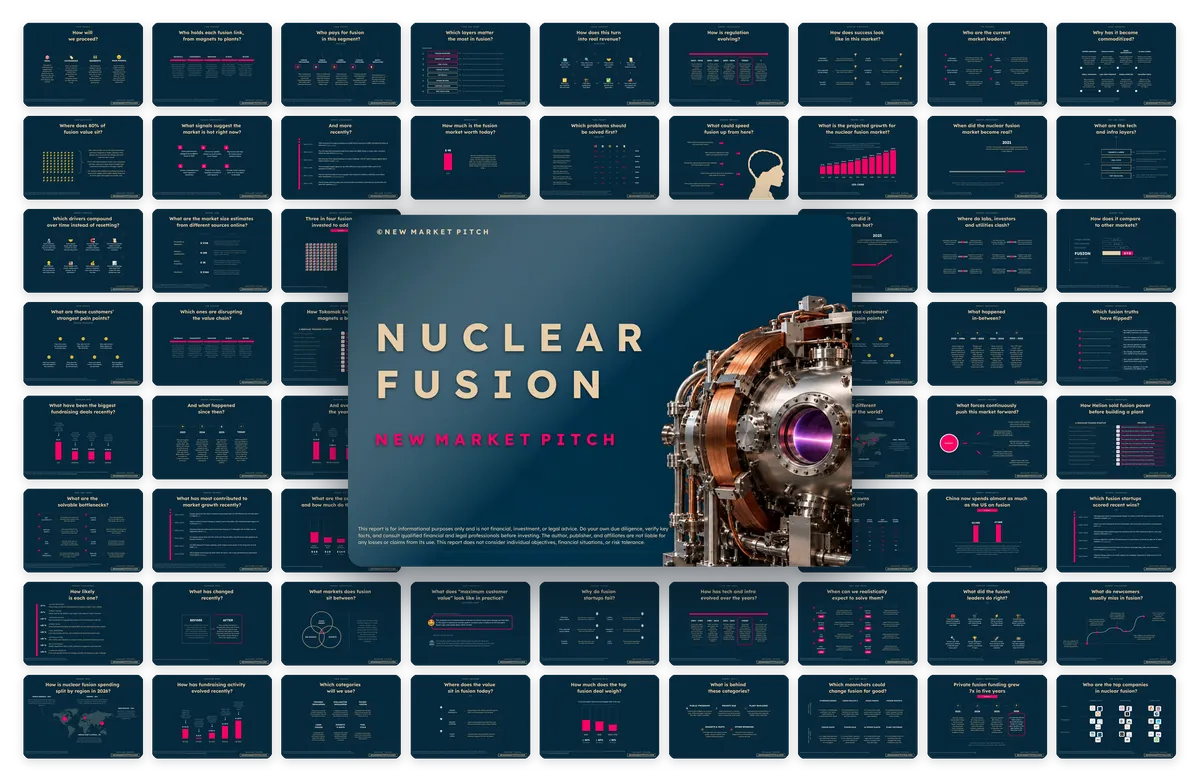
Whether you're building or investing in the nuclear fusion market, our report covers everything you need to know: the players, the money, and what's coming next.
Summary
Helion Energy is the fastest-moving fusion startup toward commercial electricity, while Commonwealth Fusion Systems (CFS) is its strongest challenger and may be better positioned to demonstrate net fusion energy in a tokamak first.
Helion's lead comes from running reactor experiments and building its first commercial power plant at the same time. Its Polaris prototype reached 150 million degrees Celsius and demonstrated measurable deuterium-tritium fusion in February 2026, while construction of its Orion plant in Washington is already underway.
The two leaders are taking very different bets. Helion wants to deliver at least 50 megawatts to Microsoft in 2028, using a pulsed reactor designed to recover electricity directly. CFS is building SPARC to prove plasma energy gain before moving to its much larger, approximately 400-megawatt ARC commercial plant in the early 2030s.
CFS has more financial firepower and a more established scientific foundation. With $4 billion raised, compared with roughly $1.5 billion for Helion, it has nearly 2.7 times as much disclosed funding. Its SPARC demonstration reactor was almost 80% complete by September 2026, putting a major technical test within reach.
Commercial commitments tell a different story from construction schedules. Google's 200-megawatt agreement with CFS is four times Helion's initial Microsoft commitment, and Eni has also signed a major electricity purchase agreement. CFS has the larger disclosed customer commitments, even though Helion is targeting earlier delivery.
Helion's 2028 deadline is the biggest reason to question its lead. It must still demonstrate net electrical production, complete its commercial reactor, establish its operating fuel cycle and connect the plant to the grid. The company's October 2026 semiconductor funding initiative also shows that critical power-recovery components are still being developed.
The financial valuations already assume enormous future success. Helion reached a $15.5 billion post-money valuation in September 2026, yet a continuously operating 50-megawatt plant would generate only about $43.8 million in annual gross electricity sales at an illustrative $100 per megawatt-hour. Investors are betting on a fleet of future reactors, not the economics of Orion alone.
Among younger challengers, Proxima Fusion stands out. Founded in 2023, it raised approximately €411 million in July 2026 and is using decades of German stellarator research to accelerate development. Its fundraising and industrial partnerships are moving faster than its physical reactor program, which remains behind Helion and CFS.
Other companies are advancing on narrower fronts. TAE Technologies has shortened its development roadmap, General Fusion is improving plasma compression temperatures, and Zap Energy is making progress with repetitive pulsed-power operation. These achievements are real, but none yet establishes a clear route to commercially viable electricity.
The decisive distinction is between fusion reactions, net plasma energy and net electricity delivered by a complete power plant. No private fusion startup has publicly demonstrated that final milestone. Helion leads on commercial execution today; CFS could overturn that ranking if SPARC delivers the energy gain its designers expect. The winner will ultimately be decided by reliable, affordable electricity rather than an announced first-power date.

Written by the New Market Pitch teamWe track new markets so founders and investors can move faster. About us
Which fusion startup is actually leading the race today?
Helion Energy is currently moving fastest toward commercial fusion electricity, while Commonwealth Fusion Systems (CFS) has a stronger case for being the first private company to demonstrate net fusion energy in a tokamak.
Helion has already started building its first commercial power plant, Orion, in Washington state. Its seventh-generation prototype, Polaris, reached 150 million degrees Celsius and demonstrated measurable deuterium-tritium fusion in February 2026. CFS, meanwhile, reported that its SPARC demonstration reactor was almost 80% complete, with the aim of showing that a fusion plasma can produce more energy than the external heating supplied to it.
The companies are racing toward different milestones. Helion wants to supply at least 50 megawatts to Microsoft starting in 2028. CFS wants to prove its reactor technology with SPARC before building ARC, a much larger commercial power plant planned for the early 2030s.
Helion has the earlier commercial construction schedule. CFS has committed considerably more capital to a reactor approach supported by decades of tokamak research. Neither company has demonstrated a complete system producing net electricity.
For now, we give Helion the lead on commercial execution. Whether that lead survives the next round of technical testing is another question.
If you want more recent data on this point, please see our latest nuclear fusion market report.
Why is the fusion startup race getting so much attention now?
Fusion startups are attracting record amounts of money because several companies are finally building serious hardware and preparing actual power plants. The industry is moving beyond laboratory experiments, although commercial electricity remains unproven.
According to the Fusion Industry Association's 2026 report, 56 fusion companies raised $4.48 billion over the preceding 12 months, up 69% from the previous year. That brings reported cumulative industry financing to $14.24 billion, with more than 16,000 people now working across the surveyed companies.
Annual investment rose from approximately $2.65 billion to $4.48 billion, adding roughly $1.83 billion in a single reporting period. The survey also covered 56 companies, compared with just 23 in 2021.
Several unusually large transactions explain the acceleration. CFS secured an additional $1 billion in July 2026, bringing its cumulative funding to $4 billion. Proxima Fusion raised approximately $518 million in July, while Inertia Enterprises announced a $450 million Series A earlier that year.
The Fusion Industry Association also found that six companies had secured siting agreements and five had power purchase agreements or similar commercial commitments. Yet 71% of surveyed companies still expected commercial fusion electricity to arrive during the 2030s.
That's the interesting contradiction: the industry's funding has accelerated considerably faster than its expected commercialization timeline.

In our report covering the nuclear fusion market, we turn what is vague and complex into simple, useful visuals. Market maps like this one show you at a glance where every startup stands.
How can we tell which fusion startup is actually moving fastest?
The fastest fusion startup should be the one getting closest to delivering usable electricity, although that requires looking beyond whichever company announces the most impressive experiment.
Three achievements matter here. Producing fusion reactions shows that a machine can create the required physical conditions. Achieving net fusion energy shows that the reactions release more energy than is delivered directly to the plasma. Generating net electricity requires the entire power plant to produce more electrical energy than it consumes.
CFS is building SPARC to demonstrate plasma energy gain, commonly expressed as Q greater than one. Helion is pursuing direct electricity recovery from a pulsed fusion system. General Fusion is testing plasma compression, while Proxima is developing stellarators capable of sustaining plasma without the same large internal currents used by tokamaks.
We cannot compare these approaches by plasma temperature alone. Fusion output also depends on density, confinement, fuel choice and how efficiently the complete system operates.
The best evidence of progress combines successful experiments, functioning hardware, completed construction and reduced engineering uncertainty. And there's a big difference between getting a reactor to work once and building one that a utility can actually depend on.
Is Helion Energy really ahead of Commonwealth Fusion Systems?
Helion Energy is ahead of Commonwealth Fusion Systems in commercial plant construction, but CFS has made greater progress toward completing a large reactor designed specifically to prove net fusion energy.
Helion's Polaris began operating in late 2024. In February 2026, the company announced measurable deuterium-tritium fusion and plasma temperatures reaching 150 million degrees Celsius. It also began constructing Orion in 2025 and secured major radioactive-material and air-emissions licenses in June 2026.
CFS has spent much of its recent development effort assembling SPARC in Devens, Massachusetts. The machine uses powerful high-temperature superconducting magnets to confine plasma inside a tokamak. By September 2026, CFS said construction was almost 80% complete, with magnets being installed and support systems entering operation.
CFS also selected Chesterfield County, Virginia, for its first commercial ARC plant. Its Fall Line Fusion Power Station is designed to produce approximately 400 megawatts, eight times Helion's initial 50-megawatt commitment to Microsoft.
The differences extend to financing. CFS has raised $4 billion, compared with approximately $1.5 billion for Helion. That gives CFS roughly 2.7 times as much disclosed cumulative funding.
Helion's advantage is that commercial construction and experimental testing are happening in parallel. CFS is prioritizing a major demonstration before completing a commercial power station. Both strategies have risks, but Helion is taking the more aggressive commercial bet.
| Indicator | Helion Energy | Commonwealth Fusion Systems |
|---|---|---|
| Main experimental machine | Polaris, operating | SPARC, under construction |
| Technology | Pulsed field-reversed configuration | High-field tokamak |
| Reported plasma temperature | 150 million °C | First plasma pending |
| Main fusion milestone | Measurable D-T reactions | Q greater than 1 targeted |
| Commercial project | Orion | ARC |
| Commercial capacity target | At least 50 MW initially | Approximately 400 MW |
| Key customers | Microsoft | Google and Eni |
| Commercial electricity target | 2028 | Early 2030s |
| Cumulative funding | Approximately $1.5B | $4B |
| Biggest remaining obstacle | Net electricity generation | SPARC gain and commercial reactor integration |
If you want more recent data on this point, please see our latest nuclear fusion market report.

Our research about nuclear fusion gets updated several times a month, so you always get the latest view of where things stand.
Has Helion actually proved that its fusion technology works?
Helion has demonstrated increasingly powerful fusion reactions, but it still has to prove that its reactor can produce net useful electricity. That is the decisive technical gap behind its commercial ambitions.
Helion's development history offers more substantial evidence than its latest announcement alone. Its sixth-generation machine, Trenta, reached approximately 100 million degrees Celsius and completed around 10,000 high-power pulses. Polaris subsequently achieved temperatures 50% higher and produced measurable deuterium-tritium fusion.
Helion reported these results in February 2026, describing Polaris as the first privately developed fusion machine to demonstrate measurable D-T fusion.
The improvement is meaningful, particularly because Helion's development strategy relies on repeatedly building and testing new machines. However, the temperatures announced so far do not establish how much net energy a commercial system will generate.
The fuel choice introduces another challenge. Helion ultimately plans to use deuterium and helium-3, a reaction that requires more demanding conditions than the deuterium-tritium experiments it has demonstrated. Its design aims to recover electricity directly from plasma expansion, potentially avoiding a conventional steam turbine.
That would be a major engineering advantage if it works. Traditional fusion power plants must convert reactor heat into electricity, introducing additional equipment and efficiency losses.
Helion has not publicly established that its full fusion process delivers more electrical energy than it consumes. Until it does, the most important part of its technology remains unproven.
Can Helion really supply Microsoft with fusion electricity in 2028?
Helion's 2028 electricity delivery target is extremely aggressive, and we would not treat it as a reliable forecast yet. The company's construction progress is real, but its most important technical milestone remains unproven.
Microsoft signed a power purchase agreement with Helion in 2023 covering at least 50 megawatts after an initial ramp-up. The agreement turned a technological ambition into a specific commercial obligation involving a customer, an electricity capacity and a delivery schedule.
Helion subsequently selected Malaga, Washington, for Orion. Construction began in 2025, and the project received a conditional-use permit in October of that year. In June 2026, Washington's Department of Health issued important licenses covering radioactive materials and air emissions.
The company has also reported progress on its generator building and supporting facilities. These steps remove obstacles that can otherwise delay major energy projects for years.
Still, Helion must complete the reactor, demonstrate net electrical production, qualify the operating fuel cycle and connect the plant to the grid. The schedule leaves very little room for major technical setbacks.
Its latest manufacturing activity shows how much remains to be solved. In October 2026, Helion signed a letter of intent with the U.S. Department of Commerce for up to $175 million in research and development support for high-voltage semiconductors, alongside $50 million of additional private investment.
Helion says these components are critical to switching and recovering the enormous electrical pulses used by its reactors. The proposed federal support has not yet become a final award, but it reveals a specific bottleneck that the company is trying to remove.
Two years is very little time to solve all of that. Helion could surprise the industry, but 2028 still looks more like an ambitious deadline than a dependable delivery forecast.

In our market report about nuclear fusion, we look at what the winners do differently, so you can learn from the best instead of guessing.
Is Commonwealth Fusion Systems closer to proving net fusion energy?
Commonwealth Fusion Systems is currently one of the strongest private candidates to demonstrate net fusion energy in a tokamak, with SPARC approaching the end of construction and a design supported by decades of research.
SPARC is intended to achieve a fusion energy gain greater than one. In practical terms, its plasma should release more fusion energy than the external heating systems deliver directly to it. That would be a major scientific achievement, even though the complete facility would still consume more electricity than it produces.
CFS has built its approach around high-temperature superconducting magnets. These allow much stronger magnetic fields than conventional superconducting systems and could make powerful tokamak reactors substantially smaller.
In 2021, CFS and MIT demonstrated a large-scale superconducting magnet reaching approximately 20 tesla. The company then moved into magnet manufacturing, vessel assembly and installation of SPARC's reactor components.
The company's nearly 80% construction-completion announcement shows how far that program has progressed. Unlike a laboratory-scale component test, SPARC will bring the magnets, plasma chamber, heating equipment and other support systems together in one machine.
CFS has also built an unusually large financial base. Its July 2026 $1 billion financing came after an $863 million round in August 2025, meaning the company secured approximately $1.86 billion across those two announcements alone.
SPARC's first plasma and measured energy gain remain the tests that matter most. If the reactor performs as designed, CFS could establish one of the clearest technical foundations for commercial fusion among private companies.
Does Commonwealth Fusion Systems have better customers than Helion?
Commonwealth Fusion Systems has secured larger disclosed electricity commitments than Helion, particularly through Google and Eni, although neither company currently earns revenue from commercial fusion power.
Google agreed in June 2025 to purchase 200 megawatts from CFS's first ARC power plant. Eni subsequently signed another power purchase agreement, and CFS says the two companies together have committed to buy more than half of ARC's planned output.
ARC is designed to produce approximately 400 megawatts. Google's commitment alone is four times the initial capacity covered by Helion's Microsoft agreement.
The projects also target different kinds of deployment. Helion is aiming to reach its first commercial customer quickly with a smaller plant. CFS is designing a much larger facility from the outset, potentially giving it a stronger position with utilities and major industrial buyers if its reactor works as intended.
CFS has also worked with Dominion Energy on its Virginia site and become the first fusion company to submit an application to PJM Interconnection, the largest wholesale electricity market in the United States.
We give CFS the advantage in announced commercial capacity and utility integration. Helion still has the earlier planned delivery date, and neither company has supplied commercial fusion electricity.

In our document detailing everything you need to know about nuclear fusion, you will always find fresh funding data, taken straight from our own verified funding database.
Is Helion growing faster than other fusion startups?
Helion is growing exceptionally quickly, but Commonwealth Fusion Systems is raising more money, and several younger fusion companies are expanding from much smaller starting points.
Helion completed a $500 million Series G financing in September 2026, raising its total investment to approximately $1.5 billion. The round valued the company at $15.5 billion post-money, nearly three times its previous valuation of about $5.4 billion.
Its workforce also passed 800 employees in 2026. That expansion reflects the growing amount of work involved in prototype testing, manufacturing, construction and commercial operations.
CFS is operating at a larger financial scale. Its cumulative funding reached $4 billion following a $1 billion equity financing in July 2026. According to the company's announcement, that represented approximately 30% of the cumulative investment raised across the fusion industry.
Proxima Fusion provides another comparison. Founded in 2023, it raised €130 million in 2025 and approximately €411 million in July 2026. Within about three years of formation, Proxima had attracted financing that took established fusion developers much longer to accumulate.
The financial picture also helps explain Helion's $15.5 billion valuation. That figure is based on expectations of multiple future power plants rather than established electricity sales.
Consider its initial 50-megawatt target. A plant operating continuously at that capacity would generate approximately 438,000 megawatt-hours annually. At an illustrative electricity price of $100 per megawatt-hour, annual gross sales would be $43.8 million.
That is only a hypothetical calculation: Helion's contract pricing and actual future output are not publicly established. But it shows how much investors are expecting beyond Orion. Even a successful first plant would account for only a tiny fraction of the business implied by a $15.5 billion valuation.
If you want more recent data on this point, please see our latest nuclear fusion market report.
Could TAE Technologies overtake Helion and Commonwealth Fusion Systems?
TAE Technologies could become a serious challenger because its experiments have allowed it to simplify its reactor development plan. However, it remains behind Helion and CFS in publicly demonstrated progress toward a complete commercial power plant.
TAE has spent nearly three decades researching field-reversed configuration plasmas and hydrogen-boron fusion. Its Norman experimental machine demonstrated a method of forming and maintaining plasma using neutral beam injection.
The company concluded that those results allowed it to skip its previously planned Copernicus prototype and move toward developing Da Vinci, its commercial reactor concept.
Skipping an entire prototype generation could save years of engineering work and substantial capital. It is a meaningful strategic decision, especially in a sector where each large machine can require hundreds of millions of dollars.
But TAE's preferred hydrogen-boron fuel requires more difficult plasma conditions than conventional deuterium-tritium fusion. The company must still show that its reactor can produce sufficient energy while controlling losses.
Its financing strategy has also changed. In December 2025, TAE announced a proposed business combination with Trump Media & Technology Group, and a Form S-4 registration statement followed in September 2026.
A completed transaction could offer more capital for reactor development. It would not automatically shorten the remaining experimental work. Skipping Copernicus is a bold move, but TAE still has to prove that the shortcut works.

Learning from others' mistakes is the cheapest lesson there is. In our report covering the nuclear fusion market, we look at what broke startups before you, so you don't repeat it.
Is Proxima Fusion moving faster than other European fusion startups?
Proxima Fusion is one of Europe's fastest-moving fusion startups, having raised hundreds of millions of euros and secured major industrial partnerships within just three years of its founding.
Proxima was founded in 2023 as a spinout from Germany's Max Planck Institute for Plasma Physics. It is developing stellarators, which use carefully shaped external magnetic fields to confine plasma and offer a potential route to continuous fusion operation.
Its technology builds on decades of stellarator research, including Germany's Wendelstein 7-X experiment. That research gives Proxima a substantial scientific foundation, although Wendelstein 7-X is operated by the Max Planck Institute rather than Proxima itself.
The company's financing has accelerated sharply. After announcing a €130 million Series A in 2025, Proxima raised approximately €411 million in July 2026, reaching a reported valuation of around €2.4 billion.
It has also established partnerships with major European industrial organizations. In February 2026, Proxima signed an agreement with RWE, the Bavarian government and the Max Planck Institute supporting development of its first commercial fusion project in Germany.
The development roadmap includes a Stellarator Model Coil demonstration in 2027, the Alpha demonstration stellarator in the early 2030s, and the subsequent Stellaris commercial plant.
Proxima looks particularly strong in fundraising and project preparation. Its ability to build on existing German research gives it an unusually good starting position for such a young company. Helion and CFS, however, currently have more advanced physical reactor programs.
Is General Fusion finally catching up with the fusion leaders?
General Fusion is making measurable technical progress again, particularly in plasma compression, but it still has considerable ground to cover before competing with Helion or CFS on commercial electricity delivery.
General Fusion's Lawson Machine 26, or LM26, uses mechanical compression to heat magnetized plasma. The company completed assembly in December 2024, produced first plasma in February 2025 and achieved initial compression in April 2025.
Its experimental results have improved since then. General Fusion reported electron temperatures of approximately 0.72 kiloelectronvolts, equivalent to 8.4 million degrees Celsius, in June 2026.
In October 2026, the company and the UK Atomic Energy Authority announced temperatures exceeding 1 keV, or approximately 12 million degrees Celsius. That represents an improvement of at least 39% over the earlier reported result.
The measurements used Thomson scattering and other plasma diagnostics. General Fusion also reported meaningful ion heating, although the company still needs to demonstrate much more demanding plasma conditions to meet its ultimate reactor objectives.
Financing has become another part of its recovery. General Fusion began trading on Nasdaq under the ticker GFUZ in July 2026 following a business combination, becoming the first publicly listed pure-play fusion company. It reported approximately $150 million in cash at the time, including transaction proceeds, to fund further technical development.
The next major target is 10 keV compression heating, followed by work toward the Lawson criterion. General Fusion's current commercial timeline points toward approximately 2035.
So yes, General Fusion is making progress again. But its current experimental temperatures remain far below Helion's reported results, and its 2035 commercial target puts it years behind the leading schedules. It is still in catch-up mode.
If you want more recent data on this point, please see our latest nuclear fusion market report.

Your time is limited. In our research about nuclear fusion, we put numbers on each part of the market, so you can see where it makes sense to focus.
Could Zap Energy build a fusion reactor faster by avoiding giant magnets?
Zap Energy could eventually build simpler fusion systems than conventional tokamak companies, and its repetitive pulsed-power experiments are advancing quickly. The company has not yet shown that this simpler architecture can generate net fusion energy.
Zap uses a sheared-flow-stabilized Z-pinch design, where electrical currents create the magnetic fields needed to confine and compress plasma.
This approach avoids the large superconducting magnet structures used by CFS and Proxima. That could reduce equipment costs and manufacturing complexity if Zap can maintain stable plasma conditions.
The company's Century engineering platform provides a useful measure of progress. Commissioned in June 2024, Century combines repetitive pulsed-power systems, a plasma chamber and circulating liquid metal designed to help manage heat and component wear.
In September 2025, Zap reported more than 100 plasma shots at 0.2 hertz, equivalent to one shot every five seconds. The system operated at 39 kilowatts delivered to cables leading to the plasma chamber, approximately 20 times the sustained average-power level reported at commissioning.
That improvement shows that Zap is getting better at repeatedly operating the equipment required for its reactor architecture.
However, Century uses ordinary hydrogen and is designed to test engineering systems. Its reported electrical power describes energy supplied to the equipment rather than fusion electricity generated.
Zap's design could be substantially simpler to manufacture, but the company still has a long way to go before that simplicity translates into a competitive power plant.
Are newer fusion startups catching up with the established players?
Newer fusion startups are progressing surprisingly quickly in reactor design and specialized hardware, but they have yet to match the integrated experimental experience accumulated by Helion, CFS and TAE.
Proxima Fusion illustrates how quickly a young company can build on publicly funded research. Its stellarator designs benefit from decades of work at the Max Planck Institute, allowing the startup to concentrate on industrial development rather than starting the underlying physics research from scratch.
Thea Energy offers another example. The Princeton-linked company raised $100 million in Series B financing in May 2026 and is developing stellarators using relatively simple planar magnets combined with sophisticated magnetic-field control.
Its full-scale shaping-coil demonstrations are important because conventional stellarators can require extremely complicated magnet geometries. Simplifying those components could make future machines easier to manufacture.
Inertia Enterprises has taken a different route. Its $450 million Series A in February 2026 was exceptionally large for a young company and supports the development of laser-driven inertial fusion technology.
Newer companies can raise substantial funding and build key components much faster than earlier generations, partly because the scientific foundation already exists. But integrated reactors remain much harder to develop than individual magnets, lasers or plasma-control systems.
Helion's seven prototype generations and TAE's decades of experimental work represent experience that new entrants cannot immediately reproduce. CFS has also spent years developing and manufacturing the superconducting magnets now being installed in SPARC.

In our market report about nuclear fusion, we always try to gather several sources and make estimates that make sense, so you can work with solid numbers.
What could stop Helion or Commonwealth Fusion Systems from winning?
Helion and Commonwealth Fusion Systems still face the same fundamental commercial obstacle: producing enough usable electricity from fusion to operate a reliable power plant. Their remaining engineering problems, however, are quite different.
Helion must prove that its pulsed system can recover more electrical energy than the complete operating cycle consumes. That requires efficient power electronics, repeated fusion pulses and reliable energy recovery. Its investment in high-voltage semiconductors highlights how important this supporting technology has become.
CFS must show that SPARC achieves its predicted plasma performance before transferring the technology into ARC. The commercial reactor will need systems for heat extraction, fuel management and electricity generation, along with materials capable of surviving intense neutron exposure.
There is also the issue of tritium. Deuterium-tritium reactors depend on a radioactive fuel that is scarce and difficult to produce at industrial scale. Commercial reactors generally expect to breed tritium using lithium, adding another major engineering system.
These challenges appear throughout the industry. In the Fusion Industry Association's 2026 survey, 64% of companies identified power efficiency as a short-term obstacle, and the same percentage highlighted neutron-resistant materials. Tritium self-sufficiency was identified by 52% as a longer-term challenge.
The survey also found that companies expected to need an average of $2.7 billion to reach a commercially viable power plant, with estimates ranging from $100 million to $10.9 billion.
Money can help solve these problems, but neither company can simply spend its way past the underlying physics. A single major failure in fuel handling, component durability or energy recovery could push commercialization back by years.
Which fusion startup is most likely to deliver electricity first?
Helion Energy currently has the strongest claim to being first to deliver commercial fusion electricity, mainly because its Orion project is already under construction and targets operations years before most competitors.
Its 2028 target is considerably earlier than CFS's planned commercial delivery from ARC in the early 2030s. Proxima expects its Alpha demonstration stellarator during the early 2030s, while General Fusion's current commercialization goal is around 2035.
TAE is also targeting commercial development in the early 2030s, although it must still demonstrate the advanced-fuel reactor performance required for its proposed system.
We should be careful with these dates. They are company targets, and the underlying reactor technologies have not reached the same level of maturity.
A particularly interesting difference is plant capacity. Helion is initially targeting at least 50 megawatts for Microsoft, compared with approximately 400 megawatts for CFS's ARC. Helion could potentially reach its first commercial milestone with a smaller facility, while CFS is preparing a much larger initial deployment.
Our ranking favors Helion for first delivery and CFS for a large-scale tokamak demonstration. But Helion's 2028 deadline is tight enough that a relatively small technical setback could change the order. Once either company publishes measured net-energy results from its next machine, the comparison will become much more concrete.
If you want more recent data on this point, please see our latest nuclear fusion market report.

If you build or invest in the nuclear fusion market, you need to know which business models pay off now and which ones are fading. That's why our report covering it has a whole section on it.
Which fusion startup is moving the fastest overall?
Helion Energy is currently the fastest-moving fusion startup toward commercial electricity. Commonwealth Fusion Systems is its strongest challenger, with more funding, a nearly completed demonstration reactor and a larger planned commercial power plant.
Helion earns the lead because it has combined successful fusion experiments with actual commercial construction. Its Polaris results demonstrate significant progress in plasma performance, while Orion has already moved through important permitting and construction stages. The company's Microsoft agreement also establishes a specific delivery commitment.
CFS is ahead in cumulative funding, having raised $4 billion, and its SPARC project is approaching a critical experimental milestone. If SPARC achieves its targeted fusion energy gain, CFS could gain a major technical advantage, even if its commercial electricity arrives later.
The other contenders have narrower but credible claims. Proxima is moving exceptionally quickly in European fundraising and industrial partnerships. TAE has simplified its reactor roadmap. General Fusion is improving its compression-heating results, and Zap Energy is advancing repetitive pulsed-power engineering.
We still haven't seen any private fusion startup demonstrate a complete system delivering net commercial electricity.
Helion is moving fastest toward putting a plant into operation. CFS may be better positioned to prove a widely recognized reactor-performance benchmark first. The company that wins commercially will be whichever one can turn those achievements into reliable electricity at a price customers can afford.
Our methodology
This analysis assesses which fusion startup is moving fastest toward commercial electricity based on the evidence available through October 2026. We compare Helion Energy, Commonwealth Fusion Systems, TAE Technologies, Proxima Fusion, General Fusion, Zap Energy and several younger competitors across scientific progress, engineering execution, commercial development, financing and proximity to electricity delivery.
We distinguish three technical milestones: demonstrating fusion reactions, achieving net fusion energy at the plasma or target level, and producing net electricity from a complete power plant. These milestones are not interchangeable. A high plasma temperature, a successful fusion experiment or a power purchase agreement does not establish that a reactor can generate commercially viable electricity.
We evaluate each company according to its own reactor architecture and development objectives. Helion's pulsed field-reversed configuration is assessed through its experimental results, direct electricity recovery approach and Orion construction progress. CFS is assessed through SPARC's construction, superconducting magnet technology, targeted plasma energy gain and ARC commercial development. Other companies are evaluated against their corresponding reactor and engineering milestones.
Our assessment prioritizes documented developments from 2025 and 2026, including reactor experiments, physical construction, regulatory approvals, financing transactions, announced power purchase agreements and project schedules. Company-reported achievements are treated as reported results, while commercialization dates remain targets rather than guaranteed delivery dates.
Financing and customer commitments are important indicators of execution capacity, but neither independently establishes technological leadership. Cumulative funding is compared separately from commercial progress, and announced power capacities are distinguished from electricity already generated or sold. The illustrative revenue calculation for Helion's 50-megawatt plant assumes continuous operation at full capacity and $100 per megawatt-hour; it is not a forecast of actual sales, contracted prices or plant economics.
The industry-wide financing figures, commercialization expectations and engineering challenges come from the Fusion Industry Association's 2026 industry research. The distinction between scientific fusion performance and commercial engineering requirements is informed by the U.S. Department of Energy's Fusion Science and Technology Roadmap.
For Helion, key primary sources include its Polaris experimental results, technical explanation of deuterium-tritium fusion measurements, Orion commercial power plant information, June 2026 licensing announcement, Series G financing disclosure and October 2026 semiconductor funding letter of intent.
For Commonwealth Fusion Systems, we used its SPARC construction update, July 2026 financing announcement, ARC project information, Google power purchase agreement, Eni commercial agreement and PJM interconnection application.
Other primary references include Proxima Fusion's July 2026 financing and industrial partnership announcement, TAE Technologies' revised reactor roadmap, the SEC filing for TAE's proposed business combination, General Fusion and UKAEA's October 2026 experiment, Zap Energy's Century engineering results, and Thea Energy's Series B financing and full-scale shaping-coil demonstration.
The final ranking is our synthesis of these sources, not an official industry ranking. We give more weight to demonstrated technical results, functioning equipment, construction progress and reduced engineering uncertainty than to valuations or ambitious future schedules. Helion leads our assessment of commercial execution, while CFS has the stronger position in disclosed funding, announced commercial capacity and its approach to demonstrating tokamak plasma energy gain. Neither has yet proved net electricity generation from a complete commercial fusion system.

In our report covering the nuclear fusion market, we don't want to repeat what boring consulting reports say. Instead, we show you the real and latest market signals that matter.
Written by the New Market Pitch teamWe track new markets so founders and investors can move faster. About us