
What are the top nuclear fusion startups by revenue today?
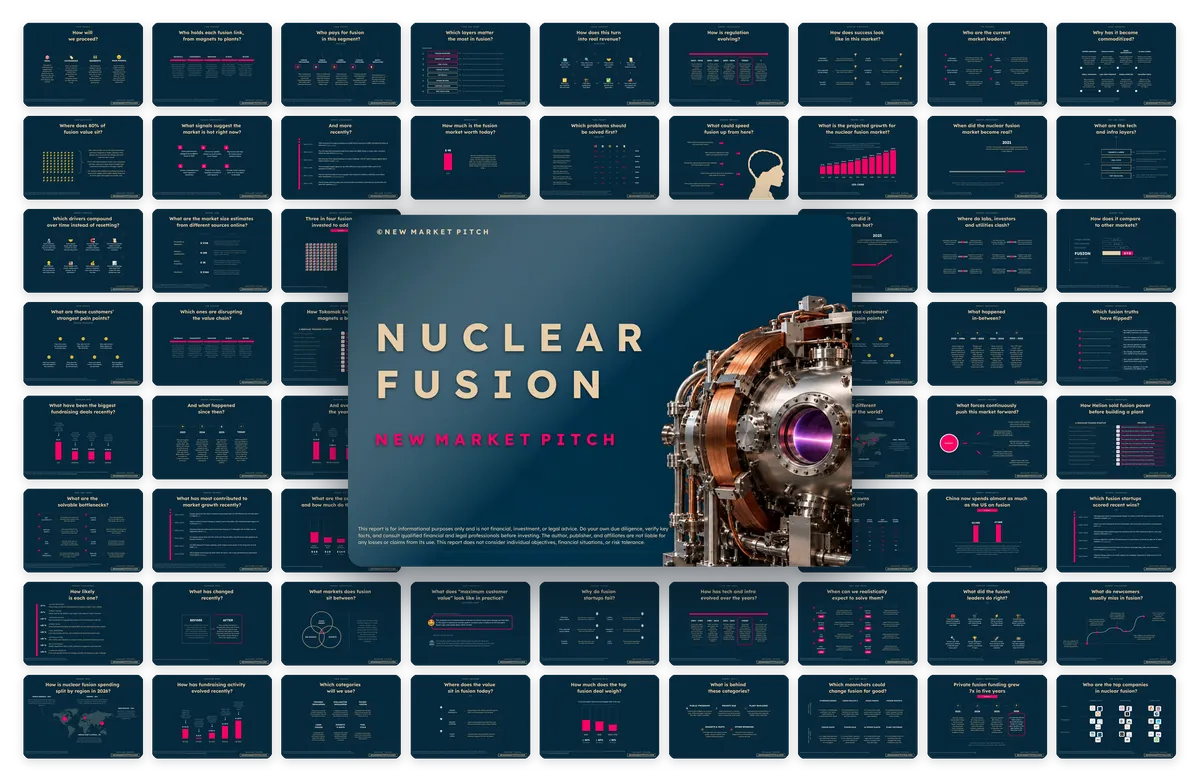
Whether you're building or investing in the nuclear fusion market, our report covers everything you need to know: the players, the money, and what's coming next.
Summary
TAE Technologies and Tokamak Energy are among the nuclear fusion startups with verified revenue today, while Kyoto Fusioneering is emerging as a significant commercial equipment supplier. No complete public revenue ranking exists, and most major fusion reactor developers have yet to generate electricity sales.
TAE Technologies reported $1.214 million in consolidated sales for its fiscal year ending March 2026. Tokamak Energy recorded £872,000 in 2024 turnover, although its more recent £70 million engineering contract points to a much larger business opportunity.
The industry's funding boom is running far ahead of its revenue. The Fusion Industry Association recorded $4.48 billion raised across 56 companies in the preceding 12 months, bringing cumulative reported investment since 2021 to $14.24 billion.
General Fusion illustrates the gap. Despite years of reactor development and an accumulated deficit of approximately $457 million by June 2026, the company disclosed that it had generated no revenue since inception.
Commonwealth Fusion Systems has secured one of the largest future commercial commitments, a power purchase agreement exceeding $1 billion with Eni. The money relates to electricity from its planned ARC facility, expected to connect to the grid in the early 2030s, rather than revenue already earned.
Tokamak Energy's £70 million STEP contract is particularly notable because it covers engineering work through March 2029. That is roughly 80 times the company's reported 2024 annual turnover, though the contract value cannot be treated as revenue for a single year.
Kyoto Fusioneering has a similar opportunity in plasma-heating equipment. Its approximately £6.59 million UK contract shows that suppliers can attract substantial orders while commercial fusion plants remain under development.
The more immediate commercial opportunities are often in magnets, heating systems, specialized materials and reactor engineering. These businesses sell to fusion projects during construction and experimentation, well before electricity reaches the grid.
Some apparently large revenue figures are misleading. UK Fusion Energy reported £106.6 million in accounting revenue, but the entire amount came from government grant-in-aid. Next Hydrogen's C$3.42 million in 2025 revenue came from a broader hydrogen technology business, not verified fusion sales.
The strongest current revenue evidence belongs to companies selling technology and services, while Commonwealth Fusion Systems and Helion Energy are better assessed through their future electricity commitments. Actual customer sales, signed contract values and future power deliveries need to remain separate.
The central conclusion is that nuclear fusion already has a commercial supply chain, but no established revenue leader among utility-scale fusion electricity startups. TAE provides a rare recent sales disclosure, Tokamak Energy stands out for contracted engineering work, and Commonwealth Fusion Systems has one of the largest prospective electricity businesses.

Written by the New Market Pitch teamWe track new markets so founders and investors can move faster. About us

In our report covering the nuclear fusion market, we turn what is vague and complex into simple, useful visuals. Market maps like this one show you at a glance where every startup stands.
The ranking of top startups in the nuclear fusion market by revenue
Below is a table ranking all the companies in this market by their current revenue scale. You can find our methodology at the end of this page.
If you want a deeper understanding of the market and its current dynamics, get our report covering the nuclear fusion market.
| Ranking | Company | Latest Metric | Metric Type | Freshness | Disclosed When | Source Quality | Confidence | Segment | Why This Ranking | Local Metric | Country |
|---|---|---|---|---|---|---|---|---|---|---|---|
| 1 | UK Fusion Energy | ~$143M | Fiscal-Year Accounting Revenue: Government Grant-in-Aid | Fresh · 7mo | Oct 13, 2026 | Filed / Audited | Medium | Fusion Plant Development | Largest verified accounting-revenue figure, but it is not customer revenue. Its #1 position is valid only for reported accounting income, not commercial sales. | £107M | gb |
| 2 | Next Hydrogen Solutions | ~$2.45M | Fiscal-Year Revenue | Fresh · 10mo | Mar 31, 2026 | Filed / Audited | Medium | Fusion Fuel-Handling Systems | Highest verified conventional annual sales among the included specialist/adjacent suppliers. Two fusion contracts worth approximately $3.75M were awarded in March 2026, but those awards are not recognized revenue. | CAD 3.42M | ca |
| 3 | TAE Technologies | $1.21M | Fiscal-Year Revenue: Consolidated Sales | Fresh · 7mo | Sep 30, 2026 | Filed / Audited | Medium | Field-Reversed Configuration Fusion | More current direct revenue than Tokamak Energy's verified 2024 turnover, but substantially less than Next Hydrogen's FY2025 figure. These are consolidated sales, not fusion electricity sales. | us | |
| 4 | Tokamak Energy | ~$1.11M | Annual Revenue: Turnover | Aging · 22mo | Sep 19, 2025 | Credible Reported | Low | Fusion Magnets and Tokamak Systems | Historical turnover is stronger revenue evidence than a contract proxy. However, its newly awarded £70M STEP magnet contract signals a major commercial advance. FY2025 accounts filed October 8, 2026 require further checking. | £872K | gb |
| 5 | American Fusion | $58K | Quarterly Revenue | Very Fresh · 4mo | Aug 2026 | Filed / Audited | Low | Compact Fusion Reactors | Verified current sales place it above companies supported only by future commitments. Its $58,000 quarterly figure is not annualized, and the filing does not establish material fusion-product revenue. | us | |
| 6 | Kyoto Fusioneering | ~$8.84M | Awarded Contract Value: Includes VAT | Very Fresh · 3mo | Jul 1, 2026 | Filed / Audited | Medium | Fusion Heating and Reactor Engineering | Strong near-term fusion-specific supplier contract, but below firms with recognized sales. More directly deliverable than CFS's distant electricity offtake. | £6.59M | jp |
| 7 | Oxford Sigma | ~$1.87M | Awarded Contract Value | Historical · 34mo | Dec 8, 2023 | Filed / Audited | Low | Fusion Materials and Breeder Blankets | Larger documented fusion contract than Duality, but much older than Kyoto's award. No claim is made that the entire amount was earned in one year. | £1.5M | gb |
| 8 | Duality Quantum Photonics | ~$1.77M | Awarded Contract Value | Historical · 34mo | Dec 2023 | Filed / Audited | Low | Plasma and Magnet Diagnostics | Slightly smaller awarded fusion contract than Oxford Sigma. The technology specifically addresses real-time tokamak diagnostics, but company-wide revenue is not established. | £1.43M | gb |
| 9 | 3-Sci | ~$1.11M | Awarded Contract Value | Historical · 34mo | Dec 6, 2023 | Filed / Audited | Low | Fusion Sensors and Diagnostics | Smaller historical contract than Duality, but directly relevant to extreme-temperature and radiation monitoring in fusion machines. | £896K | gb |
| 10 | Full Matrix | ~$665K | Awarded Contract Value | Historical · 34mo | Dec 2023 | Filed / Audited | Low | Fusion Plant Monitoring | Verified award for fusion-plant pipe monitoring, but below 3-Sci's larger contract and below newer awards. | £535K | gb |
| 11 | Fusion Fuel Cycles | ~$174K | Awarded Contract Value: Excluding VAT | Very Fresh · 1mo | Sep 17, 2026 | Filed / Audited | Medium | Tritium and Fusion Fuel Cycle | Smaller contract than the older specialist awards, but materially fresher and clearly attributed to this company. | £130K | gb |
| 12 | Commonwealth Fusion Systems | >$1B | Future Power Purchase Agreement Value | Fresh · 13mo | Sep 22, 2025 | Company Disclosed | Low | High-Field Tokamak Fusion | Largest disclosed future commercial commitment in the ranking. Placed below current supplier contracts because electricity has not been delivered and the $1B-plus is not recognized revenue. | us | |
| 13 | Helion Energy | 50 MW contracted capacity | Contracted Future Power Capacity: PPA | Historical · 41mo | May 10, 2023 | Company Disclosed | Low | Pulsed Fusion and Direct Energy Conversion | Named commercial customer and defined power target, but no disclosed contract price or recognized electricity revenue. Less financially measurable than CFS's PPA. | us | |
| 14 | General Fusion | $0 | Fiscal-Year Revenue | Fresh · 10mo | Sep 8, 2026 | Filed / Audited | High | Magnetized Target Fusion | Definitive zero-revenue evidence. Ranks below companies with contracts or offtake agreements, but remains more transparent than the numerous businesses without any comparable disclosure. | ca |

Our research about nuclear fusion gets updated several times a month, so you always get the latest view of where things stand.
Are nuclear fusion startups finally making real money?
Nuclear fusion startups are attracting record investment and signing increasingly large commercial contracts, but most companies developing fusion power plants still generate little or no revenue from their core technology. The biggest businesses by funding are not necessarily the biggest by sales.
The Fusion Industry Association's 2026 survey provides a striking contrast. Across 56 fusion companies, the industry raised $4.48 billion in the preceding 12 months, a 69% increase from the previous year's funding. Cumulative funding reported since the association began its annual surveys in 2021 reached $14.24 billion, while employment exceeded 16,000 people.
Yet one of the most revealing financial disclosures came from General Fusion. In its 2026 SEC filings, the Canadian company acknowledged that it had never generated revenue, despite having developed its technology for years and accumulated a deficit of approximately $457 million by June 2026.
Other companies are beginning to show a different commercial trajectory. Commonwealth Fusion Systems secured an electricity purchase agreement worth more than $1 billion with Eni in September 2025. Tokamak Energy won a £70 million engineering contract in April 2026. TAE Technologies disclosed approximately $1.21 million in consolidated annual sales in its SEC financial statements.
These figures describe three very different commercial situations: future electricity suppliers, companies selling fusion-related engineering equipment, and research-intensive developers preparing for eventual commercialization.
The clearest finding is that fusion's commercial supply chain is already generating revenue while the developers of utility-scale fusion power plants remain largely pre-revenue. That distinction changes which companies can reasonably be considered industry leaders today.
What counts as a nuclear fusion startup by revenue?
A nuclear fusion startup can generate revenue without selling electricity, but not every organization receiving money to develop fusion technology has established a commercial business.
We can distinguish three economically meaningful groups. The first consists of reactor developers such as Commonwealth Fusion Systems, Helion Energy, General Fusion, TAE Technologies and Zap Energy. Their ultimate objective is to sell fusion-generated electricity or commercially deploy fusion systems.
The second consists of fusion equipment and engineering businesses such as Kyoto Fusioneering, Tokamak Energy and Oxford Sigma. These companies can sell heating systems, superconducting magnets, materials technology, diagnostic equipment and engineering services long before commercial fusion power becomes available.
The third group includes publicly financed fusion development organizations, such as UK Fusion Energy, which may report accounting income derived from government funding rather than sales to independent customers.
For a revenue comparison, we treat recognized company sales as the strongest evidence, followed by disclosed customer contracts and other measurable commercial activity. Funding raised, grants, future electricity purchase agreements and estimated potential revenue remain separate.
A company can secure billions in financing without having sold any electricity. Meanwhile, a much smaller supplier can earn actual revenue by providing components to laboratories and reactor developers.

In our market report about nuclear fusion, we look at what the winners do differently, so you can learn from the best instead of guessing.
Which nuclear fusion companies have the most verified revenue today?
TAE Technologies, Tokamak Energy and several specialized suppliers have measurable commercial activity, but there is no sufficiently complete public revenue dataset to establish a definitive industry-wide ranking of independent fusion startups.
The available evidence gives us a more useful picture than a conventional top-ten list. Companies with reported sales can be identified separately from companies whose commercial scale is demonstrated through contracts, equipment orders or future electricity commitments.
For example, TAE Technologies reported $1.214 million in consolidated sales for its fiscal year ending March 2026. Tokamak Energy has a historical turnover figure of £872,000 for 2024, alongside a much larger recently awarded engineering contract. Next Hydrogen Solutions reported C$3.42 million of fiscal 2025 revenue, although it primarily develops hydrogen electrolyzer technology and its revenue is not attributable to nuclear fusion.
UK Fusion Energy reported £106.629 million of accounting revenue for its financial year ending March 2026. However, its audited accounts identify this entire amount as government grant-in-aid. It is a publicly owned development organization rather than an independent commercial fusion startup, so placing it first in a commercial startup ranking would give readers the wrong impression.
The following comparison separates verified sales, accounting income and commercial commitments instead of treating them as interchangeable.
| Company | Reported amount | Type of evidence | What it establishes |
|---|---|---|---|
| UK Fusion Energy | £106.6M | FY2025/26 accounting revenue | Government grant-in-aid, not customer sales |
| Next Hydrogen Solutions | C$3.42M | FY2025 revenue | Company-wide hydrogen technology sales, not fusion-specific |
| TAE Technologies | $1.21M | FY2026 consolidated sales | Recognized revenue, including non-fusion activities |
| Tokamak Energy | £872K | FY2024 turnover | Historical company sales |
| American Fusion | $58K | Q2 2026 revenue | Small quarterly sales, fusion attribution uncertain |
| Tokamak Energy | £70M | STEP engineering contract | Contracted future work, not annual revenue |
| Kyoto Fusioneering | £6.59M | UK fusion equipment contract | Awarded contract value, including VAT |
| Commonwealth Fusion Systems | More than $1B | Future electricity purchase agreement | Potential future sales, not current revenue |
| Helion Energy | 50 MW | Future electricity supply agreement | Contracted power capacity, not reported revenue |
| General Fusion | $0 | SEC-disclosed revenue history | No revenue generated since inception |
Is Commonwealth Fusion Systems the biggest nuclear fusion startup?
Commonwealth Fusion Systems is one of the industry's largest and most commercially significant private fusion developers, but its financial strength should not be confused with realized electricity revenue.
The Massachusetts company has attracted multibillion-dollar investment commitments to develop high-temperature superconducting magnet technology, its SPARC demonstration machine and the planned ARC power plant.
Its September 2025 agreement with Eni is a major milestone because it establishes a named corporate buyer for electricity from the company's first planned ARC facility in Chesterfield County, Virginia. The agreement exceeds $1 billion and concerns a plant designed to produce approximately 400 megawatts of electricity.
A $1 billion electricity commitment is vastly larger than the annual sales reported by most independent fusion technology developers. But the agreement concerns future supply, not $1 billion of earned revenue.
The ARC plant is expected to connect to the grid in the early 2030s. The Eni agreement demonstrates potential demand and commercial credibility while leaving important questions about delivery timing, plant economics and actual revenue unanswered.
That makes Commonwealth Fusion Systems a leading contender for future electricity revenue, though not a verified leader in revenue being generated today.

In our document detailing everything you need to know about nuclear fusion, you will always find fresh funding data, taken straight from our own verified funding database.
How much revenue does TAE Technologies make?
TAE Technologies reported approximately $1.21 million in consolidated sales for its fiscal year ending March 2026, making it one of the relatively few prominent fusion developers with a specific recent revenue figure in publicly accessible financial documentation.
The amount appears in SEC financial information associated with TAE's corporate transaction disclosures. It provides a firmer basis for assessing commercial activity than company valuations or financing announcements alone.
However, these sales are not equivalent to revenue from a commercial nuclear fusion power plant. TAE has developed technologies and business activities extending beyond electricity generation, meaning its consolidated financial figures cannot be treated as pure fusion electricity revenue.
General Fusion explicitly reported no revenue in its SEC disclosures, while Commonwealth Fusion Systems and Helion Energy have announced major future electricity commitments without establishing comparable current electricity sales.
TAE's sales show that a fusion-focused developer can earn money before commercial power generation. They don't demonstrate that the company's central reactor technology has become a profitable electricity business.
It's an important early commercial result, but nowhere near enough to establish TAE as the industry's overall revenue leader.
Is Tokamak Energy becoming a real commercial business?
Tokamak Energy has moved beyond laboratory development into meaningful commercial engineering contracts, and its £70 million STEP award is one of the clearest examples of fusion-related technology attracting major customers before commercial reactors begin producing electricity.
The British company originally concentrated on compact tokamak reactors and high-temperature superconducting magnets. It subsequently developed a distinct commercial opportunity around magnet technology, which has applications in fusion and other industrial systems.
In April 2026, UK Fusion Energy selected Tokamak Energy as the magnet systems partner for the government's Spherical Tokamak for Energy Production programme. The £70 million contract covers work through March 2029, including magnet architecture, superconducting systems engineering and plasma-facing integration.
That award represents approximately 80 times Tokamak Energy's reported £872,000 turnover for 2024. The comparison does not mean annual revenue has multiplied 80-fold, because the contract covers multiple years and its value will not necessarily be recognized evenly.
Still, the change in contracted commercial scale is substantial. Tokamak Energy is increasingly positioned to earn revenue from technologies that other fusion developers need, regardless of when its own reactor designs become commercially viable.
Few fusion developers have demonstrated such a clear route to monetizing their engineering capabilities before electricity generation begins.

Learning from others' mistakes is the cheapest lesson there is. In our report covering the nuclear fusion market, we look at what broke startups before you, so you don't repeat it.
Can Kyoto Fusioneering make money before commercial fusion exists?
Kyoto Fusioneering has a credible route to commercialization through reactor components and engineering systems, although its publicly documented contract awards do not establish a complete annual revenue figure.
The Japanese company focuses on the technologies needed to build and operate fusion facilities, including heating systems and other engineering infrastructure. Those products address immediate needs among research programs and reactor developers.
A notable example is the approximately £6.59 million gyrotron procurement contract awarded by UK Fusion Energy in July 2026. The published award value includes VAT, and delivery is scheduled over a period extending toward March 2029.
Gyrotrons are specialized microwave systems used to heat plasma. Customers need these technologies during reactor development, before they have a functioning power plant capable of selling electricity.
The comparison with Tokamak Energy and Oxford Sigma illustrates a wider market pattern. Tokamak Energy supplies superconducting magnet expertise, Kyoto Fusioneering provides heating and engineering capabilities, and Oxford Sigma addresses specialized materials and reactor components.
All three can participate in the fusion industry's spending cycle without first proving that a full-scale fusion plant can produce competitive electricity.
Kyoto Fusioneering therefore belongs among the more commercially advanced fusion equipment startups, even though available contract values cannot be converted into verified annual revenue.
Our methodology
This analysis compares the commercial revenue and disclosed customer commitments of nuclear fusion startups, reactor developers and specialized fusion equipment suppliers. We prioritize reported sales and audited financial disclosures, while distinguishing them from signed contract values, future electricity purchase agreements, investment proceeds and government funding.
Our revenue comparisons use the latest identifiable reporting periods rather than assuming every company publishes figures for the same year. TAE Technologies' fiscal 2026 sales, Tokamak Energy's 2024 turnover and American Fusion's second-quarter 2026 sales are historical reported amounts. Multi-year contracts awarded to Tokamak Energy and Kyoto Fusioneering are presented at their disclosed total values, without converting them into annual revenue estimates.
We distinguish company-wide revenue from fusion-specific sales. TAE's consolidated results include activities beyond reactor development, while Next Hydrogen's revenue comes from hydrogen technology rather than verified nuclear fusion operations. UK Fusion Energy's government grant-in-aid is identified separately from commercial customer revenue. Future electricity agreements involving Commonwealth Fusion Systems and Helion Energy are treated as commitments rather than realized sales.
We also use the Fusion Industry Association's 2026 industry survey to assess funding and commercialization activity. Its investment figures provide industry context but do not form part of the revenue ranking.
Key sources include the Fusion Industry Association's 2026 industry survey, General Fusion's SEC financial disclosures, SEC financial disclosures covering TAE Technologies, UK Fusion Energy's 2025/26 annual report, Tokamak Energy's historical financial data, the STEP programme's Tokamak Energy contract announcement, UK Fusion Energy's Kyoto Fusioneering procurement notice, Commonwealth Fusion Systems' Eni power purchase agreement announcement, Next Hydrogen's fiscal 2025 financial results, and American Fusion's second-quarter 2026 Form 10-Q.

Your time is limited. In our research about nuclear fusion, we put numbers on each part of the market, so you can see where it makes sense to focus.
Written by the New Market Pitch teamWe track new markets so founders and investors can move faster. About us