
Fusion power plants: which startup is ahead?
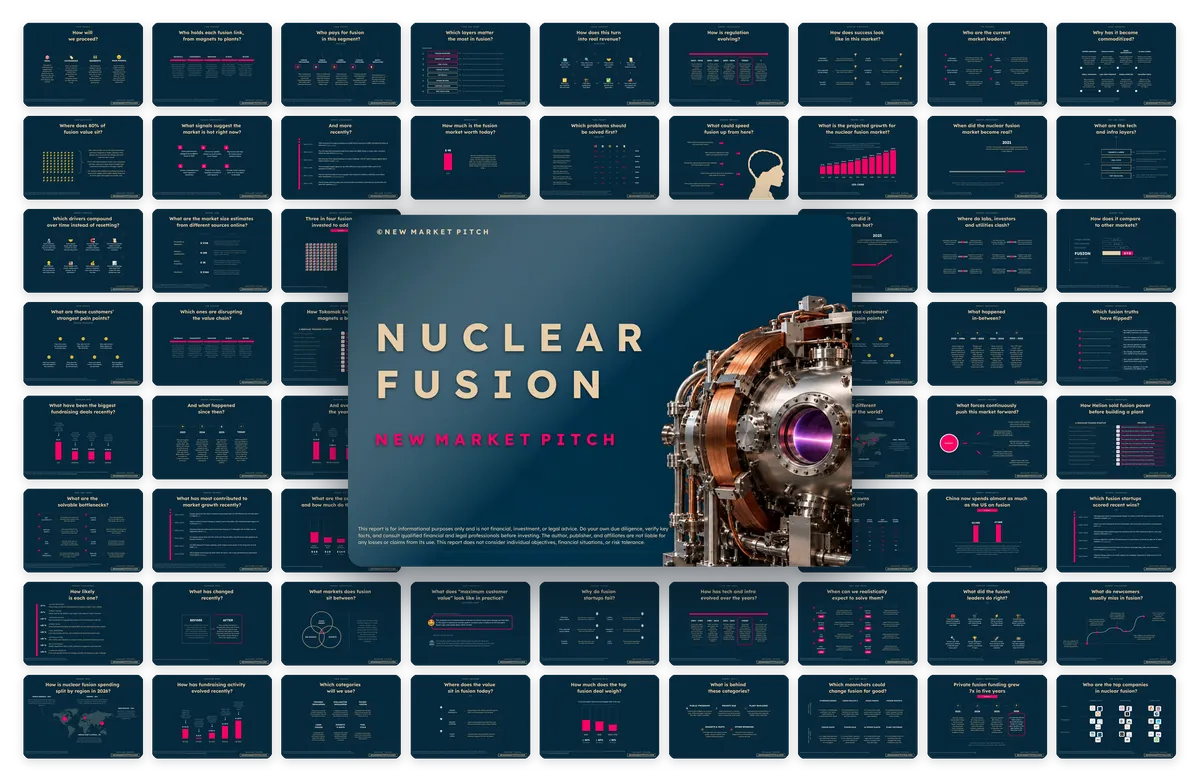
Whether you're building or investing in the nuclear fusion market, our report covers everything you need to know: the players, the money, and what's coming next.
Summary
Commonwealth Fusion Systems is currently ahead in the race to build a commercially viable fusion power plant. Helion Energy is its closest challenger and has the more aggressive electricity-delivery schedule, but CFS has the stronger combination of established reactor physics, financing, and commercial plant planning.
The distinction is important because neither company has yet demonstrated a complete fusion system producing net electricity. CFS is prioritizing scientific validation before commercial deployment, while Helion is already developing a plant intended to supply Microsoft in 2028.
CFS's SPARC experiment, targeting fusion energy gain in 2027, is the next major test of its lead. If successful, it would validate the physics underlying ARC, a proposed 400-megawatt commercial plant planned for the early 2030s.
Helion has made faster progress toward a specific commercial site. Its Orion project in Washington has secured important regulatory licenses, and its Polaris prototype reportedly reached 150 million degrees Celsius in February 2026. But the company still needs to prove that its pulsed fusion system can recover more usable electricity than it consumes.
CFS also has a considerable financing advantage. Its July 2026 capital raise brought cumulative funding to approximately $4 billion, giving it greater capacity to absorb engineering delays and the high costs of developing its first commercial reactor.
Microsoft and Google have already committed to purchasing future fusion electricity from Helion and CFS, respectively. These contracts provide real commercial targets, but their financial value ultimately depends on reactors that have not yet demonstrated commercial operation.
The technological alternatives are becoming more credible. General Fusion has demonstrated plasma compression exceeding 1 keV, while Type One Energy and Proxima Fusion are developing stellarators that could eventually offer more stable continuous operation than conventional tokamaks.
The biggest obstacle may increasingly be power plant engineering rather than headline plasma performance. In the Fusion Industry Association's 2026 survey, 64% of respondents identified power efficiency as a near-term challenge, and the same percentage highlighted neutron-resistant materials.
No startup has demonstrated that fusion electricity can compete economically with other power sources. Stronger magnets, direct electricity conversion, advanced fuels, and continuous-operation stellarators all promise different cost advantages, but none has yet proved them at commercial scale.
The ranking could change quickly. Helion would become the front-runner if it demonstrates reliable net electricity delivery, while a major SPARC underperformance would weaken CFS's case. For now, CFS offers the most convincing route to a working power plant, even if Helion could reach the finish line first.

Written by the New Market Pitch teamWe track new markets so founders and investors can move faster. About us
Why are fusion power startups suddenly racing to build real power plants?
Fusion power startups are moving from laboratory experiments toward actual power plants, and the money flowing into the industry has reached a new record. But none has yet demonstrated a commercially viable fusion electricity plant.
According to the Fusion Industry Association's 2026 report, 56 fusion companies reported $4.48 billion in funding over the preceding 12 months, up 69% from $2.64 billion the previous year. Cumulative reported funding reached $14.24 billion, roughly seven times the amount recorded when the association began its surveys in 2021.
The acceleration is striking. We calculate that the last two reporting periods alone account for approximately $7.12 billion, or half of all cumulative funding reported by the association. Fusion has attracted more money in two years than it did during much of its earlier development history.
The industry is also moving beyond experimental facilities. Helion Energy is developing its Orion plant in Washington to supply Microsoft, Commonwealth Fusion Systems is preparing a 400-megawatt project in Virginia, and Type One Energy is working with the Tennessee Valley Authority on a commercial stellarator plant.
Those projects have turned fusion into a competition with actual construction schedules, electricity customers, and regulatory requirements. The difficult question now is which startup can convert promising physics into a power station that works reliably.
What would make a fusion startup the leader today?
The fusion startup that deserves to lead the industry is the one with the strongest demonstrated path to producing usable electricity at a competitive cost. By that standard, Commonwealth Fusion Systems and Helion Energy currently stand ahead of most competitors, although neither has completed the job.
Fusion experiments can reach extremely high temperatures or produce measurable fusion reactions without generating more electricity than they consume. The distinction between fusion energy gain and net electricity is crucial.
For example, the National Ignition Facility achieved scientific fusion ignition in December 2022, producing approximately 3.15 megajoules of fusion energy from 2.05 megajoules of laser energy delivered to the target. That result was historic, but the overall laser facility consumed substantially more energy than the experiment generated.
A commercial power plant has to account for every major energy-consuming system, including plasma heating, magnets, cooling, fuel processing, and electricity conversion. It also needs to operate repeatedly or continuously over long periods.
That gives us three useful ways to compare the startups: what their machines have actually demonstrated, how far they have progressed toward a complete power plant, and whether their technology has a credible route to producing electricity economically.
These measures sometimes point to different winners. Helion has made impressive progress with high-temperature plasma and commercial site development. Commonwealth Fusion Systems has a more established reactor design and a stronger scientific foundation for its planned plant.

In our report covering the nuclear fusion market, we turn what is vague and complex into simple, useful visuals. Market maps like this one show you at a glance where every startup stands.
Which fusion startup is actually ahead right now?
Commonwealth Fusion Systems is currently the strongest overall contender to build a commercially viable fusion power plant. Helion Energy is its closest challenger and has a more aggressive timetable for delivering electricity.
Founded in 2018 as an MIT spinout, Commonwealth Fusion Systems (CFS) develops high-temperature superconducting magnets for compact tokamak reactors. Its SPARC machine is designed to demonstrate fusion energy gain before the company builds ARC, a commercial plant targeting approximately 400 megawatts of net electricity.
CFS also has the largest publicly reported financing base in the industry. Its July 2026 equity raise brought total funding to approximately $4 billion, while Google has agreed to purchase 200 megawatts from its planned ARC facility.
Helion approaches the problem differently. Its reactors use rapidly compressed plasma and aim to convert fusion energy directly into electricity, potentially avoiding conventional steam turbines. The company has already developed seven prototypes and is working on the Orion facility for its Microsoft agreement.
Helion's target of electricity delivery in 2028 is several years ahead of CFS's early-2030s commercial ambition. But CFS benefits from a reactor approach developed through decades of tokamak research, with an extensive experimental and peer-reviewed foundation.
We give CFS the lead because its proposed route to a working commercial plant currently has stronger scientific support, substantial capital, and a detailed engineering plan. Helion is pursuing a faster route with more technology-specific uncertainties still to resolve.
If you want more recent data on this point, please see our latest nuclear fusion market report.
Is Helion closer than Commonwealth Fusion Systems to producing fusion electricity?
Helion is further ahead in developing a specifically identified first commercial fusion power plant, but Commonwealth Fusion Systems has a stronger scientific basis for predicting how its reactor will perform.
Helion announced its Microsoft electricity agreement in May 2023, targeting delivery from a plant producing at least 50 megawatts in 2028. It began work at its Orion site in Malaga, Washington, in July 2025.
In June 2026, Washington State's Department of Health issued Helion radioactive-materials and radioactive-air-emissions licenses for Orion. That represents a concrete regulatory milestone, although the licenses alone do not establish that the reactor can operate commercially.
CFS is following a different development sequence. Its SPARC experiment is intended to demonstrate net fusion energy gain in the plasma before the company advances to ARC. SPARC is targeting that milestone in 2027, followed by commercial electricity generation in the early 2030s.
The distinction explains why both companies can reasonably claim progress toward leadership. Helion has committed to an earlier delivery schedule and is working on its commercial site. CFS is building an experimental reactor specifically designed to validate the physics behind its future power station.
If Helion delivers measurable net electricity in 2028, its position would change dramatically. For now, the announced deadline remains much more ambitious than what its publicly demonstrated electricity-generation performance supports.

Our research about nuclear fusion gets updated several times a month, so you always get the latest view of where things stand.
Has Helion actually proved that its fusion reactor works?
Helion has proved that its technology can produce fusion reactions at extremely high plasma temperatures, but the company has not publicly demonstrated net electricity generation from a complete fusion power system.
In February 2026, Helion announced that its seventh-generation Polaris machine had achieved plasma temperatures of 150 million degrees Celsius and measurable deuterium-tritium fusion. Those results followed years of development across seven successive prototypes.
The temperature is particularly impressive. It exceeds the roughly 100-million-degree range commonly associated with deuterium-tritium fusion conditions, although temperature alone says little about whether a machine can produce more energy than it consumes.
Helion's approach uses two magnetized plasma structures that are accelerated together, compressed, and then allowed to expand. Its long-term plan is to recover electrical energy directly through electromagnetic induction.
That could simplify electricity generation considerably. Conventional fusion power plant designs generally rely on capturing fusion energy as heat and converting it into electricity. Helion hopes to avoid much of that thermal conversion equipment.
The challenge lies in the complete electrical balance. The machine must repeatedly generate enough recoverable energy to cover plasma formation, acceleration, compression, and the facility's other electricity requirements.
Until Helion publishes convincing measurements of that full system, we can credit its plasma results without treating its commercial electricity claims as established.
Why does Commonwealth Fusion Systems have an advantage over Helion?
Commonwealth Fusion Systems has a major advantage because its reactor builds on decades of tokamak experiments, while Helion still has to validate several features of its own electricity-generation architecture.
Tokamaks confine extremely hot plasma using powerful magnetic fields. More than 150 tokamaks have been built around the world, creating a large body of experimental data on plasma confinement, heating, stability, and energy production.
CFS's main technological contribution is its use of high-temperature superconducting magnets. Stronger magnetic fields allow the company to pursue fusion conditions in a smaller machine than would otherwise be required.
In 2020, CFS and MIT researchers published seven papers explaining SPARC's physics basis. In June 2026, five additional peer-reviewed papers in the Journal of Plasma Physics examined the company's ARC commercial plant design.
Those ARC studies describe approximately 1.1 gigawatts of fusion power being converted into about 400 megawatts of net electricity. The proposed electrical output is roughly 36% of the reactor's fusion power, once the modeled conversion process and internal power consumption are accounted for.
The advantage is that these calculations can be tested against a long history of tokamak research. Helion's direct-conversion approach could ultimately be simpler, but its commercial performance is harder to judge from the experimental evidence currently available.
CFS still has major engineering problems ahead, particularly around tritium production, neutron-resistant materials, and heat extraction. Its scientific foundation makes those problems more clearly defined, rather than already solved.
If you want more recent data on this point, please see our latest nuclear fusion market report.

In our market report about nuclear fusion, we look at what the winners do differently, so you can learn from the best instead of guessing.
Could SPARC make Commonwealth Fusion Systems the clear fusion leader?
A successful SPARC experiment would substantially strengthen Commonwealth Fusion Systems' lead, especially if the machine achieves the fusion energy gain predicted by its published research.
SPARC is being developed in Devens, Massachusetts, using high-temperature superconducting magnets and a compact tokamak configuration. The company is targeting a demonstration of net fusion energy production in the plasma in 2027.
The important measurement will be the ratio between fusion energy released and the external energy supplied to heat the plasma. CFS aims to show that the reactor can produce more fusion energy than the heating energy delivered to it.
That would validate an essential part of the company's approach and support its calculations for ARC, the larger commercial reactor.
SPARC will not generate electricity for sale. It also will not demonstrate every component needed in a commercial power station, particularly the tritium-breeding and electricity-generation systems.
Still, SPARC has the potential to provide unusually strong experimental evidence for a private fusion developer. If its measured performance comes close to the published predictions, CFS would have a stronger technical case than competitors whose commercial concepts still depend mainly on smaller or less integrated experiments.
Which fusion startup has demonstrated the most impressive technology?
Helion currently stands out for the plasma temperatures achieved by its Polaris prototype, while General Fusion has made notable progress in plasma compression and CFS is developing one of the most ambitious integrated tokamak experiments.
Comparing these technologies requires some care because the companies are trying to achieve different things.
General Fusion's Lawson Machine 26 began operating in February 2025 and completed its initial plasma compression experiments in April. The company reported electron temperatures around 0.72 kiloelectronvolts in June 2026.
In October 2026, General Fusion and the UK Atomic Energy Authority announced electron temperatures exceeding 1 kiloelectronvolt, equivalent to more than 12 million degrees Celsius. The result was measured using Thomson scattering and supported by a technical paper co-authored with UKAEA.
The progression from 0.72 to more than 1 keV represents an increase of at least 39% in measured electron temperature. General Fusion's next major objective is 10 keV, followed by the combination of plasma conditions required for net fusion energy.
Helion has reached much higher reported plasma temperatures, but its pulsed reactor design makes direct comparisons difficult. CFS has concentrated on building SPARC around predictive tokamak physics rather than reporting temperature records from a completed SPARC experiment.
| Startup | Main technical achievement | What still needs proving |
|---|---|---|
| Helion Energy | Polaris reached 150 million °C and demonstrated D-T fusion | Net electricity from the complete system |
| Commonwealth Fusion Systems | High-field superconducting magnets and detailed SPARC physics | Fusion energy gain in SPARC |
| General Fusion | LM26 exceeded 1 keV using plasma compression | 10 keV and net fusion conditions |
| TAE Technologies | Neutral-beam-driven field-reversed plasma advances | Commercially relevant fusion gain |
| Zap Energy | Sheared-flow-stabilized Z-pinch experiments | Reactor-scale energy production |
| Tokamak Energy | Spherical tokamak and superconducting magnet development | Integrated commercial reactor performance |
| Type One Energy | Stellarator engineering and commercial site development | Full-scale reactor operation |
| Proxima Fusion | Optimized stellarator design using superconducting magnets | Experimental and plant-scale validation |

In our document detailing everything you need to know about nuclear fusion, you will always find fresh funding data, taken straight from our own verified funding database.
Could TAE Technologies build a better fusion reactor than CFS or Helion?
TAE Technologies could eventually have a more attractive fusion reactor, particularly if its advanced fuel strategy works, but it currently trails CFS and Helion in progress toward a complete commercial power station.
Founded in 1998, TAE is one of the oldest private fusion developers. Its technology uses a field-reversed plasma configuration stabilized and heated by neutral particle beams.
The company's long-term ambition involves hydrogen-boron fusion, which could reduce some of the high-energy neutron problems associated with deuterium-tritium reactors. However, hydrogen-boron fusion is considerably harder to achieve and requires more demanding plasma conditions.
TAE made an important strategic change in 2025. Following results from its Norm experiment, the company announced that it would skip its previously planned Copernicus prototype and move toward its Da Vinci power plant development program.
That could shorten the development process by eliminating an intermediate machine. It also increases the importance of validating the remaining physics and engineering assumptions before commercial operation.
The company has continued pursuing fuel supply arrangements, commercial partnerships, and a proposed public-market transaction involving Trump Media & Technology Group.
TAE's potential advantage is substantial if its fuel strategy can reduce operating costs and reactor complexity. But skipping a prototype also means fewer opportunities to discover problems before committing to a commercial-scale machine. We wouldn't put it ahead of companies already developing specific power plant sites and major integrated experiments.
If you want more recent data on this point, please see our latest nuclear fusion market report.
Could stellarator startups beat Commonwealth Fusion Systems?
Stellarator startups such as Type One Energy and Proxima Fusion could eventually build easier-to-operate fusion plants, but they are still behind Commonwealth Fusion Systems in demonstrating a commercial reactor.
Stellarators and tokamaks both use magnetic fields to confine plasma. The main difference is that stellarators rely on external coils to create the confining magnetic field, potentially avoiding certain instabilities associated with the plasma current used in tokamaks.
That makes stellarators particularly interesting for continuous operation. The difficulty is manufacturing the complicated magnetic coils and assembling the machine with sufficient precision.
Type One Energy is working with the Tennessee Valley Authority on Infinity Two, a planned 400-megawatt electric stellarator facility in Tennessee. In August 2026, the company received a fusion-specific byproduct-material license for its Bull Run site.
Proxima Fusion, based in Germany, is developing optimized stellarators using high-temperature superconducting magnets. Its $518 million financing reported in July 2026 placed it among the best-funded fusion startups of the year.
General Fusion is pursuing another alternative: compressing magnetized plasma using a metal liner. As seen above, its recent UKAEA-supported results confirm progress in compressional heating, although its next targeted temperature is still ten times the 1 keV milestone.
These approaches could eventually compete with CFS on plant reliability, maintenance, or cost. But CFS remains ahead on the development of a complete, quantitatively specified commercial reactor.

Learning from others' mistakes is the cheapest lesson there is. In our report covering the nuclear fusion market, we look at what broke startups before you, so you don't repeat it.
Which fusion startup has raised the most money?
Commonwealth Fusion Systems is the best-funded fusion startup, having raised approximately $4 billion, and its financing lead has become difficult for most competitors to match.
The company's funding history shows how rapidly its access to capital has grown. CFS raised $1.8 billion in 2021, followed by $863 million in August 2025 and another $1 billion in July 2026.
Its latest financing brought the cumulative total to approximately 28% of the $14.24 billion reported for the global fusion industry in the Fusion Industry Association's 2026 survey. The comparison is approximate because CFS's latest round closed after the survey's reporting cutoff.
Helion remains one of the largest privately funded competitors. It announced a $425 million financing round in January 2025 and has attracted further commitments, including the $465 million reported in the association's latest survey.
The industry's financing is concentrated, but the range of funded technologies is widening. Proxima Fusion, for example, reported $518 million in new financing, while Inertia Enterprises attracted $450 million.
The capital requirements explain why this matters. The Fusion Industry Association's 2026 survey found that respondents estimated needing an average of $2.7 billion in additional capital to make a fusion plant commercially viable, with estimates ranging from $100 million to $10.9 billion.
CFS has more room to finance unexpected delays, specialist equipment, and future construction than most rivals. Whether $4 billion is sufficient will depend on SPARC's results and the final cost of ARC.
Are Microsoft and Google really betting on fusion power?
Microsoft and Google have made meaningful commitments to future fusion electricity, but their agreements still depend on reactors that have yet to demonstrate commercial operation.
Microsoft's 2023 agreement with Helion targets electricity from Orion in 2028, making it one of the earliest announced commercial power purchase arrangements in the private fusion industry.
Google took a different approach in June 2025, agreeing to purchase 200 megawatts from Commonwealth Fusion Systems' planned ARC plant. That represents half of the plant's intended 400-megawatt net electrical capacity.
The two deals are important partly because they establish specific buyers for electricity that does not yet exist. They give developers commercial targets and can help support future financing.
However, neither agreement publicly discloses every provision that would allow us to assess the full financial risk. Electricity prices, performance requirements, cancellation terms, and customer protections are particularly relevant.
Technology companies are clearly willing to support future sources of firm, low-carbon electricity as their data center demand grows. But a signed agreement is a long way from a functioning power plant. Actual deliveries will tell us much more about the value of these contracts.

Your time is limited. In our research about nuclear fusion, we put numbers on each part of the market, so you can see where it makes sense to focus.
Can Helion really deliver fusion electricity by 2028?
Helion's 2028 electricity-delivery target looks extremely ambitious given what the company has publicly demonstrated. It is possible in principle, but there isn't enough system-level evidence yet to make that deadline convincing.
The Fusion Industry Association's 2026 survey found that 71% of responding companies expected the first commercial fusion electricity during the 2030s. Helion's deadline therefore places it ahead of the timetable preferred by most of the industry.
Its strategy could explain part of that ambition. Helion is developing a pulsed machine designed to recover electricity directly, potentially avoiding a large steam-generation system. Its sequence of seven prototypes also shows an emphasis on testing and upgrading equipment frequently.
But the missing technical milestone remains substantial. A machine that generates fusion reactions must still demonstrate repeated electrical energy recovery sufficient to cover its operating requirements.
This will become especially important as Helion moves from Polaris to Orion. A commercial plant needs reliable power output, predictable maintenance, and equipment capable of operating through large numbers of cycles.
Helion has made real progress, particularly on its commercial site. But its 2028 target leaves very little room for problems that have not yet been solved publicly. If Orion takes longer than expected, the delay would bring Helion's schedule closer to the early-2030s targets pursued by competitors.
If you want more recent data on this point, please see our latest nuclear fusion market report.
What could still stop fusion startups from building working power plants?
The greatest remaining obstacle for fusion startups is integrating reactor physics with materials, fuel systems, electricity conversion, and reliable operation. Even successful plasma experiments leave substantial engineering work unfinished.
The U.S. Department of Energy's Fusion Science and Technology Roadmap, finalized in June 2026, highlights challenges involving plasma-facing materials, fuel cycles, reactor components, and complete plant integration.
Deuterium-tritium reactors face particularly demanding conditions because their fusion reactions produce high-energy neutrons. These neutrons damage materials and create the need for shielding, component replacement, and careful management of the reactor's internal structure.
Tritium supply is another issue. Commercial deuterium-tritium plants will generally need to breed tritium from lithium rather than depend indefinitely on limited external supplies.
CFS's ARC design includes a tritium-breeding blanket, while Helion's preferred deuterium-helium-3 system has different fuel production and recycling challenges.
The concerns are widespread. In the Fusion Industry Association's 2026 survey, 64% of respondents identified power efficiency as a major near-term challenge, and the same share pointed to neutron-resistant materials. For longer-term challenges, 52% cited tritium self-sufficiency.
These figures are revealing. Companies with very different reactor designs repeatedly identify problems that appear after fusion reactions become possible. A substantial share of future delays could therefore come from power plant engineering rather than the headline physics experiments.

In our market report about nuclear fusion, we always try to gather several sources and make estimates that make sense, so you can work with solid numbers.
Which fusion startup could build the cheapest power plants?
No fusion startup has yet proved it can produce electricity more cheaply than competing power sources, but CFS, Helion, and stellarator developers are pursuing distinctly different ways to lower costs.
CFS is betting that very strong superconducting magnets will make tokamak reactors compact enough to manufacture and deploy economically. Its ARC concept targets 400 megawatts of net electrical output, making it comparable in scale to a substantial conventional generating facility.
Helion hopes to simplify the plant by generating electricity directly from the expansion of magnetized plasma. If successful, this could eliminate costly thermal conversion equipment. But the power electronics, pulsed components, and fuel cycle must still operate economically.
Stellarator developers are placing more emphasis on continuous operation and avoiding certain plasma disruptions. That could improve availability, although their complex magnetic systems may be expensive to manufacture and maintain.
We should also distinguish the cost of building the first plant from the cost of building subsequent plants. Early projects will include development expenses, custom equipment, and manufacturing processes that may not yet be optimized.
The real comparison will require evidence of capital cost per kilowatt, operating cost per megawatt-hour, equipment lifetime, and the percentage of time each facility can produce electricity.
| Startup | Potential cost advantage | Main cost uncertainty |
|---|---|---|
| Commonwealth Fusion Systems | Smaller tokamak using stronger magnets | Magnet cost, tritium breeding, neutron damage |
| Helion Energy | Direct electricity conversion without a conventional turbine | Pulsed-system efficiency and component lifetime |
| TAE Technologies | Potentially lower neutron-related costs with advanced fuels | Extreme plasma conditions and fuel requirements |
| General Fusion | Mechanical compression using liquid-metal technology | Compression hardware, repetition, and maintenance |
| Type One Energy | Potentially stable continuous operation | Complex stellarator coil manufacturing |
| Proxima Fusion | Optimized magnets and continuous-operation design | Construction precision and overall plant cost |
| Tokamak Energy | Compact spherical tokamak design | Magnets, shielding, and maintenance access |
| Zap Energy | Potentially fewer large magnetic components | Plasma stability and reliable repeated operation |
What could make Helion or another startup overtake Commonwealth Fusion Systems?
Helion could overtake Commonwealth Fusion Systems by demonstrating net electricity from Orion, while other competitors would need to show that their reactor designs offer a major operating or cost advantage.
For Helion, the most important next step is an independently convincing measurement of usable electricity produced by its complete system. Demonstrating reliable delivery under its Microsoft agreement would give the company a commercial achievement no private fusion developer has yet matched.
TAE could change the ranking by showing that its field-reversed configuration and advanced fuel strategy work under conditions relevant to a commercial reactor. Its technical approach has potential, but the evidence needs to move beyond individual plasma achievements.
Type One Energy and Proxima Fusion could gain ground if their stellarators demonstrate better availability or lower maintenance requirements than tokamaks. Those advantages would become especially valuable once the industry begins comparing actual power station operating data.
CFS also has a critical test ahead. Its SPARC machine must validate the fusion performance predicted by its models. A major shortfall would force the company to reconsider assumptions underlying ARC.
We would therefore pay closest attention to measured energy gain, complete electricity production, and sustained operating performance. Those results would change the competitive ranking far more than another financing announcement or a new construction target.

If you build or invest in the nuclear fusion market, you need to know which business models pay off now and which ones are fading. That's why our report covering it has a whole section on it.
Fusion power plants: which startup is ahead?
Commonwealth Fusion Systems is currently ahead in the race to build a commercially viable fusion power plant. Helion Energy is its strongest challenger and could produce electricity first, but CFS has the more convincing overall combination of established physics, funding, and commercial plant planning.
CFS has raised approximately $4 billion, developed high-temperature superconducting magnet technology, published detailed peer-reviewed reactor studies, and secured Google as a major future electricity customer. Its SPARC experiment will be a critical test of whether the company's reactor predictions hold up.
Helion has moved faster toward an identified commercial project. Its Orion facility, Microsoft agreement, regulatory progress, and repeated prototype development make it a serious contender for the first fusion electricity delivery. The missing proof is that its technology can generate net usable electricity reliably.
TAE, General Fusion, Type One Energy, and Proxima Fusion remain credible competitors, particularly if their alternative reactor designs eventually prove cheaper or easier to operate.
Our judgment favors CFS because its route from demonstrated technology to a complete power station is currently better supported by the available evidence. Helion leads on its announced commercial timetable, and its ranking could improve quickly if it validates electricity production.
The winner will ultimately be the startup that turns fusion reactions into reliable, competitively priced electricity. For now, Commonwealth Fusion Systems has the strongest claim to that position.
If you want more recent data on this point, please see our latest nuclear fusion market report.
Our methodology
This analysis examines which private fusion developer has the strongest demonstrated path to a commercially viable electricity plant as of October 2026. We compare Commonwealth Fusion Systems, Helion Energy, TAE Technologies, General Fusion, Type One Energy, Proxima Fusion, and other relevant startups across scientific performance, experimental validation, engineering readiness, commercial development, financing capacity, and prospective electricity costs.
We started by separating experimental achievements from commercial power generation. Plasma temperature, fusion energy gain, net electricity production, and reliable power plant operation are different milestones. For example, fusion energy gain measures energy produced by fusion reactions relative to the energy supplied to heat the fuel, while a commercially viable plant must also cover its wider electricity consumption and operating costs. We therefore assess each company's achievements against the specific milestone they establish, rather than treating different reactor technologies as directly comparable based on a single number.
Our scientific assessment gives particular attention to experimentally measured performance, independent technical validation, peer-reviewed reactor studies, and the remaining engineering assumptions. For CFS, we examined the published SPARC physics basis and the June 2026 ARC reactor studies. For Helion, we considered the reported Polaris plasma results alongside the absence of publicly demonstrated net electricity generation from its complete system. For other technologies, we examined their latest reactor experiments and development roadmaps, including General Fusion's October 2026 temperature results and TAE's decision to proceed toward Da Vinci.
We assessed commercial readiness separately, using announced construction activity, regulatory approvals, customer agreements, and power plant development schedules. Helion's Orion project and Microsoft agreement were compared with CFS's SPARC-to-ARC development sequence and Google electricity purchase agreement. These commitments help establish commercial progress, but planned production capacity, announced deadlines, and future contracted electricity are not counted as demonstrated electricity generation.
Financing was evaluated using announced equity rounds and cumulative capital raised, with the Fusion Industry Association's 2026 survey providing the broader industry context. We considered the ability to finance major reactor construction, absorb development delays, and fund expensive engineering work. Financing strengthens a company's capacity to execute its plans, but it cannot substitute for experimental results or commercial electricity production.
For future electricity costs, we compared each technology's proposed advantages with its remaining uncertainties. These include superconducting magnets and tritium breeding for tokamaks, direct electrical conversion and pulsed-system durability for Helion, advanced fuel requirements for TAE, and coil manufacturing and maintenance for stellarators. Since no startup has demonstrated commercial-scale operating costs, we do not assign a definitive cost winner or present projected electricity prices as proven results.
We then combined the evidence across these dimensions, giving greater weight to demonstrated technical progress, credible engineering plans, and progress toward an integrated power plant than to financing announcements or ambitious schedules alone. This is a qualitative comparative judgment rather than a numerical scoring model. It explains why CFS leads our overall assessment, while Helion leads on its announced commercial electricity timetable. The ranking can change as new experimental and operating results become available.
Key industry and scientific sources include the Fusion Industry Association's Global Fusion Industry Report 2026, the U.S. Department of Energy's National Ignition Facility announcement, and the Department of Energy's June 2026 Fusion Science and Technology Roadmap.
For Commonwealth Fusion Systems, we used the peer-reviewed ARC physics overview in the Journal of Plasma Physics, the ARC Fusion Power Plant Physics Basis research collection, the company's SPARC technical objectives, its June 2026 ARC research announcement, its July 2026 financing announcement, and the company's electricity agreements with Google and Eni.
For Helion Energy, the primary references were its February 2026 Polaris fusion results, the Microsoft electricity agreement, the Orion site development announcement, the June 2026 regulatory milestone, and its January 2025 financing announcement.
For competing reactor technologies, we examined the UK Atomic Energy Authority's October 2026 General Fusion announcement, General Fusion's LM26 Thomson scattering technical report, TAE Technologies' revised commercial reactor roadmap, and Type One Energy's Tennessee licensing announcement. We prioritized original experimental disclosures, peer-reviewed research, government publications, and specific commercial or regulatory records over promotional forecasts and secondary commentary without additional evidence.

In our report covering the nuclear fusion market, we don't want to repeat what boring consulting reports say. Instead, we show you the real and latest market signals that matter.
Written by the New Market Pitch teamWe track new markets so founders and investors can move faster. About us