Who are the top investors in solid-state battery?
Whether you're building or investing in the solid-state battery market, our report covers everything you need to know: the players, the money, and what's coming next.
Summary
EIT InnoEnergy, High-Tech Gründerfonds, Tianhong Investment, Jiuzhi Capital and Oriental Fortune Capital are tied as the most active solid-state battery investors, with 2 rounds joined each. We identified 117 named investors in the market, but repeat backers remain unusual.
Those 5 investors do different things. EIT InnoEnergy was named lead in both its recorded rounds, High-Tech Gründerfonds backed the same startup, BTRY, twice, and the others have backed different battery materials, stages and companies.
The busiest investor this year is Tianhong Investment, which has joined 2 rounds. EIT InnoEnergy and High-Tech Gründerfonds, despite sharing the longer-run lead, have joined no recorded round this year.
There is plenty of interest, but very little repeat activity. Many funds appear beside a single company and then disappear from the recent deal record.
Some investors are paying for chemistry that still needs to be tested. Others are helping cell and electrolyte producers work out how to manufacture reliably.
Seed rounds give the clearest picture of the first group. EIT InnoEnergy, High-Tech Gründerfonds and Oriental Fortune Capital each joined 2 seed financings, backing distinct technical approaches.
The bigger checks bring in other names. Jiuzhi Capital appears at Series B, while Puhua Capital, Openwater Investment and Amazon have been linked to more advanced manufacturing projects.
Corporate involvement can make a difference even without repeated deals. Amazon backed Blue Current, and Xiaomi's fund appeared in a Chinese cell manufacturer's financing.
Investor partnerships are also thin: no named pair has joined more than 1 qualifying round together. A crowded announcement rarely turns into a recurring partnership.
There is no single fund that dominates solid-state battery startup investing. The most relevant backer depends on whether a company needs its first materials check, help making cells at scale or an investor willing to lead a later round.

Written by the New Market Pitch teamWe track new markets so founders and investors can move faster. About us

In our report covering the solid-state battery market, you will always find fresh funding data, taken straight from our own verified funding database.
Which VCs invest the most in solid-state battery right now?
EIT InnoEnergy, High-Tech Gründerfonds, Tianhong Investment, Jiuzhi Capital and Oriental Fortune Capital are tied for the most solid-state battery rounds, with 2 each.
There is no single top investor by the number of rounds joined. Behind them, 15 investors have joined 1 round each.
EIT InnoEnergy was named as lead in its 2 recorded rounds, supporting TaiSan and Qkera. High-Tech Gründerfonds joined both of BTRY's seed financings, in 2024 and 2025, and was named lead in one of them. Tianhong Investment backed Sichuan All-Solid-State New Materials and Tianshi Kefeng, while Jiuzhi Capital appeared in rounds for LionGo New Energy and Golden Feather New Energy. Oriental Fortune Capital supported Ronggu New Materials and Yihua New Energy. They are betting on different parts of the battery supply chain.
We identify 117 named investors across the market, but only 56 of the 71 recorded rounds named at least one investor, so quieter backers are probably missing from these counts. The ranking counts rounds joined, not the dollars each investor wrote.
The table below ranks the 20 most active solid-state battery investors by the number of equity rounds they joined, with the rounds they led, their main stages, the startups they backed and the biggest round they joined.
If you want to go more into detail and get more data to understand what investors are betting on now, please check our solid-state battery report.
| # | Investor | Rounds | Led | Main stages | Solid-state battery startups backed | Biggest round joined | Latest round |
|---|---|---|---|---|---|---|---|
| 1 | EIT InnoEnergy | 2 | 2Named as lead in every round found | Seed 2 | TaiSan, Qkera | $1.7MTaiSan · 2024 | Oct 2025 |
| 2 | High-Tech Gründerfonds | 2 | 1Leads half its rounds | Seed 2 | BTRY | $5.7MBTRY · 2025 | Nov 2025 |
| 3 | Tianhong Investment | 2 | 0Never led | Seed 1Series A 1 | Sichuan All-Solid-State New Materials, Tianshi Kefeng | Undisclosed | Oct 2026 |
| 4 | Jiuzhi Capital | 2 | 0Lead not published | Series B 2 | LionGo New Energy, Golden Feather New Energy | $28MLionGo New Energy · 2025 | Sep 2026 |
| 5 | Oriental Fortune Capital | 2 | 0Lead not published | Seed 2 | Ronggu New Materials, Yihua New Energy | Undisclosed | Mar 2024 |
| 6 | Hongrong Capital | 1 | 1Named as lead in its only round found | Series A 1 | Sichuan All-Solid-State New Materials | Undisclosed | Oct 2026 |
| 7 | Mingshi Capital | 1 | 1Named as lead in its only round found | Series A 1 | Sichuan All-Solid-State New Materials | Undisclosed | Oct 2026 |
| 8 | Spark Seedling Fund (Wuhan Innovation Investment Group) | 1 | 1Named as lead in its only round found | Seed 1 | Yuanqi Membrane Innovation | Undisclosed | Oct 2026 |
| 9 | CICC Capital | 1 | 1Named as lead in its only round found | Series A 1 | SEVC Power | Undisclosed | Aug 2026 |
| 10 | Saike Investment | 1 | 1Named as lead in its only round found | Series A 1 | SEVC Power | Undisclosed | Aug 2026 |
| 11 | Shanghai Xiba Technology | 1 | 1Named as lead in its only round found | — | Keyuan Solid Energy | $5.6MKeyuan Solid Energy · 2026 | Aug 2026 |
| 12 | Openwater Investment | 1 | 1Named as lead in its only round found | Series C 1 | Solivis | $17MSolivis · 2026 | Aug 2026 |
| 13 | Puhua Capital | 1 | 1Named as lead in its only round found | Series B 1 | INX Technology | $100MINX Technology · 2026 | Aug 2026 |
| 14 | Toukong Donghai | 1 | 1Named as lead in its only round found | Series B 1 | Guxin Energy | Undisclosed | Aug 2026 |
| 15 | Eos Advisory | 1 | 1Named as lead in its only round found | Seed 1 | TaiSan | $5.3MTaiSan · 2026 | Jul 2026 |
| 16 | Midlands Engine Investment Fund II (Mercia Ventures) | 1 | 1Named as lead in its only round found | Seed 1 | TaiSan | $5.3MTaiSan · 2026 | Jul 2026 |
| 17 | Xiaomi Yangtze River Industry Fund | 1 | 1Named as lead in its only round found | Series A 1 | Heyuan Lichuang New Energy | Undisclosed | Jun 2026 |
| 18 | Oriza Seed | 1 | 1Named as lead in its only round found | Seed 1 | Tianshi Kefeng | Undisclosed | May 2026 |
| 19 | Keda Silicon Valley Guidance Fund | 1 | 1Named as lead in its only round found | Seed 1 | Jihui Chuangzhi | Undisclosed | Mar 2026 |
| 20 | Wuyuefeng Capital | 1 | 1Named as lead in its only round found | Series A 1 | Yaoshi Lithium | $29MYaoshi Lithium · 2026 | Feb 2026 |
No investors match this search.
Data from January 2024 through 14 November 2026, which is enough to show who is active today and who has been for years. Rounds: equity rounds in which the investor is named. Led: rounds it led or co-led. ▲ more rounds in 2026 so far than its 2025 pace, ▼ fewer.

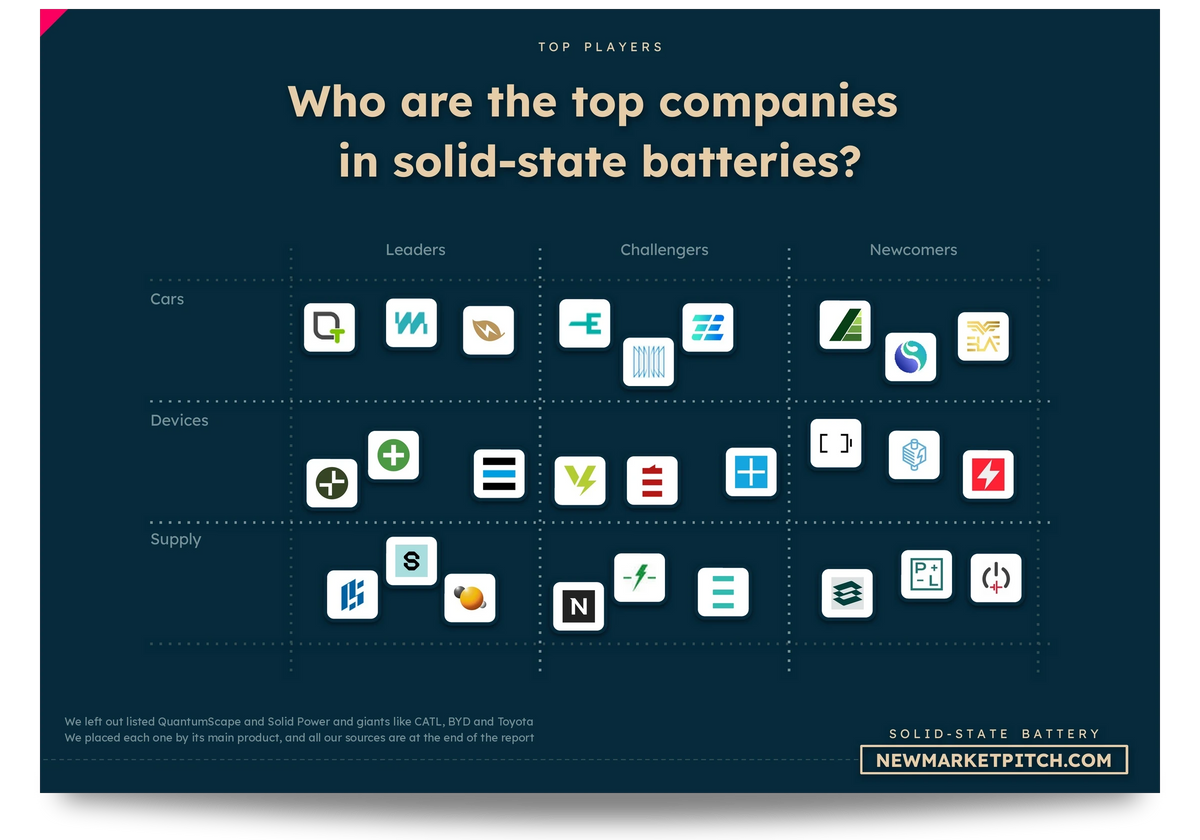
In our research about solid-state batteries, we turn what is vague and complex into simple, useful visuals. Market maps like this one show you at a glance where every startup stands.
Is EIT InnoEnergy still leading solid-state battery startup rounds?
The strongest repeat named-lead record belongs to EIT InnoEnergy, but it has not joined a solid-state battery round this year.
EIT InnoEnergy was named lead in both of the 2 rounds it joined. One backed TaiSan, which develops quasi-solid sodium batteries using a polymer electrolyte; the other backed Qkera, a Munich-based startup commercializing ceramic electrolyte membranes. The companies target different customer problems, yet both seek to make electrolyte innovation usable in actual manufacturing rather than merely publish laboratory measurements.
The earlier TaiSan investment was announced by EIT in 2024, and EIT announced its Qkera lead in October 2025. Qkera's institutional roots at the Technical University of Munich and MIT explain why an investor interested in the European energy transition could see value in a materials business before automotive-scale production. TaiSan's polymer-based approach could appeal to manufacturers concerned about lithium availability, cell weight and safety.
The key difference is who led before and who is still active now. EIT InnoEnergy led both of its rounds, but Tianhong Investment is the busier investor this year.
Do famous Silicon Valley VCs dominate solid-state battery investing?
No, the investors joining the most solid-state battery startup rounds are not the usual Silicon Valley giants.
Our most active group instead contains EIT InnoEnergy, High-Tech Gründerfonds, Tianhong Investment, Jiuzhi Capital and Oriental Fortune Capital. Generalist firms may still back battery startups. But the investors repeatedly named in these private solid-state deals are different firms. A famous firm might back one battery company and still be absent from the most active group.
Industrial battery projects need electrochemistry experts, specialized factories, long qualification cycles and customers willing to validate materials over time. InnoEnergy's decision to lead Qkera's ceramic-membrane seed round and the investor mix behind TaiSan reflect that difference. Redstone VC's support of the Swiss microbattery company BTRY and At One Ventures' backing of Adden Energy show that some venture firms do specialize in hard-technology manufacturing projects.
Well-known corporations still show up. Amazon anchored Blue Current's later financing, and the company says it is developing solid-state cells for mobility and stationary applications. But a single high-profile deal does not make its lead investor the most active backer across the sector.
Is Amazon becoming a major solid-state battery investor?
Amazon has backed solid-state battery maker Blue Current, but it is not a frequent investor in this market.
Blue Current's December 2025 financing was anchored by Amazon, according to the battery company's announcement and reporting by The Wall Street Journal. Blue Current develops silicon-rich solid-state batteries and has a production and testing facility in Hayward, California. Its roadmap spans mobility and stationary energy storage, including potential backup-power applications, rather than a battery product limited to consumer electronics.
That combination makes the investment distinctive. Amazon has possible interest in reliable power for computing infrastructure and transport electrification, while Blue Current needs a partner comfortable with long hardware development cycles. The Wall Street Journal reported that Amazon executive James Hamilton would join Blue Current's board, connecting the financing to technical and commercialization expertise. Such involvement can matter beyond the size of the check, although it does not guarantee purchase orders or large-scale deployment.

Your time is limited. In our market report about solid-state batteries, we put numbers on each part of the market, so you can see where it makes sense to focus.
Which solid-state battery investors are still investing this year?
Tianhong Investment is the busiest named solid-state battery investor this year, with 2 recorded rounds.
EIT InnoEnergy, High-Tech Gründerfonds and Oriental Fortune Capital, despite sharing the overall lead, have joined no recorded round this year. Of the 20 investors in the leading group, 17 have been active this year and 3 have not.
Tianhong Investment backed Tianshi Kefeng and Sichuan All-Solid-State New Materials, businesses connected to sulfide electrolytes and their supply chain. Its current activity stands apart from EIT InnoEnergy's older investments in TaiSan and Qkera. Jiuzhi Capital, another investor tied at the overall top, also joined a round this year.
Across all financings with named investors, we recorded 25 rounds this year and 17 last year. Those counts demonstrate continuing opportunities for backers of specialized materials as well as complete battery cells. They do not establish a full-year trend because the current year is still in progress, and an investor can appear in a round whose company has chosen not to disclose its amount.
The table below shows, year by year, how many rounds 12 of the most active solid-state battery investors joined, so it is easy to see who is still investing and who has slowed down.
If you want to go more into detail and see which investors are still writing checks and which have slowed down, please check our solid-state battery report.
| Investor | 2024 | 2025 | 2026* | Total |
|---|---|---|---|---|
| Tianhong Investment | 2 | 2 | ||
| Jiuzhi Capital | 1 | 1 | 2 | |
| Hongrong Capital | 1 | 1 | ||
| Mingshi Capital | 1 | 1 | ||
| Spark Seedling Fund (Wuhan Innovation Investment Group) | 1 | 1 | ||
| CICC Capital | 1 | 1 | ||
| Saike Investment | 1 | 1 | ||
| Shanghai Xiba Technology | 1 | 1 | ||
| Openwater Investment | 1 | 1 | ||
| Puhua Capital | 1 | 1 | ||
| Toukong Donghai | 1 | 1 | ||
| Eos Advisory | 1 | 1 |
* 2026: January to 14 November. Darker cells mean more rounds that year. Data from January 2024 through 14 November 2026.
Who is funding sulfide battery materials in China?
China's sulfide battery suppliers have attracted Tianhong Investment, which is funding materials rather than finished consumer products.
Its 2 joined rounds this year involve Tianshi Kefeng and Sichuan All-Solid-State New Materials. Tianshi Kefeng develops sulfide electrolyte powder; Sichuan All-Solid-State New Materials produces lithium-sulfide feedstock for batteries using that chemistry. One business works closer to a battery-ready electrolyte, while the other sits earlier in the material supply chain. The overlap is meaningful, although the deals alone do not prove that Tianhong Investment has adopted an exclusive sulfide-investment mandate.
There is a clear commercial reason to examine the category. Sulfide electrolytes are candidates for high-performance all-solid-state cells, but their production introduces handling, interface and consistency challenges. SEVC Power's August 2026 announcement described plans to expand sulfide-electrolyte and cell manufacturing.
The companies backed by Tianhong Investment make materials that other battery makers will need. A supplier that can produce reliable battery-grade input material may sell into several cell programs. Whether Tianhong's chosen companies achieve that commercial position remains to be demonstrated.
Are Chinese investors taking over solid-state battery startup deals?
Chinese backers appear throughout recent solid-state battery rounds, although no Chinese fund dominates the investor list.
Tianhong Investment backs sulfide-oriented materials businesses, Jiuzhi Capital has backed LionGo New Energy and Golden Feather New Energy, and Oriental Fortune Capital financed Ronggu New Materials and Yihua New Energy. More recently, CICC Capital and Saike Investment were named as leads in SEVC Power's Series A, while the Xiaomi Yangtze River Industry Fund was named on Heyuan Lichuang New Energy's Series A.
Those investments cover distinct industrial problems. LionGo develops oxide electrolytes, Golden Feather manufactures lithium-metal battery systems, and SEVC Power develops sulfide-based all-solid-state batteries. SEVC's own announcement described manufacturing expansion and work on solid-solid interfaces, indicating a project that requires significant technical resources before cells can be supplied at scale.
Even in China, the investors are funding different things. Some investors support first-stage research companies, while others finance production lines or the development of later-stage cells. It would be wrong to read all that activity as one national strategy. Not every fund's home country is public, so we can say Chinese investors show up often, but not what share of the money they put in.
Does Xiaomi invest in solid-state battery startups?
Yes, Xiaomi’s venture fund has backed a Chinese solid-state battery cell developer.
Our record identifies the fund in Heyuan Lichuang New Energy's Series A in June 2026. The company is developing solid-state battery cell manufacturing, which places the investment closer to an industrial product than to a generic charging or battery-management application. It is one documented market entry by the fund, not evidence that Xiaomi is one of the most active investors across all solid-state battery financing.
Xiaomi's fund is one of several corporate-linked investors willing to support battery development. SEVC Power's Series A, led by Saike Investment and CICC Capital, is another example. Different industrial backers are choosing different parts of the battery supply chain.
An investor announcement cannot tell us whether that cell will ever be widely sold. Toyota and BMW continue to test solid-state technologies in industrial collaborations, underscoring how much work sits between venture financing and a qualified supply contract. Xiaomi's fund can be named as a participant in the startup market; its eventual strategic benefit remains an open commercial question.

In our document detailing everything you need to know about solid-state battery, we always try to gather several sources and make estimates that make sense, so you can work with solid numbers.
Which solid-state battery investors back seed rounds, and which back growth rounds?
EIT InnoEnergy, High-Tech Gründerfonds and Oriental Fortune Capital are the busiest solid-state battery seed investors, Jiuzhi Capital is the busiest at Series B, and later rounds are rare. Seed is the busiest stage, with 26 of the 50 rounds with a known stage.
EIT InnoEnergy, High-Tech Gründerfonds and Oriental Fortune Capital are tied as the most active seed investors, with 2 seed rounds each. No investor has a comparable broad record across the scarce later stages.
EIT InnoEnergy supported TaiSan and Qkera, companies developing polymer and ceramic electrolyte solutions. Oriental Fortune Capital's seed activity involved Ronggu New Materials and Yihua New Energy, covering solid-electrolyte materials and sodium-based batteries. High-Tech Gründerfonds joined two seed financings of the Swiss microbattery maker BTRY. The count matches, but the products they are funding do not.
Series B brings in other names. Jiuzhi Capital is the most active investor at Series B with 2 joined rounds, involving LionGo New Energy and Golden Feather New Energy. Only 3 rounds with named investors reached Series C or later. Later-stage examples include Solivis, which raised a Series C for its sulfide-electrolyte business, and Blue Current, whose larger financing was anchored by Amazon.
The table below shows, for 12 of the most active solid-state battery investors, how many rounds they joined at each stage, from seed to growth.
If you want to go more into detail and see where each investor places its bets, from seed to growth, please check our solid-state battery report.
| Investor | Seed | Series A | Series B | Series C | Series D+ | Growth |
|---|---|---|---|---|---|---|
| EIT InnoEnergy | 2 | · | · | · | · | · |
| High-Tech Gründerfonds | 2 | · | · | · | · | · |
| Tianhong Investment | 1 | 1 | · | · | · | · |
| Jiuzhi Capital | · | · | 2 | · | · | · |
| Oriental Fortune Capital | 2 | · | · | · | · | · |
| Hongrong Capital | · | 1 | · | · | · | · |
| Mingshi Capital | · | 1 | · | · | · | · |
| Spark Seedling Fund (Wuhan Innovation Investment Group) | 1 | · | · | · | · | · |
| CICC Capital | · | 1 | · | · | · | · |
| Saike Investment | · | 1 | · | · | · | · |
| Shanghai Xiba Technology | · | · | · | · | · | · |
| Openwater Investment | · | · | · | 1 | · | · |
Most active at each stage, among all solid-state battery investors: Seed, EIT InnoEnergy, High-Tech Gründerfonds and Oriental Fortune Capital · Series A, no investor joined more than one round · Series B, Jiuzhi Capital · Series C, no investor joined more than one round · Series D+, no investor joined more than one round. Bigger dots mean more rounds. Data from January 2024 through 14 November 2026.
Do early solid-state battery investors keep backing the same startups?
Most of the busiest solid-state battery investors back several companies, but High-Tech Gründerfonds returned to the same startup, BTRY.
EIT InnoEnergy backed TaiSan and Qkera, while Tianhong Investment backed Tianshi Kefeng and Sichuan All-Solid-State New Materials. Jiuzhi Capital appeared with LionGo New Energy and Golden Feather New Energy; Oriental Fortune Capital backed Ronggu New Materials and Yihua New Energy. Each of these four has 2 recorded rounds across 2 startups, while High-Tech Gründerfonds has 2 rounds in BTRY alone. That is a real pattern of portfolio-building, not proof that these investors never make follow-on investments elsewhere.
Individual companies can still have repeat backing. BTRY's November 2025 announcement identified earlier investors High-Tech Gründerfonds and Zürcher Kantonalbank participating again. TaiSan's July 2026 round involved new co-leads Eos Advisory and Mercia Ventures alongside a broader investor group. A startup can therefore develop a continuing supporter network even when one of the most active investors in our published ranking changes its focus to a new company.
There is no contradiction here. An investor can spread its bets across several startups while each startup still keeps some of its earlier backers.
Who funds solid-state battery electrolyte companies before they scale?
Specialist funds and locally connected investors are already funding solid-state electrolyte startups before mass production.
Qkera's early round was led by EIT InnoEnergy, with the German company commercializing ceramic electrolyte membranes originally developed in academic research. Tianshi Kefeng attracted support from Oriza Seed, while Yinshi New Materials appeared with Ruicheng Fund. Jihui Chuangzhi's early financing named Keda Silicon Valley Guidance Fund, and SEVC Power later attracted CICC Capital and Saike Investment.
Electrolyte suppliers can sell materials without building a complete battery. A cell developer has to solve cathode and anode design, solid-solid contact, manufacturing and customer integration. A specialist materials producer can instead focus on making a reliable component and potentially supply competing cell companies. Qkera, for example, describes its oxide membrane as suitable for roll-to-roll processing, while Solivis is building manufacturing around sulfide electrolyte powder.
Getting that material into a customer's cell is still difficult. Fraunhofer identifies unstable interfaces and difficult production requirements as central problems for commercial all-solid-state technology. An investor may finance an electrolyte company before any battery buyer is ready to commit, but the next check depends on reproducibility and proof that customers can integrate the material into their processes.
Is Series B where solid-state battery investors become more selective?
Series B solid-state battery investors are looking for companies with a credible factory plan, not just a promising lab result.
Jiuzhi Capital joined 2 Series B financings, the highest recorded count for that stage, backing LionGo New Energy and Golden Feather New Energy. Puhua Capital was named as lead on INX Technology's Series B, and Toukong Donghai was named as lead for Guxin Energy's Series B. Neither Jiuzhi Capital round named a lead, so we cannot tell whether it led or merely joined.
These businesses are trying to build distinct things. LionGo develops oxide-based electrolyte material, Golden Feather works on solid-state lithium-metal battery systems, and INX Technology describes lithium-metal cell production for electronics, robotics and aviation applications. Once a company is raising at Series B, the question often shifts from whether the material works in a controlled environment to whether manufacturing and customer development are progressing together.
The next stages are less frequently visible. Solivis's later Series C was linked to industrial electrolyte expansion, while Blue Current's later-stage round involved Amazon. That variation is why a founder should match investor interest to the actual industrial problem rather than assume every Series B investor will be willing to fund an eventual full-scale cell plant.

Our report covering the solid-state battery market gets updated several times a month, so you always get the latest view of where things stand.
Who leads big solid-state battery factory rounds?
Puhua Capital led INX Technology’s large Series B, one of the clearest industrial-scale solid-state battery financings.
The investor joined 1 recorded round and was named lead for INX Technology's $100M+ Series B in August 2026. That amount is the size of the whole round, and we cannot tell how much of it Puhua Capital itself put in.
INX Technology markets high-energy-density lithium-metal solid-state cells for drones, robotics, consumer devices, electric vehicles and power applications. Its company website says it has delivered cells from its Hangzhou manufacturing operations. Whether those claims translate into sustainable industrial margins is a further test, but the company is visibly working beyond the earliest laboratory stage.
Puhua's participation sits beside different kinds of later-stage support. Openwater Investment was named as lead for Solivis's Series C in South Korea, a sulfide-material project, while Amazon anchored Blue Current's advanced cell financing. Their companies are selling different technologies to different customers. All are trying to pay for manufacturing and customer tests, far beyond a first lab experiment.
Do corporate investors matter more than traditional solid-state battery VCs?
Corporate investors can be important partners for solid-state battery startups, although we cannot say they outnumber venture funds.
Amazon anchored Blue Current's financing, the Xiaomi Yangtze River Industry Fund backed Heyuan Lichuang New Energy, and Saike Investment joined CICC Capital in leading SEVC Power's Series A. Shanghai Xiba Technology was named as lead in Keyuan Solid Energy's round of undisclosed stage. Each relationship may offer different kinds of value: access to industrial knowledge, connections to manufacturing, potential suppliers or a route to end customers.
Independent venture firms remain active too. EIT InnoEnergy led Qkera's early financing, At One Ventures backed Adden Energy's planned battery pilot line, and Redstone VC led BTRY's microbattery Seed. TaiSan brought Eos Advisory and Mercia Ventures together for its later seed financing. Those are examples of financial investors prepared to work with scientific or manufacturing problems rather than seek immediate software-style growth.
The right investor depends on the battery company's next customer. A company trying to sell sulfide electrolyte needs different introductions from a company making miniature cells for sensor manufacturers. A list of who joined a round cannot show how much each backer actually helps.
Are later-stage solid-state battery investors hard to find?
Yes, very few solid-state battery startups have named backers on Series C or later rounds.
Only 3 rounds with a known investor and stage are classified as Series C or later. Openwater Investment was named as lead in Solivis's Series C, while Amazon anchored Blue Current's later-stage financing. The scarcity of these rounds is not equivalent to a complete absence of late-stage funding. Some companies do not disclose every investor or the stage name, and the market also includes financing by diversified industrial companies outside this private-startup scope.
Making the product at scale is hard. Solivis is manufacturing sulfide electrolyte, whose cost, handling and consistency have to work at industrial scale. Blue Current has been developing larger cells and has described pilot-line operation. By contrast, investors in Qkera's ceramic membranes or TaiSan's sodium chemistry can initially finance smaller validation steps before those technologies are ready for mass production.
BMW's road tests with Solid Power cells show that advanced solid-state batteries still involve years of industrial qualification by large manufacturers. Some late-stage projects still attract capital, but investors must be comfortable with long development cycles, equipment spending and a product that may take considerable time to reach routine sales.
Which solid-state battery investors most often invest together?
No named pair of solid-state battery investors has appeared together in more than 1 qualifying round.
Even with 117 named investors, no two of them keep showing up together.
Individual financings still often have several backers. SEVC Power named Saike Investment and CICC Capital as co-leads on its Series A, and TaiSan named Eos Advisory and Mercia Ventures as co-leads on its later Seed. BTRY's financing brought together Redstone VC, Bloomhaus Ventures and other investors. These combinations are meaningful for the companies concerned, but they do not repeat frequently enough to establish a durable top partnership in the qualifying records.
The result fits an industry in which investors specialize by technology, geography and the immediate task of a financing. A seed materials round and a later manufacturing round can bring together different backers. It would be misleading to present a one-off co-investment as a recurring alliance merely because the names appeared together on a well-publicized announcement.

In our research about solid-state batteries, we look at what the winners do differently, so you can learn from the best instead of guessing.
Why do solid-state battery rounds bring together different investors?
Solid-state battery startups often need different investors for materials research, factory work and customer introductions.
TaiSan's later Seed was co-led by Eos Advisory and Mercia Ventures and included investors focused on industrial technology and climate applications. The company described plans to begin pilot tests with manufacturers. BTRY's Seed was led by Redstone VC with participation from several European and Asian backers, and its stated objective was industrial-scale roll-to-roll manufacturing of ultra-thin batteries. SEVC Power's Series A involved Saike Investment, CICC Capital and other investors while the company worked to expand sulfide-electrolyte and cell production.
Those examples involve different customers and physical processes. TaiSan is working on sodium-based light-mobility batteries, BTRY on miniature power sources, and SEVC Power on all-solid-state technology and the material inputs required to manufacture it. The useful backer may be the one who can help find a customer or make the factory work.
Still, individual partnerships should not be mistaken for a stable investor club. Even with multiple investors appearing on some announcements, our records do not show any pair repeatedly joining multiple rounds together. For founders, that means a strong financing often requires building a new combination suited to each industrial milestone.
Are investors backing solid-state sodium batteries or only lithium?
Investors are also funding solid-state sodium battery companies, especially those targeting practical applications.
EIT InnoEnergy backed TaiSan's early sodium-based polymer-electrolyte work, and the company's later financing was co-led by Eos Advisory and Mercia Ventures. The latter investors are each recorded on 1 Seed involving TaiSan. LiNa Energy is another UK company developing solid-state sodium technology, this time with a strong focus on stationary storage rather than compact mobility cells.
Sodium identifies the charge carrier, while solid-state describes the electrolyte architecture. That is why a battery can be both sodium-based and solid-state. TaiSan has emphasized compatibility with existing cell-production methods and possible uses in electric bikes, scooters and tools. LiNa Energy has been advancing automated production of sodium batteries built around a ceramic electrolyte and applications in long-duration energy storage.
Sodium cells bring different trade-offs in energy density, materials and operating conditions. Investors are willing to finance them when a startup can show that the electrolyte and the target product make commercial sense. The solid-state funding market is not a single race to make the longest-range electric-car battery.
Which VCs back tiny solid-state batteries?
Redstone VC led the Seed round of BTRY, a Swiss maker of miniature solid-state batteries, which shows that venture funds do back tiny cells that never go near a car.
The Swiss company BTRY raised a Seed led by Redstone VC and supported by Bloomhaus Ventures and several other investors. Its product is a very thin solid-state battery for connected labels, sensors and wearables, not electric cars. The company's own announcement described industrial roll-to-roll manufacturing as the focus of its funding and explained why small, reliable batteries can enable products where ordinary cells are too bulky.
This is an important contrast with Blue Current, which is moving larger solid-state cells toward mobility and stationary-energy uses, or SEVC Power, which develops sulfide all-solid-state batteries. Those applications require different manufacturing equipment, performance validation and sales channels. A microbattery developer can potentially win an industrial niche before any full-size solid-state car battery reaches mass-market volumes.
The investors have to judge the customer problem accordingly. For BTRY, the questions center on thin-cell production yield, device integration and whether connected-product manufacturers place orders. For an electric-vehicle supplier, a customer may demand far more extensive endurance testing and automotive qualification. The startup category is broad enough to support both, but investment suitability depends on the actual product.
Are British investors still backing solid-state battery startups?
British investors still support solid-state battery startups, especially companies solving specific materials problems.
TaiSan provides the clearest recent example. Its later Seed was co-led by Eos Advisory and the Midlands Engine Investment Fund II through Mercia Ventures, while the company sought to advance manufacturer pilot tests. Earlier, EIT InnoEnergy and TSP Ventures led its initial financing. The succession of different leads shows a company finding investors for successive engineering tasks rather than expecting one permanent backer to fund everything.
There is also a materials-and-storage story. In March 2024, LiNa Energy, a Lancaster-based developer of solid-state sodium storage, raised equity alongside separate grant support to scale up its ceramic-electrolyte sodium batteries, aimed at stationary storage rather than vehicle packs.
These examples show continuing European investor interest, not a claim that European funds supply the largest checks globally. A company trying to manufacture a sodium cell for light mobility has a different funding case from an automaker's future traction battery platform. For founders, the strongest regional opportunity may be a well-defined application and accessible pilot customers rather than an attempt to match every giant overseas round.

In our market report about solid-state batteries, we don't want to repeat what boring consulting reports say. Instead, we show you the real and latest market signals that matter.
Do solid-state battery investors need to see working factories?
Working factories and customer trials make it easier for solid-state battery startups to win bigger checks.
Blue Current describes an operational cell pilot line in Hayward. Solivis says it operates a sulfide-electrolyte facility in South Korea and raised a later financing led by Openwater Investment. INX Technology describes lithium-metal cell deliveries and attracted Puhua Capital as a named Series B lead. The exact tasks differ, but each company can point to industrial progress beyond the original laboratory hypothesis.
Other examples show where customer testing enters the process. Renault Group signed a joint development agreement with Basquevolt in February 2026, and BMW has demonstrated large-format cells from listed Solid Power in a test car. The industrial partners are not startup financing rounds in our figures; they illustrate the type of validation an investor would like to see as a company advances.
As Fraunhofer has described, solid-electrolyte interfaces and scaling requirements remain difficult, even where a prototype has shown attractive performance. Investors are therefore comparing more than technical specifications. They want evidence that a startup can make its product repeatedly, integrate it into customer systems and eventually support a sustainable manufacturing business.
So, who are the top investors in solid-state battery today?
EIT InnoEnergy, High-Tech Gründerfonds, Tianhong Investment, Jiuzhi Capital and Oriental Fortune Capital are tied as the most active solid-state battery investors, at 2 rounds each.
The tie is the central answer, but not the whole story. EIT InnoEnergy has the strongest repeat named-lead record, High-Tech Gründerfonds is the only one to back the same startup twice, Tianhong Investment is the most active participant this year; Jiuzhi Capital stands out at Series B; and Oriental Fortune Capital's recorded activity is concentrated in earlier seed financings. An investor seeking a first chemistry project and one willing to finance a manufacturing expansion are not necessarily the same institution.
The best-known industrial names also matter without leading on frequency. Xiaomi's venture fund appeared in a Chinese cell-manufacturing round, and CICC Capital co-led a financing for SEVC Power. Eos Advisory, Mercia Ventures and Redstone VC illustrate how specialized investors can pursue sodium batteries or microbatteries instead of an entire automotive cell platform.
The solid-state battery investor group is wide, but few firms keep returning. There is no dominant repeat investor group, no repeat co-investment pair and no reason to infer how much a backer personally invested from the size of a company's announced financing.
The table below shows what we found.
| Question | Answer |
|---|---|
| Is one investor clearly ahead today? | No, the named leaders share first place in solid-state batteries. Exactly 5 investors occupy the joint top position in our research. No one firm can claim sole leadership by participation frequency. |
| Is the leading group dominated by generalists? | Not really; specialist and industrially connected investors appear prominently. The market contains 117 named backers with varied priorities. A recognizable brand does not automatically mean repeated battery investing. |
| Does lead activity match participation frequency? | No, EIT InnoEnergy was named lead in 2 rounds. Tianhong Investment joined 2 rounds without leading either one. Investor influence cannot be reduced to simple round participation. |
| Is the historical leader still active today? | Not this year; EIT InnoEnergy has no recorded new round. Tianhong Investment has joined 2 deals during the current year. Historical leadership and recent investor pace are different things. |
| Are current investors returning to funding rounds? | Yes, 17 leading investors have joined a round this year. Another 3, EIT InnoEnergy among them, have not invested this year. Activity is widespread even without an overall investor monopoly. |
| Are seed specialists still in demand? | Yes, seed represents 26 rounds with a known stage. EIT InnoEnergy, High-Tech Gründerfonds and Oriental Fortune Capital each joined 2. Both fund early technical development rather than finished products. |
| Does one investor stand out at Series B? | Yes, Jiuzhi Capital joined 2 qualifying Series B rounds. It backed LionGo New Energy and Golden Feather New Energy. That is stage-specific activity, not overall investor domination. |
| Are late-stage battery backers numerous today? | No, only 3 named-investor rounds reached Series C or later. Solivis and Blue Current illustrate that later financing does exist. Industrial readiness makes these rounds far less common. |
| Have stable investor partnerships emerged yet? | No, no named pair repeatedly joined qualifying battery startup rounds. The market nevertheless has many one-off groups of co-investors. Individual financings do not establish a lasting investor alliance. |
| Can corporate investors matter without leading rankings? | Yes, Xiaomi's fund backed Heyuan Lichuang New Energy. CICC Capital co-led a solid-state cell development financing. Industrial connections can matter even without the highest participation count. |
| Do different applications attract different investors? | Yes, Redstone VC supported BTRY's miniature solid-state battery technology. Eos Advisory backed TaiSan's sodium electrolyte and mobility work. Industrial use determines which investor relationships are most useful. |

Learning from others' mistakes is the cheapest lesson there is. In our document detailing everything you need to know about solid-state battery, we look at what broke startups before you, so you don't repeat it.
Our methodology
Our data runs through November 14, 2026. We then reviewed this article and updated its answers on November 17, 2026, the date shown under the title. We systematically review equity rounds in the solid-state battery market from January 2024 through that date. The market includes independent startups whose core technology depends on a solid electrolyte, genuine hybrid cells, dedicated electrolyte materials or solid-state-specific manufacturing methods, including borderline designs when the electrolyte architecture qualifies. Every company counted meets our startup definition rather than representing a mature diversified battery producer.
We count each equity round an investor joined and separately record whether it was publicly named as a lead. We do not treat a round's full announced amount as an investor's own check. IPOs and post-listing offerings are excluded. We merge repeated reports of the same round, standardize investor names, and do not count vague mentions such as unspecified existing investors or angels. The current-year investor comparison begins in March when sufficient months have accumulated, and it remains year to date.
Announcements name lead investors more reliably than smaller participants, so rounds that an investor joined without leading are undercounted and lead rates are an upper bound.
Rounds confirmed by a company announcement, a press article or a regulatory filing are counted in full. Where no article exists, a round is counted only when at least two recognised databases agree on its date (within one month) and amount (within 5%), and it is marked as low confidence; a round found in a single database stays in the company's history but is left out of totals. For companies that have raised more than $100M, every round counted is backed by an article.
We do not take investor lists from Crunchbase, PitchBook or similar databases at face value because they may attach investors to rounds they did not join or confuse equity with debt and grants. Some qualifying equity rounds name no investor. Our investor tallies are therefore floors, not estimates of every silent participant. A company round is counted once in the deal tracker but can count once for each separately named investor in this article; rounds naming nobody are absent from investor participation tables.
The most famous backer may have joined just one qualifying round. We rank by verified rounds joined, not the size of an investor's entire venture fund, the value of its corporate partnerships or the full amount of the financings it joined. This approach intentionally gives an early specialist that repeatedly backs qualifying startups more credit than a famous investor with one large announcement, while keeping leading activity and stage preferences visible as separate facts.
Key sources include EIT InnoEnergy's Qkera lead and electrolyte investment thesis, EIT InnoEnergy and TSP Ventures in TaiSan's earlier financing, TaiSan's later co-leads, other backers and customer pilots, TaiSan's investor partnerships and sodium battery focus, Saike Investment and CICC Capital financing SEVC Power, Solivis Series C, investor participation and sulfide factory, INX Technology's battery manufacturing and commercial applications, Blue Current's funding history and production milestones, Amazon and Blue Current's financing and board involvement, Redstone VC and other investors backing BTRY, BTRY investors, earlier backers and microbattery products, At One Ventures' Adden Energy investment and pilot manufacturing, LiNa Energy's sodium technology and manufacturing strategy, Natrion's composite solid electrolyte and production compatibility, Basquevolt's development history, backers and materials strategy, Renault and Basquevolt cell validation partnership, Fraunhofer's review of manufacturing and electrolyte challenges, BMW's test-vehicle deployment of Solid Power cells, Toyota's precision-manufacturing requirements for solid-state cells, and Adeline's investor view on TaiSan and sodium chemistry.

If you build or invest in the solid-state battery market, you need to know which business models pay off now and which ones are fading. That's why our report covering it has a whole section on it.
Written by the New Market Pitch teamWe track new markets so founders and investors can move faster. About us